 |
PDBsum entry 3f5g

|
|
|
|
|
 |
Contents |
 |
|
|
|
|
|
|
|
|
|
|
|
|
|
|
* Residue conservation analysis
|
|
|
|
|
|
|
|
|
|
|
Enzyme class:
|
|
E.C.2.7.11.1
- non-specific serine/threonine protein kinase.
|
|
|
|
|
|
|
Reaction:
|
|
|
1.
|
L-seryl-[protein] + ATP = O-phospho-L-seryl-[protein] + ADP + H+
|
|
2.
|
L-threonyl-[protein] + ATP = O-phospho-L-threonyl-[protein] + ADP + H+
|
|
|
|
|
|
|
L-seryl-[protein]
|
+
|
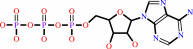 ATP
ATP
|
=
|
O-phospho-L-seryl-[protein]
Bound ligand (Het Group name = )
corresponds exactly
|
+
|
 ADP
ADP
|
+
|
H(+)
|
|
|
|
|
|
|
L-threonyl-[protein]
|
+
|
ATP
|
=
|
O-phospho-L-threonyl-[protein]
Bound ligand (Het Group name = )
corresponds exactly
|
+
|
ADP
|
+
|
H(+)
|
|
|
|
|
|
|
|
|
|
|
|
|
Molecule diagrams generated from .mol files obtained from the
KEGG ftp site
|
|
|
|
|
|
|
|
|
|
|
|
|
|
 |
|
|
|
|
|
|
| |
|
|
| |
|
DOI no:
|
Acta Crystallogr D Biol Crystallogr
65:241-248
(2009)
|
|
PubMed id:
|
|
|
|
|
|
| |
|
Structural insight into nucleotide recognition by human death-associated protein kinase.
|
|
L.K.McNamara,
D.M.Watterson,
J.S.Brunzelle.
|
|
|
|
|
| |
ABSTRACT
|
|
|
|
| |
|
|
Death-associated protein kinase (DAPK) is a member of the
Ca(2+)/calmodulin-regulated family of serine/threonine protein kinases. The role
of the kinase activity of DAPK in eukaryotic cell apoptosis and the ability of
bioavailable DAPK inhibitors to rescue neuronal death after brain injury have
made it a drug-discovery target for neurodegenerative disorders. In order to
understand the recognition of nucleotides by DAPK and to gain insight into DAPK
catalysis, the crystal structure of human DAPK was solved in complex with ADP
and Mg(2+) at 1.85 A resolution. ADP is a product of the kinase reaction and
product release is considered to be the rate-limiting step of protein kinase
catalytic cycles. The structure of DAPK-ADP-Mg(2+) was compared with a newly
determined DAPK-AMP-PNP-Mg(2+) structure and the previously determined apo DAPK
structure (PDB code 1jks). The comparison shows that nucleotide-induced changes
are localized to the glycine-rich loop region of DAPK.
|
|
|
|
|
|
| |
Selected figure(s)
|
|
|
|
| |
|
|

|
|

|
|
Figure 2.
Figure 2 Superposition by least-squares fitting of
DAPK-ADP-Mg^2+ and apo DAPK reveals little change between the
two structures apart from in two key areas: the hinge region
near Ala97 and the glycine-rich loop near Ser21. The
DAPK-ADP-Mg^2+ structure is shown in red and the apo DAPK
structure is shown in beige. Protein residues from the
N-terminal domain and hinge region are shown.
|
|
Figure 5.
Figure 5 Comparisons of the glycine-rich loop. (a)
Superposition of the glycine-rich loops of apo DAPK (beige),
DAPK-ADP-Mg^2+ (red) and DAPK-AMP-PNP-Mg^2+ (blue) and their
position relative to the nucleotide. The DAPK-AMP-PNP-Mg^2+ loop
has the most closed conformation. Residues 17-28 are shown for
simplicity. The calculated r.m.s. deviation over the C^  atoms
of residues 20-25 between the apo DAPK structure and the
DAPK-AMP-PNP-Mg^2+ structure is 1.03 Å and that between
the apo DAPK and DAPK-ADP-Mg^2+ structures is 0.62 Å. (b)
2F[o] - F[c] electron-density map at 1.0 atoms
of residues 20-25 between the apo DAPK structure and the
DAPK-AMP-PNP-Mg^2+ structure is 1.03 Å and that between
the apo DAPK and DAPK-ADP-Mg^2+ structures is 0.62 Å. (b)
2F[o] - F[c] electron-density map at 1.0  of
the glycine-rich loop of DAPK-ADP-Mg^2+. One conformation of
Gln23 is modeled such that the side chain is within proximity of
the of
the glycine-rich loop of DAPK-ADP-Mg^2+. One conformation of
Gln23 is modeled such that the side chain is within proximity of
the  -phosphate
(conformation B). (c) 2F[o] - F[c] electron-density map of the
glycine-rich loop of DAPK-AMP-PNP-Mg^2+. The side chain of Phe24
in the DAPK-AMP-PNP structure can be modeled in the `open'
conformation (B) or a conformationally restricted position (A). -phosphate
(conformation B). (c) 2F[o] - F[c] electron-density map of the
glycine-rich loop of DAPK-AMP-PNP-Mg^2+. The side chain of Phe24
in the DAPK-AMP-PNP structure can be modeled in the `open'
conformation (B) or a conformationally restricted position (A).
|
|
|
|
|
|
| |
The above figures are
reprinted
from an Open Access publication published by the IUCr:
Acta Crystallogr D Biol Crystallogr
(2009,
65,
241-248)
copyright 2009.
|
|
| |
Figures were
selected
by an automated process.
|
|
|
|
|
|
|
|
|
|
|
|
|
|
|
|
 |
 |
 |
|
Literature references that cite this PDB file's key reference
|
|
|
| |
PubMed id
|
|
Reference
|
|
|
|
|
|
L.K.McNamara,
J.S.Brunzelle,
J.P.Schavocky,
D.M.Watterson,
and
V.Grum-Tokars
(2011).
Site-directed mutagenesis of the glycine-rich loop of death associated protein kinase (DAPK) identifies it as a key structure for catalytic activity.
|
| |
Biochim Biophys Acta,
1813,
1068-1073.
|
|
|
|
|
|
|
M.Zimmermann,
C.Atmanene,
Q.Xu,
L.Fouillen,
A.Van Dorsselaer,
D.Bonnet,
C.Marsol,
M.Hibert,
S.Sanglier-Cianferani,
C.Pigault,
L.K.McNamara,
D.M.Watterson,
J.Haiech,
and
M.C.Kilhoffer
(2010).
Homodimerization of the death-associated protein kinase catalytic domain: development of a new small molecule fluorescent reporter.
|
| |
PLoS One,
5,
e14120.
|
|
|
|
|
|
The most recent references are shown first.
Citation data come partly from CiteXplore and partly
from an automated harvesting procedure. Note that this is likely to be
only a partial list as not all journals are covered by
either method. However, we are continually building up the citation data
so more and more references will be included with time.
|
|


 Links
Links


