 |
PDBsum entry 3abe

|
|
|
|
|
|

|

|

|

|
|

|
|

|
|

|
|
|
 |

|

|
|
|
|
|
|
|
|
|
|
|
|
|
|
|
|
|
|
|
|
|
|
|
|
|
|
|
|
|
|
|
|
Cell cycle/replication
|
PDB id
|
|
|
|
3abe
|
|
|
|
|
|
|
|
|
|
|
|
|
|
|

|

|

|
|
|
|
|
|
|
|
 |
Contents |
 |
|
|
|
|
|
|
|
|
|
|
* Residue conservation analysis
|
|
|
|
|
|
PDB id:
|
|
|
|
| Name: |
|
Cell cycle/replication
|
|
|
Title:
|
|
Structure of human rev7 in complex with a human rev3 fragment in a tetragonal crystal
|
|
Structure:
|
|
Mitotic spindle assembly checkpoint protein mad2b. Chain: c. Synonym: rev7, mad2-like 2, hrev7. Engineered: yes. Mutation: yes. DNA polymerase zeta catalytic subunit. Chain: z. Fragment: residues 1847-1898. Synonym: rev3, hrev3.
|
|
Source:
|
|
Homo sapiens. Human. Organism_taxid: 9606. Gene: rev7. Expressed in: escherichia coli. Expression_system_taxid: 469008. Gene: rev3.
|
|
Resolution:
|
|
|
2.60Å
|
R-factor:
|
0.242
|
R-free:
|
0.281
|
|
|
Authors:
|
|
K.Hara,H.Hashimoto,Y.Murakumo,S.Kobayashi,T.Kogame,S.Unzai,S.Akashi, S.Takeda,T.Shimizu,M.Sato
|
|
Key ref:
|
|
K.Hara
et al.
(2010).
Crystal structure of human REV7 in complex with a human REV3 fragment and structural implication of the interaction between DNA polymerase zeta and REV1.
J Biol Chem,
285,
12299-12307.
PubMed id:
|
|
|
Date:
|
|
|
07-Dec-09
|
Release date:
|
16-Feb-10
|
|
|
|
|
|
|
PROCHECK
|

|
|
|
|
|
Headers
|
|
|
|
References
|
|
|
|
|
|
|
|
|
|
|
|
Enzyme class:
|
|
Chain Z:
E.C.2.7.7.7
- DNA-directed Dna polymerase.
|
|
|
|
|
|
|
Reaction:
|
|
DNA(n) + a 2'-deoxyribonucleoside 5'-triphosphate = DNA(n+1) + diphosphate
|
|
|
|
|
|
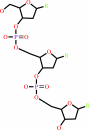 DNA(n)
|
+
|
2'-deoxyribonucleoside 5'-triphosphate
|
=
|
DNA(n+1)
|
+
|
 diphosphate
|
|
|
|
|
|
|
|
|
|
|
|
|
Molecule diagrams generated from .mol files obtained from the
KEGG ftp site
|
|
|
|
|
|
|
|
|
|
|
|
|
|
 |
|
|
|
|
|
|
| |
|
|
| |
|
|
J Biol Chem
285:12299-12307
(2010)
|
|
PubMed id:
|
|
|
|
|
|
| |
|
Crystal structure of human REV7 in complex with a human REV3 fragment and structural implication of the interaction between DNA polymerase zeta and REV1.
|
|
K.Hara,
H.Hashimoto,
Y.Murakumo,
S.Kobayashi,
T.Kogame,
S.Unzai,
S.Akashi,
S.Takeda,
T.Shimizu,
M.Sato.
|
|
|
|
|
| |
ABSTRACT
|
|
|
|
| |
|
|
DNA polymerase zeta (Polzeta) is an error-prone DNA polymerase involved in
translesion DNA synthesis. Polzeta consists of two subunits: the catalytic REV3,
which belongs to B family DNA polymerase, and the noncatalytic REV7. REV7 also
interacts with REV1 polymerase, which is an error-prone Y family DNA polymerase
and is also involved in translesion DNA synthesis. Cells deficient in one of the
three REV proteins and those deficient in all three proteins show similar
phenotype, indicating the functional collaboration of the three REV proteins.
REV7 interacts with both REV3 and REV1 polymerases, but the structure of REV7 or
REV3, as well as the structural and functional basis of the REV1-REV7 and
REV3-REV7 interactions, remains unknown. Here we show the first crystal
structure of human REV7 in complex with a fragment of human REV3 polymerase
(residues 1847-1898) and reveal the mechanism underlying REV7-REV3 interaction.
The structure indicates that the interaction between REV7 and REV3 creates a
structural interface for REV1 binding. Furthermore, we show that the
REV7-mediated interactions are responsible for DNA damage tolerance. Our results
highlight the function of REV7 as an adapter protein to recruit Polzeta to a
lesion site. REV7 is alternatively called MAD2B or MAD2L2 and also involved in
various cellular functions such as signal transduction and cell cycle
regulation. Our results will provide a general structural basis for
understanding the REV7 interaction.
|
|
|
|
|
|
|
|
|
|
|
|
|
|
|
|
|
|
 |
 |
 |
|
Literature references that cite this PDB file's key reference
|
|
|
| |
PubMed id
|
|
Reference
|
|
|
|
|
|
J.A.Neal,
K.L.Fletcher,
J.J.McCormick,
and
V.M.Maher
(2010).
The role of hRev7, the accessory subunit of hPolζ, in translesion synthesis past DNA damage induced by benzo[a]pyrene diol epoxide (BPDE).
|
| |
BMC Cell Biol,
11,
97.
|
|
|
|
|
|
The most recent references are shown first.
Citation data come partly from CiteXplore and partly
from an automated harvesting procedure. Note that this is likely to be
only a partial list as not all journals are covered by
either method. However, we are continually building up the citation data
so more and more references will be included with time.
|
|
|


 Links
Links








