 |
PDBsum entry 3v3m

|
|
|
|
|
|

|

|

|

|
|

|
|

|
|

|
|

|
|
|
 |

|

|
|
|
|
|
|
|
|
|
|
|
|
|
|
|
|
|
|
|
|
|
|
|
|
|
|
|
|
|
|
|
|
|
Hydrolase/hydrolase inhibitor
|
PDB id
|
|
|
|
3v3m
|
|
|
|
|
|
|
|
|
|
|
|
|
|
|

|

|

|
|
|
|
|
|
|
PDB id:
|
|
|
|
| Name: |
|
Hydrolase/hydrolase inhibitor
|
|
|
Title:
|
|
Severe acute respiratory syndrome coronavirus (sars-cov) 3cl protease in complex with n-[(1r)-2-(tert-butylamino)-2-oxo-1-(pyridin-3-yl) ethyl]-n-(4-tert-butylphenyl)furan-2-carboxamide inhibitor.
|
|
Structure:
|
|
3c-like proteinase. Chain: a. Ec: 3.4.19.12, 3.4.22.69, 3.4.22.-. Engineered: yes
|
|
Source:
|
|
Sars coronavirus. Sars-cov. Organism_taxid: 227859. Gene: 1a. Expressed in: homo sapiens. Expression_system_taxid: 9606
|
|
Resolution:
|
|
|
1.96Å
|
R-factor:
|
0.191
|
R-free:
|
0.236
|
|
|
Authors:
|
|
J.Jacobs,V.Grum-Tokars,Y.Zhou,M.Turlington,S.A.Saldanha,P.Chase, A.Eggler,E.S.Dawson,Y.M.Baez-Santos,S.Tomar,A.M.Mielech,S.C.Baker, C.W.Lindsley,P.Hodder,A.Mesecar,S.R.Stauffer
|
|
Key ref:
|
|
J.Jacobs
et al.
(2013).
Discovery, synthesis, and structure-based optimization of a series of N-(tert-butyl)-2-(N-arylamido)-2-(pyridin-3-yl) acetamides (ML188) as potent noncovalent small molecule inhibitors of the severe acute respiratory syndrome coronavirus (SARS-CoV) 3CL protease.
J Med Chem,
56,
534-546.
PubMed id:
|
|
|
Date:
|
|
|
13-Dec-11
|
Release date:
|
16-Jan-13
|
|
|
|
|
|
|
PROCHECK
|

|
|
|
|
|
Headers
|
|
|
|
References
|
|
|
|
|
|

|
|
P0C6U8
(R1A_CVHSA) -
Replicase polyprotein 1a from Severe acute respiratory syndrome coronavirus
|
|
|
|
Seq:
Struc:
|
|
|
|
4382 a.a.
306 a.a.
|
|

|

|

|
|
|
|
|
|
|
|
|
|
|
Key: |
 |
PfamA domain |
|
|
 |
Secondary structure |
|
 |
CATH domain |
|
|
|
|
|
|
|
|
|
|
|
|
|
Enzyme class 1:
|
|
E.C.2.7.7.50
- mRNA guanylyltransferase.
|
|
|
|
|
|
|
Reaction:
|
|
a 5'-end diphospho-ribonucleoside in mRNA + GTP + H+ = a 5'-end (5'-triphosphoguanosine)-ribonucleoside in mRNA + diphosphate
|
|
|
|
|
|
5'-end diphospho-ribonucleoside in mRNA
|
+
|
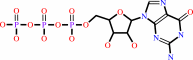 GTP
GTP
|
+
|
H(+)
|
=
|
5'-end (5'-triphosphoguanosine)-ribonucleoside in mRNA
|
+
|
 diphosphate
|
|
|
|
|
|
|
|
|
|
Enzyme class 2:
|
|
E.C.3.4.19.12
- ubiquitinyl hydrolase 1.
|
|
|
|
|
|
|
Reaction:
|
|
Thiol-dependent hydrolysis of ester, thiolester, amide, peptide and isopeptide bonds formed by the C-terminal Gly of ubiquitin (a 76-residue protein attached to proteins as an intracellular targeting signal).
|
|
|
|
|
|
Enzyme class 3:
|
|
E.C.3.4.22.-
- ?????
|
|
|
|
|
|
|
Enzyme class 4:
|
|
E.C.3.4.22.69
- Sars coronavirus main proteinase.
|
|
|
|
|
|
|
|
|
|
Note, where more than one E.C. class is given (as above), each may
correspond to a different protein domain or, in the case of polyprotein
precursors, to a different mature protein.
|
|
|
|
Molecule diagrams generated from .mol files obtained from the
KEGG ftp site
|
|
|
|
|
|
|
|
|
|
|
|
|
|
 |
|
|
|
|
|
|
| |
|
|
| |
|
|
J Med Chem
56:534-546
(2013)
|
|
PubMed id:
|
|
|
|
|
|
| |
|
Discovery, synthesis, and structure-based optimization of a series of N-(tert-butyl)-2-(N-arylamido)-2-(pyridin-3-yl) acetamides (ML188) as potent noncovalent small molecule inhibitors of the severe acute respiratory syndrome coronavirus (SARS-CoV) 3CL protease.
|
|
J.Jacobs,
V.Grum-Tokars,
Y.Zhou,
M.Turlington,
S.A.Saldanha,
P.Chase,
A.Eggler,
E.S.Dawson,
Y.M.Baez-Santos,
S.Tomar,
A.M.Mielech,
S.C.Baker,
C.W.Lindsley,
P.Hodder,
A.Mesecar,
S.R.Stauffer.
|
|
|
|
|
| |
ABSTRACT
|
|
|
|
| |
|
|
A high-throughput screen of the NIH molecular libraries sample collection and
subsequent optimization of a lead dipeptide-like series of severe acute
respiratory syndrome (SARS) main protease (3CLpro) inhibitors led to the
identification of probe compound ML188 (16-(R),
(R)-N-(4-(tert-butyl)phenyl)-N-(2-(tert-butylamino)-2-oxo-1-(pyridin-3-yl)ethyl)furan-2-carboxamide,
Pubchem CID: 46897844). Unlike the majority of reported coronavirus 3CLpro
inhibitors that act via covalent modification of the enzyme, 16-(R) is a
noncovalent SARS-CoV 3CLpro inhibitor with moderate MW and good enzyme and
antiviral inhibitory activity. A multicomponent Ugi reaction was utilized to
rapidly explore structure-activity relationships within S(1'), S(1), and S(2)
enzyme binding pockets. The X-ray structure of SARS-CoV 3CLpro bound with 16-(R)
was instrumental in guiding subsequent rounds of chemistry optimization. 16-(R)
provides an excellent starting point for the further design and refinement of
3CLpro inhibitors that act by a noncovalent mechanism of action.
|
|
|
|
|
|
|
|
|
|
|
|
|
|
|
|
|
|
 |
 |
 |
|


 Links
Links


