 |
PDBsum entry 3ecg

|
|
|
|
|
 |
Contents |
 |
|
|
|
|
|
|
|
|
|
|
|
|
|
|
* Residue conservation analysis
|
|
|
|
|
|
|
|
|
|
|
Enzyme class 1:
|
|
E.C.2.7.7.-
- ?????
|
|
|
|
|
|
|
Enzyme class 2:
|
|
E.C.2.7.7.49
- RNA-directed Dna polymerase.
|
|
|
|
|
|
|
Reaction:
|
|
DNA(n) + a 2'-deoxyribonucleoside 5'-triphosphate = DNA(n+1) + diphosphate
|
|
|
|
|
|
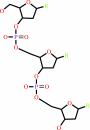 DNA(n)
|
+
|
2'-deoxyribonucleoside 5'-triphosphate
|
=
|
DNA(n+1)
|
+
|
 diphosphate
|
|
|
|
|
|
|
|
|
|
Enzyme class 3:
|
|
E.C.2.7.7.7
- DNA-directed Dna polymerase.
|
|
|
|
|
|
|
Reaction:
|
|
DNA(n) + a 2'-deoxyribonucleoside 5'-triphosphate = DNA(n+1) + diphosphate
|
|
|
|
|
|
DNA(n)
|
+
|
2'-deoxyribonucleoside 5'-triphosphate
|
=
|
DNA(n+1)
|
+
|
diphosphate
|
|
|
|
|
|
|
|
|
|
Enzyme class 4:
|
|
E.C.3.1.-.-
|
|
|
|
|
|
|
Enzyme class 5:
|
|
E.C.3.1.13.2
- exoribonuclease H.
|
|
|
|
|
|
|
Reaction:
|
|
Exonucleolytic cleavage to 5'-phosphomonoester oligonucleotides in both 5'- to 3'- and 3'- to 5'-directions.
|
|
|
|
|
|
Enzyme class 6:
|
|
E.C.3.1.26.13
- retroviral ribonuclease H.
|
|
|
|
|
|
|
Enzyme class 7:
|
|
E.C.3.4.23.47
- HIV-2 retropepsin.
|
|
|
|
|
|
|
|
|
|
Note, where more than one E.C. class is given (as above), each may
correspond to a different protein domain or, in the case of polyprotein
precursors, to a different mature protein.
|
|
|
|
Molecule diagrams generated from .mol files obtained from the
KEGG ftp site
|
|
|
|
|
|
|
|
|
|
|
|
|
|
 |
|
|
|
|
|
|
| |
|
|
| |
|
DOI no:
|
J Mol Biol
384:178-192
(2008)
|
|
PubMed id:
|
|
|
|
|
|
| |
|
Structural evidence for effectiveness of darunavir and two related antiviral inhibitors against HIV-2 protease.
|
|
A.Y.Kovalevsky,
J.M.Louis,
A.Aniana,
A.K.Ghosh,
I.T.Weber.
|
|
|
|
|
| |
ABSTRACT
|
|
|
|
| |
|
|
No drug has been targeted specifically for HIV-2 (human immunodeficiency virus
type 2) infection despite its increasing prevalence worldwide. The antiviral
HIV-1 (human immunodeficiency virus type 1) protease (PR) inhibitor darunavir
and the chemically related GRL98065 and GRL06579A were designed with the same
chemical scaffold and different substituents at P2 and P2' to optimize polar
interactions for HIV-1 PR (PR1). These inhibitors are also effective antiviral
agents for HIV-2-infected cells. Therefore, crystal structures of HIV-2 PR (PR2)
complexes with the three inhibitors have been solved at 1.2-A resolution to
analyze the molecular basis for their antiviral potency. Unusually, the crystals
were grown in imidazole and zinc acetate buffer, which formed interactions with
the PR2 and the inhibitors. Overall, the structures were very similar to the
corresponding inhibitor complexes of PR1 with an RMSD of 1.1 A on main-chain
atoms. Most hydrogen-bond and weaker C-H...O interactions with inhibitors were
conserved in the PR2 and PR1 complexes, except for small changes in interactions
with water or disordered side chains. Small differences were observed in the
hydrophobic contacts for the darunavir complexes, in agreement with relative
inhibition of the two PRs. These near-atomic-resolution crystal structures
verify the inhibitor potency for PR1 and PR2 and will provide the basis for the
development of antiviral inhibitors targeting PR2.
|
|
|
|
|
|
| |
Selected figure(s)
|
|
|
|
| |
|
|

|
|

|
|
Figure 5.
Fig. 5. Polar interactions between PR2 and inhibitors (a)
DRV, (b) GRL06579A, and (c) GRL98065. Hydrogen bonds are
indicated by dashed lines. The alternate conformation of the
Asp30 side chain in PR2–GRL06579A is shown in magenta. The two
shortest distances connecting the central OH group of each
inhibitor with the catalytic Asp25 and 25′ are indicated by
green dotted lines. The O–H…π interaction between the
aromatic system of P2 group and a water molecule is indicated by
a black dotted line.
|
|
Figure 7.
Fig. 7. Schematic representation of C–H…O unconventional
hydrogen-bond interactions in (a) PR2–DRV, (b)
PR2–GRL06579A, and (c) PR2–GRL98065. Pink dotted lines
indicate C–H…O contacts with distances in angstrom. The
green dotted lines indicate the O–H…O hydrogen bonds of the
catalytic Asp25/Asp25′.
|
|
|
|
|
|
| |
The above figures are
reprinted
from an Open Access publication published by Elsevier:
J Mol Biol
(2008,
384,
178-192)
copyright 2008.
|
|
| |
Figures were
selected
by the author.
|
|
|
|
| |
|
|
|
|
|
|
|
|
|
|
|
|
|
|
|
|
|
|
| |
|
|
|
|
| |
The crystal structures of HIV-2 protease with antiviral inhibitors suggest that darunavir and related inhibitors will be effective on both HIV-2 and HIV-1 infections.
|
|
|
|
|
|
|
|
|
|
|
|
|
 |
|
 |
 |
 |
|
|
|
|
|
|
|
|
|
|
|
|
|
|
|
|
|
Literature references that cite this PDB file's key reference
|
|
|
| |
PubMed id
|
|
Reference
|
|
|
|
|
|
J.M.Louis,
R.Ishima,
A.Aniana,
and
J.M.Sayer
(2009).
Revealing the dimer dissociation and existence of a folded monomer of the mature HIV-2 protease.
|
| |
Protein Sci,
18,
2442-2453.
|
|
|
|
|
|
|
L.Huang,
J.M.Sayer,
M.Swinford,
J.M.Louis,
and
C.Chen
(2009).
Modulation of human immunodeficiency virus type 1 protease autoprocessing by charge properties of surface residue 69.
|
| |
J Virol,
83,
7789-7793.
|
|
|
|
|
|
The most recent references are shown first.
Citation data come partly from CiteXplore and partly
from an automated harvesting procedure. Note that this is likely to be
only a partial list as not all journals are covered by
either method. However, we are continually building up the citation data
so more and more references will be included with time.
|
|


 Links
Links


