 |
PDBsum entry 2zfd

|
|
|
|
|
|

|

|

|

|
|

|
|

|
|

|
|

|
|

|
|

|
|
|
 |

|

|
|
|
|
|
|
|
|
|
|
|
|
|
|
|
|
|
|
|
|
|
|
|
|
|
|
|
|
|
|
|
|
|
|
|
Signaling protein/transferase
|
PDB id
|
|
|
|
2zfd
|
|
|
|
|
|
|
|
|
|
|
|
|
|
|

|

|

|
|
|
|
|
|
|
|
 |
Contents |
 |
|
|
|
|
|
|
|
|
|
|
|
|
|
|
* Residue conservation analysis
|
|
|
|
|
|
|
|
|
|
Enzyme class:
|
|
Chain B:
E.C.2.7.11.1
- non-specific serine/threonine protein kinase.
|
|
|
|
|
|
|
Reaction:
|
|
|
1.
|
L-seryl-[protein] + ATP = O-phospho-L-seryl-[protein] + ADP + H+
|
|
2.
|
L-threonyl-[protein] + ATP = O-phospho-L-threonyl-[protein] + ADP + H+
|
|
|
|
|
|
|
L-seryl-[protein]
|
+
|
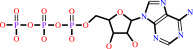 ATP
ATP
|
=
|
O-phospho-L-seryl-[protein]
|
+
|
 ADP
ADP
|
+
|
H(+)
|
|
|
|
|
|
|
L-threonyl-[protein]
|
+
|
ATP
|
=
|
O-phospho-L-threonyl-[protein]
|
+
|
ADP
|
+
|
H(+)
|
|
|
|
|
|
|
|
|
|
|
|
|
Molecule diagrams generated from .mol files obtained from the
KEGG ftp site
|
|
|
|
|
|
|
|
|
|
|
|
|
|
 |
|
|
|
|
|
|
| |
|
|
| |
|
DOI no:
|
J Mol Biol
377:246-257
(2008)
|
|
PubMed id:
|
|
|
|
|
|
| |
|
The crystal structure of plant-specific calcium-binding protein AtCBL2 in complex with the regulatory domain of AtCIPK14.
|
|
M.Akaboshi,
H.Hashimoto,
H.Ishida,
S.Saijo,
N.Koizumi,
M.Sato,
T.Shimizu.
|
|
|
|
|
| |
ABSTRACT
|
|
|
|
| |
|
|
Calcium signals mediate a multitude of plant responses to external stimuli.
Calcineurin B-like (CBL) proteins and their target kinases, CBL-interacting
protein kinases (CIPKs), represent important relays in plant calcium signaling.
CBL interacts with CIPK through a conserved motif (NAF/FISL motif) within the
C-terminal regulatory domain. To better understand the functional role of the
CBL-CIPK system, we determined the crystal structure of AtCBL2 in complex with
the regulatory domain of AtCIPK14 at 1.2 A resolution. The NAF/FISL motif is
inserted into a hydrophobic crevice within AtCBL2, accompanied by a large
displacement of the helices and loop on the opposite side of the NAF/FISL motif
from the C-terminal region, which shields the hydrophobic crevice in free form.
Ca(2+) are coordinated within four EF hands in AtCBL2 in bound form. This
calcium coordination pattern differs from that in the structure of the SOS3-SOS2
complex previously reported. Structural comparison of the two structures shows
that the recognition of CBL by CIPK is performed in a similar manner, but
inherent interactions confer binding affinity and specificity.
|
|
|
|
|
|
| |
Selected figure(s)
|
|
|
|
| |
|
|

|
|

|
|
Figure 3.
Fig. 3. Representation of the four EF-hand motifs (EF-1,
EF-2, EF-3, and EF-4). (a) Amino acid residues involved in
calcium coordination are shown. Calcium ions and water molecules
are represented as big and small balls, respectively. (b)
Superimposed structures of each EF hand in the bound and free
forms. EF-1 and EF-4 are well superimposed, but EF-2 and EF-3
are deviated.
|
|
Figure 4.
Fig. 4. Interactions between AtCBL2 and the regulatory domain
of AtCIPK14. (a) The N-lobe, C-lobe, and C-terminal region
interacting with the NAF/FISL motif are in yellow, green, and
blue, respectively. The NAF/FISL motif is represented as a red
ribbon. The NAF/FISL motif binds along the crevice of AtCBL2.
Dashed lines correspond to hydrogen bonds. (b) Close-up view of
the interaction between the CBL–NAF/FISL motif and the
regulatory domain. Hydrogen bonds are shown with dashed lines
(stereo). (c) Pull-down assay of His-tagged AtCBL2 with the
regulatory domain of AtCIPK14 of wild type and mutants.
|
|
|
|
|
|
| |
The above figures are
reprinted
by permission from Elsevier:
J Mol Biol
(2008,
377,
246-257)
copyright 2008.
|
|
| |
Figures were
selected
by an automated process.
|
|
|
|
|
|
|
|
|
|
|
|
|
|
|
|
 |
 |
 |
|
Literature references that cite this PDB file's key reference
|
|
|
| |
PubMed id
|
|
Reference
|
|
|
|
|
|
T.A.DeFalco,
K.W.Bender,
and
W.A.Snedden
(2010).
Breaking the code: Ca2+ sensors in plant signalling.
|
| |
Biochem J,
425,
27-40.
|
|
|
|
|
|
|
S.Luan
(2009).
The CBL-CIPK network in plant calcium signaling.
|
| |
Trends Plant Sci,
14,
37-42.
|
|
|
|
|
|
|
S.Weinl,
and
J.Kudla
(2009).
The CBL-CIPK Ca(2+)-decoding signaling network: function and perspectives.
|
| |
New Phytol,
184,
517-528.
|
|
|
|
|
|
The most recent references are shown first.
Citation data come partly from CiteXplore and partly
from an automated harvesting procedure. Note that this is likely to be
only a partial list as not all journals are covered by
either method. However, we are continually building up the citation data
so more and more references will be included with time.
|
|
|


 Links
Links


