 |
PDBsum entry 2wp3

|
|
|
|
|
|

|

|

|

|
|

|
|

|
|

|
|

|
|

|
|
|
 |

|

|
|
|
|
|
|
|
|
|
|
|
|
|
|
|
|
|
|
|
|
|
|
|
|
|
|
|
|
|
|
|
|
|
|
Transferase/structural protein
|
PDB id
|
|
|
|
2wp3
|
|
|
|
|
|
|
|
|
|
|
|
|
|
|

|

|

|
|
|
|
|
|
|
|
 |
Contents |
 |
|
|
|
|
|
|
|
|
|
|
|
|
* Residue conservation analysis
|
|
|
|
|
|
|
|
|
|
Enzyme class:
|
|
Chain T:
E.C.2.7.11.1
- non-specific serine/threonine protein kinase.
|
|
|
|
|
|
|
Reaction:
|
|
|
1.
|
L-seryl-[protein] + ATP = O-phospho-L-seryl-[protein] + ADP + H+
|
|
2.
|
L-threonyl-[protein] + ATP = O-phospho-L-threonyl-[protein] + ADP + H+
|
|
|
|
|
|
|
L-seryl-[protein]
|
+
|
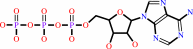 ATP
ATP
|
=
|
O-phospho-L-seryl-[protein]
|
+
|
 ADP
ADP
|
+
|
H(+)
|
|
|
|
|
|
|
L-threonyl-[protein]
|
+
|
ATP
|
=
|
O-phospho-L-threonyl-[protein]
|
+
|
ADP
|
+
|
H(+)
|
|
|
|
|
|
|
|
|
|
|
|
|
Molecule diagrams generated from .mol files obtained from the
KEGG ftp site
|
|
|
|
|
|
|
|
|
|
|
|
|
|
 |
|
|
|
|
|
|
| |
|
|
| |
|
|
Proc Natl Acad Sci U S A
107:2908-2913
(2010)
|
|
PubMed id:
|
|
|
|
|
|
| |
|
Structural insight into M-band assembly and mechanics from the titin-obscurin-like-1 complex.
|
|
S.Pernigo,
A.Fukuzawa,
M.Bertz,
M.Holt,
M.Rief,
R.A.Steiner,
M.Gautel.
|
|
|
|
|
| |
ABSTRACT
|
|
|
|
| |
|
|
In the sarcomeric M-band, the giant ruler proteins titin and obscurin, its small
homologue obscurin-like-1 (obsl1), and the myosin cross-linking protein myomesin
form a ternary complex that is crucial for the function of the M-band as a
mechanical link. Mutations in the last titin immunoglobulin (Ig) domain M10,
which interacts with the N-terminal Ig-domains of obscurin and obsl1, lead to
hereditary muscle diseases. The M10 domain is unusual not only in that it is a
frequent target of disease-linked mutations, but also in that it is the only
currently known muscle Ig-domain that interacts with two ligands--obscurin and
obsl1--in different sarcomeric subregions. Using x-ray crystallography, we show
the structural basis for titin M10 interaction with obsl1 in a novel
antiparallel Ig-Ig architecture and unravel the molecular basis of titin-M10
linked myopathies. The severity of these pathologies correlates with the
disruption of the titin-obsl1/obscurin complex. Conserved signature residues at
the interface account for differences in affinity that direct the cellular
sorting in cardiomyocytes. By engineering the interface signature residues of
obsl1 to obscurin, and vice versa, their affinity for titin can be modulated
similar to the native proteins. In single-molecule force-spectroscopy
experiments, both complexes yield at forces of around 30 pN, much lower than
those observed for the mechanically stable Z-disk complex of titin and
telethonin, suggesting why even moderate weakening of the obsl1/obscurin-titin
links has severe consequences for normal muscle functions.
|
|
|
|
|
|
|
|
|
|
|
|
|
|
|
|
|
|
 |
 |
 |
|
Literature references that cite this PDB file's key reference
|
|
|
| |
PubMed id
|
|
Reference
|
|
|
|
|
|
M.Gautel
(2011).
The sarcomeric cytoskeleton: who picks up the strain?
|
| |
Curr Opin Cell Biol,
23,
39-46.
|
|
|
|
|
|
|
S.Perera,
M.R.Holt,
B.S.Mankoo,
and
M.Gautel
(2011).
Developmental regulation of MURF ubiquitin ligases and autophagy proteins nbr1, p62/SQSTM1 and LC3 during cardiac myofibril assembly and turnover.
|
| |
Dev Biol,
351,
46-61.
|
|
|
|
|
|
|
K.Charton,
N.Danièle,
A.Vihola,
C.Roudaut,
E.Gicquel,
F.Monjaret,
A.Tarrade,
J.Sarparanta,
B.Udd,
and
I.Richard
(2010).
Removal of the calpain 3 protease reverses the myopathology in a mouse model for titinopathies.
|
| |
Hum Mol Genet,
19,
4608-4624.
|
|
|
|
|
|
The most recent references are shown first.
Citation data come partly from CiteXplore and partly
from an automated harvesting procedure. Note that this is likely to be
only a partial list as not all journals are covered by
either method. However, we are continually building up the citation data
so more and more references will be included with time.
|
|
|


 Links
Links


