 |
PDBsum entry 2va3

|
|
|
|
|
 |
Contents |
 |
|
|
|
|
|
|
|
|
|
|
|
|
|
|
|
|
* Residue conservation analysis
|
|
|
|
|
|
|
|
|
|
|
Enzyme class:
|
|
E.C.2.7.7.7
- DNA-directed Dna polymerase.
|
|
|
|
|
|
|
Reaction:
|
|
DNA(n) + a 2'-deoxyribonucleoside 5'-triphosphate = DNA(n+1) + diphosphate
|
|
|
|
|
|
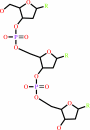 DNA(n)
|
+
|
2'-deoxyribonucleoside 5'-triphosphate
|
=
|
DNA(n+1)
|
+
|
 diphosphate
|
|
|
|
|
|
|
|
|
|
|
|
|
Molecule diagrams generated from .mol files obtained from the
KEGG ftp site
|
|
|
|
|
|
|
|
|
|
|
|
|
|
 |
|
|
|
|
|
|
| |
|
|
| |
|
DOI no:
|
J Biol Chem
282:36421-36433
(2007)
|
|
PubMed id:
|
|
|
|
|
|
| |
|
Structure and activity of Y-class DNA polymerase DPO4 from Sulfolobus solfataricus with templates containing the hydrophobic thymine analog 2,4-difluorotoluene.
|
|
A.Irimia,
R.L.Eoff,
P.S.Pallan,
F.P.Guengerich,
M.Egli.
|
|
|
|
|
| |
ABSTRACT
|
|
|
|
| |
|
|
The 2,4-difluorotoluene (DFT) analog of thymine has been used extensively to
probe the relative importance of shape and hydrogen bonding for correct
nucleotide insertion by DNA polymerases. As far as high fidelity (A-class)
polymerases are concerned, shape is considered by some as key to incorporation
of A(T) opposite T(A) and G(C) opposite C(G). We have carried out a detailed
kinetic analysis of in vitro primer extension opposite DFT-containing templates
by the trans-lesion (Y-class) DNA polymerase Dpo4 from Sulfolobus solfataricus.
Although full-length product formation was observed, steady-state kinetic data
show that dATP insertion opposite DFT is greatly inhibited relative to insertion
opposite T (approximately 5,000-fold). No products were observed in the
pre-steady-state. Furthermore, it is noteworthy that Dpo4 strongly prefers dATP
opposite DFT over dGTP (approximately 200-fold) and that the polymerase is able
to extend an A:DFT but not a G:DFT pair. We present crystal structures of Dpo4
in complex with DNA duplexes containing the DFT analog, the first for any DNA
polymerase. In the structures, template-DFT is either positioned opposite
primer-A or -G at the -1 site or is unopposed by a primer base and followed by a
dGTP:A mismatch pair at the active site, representative of a -1 frameshift. The
three structures provide insight into the discrimination by Dpo4 between dATP
and dGTP opposite DFT and its inability to extend beyond a G:DFT pair. Although
hydrogen bonding is clearly important for error-free replication by this Y-class
DNA polymerase, our work demonstrates that Dpo4 also relies on shape and
electrostatics to distinguish between correct and incorrect incoming nucleotide.
|
|
|
|
|
|
| |
Selected figure(s)
|
|
|
|
| |
|
|

|
|

|
|
Figure 2.
FIGURE 2. Dpo4-catalyzed polymerization opposite
DFT-containing template DNA. Dpo4-catalyzed (100 nM) extension
of 12/18-mer DNA (200 nM) containing DFT was allowed to proceed
in the presence of a 4 mM dNTP mix. For comparisons regarding
the time frame of full-length extensions opposite native DNA,
please see Fig. 2 of Ref. 22 and/or Fig. 1 of Ref. 24.
|
|
Figure 5.
FIGURE 5. Examples of the quality of the final electron
density. Electron density around the DNA duplex at the active
site is shown. A, Dpo4(DFT:13A); template
5'-TTCAG(DFT)AGTCCTTCCCCC-3' and primer 5'-GGGGGAAGGACTA-3',
ddCTP. B, Dpo4(dGTP); template 5'-TTCA(DFT)TAGTCCTTCCCCC-3' and
primer 5'-GGGGGAAGGACTA-3', dGTP. C, one of the Dpo4(DFT:13G)
complexes per asymmetric unit; D, second Dpo4(DFT:13G) complex;
template 5'-TTCAG(DFT)AGTCCTTCCCCC-3' and primer
5'-GGGGGAAGGACTG-3', ddCTP. The 3F[o] - 2F[c]electron density
maps (blue chicken wire) are contoured at the 1  level.
The Dpo4 protein is shown as ribbons and the DNA duplex as
sticks. The Ca^2+ ions are depicted as green spheres. level.
The Dpo4 protein is shown as ribbons and the DNA duplex as
sticks. The Ca^2+ ions are depicted as green spheres.
|
|
|
|
|
|
| |
The above figures are
reprinted
by permission from the ASBMB:
J Biol Chem
(2007,
282,
36421-36433)
copyright 2007.
|
|
| |
Figures were
selected
by an automated process.
|
|
|
|
|
|
|
|
|
|
|
|
|
|
|
|
 |
 |
 |
|
Literature references that cite this PDB file's key reference
|
|
|
| |
PubMed id
|
|
Reference
|
|
|
|
|
|
P.S.Pallan,
E.M.Greene,
P.A.Jicman,
R.K.Pandey,
M.Manoharan,
E.Rozners,
and
M.Egli
(2011).
Unexpected origins of the enhanced pairing affinity of 2'-fluoro-modified RNA.
|
| |
Nucleic Acids Res,
39,
3482-3495.
|
|
|
PDB codes:
|
|
|
|
|
|
|
|
J.D.Pata
(2010).
Structural diversity of the Y-family DNA polymerases.
|
| |
Biochim Biophys Acta,
1804,
1124-1135.
|
|
|
|
|
|
|
M.Egli,
and
P.S.Pallan
(2010).
Crystallographic studies of chemically modified nucleic acids: a backward glance.
|
| |
Chem Biodivers,
7,
60-89.
|
|
|
|
|
|
|
H.Zhang,
J.W.Beckman,
and
F.P.Guengerich
(2009).
Frameshift deletion by Sulfolobus solfataricus P2 DNA polymerase Dpo4 T239W is selective for purines and involves normal conformational change followed by slow phosphodiester bond formation.
|
| |
J Biol Chem,
284,
35144-35153.
|
|
|
|
|
|
|
H.Zhang,
R.L.Eoff,
I.D.Kozekov,
C.J.Rizzo,
M.Egli,
and
F.P.Guengerich
(2009).
Structure-function relationships in miscoding by Sulfolobus solfataricus DNA polymerase Dpo4: guanine N2,N2-dimethyl substitution produces inactive and miscoding polymerase complexes.
|
| |
J Biol Chem,
284,
17687-17699.
|
|
|
PDB codes:
|
|
|
|
|
|
|
|
O.Rechkoblit,
L.Malinina,
Y.Cheng,
N.E.Geacintov,
S.Broyde,
and
D.J.Patel
(2009).
Impact of conformational heterogeneity of OxoG lesions and their pairing partners on bypass fidelity by Y family polymerases.
|
| |
Structure,
17,
725-736.
|
|
|
PDB codes:
|
|
|
|
|
|
|
|
P.P.Christov,
K.C.Angel,
F.P.Guengerich,
and
C.J.Rizzo
(2009).
Replication past the N5-methyl-formamidopyrimidine lesion of deoxyguanosine by DNA polymerases and an improved procedure for sequence analysis of in vitro bypass products by mass spectrometry.
|
| |
Chem Res Toxicol,
22,
1086-1095.
|
|
|
|
|
|
|
P.S.Pallan,
and
M.Egli
(2009).
Pairing geometry of the hydrophobic thymine analogue 2,4-difluorotoluene in duplex DNA as analyzed by X-ray crystallography.
|
| |
J Am Chem Soc,
131,
12548-12549.
|
|
|
PDB code:
|
|
|
|
|
|
|
|
P.Xu,
L.Oum,
Y.C.Lee,
N.E.Geacintov,
and
S.Broyde
(2009).
Visualizing sequence-governed nucleotide selectivities and mutagenic consequences through a replicative cycle: processing of a bulky carcinogen N2-dG lesion in a Y-family DNA polymerase.
|
| |
Biochemistry,
48,
4677-4690.
|
|
|
|
|
|
|
H.Huang,
and
M.M.Greenberg
(2008).
Hydrogen bonding contributes to the selectivity of nucleotide incorporation opposite an oxidized abasic lesion.
|
| |
J Am Chem Soc,
130,
6080-6081.
|
|
|
|
|
|
|
J.W.Beckman,
Q.Wang,
and
F.P.Guengerich
(2008).
Kinetic analysis of correct nucleotide insertion by a Y-family DNA polymerase reveals conformational changes both prior to and following phosphodiester bond formation as detected by tryptophan fluorescence.
|
| |
J Biol Chem,
283,
36711-36723.
|
|
|
|
|
|
|
L.DeCarlo,
A.S.Gowda,
Z.Suo,
and
T.E.Spratt
(2008).
Formation of purine-purine mispairs by Sulfolobus solfataricus DNA polymerase IV.
|
| |
Biochemistry,
47,
8157-8164.
|
|
|
|
|
|
The most recent references are shown first.
Citation data come partly from CiteXplore and partly
from an automated harvesting procedure. Note that this is likely to be
only a partial list as not all journals are covered by
either method. However, we are continually building up the citation data
so more and more references will be included with time.
Where a reference describes a PDB structure, the PDB
codes are
shown on the right.
|
|


 Links
Links


