 |
PDBsum entry 2n83

|
|
|
|
|
|

|

|

|

|
|

|
|

|
|

|
|

|
|
|
 |

|

|
|
|
|
|
|
|
|
|
|
|
|
|
|
|
|
|
|
|
|
|
|
|
|
|
|
|
|
|
|
|
|
|
Signaling protein/transferase
|
PDB id
|
|
|
|
2n83
|
|
|
|
|
|
|
|
|
|
|
|
|
|
|

|

|

|
|
|
|
|
|
|
PDB id:
|
|
|
|
| Name: |
|
Signaling protein/transferase
|
|
|
Title:
|
|
P75ntr dd:rip2 card
|
|
Structure:
|
|
Tumor necrosis factor receptor superfamily member 16. Chain: a. Fragment: unp residues 334-427. Synonym: gp80-lngfr, low affinity neurotrophin receptor p75ntr, low- affinity nerve growth factor receptor, ngf receptor, p75 icd. Engineered: yes. Receptor-interacting serine/threonine-protein kinase 2. Chain: b. Fragment: unp residues 435-539.
|
|
Source:
|
|
Homo sapiens. Human. Organism_taxid: 9606. Gene: ngfr, tnfrsf16. Expressed in: escherichia coli. Expression_system_taxid: 562. Gene: ripk2, cardiak, rick, rip2, unq277/pro314/pro34092.
|
|
NMR struc:
|
|
10 models
|
|
|
Authors:
|
|
Z.Lin,C.F.Ibanez
|
|
Key ref:
|
|
Z.Lin
et al.
(2015).
Structural basis of death domain signaling in the p75 neurotrophin receptor.
Elife,
4,
e11692.
PubMed id:
DOI:
|
|
|
Date:
|
|
|
02-Oct-15
|
Release date:
|
23-Dec-15
|
|
|
|
|
|
|
PROCHECK
|

|
|
|
|
|
Headers
|
|
|
|
References
|
|
|
|
|
|
|
|
|
|
|
|
Enzyme class 2:
|
|
Chain B:
E.C.2.7.10.2
- non-specific protein-tyrosine kinase.
|
|
|
|
|
|
|
Reaction:
|
|
L-tyrosyl-[protein] + ATP = O-phospho-L-tyrosyl-[protein] + ADP + H+
|
|
|
|
|
|
L-tyrosyl-[protein]
|
+
|
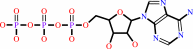 ATP
ATP
|
=
|
O-phospho-L-tyrosyl-[protein]
|
+
|
 ADP
ADP
|
+
|
H(+)
|
|
|
|
|
|
|
|
|
|
Enzyme class 3:
|
|
Chain B:
E.C.2.7.11.1
- non-specific serine/threonine protein kinase.
|
|
|
|
|
|
|
Reaction:
|
|
|
1.
|
L-seryl-[protein] + ATP = O-phospho-L-seryl-[protein] + ADP + H+
|
|
2.
|
L-threonyl-[protein] + ATP = O-phospho-L-threonyl-[protein] + ADP + H+
|
|
|
|
|
|
|
L-seryl-[protein]
|
+
|
ATP
|
=
|
O-phospho-L-seryl-[protein]
|
+
|
ADP
|
+
|
H(+)
|
|
|
|
|
|
|
L-threonyl-[protein]
|
+
|
ATP
|
=
|
O-phospho-L-threonyl-[protein]
|
+
|
ADP
|
+
|
H(+)
|
|
|
|
|
|
|
|
|
|
|
|
|
Note, where more than one E.C. class is given (as above), each may
correspond to a different protein domain or, in the case of polyprotein
precursors, to a different mature protein.
|
|
|
|
Molecule diagrams generated from .mol files obtained from the
KEGG ftp site
|
|
|
|
|
|
|
|
|
|
|
|
|
|
 |
|
|
|
|
|
|
| |
|
|
| |
|
DOI no:
|
Elife
4:e11692
(2015)
|
|
PubMed id:
|
|
|
|
|
|
| |
|
Structural basis of death domain signaling in the p75 neurotrophin receptor.
|
|
Z.Lin,
J.Y.Tann,
E.T.Goh,
C.Kelly,
K.B.Lim,
J.F.Gao,
C.F.Ibanez.
|
|
|
|
|
| |
ABSTRACT
|
|
|
|
| |
|
|
Death domains (DDs) mediate assembly of oligomeric complexes for activation of
downstream signaling pathways through incompletely understood mechanisms. Here
we report structures of complexes formed by the DD of p75 neurotrophin receptor
(p75(NTR)) with RhoGDI, for activation of the RhoA pathway, with caspase
recruitment domain (CARD) of RIP2 kinase, for activation of the NF-kB pathway,
and with itself, revealing how DD dimerization controls access of intracellular
effectors to the receptor. RIP2 CARD and RhoGDI bind to p75(NTR) DD at partially
overlapping epitopes with over 100-fold difference in affinity, revealing the
mechanism by which RIP2 recruitment displaces RhoGDI upon ligand binding. The
p75(NTR) DD forms non-covalent, low-affinity symmetric dimers in solution. The
dimer interface overlaps with RIP2 CARD but not RhoGDI binding sites, supporting
a model of receptor activation triggered by separation of DDs. These structures
reveal how competitive protein-protein interactions orchestrate the hierarchical
activation of downstream pathways in non-catalytic receptors.
|
|
|
|
|
|
|
|
|
|
|
|
|
|
|
|
|
|
 |
 |
 |
|
|


 Links
Links


