
|
|
|
|
|
 |
Contents |
 |
|
|
|
|
|
|
|
|
|
|
* Residue conservation analysis
|
|
|
|
|
|
|
|
|
|
Enzyme class:
|
|
Chains B, D, F:
E.C.2.7.11.1
- non-specific serine/threonine protein kinase.
|
|
|
|
|
|
|
Reaction:
|
|
|
1.
|
L-seryl-[protein] + ATP = O-phospho-L-seryl-[protein] + ADP + H+
|
|
2.
|
L-threonyl-[protein] + ATP = O-phospho-L-threonyl-[protein] + ADP + H+
|
|
|
|
|
|
|
L-seryl-[protein]
|
+
|
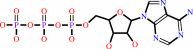 ATP
ATP
|
=
|
O-phospho-L-seryl-[protein]
|
+
|
 ADP
ADP
|
+
|
H(+)
|
|
|
|
|
|
|
L-threonyl-[protein]
|
+
|
ATP
|
=
|
O-phospho-L-threonyl-[protein]
|
+
|
ADP
|
+
|
H(+)
|
|
|
|
|
|
|
|
|
|
|
|
|
Molecule diagrams generated from .mol files obtained from the
KEGG ftp site
|
|
|
|
|
|
|
|
|
|
|
|
|
|
 |
|
|
|
|
|
|
| |
|
|
| |
|
DOI no:
|
Proc Natl Acad Sci U S A
104:1201-1206
(2007)
|
|
PubMed id:
|
|
|
|
|
|
| |
|
Structural analysis of Bub3 interactions in the mitotic spindle checkpoint.
|
|
N.A.Larsen,
J.Al-Bassam,
R.R.Wei,
S.C.Harrison.
|
|
|
|
|
| |
ABSTRACT
|
|
|
|
| |
|
|
The Mad3/BubR1, Mad2, Bub1, and Bub3 proteins are gatekeepers for the transition
from metaphase to anaphase. Mad3 from Saccharomyces cerevisiae has homology to
Bub1 but lacks a corresponding C-terminal kinase domain. Mad3 forms a stable
heterodimer with Bub3. Negative-stain electron microscopy shows that Mad3 is an
extended molecule (approximately 200 A long), whereas Bub3 is globular. The
Gle2-binding-sequence (GLEBS) motifs found in Mad3 and Bub1 are necessary and
sufficient for interaction with Bub3. The calorimetrically determined
dissociation constants for GLEBS-motif peptides and Bub3 are approximately 5
microM. Crystal structures of these peptides with Bub3 show that the
interactions for Mad3 and Bub1 are similar and mutually exclusive. In both
structures, the GLEBS peptide snakes along the top surface of the
beta-propeller, forming an extensive interface. Mutations in either protein that
disrupt the interface cause checkpoint deficiency and chromosome instability. We
propose that the structure imposed on the GLEBS segment by its association with
Bub3 enables recruitment to unattached kinetochores.
|
|
|
|
|
|
| |
Selected figure(s)
|
|
|
|
| |
|
|

|
|

|
|
Figure 2.
Fig. 2. Negative-stain electron microscopy. Shown are wide
fields with higher magnification insets. (A) Bub3 appears as
isolated punctate objects. (B) Mad3 resembles elongated beads on
a string.
|
|
Figure 5.
Fig. 5. Mad3 and R197E Bub3 do not associate. (A) Mad3 was
mixed with excess Bub3 mutant and analyzed by gel filtration.
(B) Coomassie-stained gel of peak fractions from A showing that
the Bub3 mutant does not coelute with Mad3.
|
|
|
|
| |
Figures were
selected
by an automated process.
|
|
|
|
|
|
|
|
|
|
|
|
|
|
|
|
 |
 |
 |
|
Literature references that cite this PDB file's key reference
|
|
|
| |
PubMed id
|
|
Reference
|
|
|
|
|
|
C.Xu,
and
J.Min
(2011).
Structure and function of WD40 domain proteins.
|
| |
Protein Cell,
2,
202-214.
|
|
|
PDB codes:
|
|
|
|
|
|
|
|
D.Barford
(2011).
Structure, function and mechanism of the anaphase promoting complex (APC/C).
|
| |
Q Rev Biophys,
44,
153-190.
|
|
|
|
|
|
|
V.M.Bolanos-Garcia,
and
T.L.Blundell
(2011).
BUB1 and BUBR1: multifaceted kinases of the cell cycle.
|
| |
Trends Biochem Sci,
36,
141-150.
|
|
|
|
|
|
|
S.D'Arcy,
O.R.Davies,
T.L.Blundell,
and
V.M.Bolanos-Garcia
(2010).
Defining the molecular basis of BubR1 kinetochore interactions and APC/C-CDC20 inhibition.
|
| |
J Biol Chem,
285,
14764-14776.
|
|
|
PDB code:
|
|
|
|
|
|
|
|
Y.Ren,
H.S.Seo,
G.Blobel,
and
A.Hoelz
(2010).
Structural and functional analysis of the interaction between the nucleoporin Nup98 and the mRNA export factor Rae1.
|
| |
Proc Natl Acad Sci U S A,
107,
10406-10411.
|
|
|
PDB code:
|
|
|
|
|
|
|
|
A.Doncic,
E.Ben-Jacob,
S.Einav,
and
N.Barkai
(2009).
Reverse engineering of the spindle assembly checkpoint.
|
| |
PLoS One,
4,
e6495.
|
|
|
|
|
|
|
A.Essex,
A.Dammermann,
L.Lewellyn,
K.Oegema,
and
A.Desai
(2009).
Systematic analysis in Caenorhabditis elegans reveals that the spindle checkpoint is composed of two largely independent branches.
|
| |
Mol Biol Cell,
20,
1252-1267.
|
|
|
|
|
|
|
A.W.Oliver,
S.Swift,
C.J.Lord,
A.Ashworth,
and
L.H.Pearl
(2009).
Structural basis for recruitment of BRCA2 by PALB2.
|
| |
EMBO Rep,
10,
990-996.
|
|
|
PDB codes:
|
|
|
|
|
|
|
|
H.Windecker,
M.Langegger,
S.Heinrich,
and
S.Hauf
(2009).
Bub1 and Bub3 promote the conversion from monopolar to bipolar chromosome attachment independently of shugoshin.
|
| |
EMBO Rep,
10,
1022-1028.
|
|
|
|
|
|
|
M.Theis,
M.Slabicki,
M.Junqueira,
M.Paszkowski-Rogacz,
J.Sontheimer,
R.Kittler,
A.K.Heninger,
T.Glatter,
K.Kruusmaa,
I.Poser,
A.A.Hyman,
M.T.Pisabarro,
M.Gstaiger,
R.Aebersold,
A.Shevchenko,
and
F.Buchholz
(2009).
Comparative profiling identifies C13orf3 as a component of the Ska complex required for mammalian cell division.
|
| |
EMBO J,
28,
1453-1465.
|
|
|
|
|
|
|
T.N.Gaitanos,
A.Santamaria,
A.A.Jeyaprakash,
B.Wang,
E.Conti,
and
E.A.Nigg
(2009).
Stable kinetochore-microtubule interactions depend on the Ska complex and its new component Ska3/C13Orf3.
|
| |
EMBO J,
28,
1442-1452.
|
|
|
|
|
|
|
V.M.Bolanos-Garcia,
T.Kiyomitsu,
S.D'Arcy,
D.Y.Chirgadze,
J.G.Grossmann,
D.Matak-Vinkovic,
A.R.Venkitaraman,
M.Yanagida,
C.V.Robinson,
and
T.L.Blundell
(2009).
The crystal structure of the N-terminal region of BUB1 provides insight into the mechanism of BUB1 recruitment to kinetochores.
|
| |
Structure,
17,
105-116.
|
|
|
PDB code:
|
|
|
|
|
|
|
|
V.Vanoosthuyse,
J.C.Meadows,
S.J.van der Sar,
J.B.Millar,
and
K.G.Hardwick
(2009).
Bub3p facilitates spindle checkpoint silencing in fission yeast.
|
| |
Mol Biol Cell,
20,
5096-5105.
|
|
|
|
|
|
|
B.Ibrahim,
S.Diekmann,
E.Schmitt,
and
P.Dittrich
(2008).
In-silico modeling of the mitotic spindle assembly checkpoint.
|
| |
PLoS ONE,
3,
e1555.
|
|
|
|
|
|
|
M.Sczaniecka,
A.Feoktistova,
K.M.May,
J.S.Chen,
J.Blyth,
K.L.Gould,
and
K.G.Hardwick
(2008).
The spindle checkpoint functions of Mad3 and Mad2 depend on a Mad3 KEN box-mediated interaction with Cdc20-anaphase-promoting complex (APC/C).
|
| |
J Biol Chem,
283,
23039-23047.
|
|
|
|
|
|
|
E.M.King,
S.J.van der Sar,
and
K.G.Hardwick
(2007).
Mad3 KEN boxes mediate both Cdc20 and Mad3 turnover, and are critical for the spindle checkpoint.
|
| |
PLoS ONE,
2,
e342.
|
|
|
|
|
|
The most recent references are shown first.
Citation data come partly from CiteXplore and partly
from an automated harvesting procedure. Note that this is likely to be
only a partial list as not all journals are covered by
either method. However, we are continually building up the citation data
so more and more references will be included with time.
Where a reference describes a PDB structure, the PDB
codes are
shown on the right.
|
 |


 Links
Links


