 |
PDBsum entry 2g9x

|
|
|
|
|
|

|

|

|

|
|

|
|

|
|

|
|

|
|

|
|

|
|
|
 |

|

|
|
|
|
|
|
|
|
|
|
|
|
|
|
|
|
|
|
|
|
|
|
|
|
|
|
|
|
|
|
|
|
|
|
|
Transferase/cell cycle
|
PDB id
|
|
|
|
2g9x
|
|
|
|
|
|
|
|
|
|
|
|
|
|
|

|

|

|
|
|
|
|
|
|
|
 |
Contents |
 |
|
|
|
|
|
|
|
|
|
|
|
 299 a.a.
|
|
|
|
|
|
|
|
|
|
|

 262 a.a.
|
|
|
|
|
|
|
|
|
|
|
 275 a.a.
|
|
|
|
|
|
|
|
|
|
|
* Residue conservation analysis
|
|
|
|
|
|
PDB id:
|
|
|
|
| Name: |
|
Transferase/cell cycle
|
|
|
Title:
|
|
Structure of thr 160 phosphorylated cdk2/cyclin a in complex with the inhibitor nu6271
|
|
Structure:
|
|
Cell division protein kinase 2. Chain: a, c. Synonym: p33 protein kinase. Engineered: yes. Cyclin-a2. Chain: b, d. Synonym: cyclin-a. Engineered: yes
|
|
Source:
|
|
Homo sapiens. Human. Organism_taxid: 9606. Gene: cdk2. Expressed in: escherichia coli. Expression_system_taxid: 562. Bos taurus. Cattle. Organism_taxid: 9913.
|
|
Biol. unit:
|
|
 Dimer (from
)
Dimer (from
)
|
|
Resolution:
|
|
|
2.50Å
|
R-factor:
|
0.219
|
R-free:
|
0.265
|
|
|
Authors:
|
|
A.Echalier,J.A.Endicott,M.E.Noble
|
|
Key ref:
|
|
R.J.Griffin
et al.
(2006).
Searching for cyclin-dependent kinase inhibitors using a new variant of the cope elimination.
J Am Chem Soc,
128,
6012-6013.
PubMed id:
DOI:
|
|
|
Date:
|
|
|
07-Mar-06
|
Release date:
|
23-May-06
|
|
|
|
|
|
|
PROCHECK
|

|
|
|
|
|
Headers
|
|
|
|
References
|
|
|
|
|
|

|
|
P24941
(CDK2_HUMAN) -
Cyclin-dependent kinase 2 from Homo sapiens
|
|
|
|
Seq:
Struc:
|
|
|
|
298 a.a.
299 a.a.*
|
|

|

|

|
|
|
|
|
|
|
|
|
|
|
|
|
|
|
|
|
Enzyme class:
|
|
Chains A, C:
E.C.2.7.11.22
- cyclin-dependent kinase.
|
|
|
|
|
|
|
Reaction:
|
|
|
1.
|
L-seryl-[protein] + ATP = O-phospho-L-seryl-[protein] + ADP + H+
|
|
2.
|
L-threonyl-[protein] + ATP = O-phospho-L-threonyl-[protein] + ADP + H+
|
|
|
|
|
|
|
L-seryl-[protein]
|
+
|
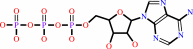 ATP
ATP
|
=
|
O-phospho-L-seryl-[protein]
|
+
|
 ADP
ADP
|
+
|
H(+)
|
|
|
|
|
|
|
L-threonyl-[protein]
|
+
|
ATP
|
=
|
O-phospho-L-threonyl-[protein]
|
+
|
ADP
|
+
|
H(+)
|
|
|
|
|
|
|
|
|
|
|
|
|
Molecule diagrams generated from .mol files obtained from the
KEGG ftp site
|
|
|
|
|
|
|
|
|
|
|
|
|
|
 |
|
|
|
|
|
|
| |
|
|
| |
|
DOI no:
|
J Am Chem Soc
128:6012-6013
(2006)
|
|
PubMed id:
|
|
|
|
|
|
| |
|
Searching for cyclin-dependent kinase inhibitors using a new variant of the cope elimination.
|
|
R.J.Griffin,
A.Henderson,
N.J.Curtin,
A.Echalier,
J.A.Endicott,
I.R.Hardcastle,
D.R.Newell,
M.E.Noble,
L.Z.Wang,
B.T.Golding.
|
|
|
|
|
| |
ABSTRACT
|
|
|
|
| |
|
|
beta-Piperidinoethylsulfides are oxidized by m-chloroperbenzoic acid to
intermediates containing both N-oxide and sulfone functions. These undergo a
Cope-type elimination to a vinylsulfone that can be captured by amines to afford
beta-aminoethylsulfones. When a beta-aminoethylsulfone group is linked to the
4-position of a phenyl group attached at N-2 of O6-cyclohexylmethylguanine, the
resulting derivatives are inhibitors of the cyclin-dependent kinase CDK2. One of
the most potent inhibitors (IC50 = 45 nM) contained a N-3-hydroxypropyl group on
the aminoethylsulfonyl substituent. The crystal structure of this inhibitor
bound to CDK2/cyclin A was determined and shows an unusual network of hydrogen
bonds. The synthetic methodology developed can be utilized in multiple-parallel
format and has numerous potential applications in medicinal chemistry.
|
|
|
|
|
|
|
|
|
|
|
|
|
|
|
|
|
|
 |
 |
 |
|
Literature references that cite this PDB file's key reference
|
|
|
| |
PubMed id
|
|
Reference
|
|
|
|
|
|
F.Marchetti,
K.L.Sayle,
J.Bentley,
W.Clegg,
N.J.Curtin,
J.A.Endicott,
B.T.Golding,
R.J.Griffin,
K.Haggerty,
R.W.Harrington,
V.Mesguiche,
D.R.Newell,
M.E.Noble,
R.J.Parsons,
D.J.Pratt,
L.Z.Wang,
and
I.R.Hardcastle
(2007).
Structure-based design of 2-arylamino-4-cyclohexylmethoxy-5-nitroso-6-aminopyrimidine inhibitors of cyclin-dependent kinase 2.
|
| |
Org Biomol Chem,
5,
1577-1585.
|
|
|
|
|
|
The most recent references are shown first.
Citation data come partly from CiteXplore and partly
from an automated harvesting procedure. Note that this is likely to be
only a partial list as not all journals are covered by
either method. However, we are continually building up the citation data
so more and more references will be included with time.
|
|
| |


 Links
Links


