|
PDBsum entry 2dpy

|
|
|
|
|
 |
Contents |
 |
|
|
|
|
|
|
|
|
|
|
|
|
* Residue conservation analysis
|
|
|
|
|
|
|
|
|
|
|
Enzyme class:
|
|
E.C.7.1.2.2
- H(+)-transporting two-sector ATPase.
|
|
|
|
|
|
|
Reaction:
|
|
ATP + H2O + 4 H+(in) = ADP + phosphate + 5 H+(out)
|
|
|
|
|
|
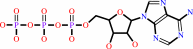 ATP
ATP
|
+
|
H2O
|
+
|
4
×
H(+)(in)
|
=
|
ADP
Bound ligand (Het Group name = )
corresponds exactly
|
+
|
 phosphate
|
+
|
5
×
H(+)(out)
|
|
|
|
|
|
|
|
|
|
|
|
|
Molecule diagrams generated from .mol files obtained from the
KEGG ftp site
|
|
|
|
|
|
|
|
|
|
|
|
|
|
 |
|
|
|
|
|
|
| |
|
|
| |
|
DOI no:
|
Proc Natl Acad Sci U S A
104:485-490
(2007)
|
|
PubMed id:
|
|
|
|
|
|
| |
|
Structural similarity between the flagellar type III ATPase FliI and F1-ATPase subunits.
|
|
K.Imada,
T.Minamino,
A.Tahara,
K.Namba.
|
|
|
|
|
| |
ABSTRACT
|
|
|
|
| |
|
|
Construction of the bacterial flagellum in the cell exterior proceeds at its
distal end by highly ordered self-assembly of many different component proteins,
which are selectively exported through the central channel of the growing
flagellum by the flagellar type III export apparatus. FliI is the ATPase of the
export apparatus that drives the export process. Here we report the 2.4 A
resolution crystal structure of FliI in the ADP-bound form. FliI consists of
three domains, and the whole structure shows extensive similarities to the alpha
and beta subunits of F0F1-ATPsynthase, a rotary motor that drives the chemical
reaction of ATP synthesis. A hexamer model of FliI has been constructed based on
the F1-ATPase structure composed of the alpha3beta3gamma subunits. Although the
regions that differ in conformation between FliI and the F1-alpha/beta subunits
are all located on the outer surface of the hexamer ring, the main chain
structures at the subunit interface and those surrounding the central channel of
the ring are well conserved. These results imply an evolutionary relation
between the flagellum and F0F1-ATPsynthase and a similarity in the mechanism
between FliI and F1-ATPase despite the apparently different functions of these
proteins.
|
|
|
|
|
|
| |
Selected figure(s)
|
|
|
|
| |
|
|

|
|

|
|
Figure 2.
Fig. 2. Structure of FliI(  1–18). (A) C^ 1–18). (A) C^  ribbon
drawing of FliI( 1–18). All of the
secondary structure elements are labeled as in Fig. 1. The
linker connecting the N-terminal and ATPase domains, which is
missing in the model, is indicated by a dashed line. (B)
Close-up stereoview of the nucleotide-binding site. The bound
ADP is colored green, and the residues interacting with ADP are
shown in cyan. Conserved residues involved in catalysis are
indicated by yellow. (C–F) Comparison of the relative domain
orientation. FliI( 1–18) (cyan) is
superimposed onto the F[1]- ribbon
drawing of FliI( 1–18). All of the
secondary structure elements are labeled as in Fig. 1. The
linker connecting the N-terminal and ATPase domains, which is
missing in the model, is indicated by a dashed line. (B)
Close-up stereoview of the nucleotide-binding site. The bound
ADP is colored green, and the residues interacting with ADP are
shown in cyan. Conserved residues involved in catalysis are
indicated by yellow. (C–F) Comparison of the relative domain
orientation. FliI( 1–18) (cyan) is
superimposed onto the F[1]-  subunits in various
states, for which only corresponding atoms in the ATPase domain
were used for fitting: (C) [E] (green), (D) [TP]
(magenta), (E) [DP] (yellow) in 1BMF
(21), and (F) [ADP+Pi] (red) in 1H8E
(22). subunits in various
states, for which only corresponding atoms in the ATPase domain
were used for fitting: (C) [E] (green), (D) [TP]
(magenta), (E) [DP] (yellow) in 1BMF
(21), and (F) [ADP+Pi] (red) in 1H8E
(22).
|
|
Figure 3.
Fig. 3. FliI hexamer model. (A) Stereoview of the ribbon
diagram. (B–D) Superposition of FliI (blue and yellow) onto
the (blue green) and (orange)
subunits of F[1]-ATPase [1BMF (ref. 21)]. (B) N-terminal domain.
(C) ATPase domain. (D) C-terminal domain. The N and C termini of
the model are labeled for one subunit in B and D, respectively.
(E–H) Electrostatic surface potential of the FliI hexamer. (E)
Side view of two opposite subunits. (F) End-on view from the
C-terminal side. (G) End-on view of a cross-section from the
C-terminal side. (H) End-on view from the N-terminal side. Black
and gray arrows indicate the hydrophobic and acidic sleeves,
respectively. The surface potential is color coded as blue
(positive) or red (negative).
|
|
|
|
| |
Figures were
selected
by an automated process.
|
|
|
|
|
|
|
|
|
|
|
|
|
|
|
|
 |
 |
 |
|
Literature references that cite this PDB file's key reference
|
|
|
| |
PubMed id
|
|
Reference
|
|
|
|
|
|
P.Abrusci,
M.Vergara-Irigaray,
S.Johnson,
M.D.Beeby,
D.R.Hendrixson,
P.Roversi,
M.E.Friede,
J.E.Deane,
G.J.Jensen,
C.M.Tang,
and
S.M.Lea
(2013).
Architecture of the major component of the type III secretion system export apparatus.
|
| |
Nat Struct Mol Biol,
20,
99.
|
|
|
PDB code:
|
|
|
|
|
|
|
|
L.J.Worrall,
E.Lameignere,
and
N.C.Strynadka
(2011).
Structural overview of the bacterial injectisome.
|
| |
Curr Opin Microbiol,
14,
3-8.
|
|
|
|
|
|
|
P.J.Matteï,
E.Faudry,
V.Job,
T.Izoré,
I.Attree,
and
A.Dessen
(2011).
Membrane targeting and pore formation by the type III secretion system translocon.
|
| |
FEBS J,
278,
414-426.
|
|
|
|
|
|
|
T.Ibuki,
K.Imada,
T.Minamino,
T.Kato,
T.Miyata,
and
K.Namba
(2011).
Common architecture of the flagellar type III protein export apparatus and F- and V-type ATPases.
|
| |
Nat Struct Mol Biol,
18,
277-282.
|
|
|
PDB code:
|
|
|
|
|
|
|
|
A.Diepold,
M.Amstutz,
S.Abel,
I.Sorg,
U.Jenal,
and
G.R.Cornelis
(2010).
Deciphering the assembly of the Yersinia type III secretion injectisome.
|
| |
EMBO J,
29,
1928-1940.
|
|
|
|
|
|
|
C.B.Stone,
D.C.Bulir,
J.D.Gilchrist,
R.K.Toor,
and
J.B.Mahony
(2010).
Interactions between flagellar and type III secretion proteins in Chlamydia pneumoniae.
|
| |
BMC Microbiol,
10,
18.
|
|
|
|
|
|
|
L.J.Worrall,
M.Vuckovic,
and
N.C.Strynadka
(2010).
Crystal structure of the C-terminal domain of the Salmonella type III secretion system export apparatus protein InvA.
|
| |
Protein Sci,
19,
1091-1096.
|
|
|
PDB codes:
|
|
|
|
|
|
|
|
M.Miyata
(2010).
Unique centipede mechanism of Mycoplasma gliding.
|
| |
Annu Rev Microbiol,
64,
519-537.
|
|
|
|
|
|
|
J.L.Hodgkinson,
A.Horsley,
D.Stabat,
M.Simon,
S.Johnson,
P.C.da Fonseca,
E.P.Morris,
J.S.Wall,
S.M.Lea,
and
A.J.Blocker
(2009).
Three-dimensional reconstruction of the Shigella T3SS transmembrane regions reveals 12-fold symmetry and novel features throughout.
|
| |
Nat Struct Mol Biol,
16,
477-485.
|
|
|
|
|
|
|
L.A.Snyder,
N.J.Loman,
K.Fütterer,
and
M.J.Pallen
(2009).
Bacterial flagellar diversity and evolution: seek simplicity and distrust it?
|
| |
Trends Microbiol,
17,
1-5.
|
|
|
|
|
|
|
T.C.Yang,
Y.W.Leu,
H.C.Chang-Chien,
and
R.M.Hu
(2009).
Flagellar biogenesis of Xanthomonas campestris requires the alternative sigma factors RpoN2 and FliA and is temporally regulated by FlhA, FlhB, and FlgM.
|
| |
J Bacteriol,
191,
2266-2275.
|
|
|
|
|
|
|
A.D.Gazi,
M.Bastaki,
S.N.Charova,
E.A.Gkougkoulia,
E.A.Kapellios,
N.J.Panopoulos,
and
M.Kokkinidis
(2008).
Evidence for a coiled-coil interaction mode of disordered proteins from bacterial type III secretion systems.
|
| |
J Biol Chem,
283,
34062-34068.
|
|
|
|
|
|
|
T.F.Moraes,
T.Spreter,
and
N.C.Strynadka
(2008).
Piecing together the type III injectisome of bacterial pathogens.
|
| |
Curr Opin Struct Biol,
18,
258-266.
|
|
|
|
|
|
|
T.Minamino,
K.Imada,
and
K.Namba
(2008).
Molecular motors of the bacterial flagella.
|
| |
Curr Opin Struct Biol,
18,
693-701.
|
|
|
|
|
|
|
T.Minamino,
and
K.Namba
(2008).
Distinct roles of the FliI ATPase and proton motive force in bacterial flagellar protein export.
|
| |
Nature,
451,
485-488.
|
|
|
|
|
|
|
A.Y.Mulkidjanian,
K.S.Makarova,
M.Y.Galperin,
and
E.V.Koonin
(2007).
Inventing the dynamo machine: the evolution of the F-type and V-type ATPases.
|
| |
Nat Rev Microbiol,
5,
892-899.
|
|
|
|
|
|
|
D.Nakane,
and
M.Miyata
(2007).
Cytoskeletal "jellyfish" structure of Mycoplasma mobile.
|
| |
Proc Natl Acad Sci U S A,
104,
19518-19523.
|
|
|
|
|
|
The most recent references are shown first.
Citation data come partly from CiteXplore and partly
from an automated harvesting procedure. Note that this is likely to be
only a partial list as not all journals are covered by
either method. However, we are continually building up the citation data
so more and more references will be included with time.
Where a reference describes a PDB structure, the PDB
code is
shown on the right.
|
|


 Links
Links