 |
PDBsum entry 2wv5

|
|
|
|
|
|

|

|

|

|
|

|
|

|
|

|
|

|
|

|
|

|
|
|
 |

|

|
|
|
|
|
|
|
|
|
|
|
|
|
|
|
|
|
|
|
|
|
|
|
|
|
|
|
|
|
|
|
|
|
|
|
Hydrolase/peptide
|
PDB id
|
|
|
|
2wv5
|
|
|
|
|
|
|
|
|
|
|
|
|
|
|

|

|

|
|
|
|
|
|
|
PDB id:
|
|
|
|
| Name: |
|
Hydrolase/peptide
|
|
|
Title:
|
|
Crystal structure of foot-and-mouth disease virus 3c protease in complex with a decameric peptide corresponding to the vp1-2a cleavage junction with a gln to glu substitution at p1
|
|
Structure:
|
|
Picornain 3c. Chain: a, b, c, d. Synonym: foot-and-mouth disease virus 3c protease, protease 3c, p3c, protease p20b. Engineered: yes. Mutation: yes. Foot and mouth disease virus (serotype a) variant vp1 capsid protein. Chain: e, f, g, h.
|
|
Source:
|
|
Foot-and-mouth disease virus. Organism_taxid: 12112. Strain: a10-61. Expressed in: escherichia coli. Expression_system_taxid: 469008. Synthetic: yes. Organism_taxid: 12112
|
|
Resolution:
|
|
|
2.70Å
|
R-factor:
|
0.236
|
R-free:
|
0.290
|
|
|
Authors:
|
|
P.A.Zunszain,S.R.Knox,T.R.Sweeney,J.Yang,N.Roque-Rosell,G.J.Belsham, R.J.Leatherbarrow,S.Curry
|
|
Key ref:
|
|
P.A.Zunszain
et al.
(2010).
Insights into cleavage specificity from the crystal structure of foot-and-mouth disease virus 3C protease complexed with a peptide substrate.
J Mol Biol,
395,
375-389.
PubMed id:
|
|
|
Date:
|
|
|
13-Oct-09
|
Release date:
|
27-Oct-09
|
|
|
|
|
|
|
PROCHECK
|

|
|
|
|
|
Headers
|
|
|
|
References
|
|
|
|
|
|

|
|
P03306
(POLG_FMDV1) -
Genome polyprotein from Foot-and-mouth disease virus (strain A10/Holland/1961 serotype A)
|
|
|
|
Seq:
Struc:
|
|
|
|
2332 a.a.
200 a.a.*
|
|

|

|

|
|
|
|
|
|
|
|
|
|
|
Key: |
 |
PfamA domain |
|
|
 |
Secondary structure |
|
 |
CATH domain |
|
|
*
PDB and UniProt seqs differ
at 5 residue positions (black
crosses)
|
|
|
|
|
|
|
|
|
|
|
|
|
Enzyme class 1:
|
|
E.C.2.7.7.48
- RNA-directed Rna polymerase.
|
|
|
|
|
|
|
Reaction:
|
|
RNA(n) + a ribonucleoside 5'-triphosphate = RNA(n+1) + diphosphate
|
|
|
|
|
|
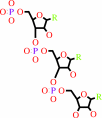 RNA(n)
|
+
|
ribonucleoside 5'-triphosphate
|
=
|
RNA(n+1)
|
+
|
 diphosphate
|
|
|
|
|
|
|
|
|
|
Enzyme class 2:
|
|
E.C.3.4.22.28
- picornain 3C.
|
|
|
|
|
|
|
Reaction:
|
|
Selective cleavage of Gln-|-Gly bond in the poliovirus polyprotein. In other picornavirus reactions Glu may be substituted for Gln, and Ser or Thr for Gly.
|
|
|
|
|
|
Enzyme class 3:
|
|
E.C.3.4.22.46
- L-peptidase.
|
|
|
|
|
|
|
Reaction:
|
|
Autocatalytically cleaves itself from the polyprotein of the foot-and-mouth disease virus by hydrolysis of a Lys-|-Gly bond, but then cleaves host cell initiation factor eIF-4G at bonds -Gly-|-Arg- and -Lys-|-Arg-.
|
|
|
|
|
|
Enzyme class 4:
|
|
E.C.3.6.1.15
- nucleoside-triphosphate phosphatase.
|
|
|
|
|
|
|
Reaction:
|
|
a ribonucleoside 5'-triphosphate + H2O = a ribonucleoside 5'-diphosphate + phosphate + H+
|
|
|
|
|
|
ribonucleoside 5'-triphosphate
|
+
|
H2O
|
=
|
ribonucleoside 5'-diphosphate
|
+
|
 phosphate
|
+
|
H(+)
|
|
|
|
|
|
|
|
|
|
|
|
|
Note, where more than one E.C. class is given (as above), each may
correspond to a different protein domain or, in the case of polyprotein
precursors, to a different mature protein.
|
|
|
|
Molecule diagrams generated from .mol files obtained from the
KEGG ftp site
|
|
|
|
|
|
|
|
|
|
|
|
|
|
 |
|
|
|
|
|
|
| |
|
|
| |
|
|
J Mol Biol
395:375-389
(2010)
|
|
PubMed id:
|
|
|
|
|
|
| |
|
Insights into cleavage specificity from the crystal structure of foot-and-mouth disease virus 3C protease complexed with a peptide substrate.
|
|
P.A.Zunszain,
S.R.Knox,
T.R.Sweeney,
J.Yang,
N.Roqué-Rosell,
G.J.Belsham,
R.J.Leatherbarrow,
S.Curry.
|
|
|
|
|
| |
ABSTRACT
|
|
|
|
| |
|
|
Picornavirus replication is critically dependent on the correct processing of a
polyprotein precursor by 3C protease(s) (3C(pro)) at multiple specific sites
with related but non-identical sequences. To investigate the structural basis of
its cleavage specificity, we performed the first crystallographic structural
analysis of non-covalent complexes of a picornavirus 3C(pro) with peptide
substrates. The X-ray crystal structure of the foot-and-mouth disease virus
3C(pro), mutated to replace the catalytic Cys by Ala and bound to a peptide
(APAKQ|LLNFD) corresponding to the P5-P5' region of the VP1-2A cleavage junction
in the viral polyprotein, was determined up to 2.5 A resolution. Comparison with
free enzyme reveals significant conformational changes in 3C(pro) on substrate
binding that lead to the formation of an extended interface of contact primarily
involving the P4-P2' positions of the peptide. Strikingly, the deep S1'
specificity pocket needed to accommodate P1'-Leu only forms when the peptide
binds. Substrate specificity was investigated using peptide cleavage assays to
show the impact of amino acid substitutions within the P5-P4' region of
synthetic substrates. The structure of the enzyme-peptide complex explains the
marked substrate preferences for particular P4, P2 and P1 residue types, as well
as the relative promiscuity at P3 and on the P' side of the scissile bond.
Furthermore, crystallographic analysis of the complex with a modified VP1-2A
peptide (APAKE|LLNFD) containing a Gln-to-Glu substitution reveals an identical
mode of peptide binding and explains the ability of foot-and-mouth disease virus
3C(pro) to cleave sequences containing either P1-Gln or P1-Glu. Structure-based
mutagenesis was used to probe interactions within the S1' specificity pocket and
to provide direct evidence of the important contribution made by Asp84 of the
Cys-His-Asp catalytic triad to proteolytic activity. Our results provide a new
level of detail in our understanding of the structural basis of polyprotein
cleavage by 3C(pro).
|
|
|
|
|
|
|
|
|
|
|
|
|
|
|
|
|
|
 |
 |
 |
|
Literature references that cite this PDB file's key reference
|
|
|
| |
PubMed id
|
|
Reference
|
|
|
|
|
|
A.Bøtner,
N.K.Kakker,
C.Barbezange,
S.Berryman,
T.Jackson,
and
G.J.Belsham
(2011).
Capsid proteins from field strains of foot-and-mouth disease virus confer a pathogenic phenotype in cattle on an attenuated, cell-culture-adapted virus.
|
| |
J Gen Virol,
92,
1141-1151.
|
|
|
|
|
|
|
S.Cui,
J.Wang,
T.Fan,
B.Qin,
L.Guo,
X.Lei,
J.Wang,
M.Wang,
and
Q.Jin
(2011).
Crystal structure of human enterovirus 71 3C protease.
|
| |
J Mol Biol,
408,
449-461.
|
|
|
PDB code:
|
|
|
|
|
|
|
The most recent references are shown first.
Citation data come partly from CiteXplore and partly
from an automated harvesting procedure. Note that this is likely to be
only a partial list as not all journals are covered by
either method. However, we are continually building up the citation data
so more and more references will be included with time.
Where a reference describes a PDB structure, the PDB
code is
shown on the right.
|
|


 Links
Links


