 |
PDBsum entry 2w8k

|
|
|
|
|
|

|

|

|

|
|

|
|

|
|

|
|

|
|

|
|

|
|

|
|
|
 |

|

|
|
|
|
|
|
|
|
|
|
|
|
|
|
|
|
|
|
|
|
|
|
|
|
|
|
|
|
|
|
|
|
|
|
|
|
Transferase/DNA
|
PDB id
|
|
|
|
2w8k
|
|
|
|
|
|
|
|
|
|
|
|
|
|
|

|

|

|
|
|
|
|
|
|
|
 |
Contents |
 |
|
|
|
|
|
|
|
|
|
|
|
|
|
|
|
|
* Residue conservation analysis
|
|
|
|
|
|
|
|
|
|
|
Enzyme class:
|
|
E.C.2.7.7.7
- DNA-directed Dna polymerase.
|
|
|
|
|
|
|
Reaction:
|
|
DNA(n) + a 2'-deoxyribonucleoside 5'-triphosphate = DNA(n+1) + diphosphate
|
|
|
|
|
|
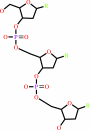 DNA(n)
|
+
|
2'-deoxyribonucleoside 5'-triphosphate
|
=
|
DNA(n+1)
|
+
|
 diphosphate
|
|
|
|
|
|
|
|
|
|
|
|
|
Molecule diagrams generated from .mol files obtained from the
KEGG ftp site
|
|
|
|
|
|
|
|
|
|
|
|
|
|
 |
|
|
|
|
|
|
| |
|
|
| |
|
DOI no:
|
J Biol Chem
284:3563-3576
(2009)
|
|
PubMed id:
|
|
|
|
|
|
| |
|
Versatility of Y-family Sulfolobus solfataricus DNA polymerase Dpo4 in translesion synthesis past bulky N2-alkylguanine adducts.
|
|
H.Zhang,
R.L.Eoff,
I.D.Kozekov,
C.J.Rizzo,
M.Egli,
F.P.Guengerich.
|
|
|
|
|
| |
ABSTRACT
|
|
|
|
| |
|
|
In contrast to replicative DNA polymerases, Sulfolobus solfataricus Dpo4 showed
a limited decrease in catalytic efficiency (k(cat)/Km) for insertion of dCTP
opposite a series of N2-alkylguanine templates of increasing size from (methyl
(Me) to (9-anthracenyl)-Me (Anth)). Fidelity was maintained with increasing size
up to (2-naphthyl)-Me (Naph). The catalytic efficiency increased slightly going
from the N2-NaphG to the N2-AnthG substrate, at the cost of fidelity.
Pre-steady-state kinetic bursts were observed for dCTP incorporation throughout
the series (N2-MeG to N2-AnthG), with a decrease in the burst amplitude and
k(pol), the rate of single-turnover incorporation. The pre-steady-state kinetic
courses with G and all of the six N2-alkyl G adducts could be fit to a general
DNA polymerase scheme to which was added an inactive complex in equilibrium with
the active ternary Dpo4.DNA.dNTP complex, and only the rates of equilibrium with
the inactive complex and phosphodiester bond formation were altered. Two crystal
structures of Dpo4 with a template N2-NaphG (in a post-insertion register
opposite a 3'-terminal C in the primer) were solved. One showed N2-NaphG in a
syn conformation, with the naphthyl group located between the template and the
Dpo4 "little finger" domain. The Hoogsteen face was within hydrogen bonding
distance of the N4 atoms of the cytosine opposite N2-NaphG and the cytosine at
the -2 position. The second structure showed N2-Naph G in an anti conformation
with the primer terminus largely disordered. Collectively these results explain
the versatility of Dpo4 in bypassing bulky G lesions.
|
|
|
|
|
|
| |
Selected figure(s)
|
|
|
|
| |
|
|

|
|

|
|
Figure 7.
Comparison of the Npg-1 and Npg-2 structures. A,
superimposition of the refined Npg-1 (cyan) and Npg-2 (purple)
structures reveals similar overall topology (r.m.s.d. 0.52). B,
the DNA substrates from Npg-1 and Npg-2 were superimposed with
the DNA from the ternary complex of Dpo4 inserting dCTP opposite
8-oxoG (orange, pdb ID code 2c2e). A more pronounced bending of
the helical axis was observed in the N^2-NaphG-modified DNA.
Other perturbations in the N^2-NaphG DNA, e.g. buckling of the
bases and widening of the major groove near the
primer·template junction, are also evident. C, the active
site of the Npg-1 crystal structure is shown in schematic form.
The 3F[o] – 2F[c] electron density map (cyan mesh) is
contoured at the 1σ level around the N^2-NaphG residue. The
incoming dGTP (red) is shown along with the magnesium ions
(green spheres). D, base pairing and stacking interactions
observed in the Npg-1 structure. E, the active site of the Npg-1
crystal structure is shown in schematic form. The 3F[o] –
2F[c] electron density map (purple mesh) is contoured at the 1σ
level around the N^2-NaphG residue. The incoming dGTP (red) is
shown along with the magnesium ions (green spheres). F, base
pairing and stacking interactions observed in the Npg-2
structure.
|
|
Figure 9.
Structural comparison between Dpo4-catalyzed bypass of
N^2-NaphG and human pol κ. A, superimposition of the Npg-1
complex (cyan) and the human pol κ ternary complex (purple; pdb
ID code 2oh2; r.m.s.d. = 5.35). B, the active site DNA residues
from the Npg-1 complex (cyan) are shown along with the
superimposed pol κ structure (purple, space-filling).
Hydrophobic and/or aromatic residues near the naphthyl moiety
are highlighted for both enzymes.
|
|
|
|
|
|
| |
The above figures are
reprinted
by permission from the ASBMB:
J Biol Chem
(2009,
284,
3563-3576)
copyright 2009.
|
|
| |
Figures were
selected
by an automated process.
|
|
|
|
|
|
|
|
|
|
|
|
|
|
|
|
 |
 |
 |
|
Literature references that cite this PDB file's key reference
|
|
|
| |
PubMed id
|
|
Reference
|
|
|
|
|
|
H.Zhang,
and
F.P.Guengerich
(2010).
Effect of N2-guanyl modifications on early steps in catalysis of polymerization by Sulfolobus solfataricus P2 DNA polymerase Dpo4 T239W.
|
| |
J Mol Biol,
395,
1007-1018.
|
|
|
|
|
|
|
J.D.Pata
(2010).
Structural diversity of the Y-family DNA polymerases.
|
| |
Biochim Biophys Acta,
1804,
1124-1135.
|
|
|
|
|
|
|
R.L.Eoff,
J.Y.Choi,
and
F.P.Guengerich
(2010).
Mechanistic Studies with DNA Polymerases Reveal Complex Outcomes following Bypass of DNA Damage.
|
| |
J Nucleic Acids,
2010,
0.
|
|
|
|
|
|
|
A.Valenti,
G.Perugino,
T.Nohmi,
M.Rossi,
and
M.Ciaramella
(2009).
Inhibition of translesion DNA polymerase by archaeal reverse gyrase.
|
| |
Nucleic Acids Res,
37,
4287-4295.
|
|
|
|
|
|
|
H.Zhang,
J.W.Beckman,
and
F.P.Guengerich
(2009).
Frameshift deletion by Sulfolobus solfataricus P2 DNA polymerase Dpo4 T239W is selective for purines and involves normal conformational change followed by slow phosphodiester bond formation.
|
| |
J Biol Chem,
284,
35144-35153.
|
|
|
|
|
|
|
H.Zhang,
R.L.Eoff,
I.D.Kozekov,
C.J.Rizzo,
M.Egli,
and
F.P.Guengerich
(2009).
Structure-function relationships in miscoding by Sulfolobus solfataricus DNA polymerase Dpo4: guanine N2,N2-dimethyl substitution produces inactive and miscoding polymerase complexes.
|
| |
J Biol Chem,
284,
17687-17699.
|
|
|
PDB codes:
|
|
|
|
|
|
|
|
P.Xu,
L.Oum,
Y.C.Lee,
N.E.Geacintov,
and
S.Broyde
(2009).
Visualizing sequence-governed nucleotide selectivities and mutagenic consequences through a replicative cycle: processing of a bulky carcinogen N2-dG lesion in a Y-family DNA polymerase.
|
| |
Biochemistry,
48,
4677-4690.
|
|
|
|
|
|
|
R.L.Eoff,
J.B.Stafford,
J.Szekely,
C.J.Rizzo,
M.Egli,
F.P.Guengerich,
and
L.J.Marnett
(2009).
Structural and functional analysis of Sulfolobus solfataricus Y-family DNA polymerase Dpo4-catalyzed bypass of the malondialdehyde-deoxyguanosine adduct.
|
| |
Biochemistry,
48,
7079-7088.
|
|
|
PDB codes:
|
|
|
|
|
|
|
|
R.L.Eoff,
R.Sanchez-Ponce,
and
F.P.Guengerich
(2009).
Conformational changes during nucleotide selection by Sulfolobus solfataricus DNA polymerase Dpo4.
|
| |
J Biol Chem,
284,
21090-21099.
|
|
|
|
|
|
The most recent references are shown first.
Citation data come partly from CiteXplore and partly
from an automated harvesting procedure. Note that this is likely to be
only a partial list as not all journals are covered by
either method. However, we are continually building up the citation data
so more and more references will be included with time.
Where a reference describes a PDB structure, the PDB
codes are
shown on the right.
|
|


 Links
Links


