 |
PDBsum entry 2fyg

|
|
|
|
|
|

|

|

|

|
|

|
|

|
|

|
|

|
|

|
|
|
 |

|

|
|
|
|
|
|
|
|
|
|
|
|
|
|
|
|
|
|
|
|
|
|
|
|
|
|
|
|
|
|
|
|
|
|
Viral protein
|
PDB id
|
|
|
|
2fyg
|
|
|
|
|
|
|
|
|
|
|
|
|
|
|

|

|

|
|
|
|
|
|
|
|
 |
Contents |
 |
|
|
|
|
|
|
|
|
|
|
|
|
|
|
* Residue conservation analysis
|
|
|
|
|
|
PDB id:
|
|
|
|
| Name: |
|
Viral protein
|
|
|
Title:
|
|
Crystal structure of nsp10 from sars coronavirus
|
|
Structure:
|
|
Replicase polyprotein 1ab. Chain: a. Fragment: residues 4240-4362. Engineered: yes
|
|
Source:
|
|
Sars coronavirus. Organism_taxid: 227859. Strain: tor-2. Gene: orf1ab. Expressed in: escherichia coli. Expression_system_taxid: 562.
|
|
Resolution:
|
|
|
1.80Å
|
R-factor:
|
0.198
|
R-free:
|
0.233
|
|
|
Authors:
|
|
J.S.Joseph,K.S.Saikatendu,V.Subramanian,B.W.Neuman,A.Brooun, M.Griffith,K.Moy,M.K.Yadav,J.Velasquez,M.J.Buchmeier,R.C.Stevens, P.Kuhn
|
|
Key ref:
|
|
J.S.Joseph
et al.
(2006).
Crystal structure of nonstructural protein 10 from the severe acute respiratory syndrome coronavirus reveals a novel fold with two zinc-binding motifs.
J Virol,
80,
7894-7901.
PubMed id:
|
|
|
Date:
|
|
|
07-Feb-06
|
Release date:
|
08-Aug-06
|
|
|
|
|
|
|
PROCHECK
|

|
|
|
|
|
Headers
|
|
|
|
References
|
|
|
|
|
|

|
|
P0C6U8
(R1A_CVHSA) -
Replicase polyprotein 1a from Severe acute respiratory syndrome coronavirus
|
|
|
|
Seq:
Struc:
|
|
|
|
4382 a.a.
128 a.a.*
|
|

|

|

|
|
|
|
|
|
|
|
|
|
|
Key: |
 |
PfamA domain |
|
|
 |
Secondary structure |
|
|
*
PDB and UniProt seqs differ
at 5 residue positions (black
crosses)
|
|
|
|
|
|
|
|
|
|
|
|
|
Enzyme class 1:
|
|
E.C.2.7.7.50
- mRNA guanylyltransferase.
|
|
|
|
|
|
|
Reaction:
|
|
a 5'-end diphospho-ribonucleoside in mRNA + GTP + H+ = a 5'-end (5'-triphosphoguanosine)-ribonucleoside in mRNA + diphosphate
|
|
|
|
|
|
5'-end diphospho-ribonucleoside in mRNA
|
+
|
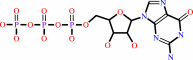 GTP
GTP
|
+
|
H(+)
|
=
|
5'-end (5'-triphosphoguanosine)-ribonucleoside in mRNA
|
+
|
 diphosphate
|
|
|
|
|
|
|
|
|
|
Enzyme class 2:
|
|
E.C.3.4.19.12
- ubiquitinyl hydrolase 1.
|
|
|
|
|
|
|
Reaction:
|
|
Thiol-dependent hydrolysis of ester, thiolester, amide, peptide and isopeptide bonds formed by the C-terminal Gly of ubiquitin (a 76-residue protein attached to proteins as an intracellular targeting signal).
|
|
|
|
|
|
Enzyme class 3:
|
|
E.C.3.4.22.-
- ?????
|
|
|
|
|
|
|
Enzyme class 4:
|
|
E.C.3.4.22.69
- Sars coronavirus main proteinase.
|
|
|
|
|
|
|
|
|
|
Note, where more than one E.C. class is given (as above), each may
correspond to a different protein domain or, in the case of polyprotein
precursors, to a different mature protein.
|
|
|
|
Molecule diagrams generated from .mol files obtained from the
KEGG ftp site
|
|
|
|
|
|
|
|
|
|
|
|
|
|
 |
|
|
|
|
|
|
| |
|
|
| |
|
|
J Virol
80:7894-7901
(2006)
|
|
PubMed id:
|
|
|
|
|
|
| |
|
Crystal structure of nonstructural protein 10 from the severe acute respiratory syndrome coronavirus reveals a novel fold with two zinc-binding motifs.
|
|
J.S.Joseph,
K.S.Saikatendu,
V.Subramanian,
B.W.Neuman,
A.Brooun,
M.Griffith,
K.Moy,
M.K.Yadav,
J.Velasquez,
M.J.Buchmeier,
R.C.Stevens,
P.Kuhn.
|
|
|
|
|
| |
ABSTRACT
|
|
|
|
| |
|
|
The severe acute respiratory syndrome coronavirus (SARS-CoV) possesses a large
29.7-kb positive-stranded RNA genome. The first open reading frame encodes
replicase polyproteins 1a and 1ab, which are cleaved to generate 16
"nonstructural" proteins, nsp1 to nsp16, involved in viral replication and/or
RNA processing. Among these, nsp10 plays a critical role in minus-strand RNA
synthesis in a related coronavirus, murine hepatitis virus. Here, we report the
crystal structure of SARS-CoV nsp10 at a resolution of 1.8 A as determined by
single-wavelength anomalous dispersion using phases derived from hexatantalum
dodecabromide. nsp10 is a single domain protein consisting of a pair of
antiparallel N-terminal helices stacked against an irregular beta-sheet, a
coil-rich C terminus, and two Zn fingers. nsp10 represents a novel fold and is
the first structural representative of this family of Zn finger proteins found
so far exclusively in coronaviruses. The first Zn finger coordinates a Zn2+ ion
in a unique conformation. The second Zn finger, with four cysteines, is a
distant member of the "gag-knuckle fold group" of Zn2+-binding domains and
appears to maintain the structural integrity of the C-terminal tail. A distinct
clustering of basic residues on the protein surface suggests a nucleic
acid-binding function. Gel shift assays indicate that in isolation, nsp10 binds
single- and double-stranded RNA and DNA with high-micromolar affinity and
without obvious sequence specificity. It is possible that nsp10 functions within
a larger RNA-binding protein complex. However, its exact role within the
replicase complex is still not clear.
|
|
|
|
|
|
|
|
|
|
|
|
|
|
|
|
|
|
 |
 |
 |
|
Literature references that cite this PDB file's key reference
|
|
|
| |
PubMed id
|
|
Reference
|
|
|
|
|
|
M.Bouvet,
C.Debarnot,
I.Imbert,
B.Selisko,
E.J.Snijder,
B.Canard,
and
E.Decroly
(2010).
In vitro reconstitution of SARS-coronavirus mRNA cap methylation.
|
| |
PLoS Pathog,
6,
e1000863.
|
|
|
|
|
|
|
M.C.Hagemeijer,
M.H.Verheije,
M.Ulasli,
I.A.Shaltiël,
L.A.de Vries,
F.Reggiori,
P.J.Rottier,
and
C.A.de Haan
(2010).
Dynamics of coronavirus replication-transcription complexes.
|
| |
J Virol,
84,
2134-2149.
|
|
|
|
|
|
|
S.Fang,
H.Shen,
J.Wang,
F.P.Tay,
and
D.X.Liu
(2010).
Functional and genetic studies of the substrate specificity of coronavirus infectious bronchitis virus 3C-like proteinase.
|
| |
J Virol,
84,
7325-7336.
|
|
|
|
|
|
|
S.Perlman,
and
J.Netland
(2009).
Coronaviruses post-SARS: update on replication and pathogenesis.
|
| |
Nat Rev Microbiol,
7,
439-450.
|
|
|
|
|
|
|
Y.Zhou,
W.P.Tzeng,
Y.Ye,
Y.Huang,
S.Li,
Y.Chen,
T.K.Frey,
and
J.J.Yang
(2009).
A cysteine-rich metal-binding domain from rubella virus non-structural protein is essential for viral protease activity and virus replication.
|
| |
Biochem J,
417,
477-483.
|
|
|
|
|
|
|
Z.J.Miknis,
E.F.Donaldson,
T.C.Umland,
R.A.Rimmer,
R.S.Baric,
and
L.W.Schultz
(2009).
Severe acute respiratory syndrome coronavirus nsp9 dimerization is essential for efficient viral growth.
|
| |
J Virol,
83,
3007-3018.
|
|
|
PDB code:
|
|
|
|
|
|
|
|
B.Canard,
J.S.Joseph,
and
P.Kuhn
(2008).
International research networks in viral structural proteomics: again, lessons from SARS.
|
| |
Antiviral Res,
78,
47-50.
|
|
|
|
|
|
|
B.W.Neuman,
J.S.Joseph,
K.S.Saikatendu,
P.Serrano,
A.Chatterjee,
M.A.Johnson,
L.Liao,
J.P.Klaus,
J.R.Yates,
K.Wüthrich,
R.C.Stevens,
M.J.Buchmeier,
and
P.Kuhn
(2008).
Proteomics analysis unravels the functional repertoire of coronavirus nonstructural protein 3.
|
| |
J Virol,
82,
5279-5294.
|
|
|
|
|
|
|
C.Zhang,
O.Crasta,
S.Cammer,
R.Will,
R.Kenyon,
D.Sullivan,
Q.Yu,
W.Sun,
R.Jha,
D.Liu,
T.Xue,
Y.Zhang,
M.Moore,
P.McGarvey,
H.Huang,
Y.Chen,
J.Zhang,
R.Mazumder,
C.Wu,
and
B.Sobral
(2008).
An emerging cyberinfrastructure for biodefense pathogen and pathogen-host data.
|
| |
Nucleic Acids Res,
36,
D884-D891.
|
|
|
|
|
|
|
J.Pan,
X.Peng,
Y.Gao,
Z.Li,
X.Lu,
Y.Chen,
M.Ishaq,
D.Liu,
M.L.Dediego,
L.Enjuanes,
and
D.Guo
(2008).
Genome-wide analysis of protein-protein interactions and involvement of viral proteins in SARS-CoV replication.
|
| |
PLoS ONE,
3,
e3299.
|
|
|
|
|
|
|
M.Bartlam,
X.Xue,
and
Z.Rao
(2008).
The search for a structural basis for therapeutic intervention against the SARS coronavirus.
|
| |
Acta Crystallogr A,
64,
204-213.
|
|
|
|
|
|
|
R.L.Graham,
J.S.Sparks,
L.D.Eckerle,
A.C.Sims,
and
M.R.Denison
(2008).
SARS coronavirus replicase proteins in pathogenesis.
|
| |
Virus Res,
133,
88.
|
|
|
|
|
|
|
R.Züst,
T.B.Miller,
S.J.Goebel,
V.Thiel,
and
P.S.Masters
(2008).
Genetic interactions between an essential 3' cis-acting RNA pseudoknot, replicase gene products, and the extreme 3' end of the mouse coronavirus genome.
|
| |
J Virol,
82,
1214-1228.
|
|
|
|
|
|
|
D.J.Deming,
R.L.Graham,
M.R.Denison,
and
R.S.Baric
(2007).
Processing of open reading frame 1a replicase proteins nsp7 to nsp10 in murine hepatitis virus strain A59 replication.
|
| |
J Virol,
81,
10280-10291.
|
|
|
|
|
|
|
E.F.Donaldson,
A.C.Sims,
R.L.Graham,
M.R.Denison,
and
R.S.Baric
(2007).
Murine hepatitis virus replicase protein nsp10 is a critical regulator of viral RNA synthesis.
|
| |
J Virol,
81,
6356-6368.
|
|
|
|
|
|
|
E.F.Donaldson,
R.L.Graham,
A.C.Sims,
M.R.Denison,
and
R.S.Baric
(2007).
Analysis of murine hepatitis virus strain A59 temperature-sensitive mutant TS-LA6 suggests that nsp10 plays a critical role in polyprotein processing.
|
| |
J Virol,
81,
7086-7098.
|
|
|
|
|
|
|
J.S.Joseph,
K.S.Saikatendu,
V.Subramanian,
B.W.Neuman,
M.J.Buchmeier,
R.C.Stevens,
and
P.Kuhn
(2007).
Crystal structure of a monomeric form of severe acute respiratory syndrome coronavirus endonuclease nsp15 suggests a role for hexamerization as an allosteric switch.
|
| |
J Virol,
81,
6700-6708.
|
|
|
PDB code:
|
|
|
|
|
|
|
|
J.Ziebuhr,
B.Schelle,
N.Karl,
E.Minskaia,
S.Bayer,
S.G.Siddell,
A.E.Gorbalenya,
and
V.Thiel
(2007).
Human coronavirus 229E papain-like proteases have overlapping specificities but distinct functions in viral replication.
|
| |
J Virol,
81,
3922-3932.
|
|
|
|
|
|
|
K.L.Maxwell,
and
L.Frappier
(2007).
Viral proteomics.
|
| |
Microbiol Mol Biol Rev,
71,
398-411.
|
|
|
|
|
|
|
M.Bartlam,
Y.Xu,
and
Z.Rao
(2007).
Structural proteomics of the SARS coronavirus: a model response to emerging infectious diseases.
|
| |
J Struct Funct Genomics,
8,
85-97.
|
|
|
|
|
|
|
M.Oostra,
E.G.te Lintelo,
M.Deijs,
M.H.Verheije,
P.J.Rottier,
and
C.A.de Haan
(2007).
Localization and membrane topology of coronavirus nonstructural protein 4: involvement of the early secretory pathway in replication.
|
| |
J Virol,
81,
12323-12336.
|
|
|
|
|
|
|
M.S.Almeida,
M.A.Johnson,
T.Herrmann,
M.Geralt,
and
K.Wüthrich
(2007).
Novel beta-barrel fold in the nuclear magnetic resonance structure of the replicase nonstructural protein 1 from the severe acute respiratory syndrome coronavirus.
|
| |
J Virol,
81,
3151-3161.
|
|
|
PDB codes:
|
|
|
|
|
|
|
|
S.G.Sawicki,
D.L.Sawicki,
and
S.G.Siddell
(2007).
A contemporary view of coronavirus transcription.
|
| |
J Virol,
81,
20-29.
|
|
|
|
|
|
|
V.C.Cheng,
S.K.Lau,
P.C.Woo,
and
K.Y.Yuen
(2007).
Severe acute respiratory syndrome coronavirus as an agent of emerging and reemerging infection.
|
| |
Clin Microbiol Rev,
20,
660-694.
|
|
|
|
|
|
|
J.R.Mesters,
J.Tan,
and
R.Hilgenfeld
(2006).
Viral enzymes.
|
| |
Curr Opin Struct Biol,
16,
776-786.
|
|
|
|
|
|
The most recent references are shown first.
Citation data come partly from CiteXplore and partly
from an automated harvesting procedure. Note that this is likely to be
only a partial list as not all journals are covered by
either method. However, we are continually building up the citation data
so more and more references will be included with time.
Where a reference describes a PDB structure, the PDB
code is
shown on the right.
|
|


 Links
Links


