 |
PDBsum entry 1vym

|
|
|
|
|
|

|

|

|

|
|

|
|

|
|

|
|

|
|

|
|

|
|
|
 |

|

|
|
|
|
|
|
|
|
|
|
|
|
|
|
|
|
|
|
|
|
|
|
|
|
|
|
|
|
|
|
|
|
|
|
|
DNA binding protein
|
PDB id
|
|
|
|
1vym
|
|
|
|
|
|
|
|
|
|
|
|
|
|
|

|

|

|
|
|
|
|
|
|
|
 |
Contents |
 |
|
|
|
|
|
|
|
|
|
|
* Residue conservation analysis
|
|
|
|
|
|
PDB id:
|
|
|
|
| Name: |
|
DNA binding protein
|
|
|
Title:
|
|
Native human pcna
|
|
Structure:
|
|
Proliferating cell nuclear antigen. Chain: a, b, c. Synonym: pcna, cyclin. Engineered: yes
|
|
Source:
|
|
Homo sapiens. Human. Organism_taxid: 9606. Expressed in: escherichia coli. Expression_system_taxid: 469008.
|
|
Biol. unit:
|
|
Trimer (from PDB file)
|
|
Resolution:
|
|
|
2.30Å
|
R-factor:
|
0.191
|
R-free:
|
0.279
|
|
|
Authors:
|
|
G.Kontopidis,S.Wu,D.Zheleva,P.Taylor,C.Mcinnes,D.Lane,P.Fischer, M.Walkinshaw
|
Key ref:

|
|
G.Kontopidis
et al.
(2005).
Structural and biochemical studies of human proliferating cell nuclear antigen complexes provide a rationale for cyclin association and inhibitor design.
Proc Natl Acad Sci U S A,
102,
1871-1876.
PubMed id:
DOI:

|
|
|
Date:
|
|
|
03-May-04
|
Release date:
|
13-Jan-05
|
|
|
|
|
|
|
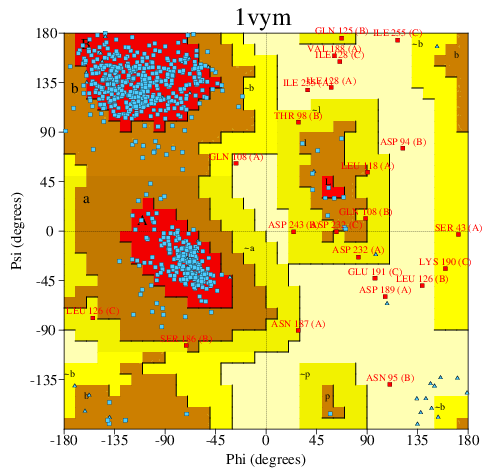
PROCHECK
|
|
|
|
|
|
Headers
|
|
|
|
References
|
|
|
|
|
|

|
|
P12004
(PCNA_HUMAN) -
Proliferating cell nuclear antigen from Homo sapiens
|
|
|
|
Seq:
Struc:
|
|
|
|
261 a.a.
256 a.a.
|
|

|

|
|
|
|
|
|
|
|
|
|
|
|
Key: |
 |
PfamA domain |
|
|
 |
Secondary structure |
|
 |
CATH domain |
|
|
|
|
|
|
|
|
|
|
|
|
|
|
|
|
|
 |
|
|
|
|
|
|
| |
|
DOI no:
|
Proc Natl Acad Sci U S A
102:1871-1876
(2005)
|
|
PubMed id:
|
|
|
|
|
|
| |
|
Structural and biochemical studies of human proliferating cell nuclear antigen complexes provide a rationale for cyclin association and inhibitor design.
|
|
G.Kontopidis,
S.Y.Wu,
D.I.Zheleva,
P.Taylor,
C.McInnes,
D.P.Lane,
P.M.Fischer,
M.D.Walkinshaw.
|
|
|
|
|
| |
ABSTRACT
|
|
|
|
| |
|
|
The interactions between the tumor suppressor protein p21WAF1 and the
cyclin-dependent kinase (CDK) complexes and with proliferating cell nuclear
antigen (PCNA) regulate and coordinate the processes of cell-cycle progression
and DNA replication. We present the x-ray crystal structure of PCNA complexed
with a 16-mer peptide related to p21 that binds with a Kd of 100 nM. Two
additional crystal structures of native PCNA provide previously undescribed
structures of uncomplexed human PCNA and show that significant changes on ligand
binding include rigidification of a number of flexible regions on the surface of
PCNA. In the competitive binding experiments described here, we show that a
20-mer sequence from p21 can be associated simultaneously with PCNA and
CDK/cyclin complexes. A structural model for this quaternary complex is
presented in which the C-terminal sequence of p21 acts like double-sided tape
and docks to both the PCNA and cyclin molecules. The quaternary complex shows
little direct interaction between PCNA and cyclin, giving p21 the role of an
adaptor molecule. Taken together, the biochemical and structural results
delineate a druggable inhibitor site on the surface of PCNA that may be
exploited in the design of peptidomimetics, which will act independently of
cyclin-groove inhibitors.
|
|
|
|
|
|
| |
Selected figure(s)
|
|
|
|
| |
|
|

|
|

|
|
Figure 4.
Fig. 4. Alignment of the PCNA structures in complex with
the p21-derived peptide 139GRKRRQTSMTDFYHSKRRLIFS160 (green)
with PCNA (cyan) (Protein Data Bank ID code 1AXC [PDB]
) and the PL peptide 1SAVLQKKITDYFHPKK16 (orange) with PCNA
(blue). Key interacting residues are labeled. The
phosphorylation site (S146) is highlighted, and the interaction
with D149 (D10) is shown (purple).
|
|
Figure 6.
Fig. 6. Quaternary complex of CDK (green), cyclin (red),
and PCNA (blue). The model was produced by fitting together the
"RRLIF sequences" from the two crystal complexes [PCNA/p21
(Protein Data Bank ID code 1AXC [PDB]
) with the labeled peptide in yellow] and CDK/cyclin/RRLIF
(Protein Data Bank ID code 1OKV [PDB]
) with the peptide colored cyan. The exploded view shows that
the RRLIF conformations in the cyclin A- and PCNA-bound
structures are very similar.
|
|
|
|
| |
Figures were
selected
by an automated process.
|
|
|
|
|
|
|
|
|
|
|
|
|
|
|
|
 |
 |
 |
|
Literature references that cite this PDB file's key reference
|
|
|
| |
PubMed id
|
|
Reference
|
|
|
|
|
|
A.De Biasio,
R.Sánchez,
J.Prieto,
M.Villate,
R.Campos-Olivas,
and
F.J.Blanco
(2011).
Reduced Stability and Increased Dynamics in the Human Proliferating Cell Nuclear Antigen (PCNA) Relative to the Yeast Homolog.
|
| |
PLoS One,
6,
e16600.
|
|
|
|
|
|
|
A.Kawai,
H.Hashimoto,
S.Higuchi,
M.Tsunoda,
M.Sato,
K.T.Nakamura,
and
S.Miyamoto
(2011).
A novel heterotetrameric structure of the crenarchaeal PCNA2-PCNA3 complex.
|
| |
J Struct Biol,
174,
443-450.
|
|
|
PDB codes:
|
|
|
|
|
|
|
|
J.E.Ladner,
M.Pan,
J.Hurwitz,
and
Z.Kelman
(2011).
Crystal structures of two active proliferating cell nuclear antigens (PCNAs) encoded by Thermococcus kodakaraensis.
|
| |
Proc Natl Acad Sci U S A,
108,
2711-2716.
|
|
|
PDB codes:
|
|
|
|
|
|
|
|
C.Ludwig,
M.A.Wear,
and
M.D.Walkinshaw
(2010).
Streamlined, automated protocols for the production of milligram quantities of untagged recombinant human cyclophilin-A (hCypA) and untagged human proliferating cell nuclear antigen (hPCNA) using AKTAxpress.
|
| |
Protein Expr Purif,
71,
54-61.
|
|
|
|
|
|
|
F.W.Cheung,
C.T.Che,
H.Sakagami,
M.Kochi,
and
W.K.Liu
(2010).
Sodium 5,6-benzylidene-L-ascorbate induces oxidative stress, autophagy, and growth arrest in human colon cancer HT-29 cells.
|
| |
J Cell Biochem,
111,
412-424.
|
|
|
|
|
|
|
G.Huang,
G.Li,
H.Chen,
Y.He,
Q.Yao,
and
K.Chen
(2010).
Proteomic analysis of 3T3-L1 preadipocytes having a higher cell proliferation rate after treatment with low-molecular-weight silk fibroin peptides.
|
| |
Cell Prolif,
43,
515-527.
|
|
|
|
|
|
|
M.M.Maslon,
and
T.R.Hupp
(2010).
Drug discovery and mutant p53.
|
| |
Trends Cell Biol,
20,
542-555.
|
|
|
|
|
|
|
R.R.Iyer,
A.Pluciennik,
J.Genschel,
M.S.Tsai,
L.S.Beese,
and
P.Modrich
(2010).
MutLalpha and proliferating cell nuclear antigen share binding sites on MutSbeta.
|
| |
J Biol Chem,
285,
11730-11739.
|
|
|
|
|
|
|
A.Hishiki,
H.Hashimoto,
T.Hanafusa,
K.Kamei,
E.Ohashi,
T.Shimizu,
H.Ohmori,
and
M.Sato
(2009).
Structural basis for novel interactions between human translesion synthesis polymerases and proliferating cell nuclear antigen.
|
| |
J Biol Chem,
284,
10552-10560.
|
|
|
PDB codes:
|
|
|
|
|
|
|
|
B.Rubis,
M.Kaczmarek,
N.Szymanowska,
E.Galezowska,
A.Czyrski,
B.Juskowiak,
T.Hermann,
and
M.Rybczynska
(2009).
The biological activity of G-quadruplex DNA binding papaverine-derived ligand in breast cancer cells.
|
| |
Invest New Drugs,
27,
289-296.
|
|
|
|
|
|
|
E.Morgunova,
F.C.Gray,
S.A.Macneill,
and
R.Ladenstein
(2009).
Structural insights into the adaptation of proliferating cell nuclear antigen (PCNA) from Haloferax volcanii to a high-salt environment.
|
| |
Acta Crystallogr D Biol Crystallogr,
65,
1081-1088.
|
|
|
PDB code:
|
|
|
|
|
|
|
|
J.A.Winter,
P.Christofi,
S.Morroll,
and
K.A.Bunting
(2009).
The crystal structure of Haloferax volcanii proliferating cell nuclear antigen reveals unique surface charge characteristics due to halophilic adaptation.
|
| |
BMC Struct Biol,
9,
55.
|
|
|
PDB code:
|
|
|
|
|
|
|
|
A.Hishiki,
T.Shimizu,
A.Serizawa,
H.Ohmori,
M.Sato,
and
H.Hashimoto
(2008).
Crystallographic study of G178S mutant of human proliferating cell nuclear antigen.
|
| |
Acta Crystallogr Sect F Struct Biol Cryst Commun,
64,
819-821.
|
|
|
|
|
|
|
A.Hishiki,
T.Shimizu,
T.Hanafusa,
H.Ohmori,
M.Sato,
and
H.Hashimoto
(2008).
Initial crystallographic study of human PCNA in complex with a peptide containing the noncanonical PIP-box sequence of human DNA polymerase iota.
|
| |
Acta Crystallogr Sect F Struct Biol Cryst Commun,
64,
954-956.
|
|
|
|
|
|
|
R.R.Iyer,
T.J.Pohlhaus,
S.Chen,
G.L.Hura,
L.Dzantiev,
L.S.Beese,
and
P.Modrich
(2008).
The MutSalpha-proliferating cell nuclear antigen interaction in human DNA mismatch repair.
|
| |
J Biol Chem,
283,
13310-13319.
|
|
|
|
|
|
|
V.Hlinkova,
G.Xing,
J.Bauer,
Y.J.Shin,
I.Dionne,
K.R.Rajashankar,
S.D.Bell,
and
H.Ling
(2008).
Structures of monomeric, dimeric and trimeric PCNA: PCNA-ring assembly and opening.
|
| |
Acta Crystallogr D Biol Crystallogr,
64,
941-949.
|
|
|
PDB codes:
|
|
|
|
|
|
|
|
C.D.Putnam,
M.Hammel,
G.L.Hura,
and
J.A.Tainer
(2007).
X-ray solution scattering (SAXS) combined with crystallography and computation: defining accurate macromolecular structures, conformations and assemblies in solution.
|
| |
Q Rev Biophys,
40,
191-285.
|
|
|
|
|
|
|
L.M.Kauri,
G.S.Wang,
C.Patrick,
M.Bareggi,
D.J.Hill,
and
F.W.Scott
(2007).
Increased islet neogenesis without increased islet mass precedes autoimmune attack in diabetes-prone rats.
|
| |
Lab Invest,
87,
1240-1251.
|
|
|
|
|
|
|
S.S.Shell,
C.D.Putnam,
and
R.D.Kolodner
(2007).
The N terminus of Saccharomyces cerevisiae Msh6 is an unstructured tether to PCNA.
|
| |
Mol Cell,
26,
565-578.
|
|
|
|
|
|
|
A.S.Doré,
M.L.Kilkenny,
S.A.Jones,
A.W.Oliver,
S.M.Roe,
S.D.Bell,
and
L.H.Pearl
(2006).
Structure of an archaeal PCNA1-PCNA2-FEN1 complex: elucidating PCNA subunit and client enzyme specificity.
|
| |
Nucleic Acids Res,
34,
4515-4526.
|
|
|
PDB code:
|
|
|
|
|
|
|
|
C.Raynaud,
R.Sozzani,
N.Glab,
S.Domenichini,
C.Perennes,
R.Cella,
E.Kondorosi,
and
C.Bergounioux
(2006).
Two cell-cycle regulated SET-domain proteins interact with proliferating cell nuclear antigen (PCNA) in Arabidopsis.
|
| |
Plant J,
47,
395-407.
|
|
|
|
|
|
|
E.Warbrick
(2006).
A functional analysis of PCNA-binding peptides derived from protein sequence, interaction screening and rational design.
|
| |
Oncogene,
25,
2850-2859.
|
|
|
|
|
|
|
G.J.Williams,
K.Johnson,
J.Rudolf,
S.A.McMahon,
L.Carter,
M.Oke,
H.Liu,
G.L.Taylor,
M.F.White,
and
J.H.Naismith
(2006).
Structure of the heterotrimeric PCNA from Sulfolobus solfataricus.
|
| |
Acta Crystallogr Sect F Struct Biol Cryst Commun,
62,
944-948.
|
|
|
PDB code:
|
|
|
|
|
|
|
The most recent references are shown first.
Citation data come partly from CiteXplore and partly
from an automated harvesting procedure. Note that this is likely to be
only a partial list as not all journals are covered by
either method. However, we are continually building up the citation data
so more and more references will be included with time.
Where a reference describes a PDB structure, the PDB
codes are
shown on the right.
|
|


 Links
Links


