 |
PDBsum entry 2io4

|
|
|
|
|
|

|

|

|

|
|

|
|

|
|

|
|

|
|

|
|

|
|

|
|
|
 |

|

|
|
|
|
|
|
|
|
|
|
|
|
|
|
|
|
|
|
|
|
|
|
|
|
|
|
|
|
|
|
|
|
|
|
|
|
DNA binding protein
|
PDB id
|
|
|
|
2io4
|
|
|
|
|
|
|
|
|
|
|
|
|
|
|

|

|

|
|
|
|
|
|
|
|
 |
Contents |
 |
|
|
|
|
|
|
|
|
|
|
|
|
|
|
* Residue conservation analysis
|
|
|
|
|
|
PDB id:
|
|
|
|
| Name: |
|
DNA binding protein
|
|
|
Title:
|
|
Crystal structure of pcna12 dimer from sulfolobus solfataricus.
|
|
Structure:
|
|
DNA polymerase sliding clamp b. Chain: a, c. Synonym: proliferating cell nuclear antigen homolog b, pcna b. Engineered: yes. Mutation: yes. DNA polymerase sliding clamp c. Chain: b, d. Synonym: proliferating cell nuclear antigen homolog c, pcna c. Engineered: yes
|
|
Source:
|
|
Sulfolobus solfataricus. Organism_taxid: 273057. Strain: p2. Gene: pcnb, pcna-2. Expressed in: escherichia coli bl21(de3). Expression_system_taxid: 469008. Gene: pcnc, pcna-2.
|
|
Resolution:
|
|
|
2.60Å
|
R-factor:
|
0.234
|
R-free:
|
0.260
|
|
|
Authors:
|
|
V.Hlinkova,H.Ling
|
Key ref:

|
|
V.Hlinkova
et al.
(2008).
Structures of monomeric, dimeric and trimeric PCNA: PCNA-ring assembly and opening.
Acta Crystallogr D Biol Crystallogr,
64,
941-949.
PubMed id:
DOI:

|
|
|
Date:
|
|
|
09-Oct-06
|
Release date:
|
08-Apr-08
|
|
|
|
|
|
|
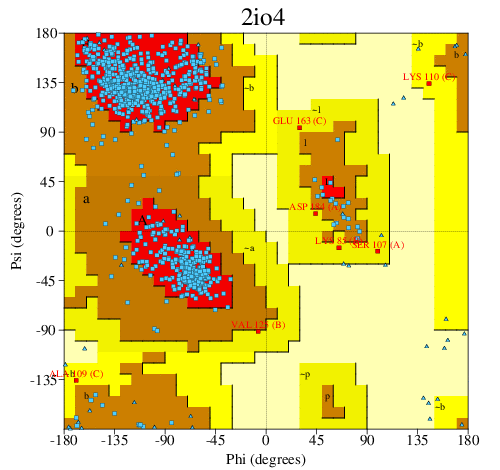
PROCHECK
|
|
|
|
|
|
Headers
|
|
|
|
References
|
|
|
|
|
|
|
|
|
|
|
|
Enzyme class:
|
|
Chains A, B, C, D:
E.C.?
|
|
|
|
|
|
|
|
|
|
|
|
|
|
|
|
|
|
|
 |
|
|
|
|
|
|
| |
|
DOI no:
|
Acta Crystallogr D Biol Crystallogr
64:941-949
(2008)
|
|
PubMed id:
|
|
|
|
|
|
| |
|
Structures of monomeric, dimeric and trimeric PCNA: PCNA-ring assembly and opening.
|
|
V.Hlinkova,
G.Xing,
J.Bauer,
Y.J.Shin,
I.Dionne,
K.R.Rajashankar,
S.D.Bell,
H.Ling.
|
|
|
|
|
| |
ABSTRACT
|
|
|
|
| |
|
|
DNA sliding clamps form an oligomeric ring encircling DNA and serve as a moving
platform for DNA-processing proteins. The opening and closing of a sliding-clamp
ring is essential to load the clamp onto DNA in order to perform its functions.
The molecular details of how clamp rings open and enclose DNA are still not
clear. Three PCNA homologues have been found in Sulfolobus solfataricus which
form a heterotrimer. Taking advantage of their hetero-oligomeric nature, the
structures of the PCNAs in monomeric PCNA3, dimeric PCNA1-PCNA2 and trimeric
PCNA1-PCNA2-PCNA3 forms were determined at resolutions of 2.6-1.9 A. The
distinct oligomeric structures represent different stages in ring formation,
which were verified in solution by ultracentrifugation analysis. The heterodimer
opens in a V-shape of 130 degrees , while the heterotrimers form a ring with a
120 degrees rotation between monomers. The association of a rigid PCNA3 monomer
with an opened PCNA1-PCNA2 heterodimer closes the ring and introduces a spring
tension in the PCNA1-PCNA2 interface, thus bending the nine-stranded
intermolecular beta-sheet to fit the 120 degrees rotation. The release of the
spring tension as PCNA3 dissociates from the ring may facilitate ring opening.
The structural features in different assemblies present a molecular model for
clamp ring assembly and opening.
|
|
|
|
|
|
| |
Selected figure(s)
|
|
|
|
| |
|
|

|
|

|
|
Figure 4.
Figure 4 The three distinct ligand-binding sites of the PCNA123
trimer. The front face of the trimeric ring is shown as an
electrostatic charged surface with the C-terminal fragment of
Pol IV modeled in the three distinct ligand-binding sites. The
binding sites are mapped by ribbon-styled C-termini with the
side chains as white mesh surfaces. The modeling was performed
by superposing the PCNA123 trimer with the  -clamp-PolIV-LF
complex (PDB code 1ok7 ; Bunting et al., 2003[Bunting, K. A.,
Roe, S. M. & Pearl, L. H. (2003). EMBO J. 22, 5883-5892.]). -clamp-PolIV-LF
complex (PDB code 1ok7 ; Bunting et al., 2003[Bunting, K. A.,
Roe, S. M. & Pearl, L. H. (2003). EMBO J. 22, 5883-5892.]).
|
|
Figure 7.
Figure 7 Assembly and opening of the PCNA123 ring. (a) PCNA12
dimer and PCNA3 monomer approaching each other during ring
assembly. (b) The ring of the PCNA123 trimer. (c) PCNA12 dimer
with PCNA3 modeled in contact with PCNA2 with an angle of
120° as in the trimer. A gap (6-7 Å) remains in the
ring-shaped molecule as the angle between PCNA1 and PCNA2 is
130° instead of 120°.
|
|
|
|
|
|
| |
The above figures are
reprinted
by permission from the IUCr:
Acta Crystallogr D Biol Crystallogr
(2008,
64,
941-949)
copyright 2008.
|
|
| |
Figures were
selected
by an automated process.
|
|
|
|
|
|
|
|
|
|
|
|
|
|
|
|
 |
 |
 |
|
Literature references that cite this PDB file's key reference
|
|
|
| |
PubMed id
|
|
Reference
|
|
|
|
|
|
A.De Biasio,
R.Sánchez,
J.Prieto,
M.Villate,
R.Campos-Olivas,
and
F.J.Blanco
(2011).
Reduced Stability and Increased Dynamics in the Human Proliferating Cell Nuclear Antigen (PCNA) Relative to the Yeast Homolog.
|
| |
PLoS One,
6,
e16600.
|
|
|
|
|
|
|
A.Kawai,
H.Hashimoto,
S.Higuchi,
M.Tsunoda,
M.Sato,
K.T.Nakamura,
and
S.Miyamoto
(2011).
A novel heterotetrameric structure of the crenarchaeal PCNA2-PCNA3 complex.
|
| |
J Struct Biol,
174,
443-450.
|
|
|
PDB codes:
|
|
|
|
|
|
|
|
S.A.MacNeill
(2011).
Protein-protein interactions in the archaeal core replisome.
|
| |
Biochem Soc Trans,
39,
163-168.
|
|
|
|
|
|
|
H.Hirakawa,
and
T.Nagamune
(2010).
Molecular assembly of P450 with ferredoxin and ferredoxin reductase by fusion to PCNA.
|
| |
Chembiochem,
11,
1517-1520.
|
|
|
|
|
|
|
Z.Zhuang,
and
Y.Ai
(2010).
Processivity factor of DNA polymerase and its expanding role in normal and translesion DNA synthesis.
|
| |
Biochim Biophys Acta,
1804,
1081-1093.
|
|
|
|
|
|
The most recent references are shown first.
Citation data come partly from CiteXplore and partly
from an automated harvesting procedure. Note that this is likely to be
only a partial list as not all journals are covered by
either method. However, we are continually building up the citation data
so more and more references will be included with time.
Where a reference describes a PDB structure, the PDB
codes are
shown on the right.
|
|
|


 Links
Links


