
|
|
|
|
|
 |
Contents |
 |
|
|
|
|
|
|
|
|
|
|
|
|
|
|
* Residue conservation analysis
|
|
|
|
|
|
PDB id:
|
|
|
|
| Name: |
|
Hydrolase
|
|
|
Title:
|
|
Factor xa in complex with the inhibitor 1-[6-methyl-4,5,6,7- tetrahydrothiazolo(5,4-c)pyridin-2-yl] carbonyl-2-carbamoyl-4-(6- chloronaphth-2-ylsulphonyl)piperazine
|
|
Structure:
|
|
Coagulation factor x, heavy chain. Chain: a. Fragment: residues 16-243. Synonym: factor xa heavy chain, activated factor xa heavy chain. Coagulation factor x, light chain. Chain: b. Fragment: residues 87-138. Synonym: factor xa light chain. Ec: 3.4.21.6
|
|
Source:
|
|
Homo sapiens. Human. Organism_taxid: 9606. Other_details: proteolytic cleavage product
|
|
Biol. unit:
|
|
Dimer (from
)
|
|
Resolution:
|
|
|
2.20Å
|
R-factor:
|
0.194
|
R-free:
|
0.233
|
|
|
Authors:
|
|
M.Suzuki
|
|
Key ref:
|
|
N.Haginoya
et al.
(2004).
Synthesis and conformational analysis of a non-amidine factor Xa inhibitor that incorporates 5-methyl-4,5,6,7-tetrahydrothiazolo[5,4-c]pyridine as S4 binding element.
J Med Chem,
47,
5167-5182.
PubMed id:
DOI:
|
|
|
Date:
|
|
|
07-Nov-03
|
Release date:
|
07-Nov-04
|
|
|
|
|
|
|
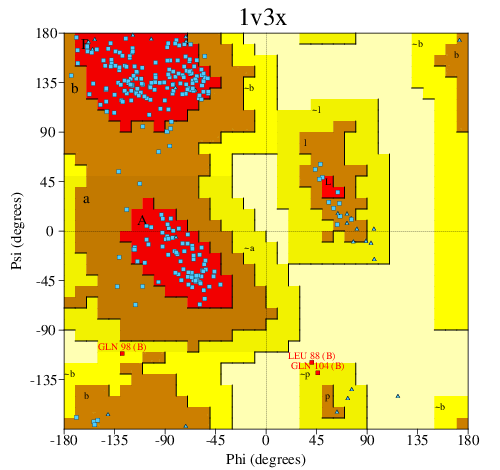
PROCHECK
|
|
|
|
|
|
Headers
|
|
|
|
References
|
|
|
|
|
|
|
|
|
|
|
|
Enzyme class:
|
|
Chains A, B:
E.C.3.4.21.6
- coagulation factor Xa.
|
|
|
|
|
|
|
Reaction:
|
|
Preferential cleavage: Arg-|-Thr and then Arg-|-Ile bonds in prothrombin to form thrombin.
|
|
|
|
|
|
|
|
|
|
|
|
|
|
|
|
|
|
 |
|
|
|
|
|
|
| |
|
DOI no:
|
J Med Chem
47:5167-5182
(2004)
|
|
PubMed id:
|
|
|
|
|
|
| |
|
Synthesis and conformational analysis of a non-amidine factor Xa inhibitor that incorporates 5-methyl-4,5,6,7-tetrahydrothiazolo[5,4-c]pyridine as S4 binding element.
|
|
N.Haginoya,
S.Kobayashi,
S.Komoriya,
T.Yoshino,
M.Suzuki,
T.Shimada,
K.Watanabe,
Y.Hirokawa,
T.Furugori,
T.Nagahara.
|
|
|
|
|
| |
ABSTRACT
|
|
|
|
| |
|
|
Our exploratory study was based on the concept that a non-amidine factor Xa
(fXa) inhibitor is suitable for an orally available anticoagulant. We
synthesized and evaluated a series of
N-(6-chloronaphthalen-2-yl)sulfonylpiperazine derivatives incorporating various
fused-bicyclic rings containing an aliphatic amine expected to be S4 binding
element. Among this series, 5-methyl-4,5,6,7-tetrahydrothiazolo[5,4-c]pyridine
type 61 displayed orally potent anti-fXa activity and evident prolongation of
prothrombin time (PT) with the moderate bioavailability in rats. The X-ray
crystal analysis afforded an obvious binding mode that
5-methyl-4,5,6,7-tetrahydrothiazolo[5,4-c]pyridine and 6-chloronaphthalene
respectively bound to S4 and S1 subsites. In this X-ray study, we discovered a
novel intramolecular S-O close contact. Ab initio energy calculations of model
compounds deduced that conformers with the most close S-O proximity were most
stable. The Mulliken population analysis proposed that this energy profile was
caused by both of electrostatic S-O affinity and N-O repulsion. The results of
these calculations and X-ray analysis suggested a possibility that the
restricted conformation effected the affinity to S4 subsite of fXa.
|
|
|
|
|
|
|
|
|
|
|
|
|
|
|
|
|
|
 |
 |
 |
|
Literature references that cite this PDB file's key reference
|
|
|
| |
PubMed id
|
|
Reference
|
|
|
|
|
|
Y.K.Lee,
and
M.R.Player
(2011).
Developments in factor Xa inhibitors for the treatment of thromboembolic disorders.
|
| |
Med Res Rev,
31,
202-283.
|
|
|
|
|
|
|
A.Hazra,
A.Chatterjee,
and
T.P.Begley
(2009).
Biosynthesis of the thiamin thiazole in Bacillus subtilis: identification of the product of the thiazole synthase-catalyzed reaction.
|
| |
J Am Chem Soc,
131,
3225-3229.
|
|
|
|
|
|
|
N.Singh,
and
J.M.Briggs
(2008).
Molecular dynamics simulations of Factor Xa: insight into conformational transition of its binding subsites.
|
| |
Biopolymers,
89,
1104-1113.
|
|
|
|
|
|
|
R.Abel,
T.Young,
R.Farid,
B.J.Berne,
and
R.A.Friesner
(2008).
Role of the active-site solvent in the thermodynamics of factor Xa ligand binding.
|
| |
J Am Chem Soc,
130,
2817-2831.
|
|
|
|
|
|
|
Y.Imaeda,
T.Miyawaki,
H.Sakamoto,
F.Itoh,
N.Konishi,
K.Hiroe,
M.Kawamura,
T.Tanaka,
and
K.Kubo
(2008).
Discovery of sulfonylalkylamides: A new class of orally active factor Xa inhibitors.
|
| |
Bioorg Med Chem,
16,
2243-2260.
|
|
|
|
|
|
|
R.Fasan,
R.L.Dias,
K.Moehle,
O.Zerbe,
D.Obrecht,
P.R.Mittl,
M.G.Grütter,
and
J.A.Robinson
(2006).
Structure-activity studies in a family of beta-hairpin protein epitope mimetic inhibitors of the p53-HDM2 protein-protein interaction.
|
| |
Chembiochem,
7,
515-526.
|
|
|
PDB code:
|
|
|
|
|
|
|
|
S.Komoriya,
N.Haginoya,
S.Kobayashi,
T.Nagata,
A.Mochizuki,
M.Suzuki,
T.Yoshino,
H.Horino,
T.Nagahara,
M.Suzuki,
Y.Isobe,
and
T.Furugoori
(2005).
Design, synthesis, and biological activity of non-basic compounds as factor Xa inhibitors: SAR study of S1 and aryl binding sites.
|
| |
Bioorg Med Chem,
13,
3927-3954.
|
|
|
PDB codes:
|
|
|
|
|
|
|
The most recent references are shown first.
Citation data come partly from CiteXplore and partly
from an automated harvesting procedure. Note that this is likely to be
only a partial list as not all journals are covered by
either method. However, we are continually building up the citation data
so more and more references will be included with time.
Where a reference describes a PDB structure, the PDB
code is
shown on the right.
|
 |


 Links
Links


