 |
PDBsum entry 1v25

|
|
|
|
|
 |
Contents |
 |
|
|
|
|
|
|
|
|
|
|
|
|
|
|
* Residue conservation analysis
|
|
|
|
|
|
PDB id:
|
|
|
|
| Name: |
|
Ligase
|
|
|
Title:
|
|
Crystal structure of tt0168 from thermus thermophilus hb8
|
|
Structure:
|
|
Long-chain-fatty-acid-coa synthetase. Chain: a, b. Engineered: yes
|
|
Source:
|
|
Thermus thermophilus. Organism_taxid: 274. Expressed in: escherichia coli. Expression_system_taxid: 562.
|
|
Biol. unit:
|
|
Dimer (from
)
|
|
Resolution:
|
|
|
2.30Å
|
R-factor:
|
0.208
|
R-free:
|
0.240
|
|
|
Authors:
|
|
Y.Hisanaga,H.Ago,T.Nakatsu,K.Hamada,K.Ida,H.Kanda,M.Yamamoto,T.Hori, Y.Arii,M.Sugahara,S.Kuramitsu,S.Yokoyama,M.Miyano,Riken Structural Genomics/proteomics Initiative (Rsgi)
|
Key ref:

|
|
Y.Hisanaga
et al.
(2004).
Structural basis of the substrate-specific two-step catalysis of long chain fatty acyl-CoA synthetase dimer.
J Biol Chem,
279,
31717-31726.
PubMed id:
DOI:

|
|
|
Date:
|
|
|
07-Oct-03
|
Release date:
|
27-Jul-04
|
|
|
|
|
|
|
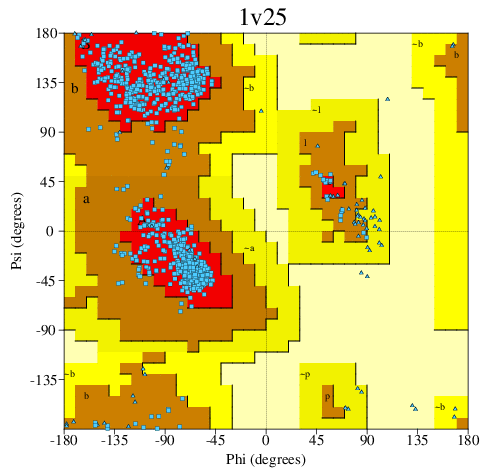
PROCHECK
|
|
|
|
|
|
Headers
|
|
|
|
References
|
|
|
|
|
|

|
|
Q5SKN9
(LCFCS_THET8) -
Long-chain-fatty-acid--CoA ligase from Thermus thermophilus (strain ATCC 27634 / DSM 579 / HB8)
|
|
|
|
Seq:
Struc:
|
|
|
|
541 a.a.
491 a.a.
|
|

|

|
|
|
|
|
|
|
|
|
|
|
|
Key: |
 |
PfamA domain |
|
|
 |
Secondary structure |
|
 |
CATH domain |
|
|
|
|
|
|
|
|
|
|
|
|
|
Enzyme class:
|
|
E.C.6.2.1.3
- long-chain-fatty-acid--CoA ligase.
|
|
|
|
|
|
|
Reaction:
|
|
a long-chain fatty acid + ATP + CoA = a long-chain fatty acyl-CoA + AMP + diphosphate
|
|
|
|
|
|
 long-chain fatty acid
|
+
|
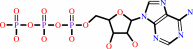 ATP
ATP
|
+
|
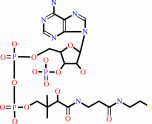 CoA
CoA
|
=
|
long-chain fatty acyl-CoA
|
+
|
AMP
Bound ligand (Het Group name = )
matches with 74.19% similarity
|
+
|
 diphosphate
|
|
|
|
|
|
|
|
|
|
|
|
|
Molecule diagrams generated from .mol files obtained from the
KEGG ftp site
|
|
|
|
|
|
|
|
|
|
|
|
|
|
 |
|
|
|
|
|
|
| |
|
|
| |
|
DOI no:
|
J Biol Chem
279:31717-31726
(2004)
|
|
PubMed id:
|
|
|
|
|
|
| |
|
Structural basis of the substrate-specific two-step catalysis of long chain fatty acyl-CoA synthetase dimer.
|
|
Y.Hisanaga,
H.Ago,
N.Nakagawa,
K.Hamada,
K.Ida,
M.Yamamoto,
T.Hori,
Y.Arii,
M.Sugahara,
S.Kuramitsu,
S.Yokoyama,
M.Miyano.
|
|
|
|
|
| |
ABSTRACT
|
|
|
|
| |
|
|
Long chain fatty acyl-CoA synthetases are responsible for fatty acid degradation
as well as physiological regulation of cellular functions via the production of
long chain fatty acyl-CoA esters. We report the first crystal structures of long
chain fatty acyl-CoA synthetase homodimer (LC-FACS) from Thermus thermophilus
HB8 (ttLC-FACS), including complexes with the ATP analogue adenosine
5'-(beta,gamma-imido) triphosphate (AMP-PNP) and myristoyl-AMP. ttLC-FACS is a
member of the adenylate forming enzyme superfamily that catalyzes the
ATP-dependent acylation of fatty acid in a two-step reaction. The first reaction
step was shown to propagate in AMP-PNP complex crystals soaked with myristate
solution. Myristoyl-AMP was identified as the intermediate. The AMP-PNP and the
myristoyl-AMP complex structures show an identical closed conformation of the
small C-terminal domains, whereas the uncomplexed form shows a variety of open
conformations. Upon ATP binding, the fatty acid-binding tunnel gated by an
aromatic residue opens to the ATP-binding site. The gated fatty acid-binding
tunnel appears only to allow one-way movement of the fatty acid during overall
catalysis. The protein incorporates a hydrophobic branch from the fatty
acid-binding tunnel that is responsible for substrate specificity. Based on
these high resolution crystal structures, we propose a unidirectional Bi Uni Uni
Bi Ping-Pong mechanism for the two-step acylation by ttLC-FACS.
|
|
|
|
|
|
| |
Selected figure(s)
|
|
|
|
| |
|
|

|
|

|
|
Figure 3.
FIG. 3. ttLC-FACS crystal structure. Ribbon representations
of the ttLC-FACS dimer are shown (A). In the panel, the
secondary structure of the C-terminal domain is colored in
green. In the N-terminal domain,  -helix and -helix and  -sheet
are colored in cyan and red, respectively, with the N-terminal
domain-swapping peptide colored in yellow. The electrostatic
potential surface map of ttLC-FACS dimer in the same orientation
as the representation in A. Red represents negatively charged
regions, and blue represents positively charged regions (B).
Close-up view of the N-terminal peptide involved in domain
swapping in the reverse orientation view to A (C). Residues with
carbons colored in pink against a cyan surface of one monomer
interacts with the concave surface of the other monomer colored
in yellow. There are salt bridges at the domain swapping region.
The monomer of ttLC-FACS with each secondary structure feature
is labeled according to the scheme given in Fig. 2A (D). -sheet
are colored in cyan and red, respectively, with the N-terminal
domain-swapping peptide colored in yellow. The electrostatic
potential surface map of ttLC-FACS dimer in the same orientation
as the representation in A. Red represents negatively charged
regions, and blue represents positively charged regions (B).
Close-up view of the N-terminal peptide involved in domain
swapping in the reverse orientation view to A (C). Residues with
carbons colored in pink against a cyan surface of one monomer
interacts with the concave surface of the other monomer colored
in yellow. There are salt bridges at the domain swapping region.
The monomer of ttLC-FACS with each secondary structure feature
is labeled according to the scheme given in Fig. 2A (D).
|
|
Figure 6.
FIG. 6. Superimposed structures of the vicinity of linker
peptides and bound adenylates in adenylate forming enzyme
complexes in stereo. The adenylate complexed enzymes of the
known structures, DhbE (Protein Data Bank code 1mdb [PDB]
) (30), PheA (Protein Data Bank code 1amu [PDB]
) (29), SC-FACS (Protein Data Bank code 1pg3 [PDB]
) (31), and ttLC-FACS (this work) are superimposed around each
bound adenosine moiety. The backbone of the linker region
(Lys431-Asp-Arg-Leu-Lys-Asp-Leu437) including the L motif in
ttLC-FACS complex structure and the corresponding peptides are
presented as wire models (ttLC-FACS, thick violet; SC-FACS, red
violet; DhbE, blue; PheA, light green). The bound myristoyl-AMP
in the ttLC-FACS is represented as by thick green sticks, and
other bound adenylates each shown in thin colored sticks. Arg433
and Lys439 of ttLC-FACS and the corresponding residues are also
shown.
|
|
|
|
|
|
| |
The above figures are
reprinted
by permission from the ASBMB:
J Biol Chem
(2004,
279,
31717-31726)
copyright 2004.
|
|
| |
Figures were
selected
by the author.
|
|
|
|
|
|
|
|
|
|
|
|
|
|
|
|
 |
 |
 |
|
Literature references that cite this PDB file's key reference
|
|
|
| |
PubMed id
|
|
Reference
|
|
|
|
|
|
A.J.Hughes,
and
A.Keatinge-Clay
(2011).
Enzymatic extender unit generation for in vitro polyketide synthase reactions: structural and functional showcasing of Streptomyces coelicolor MatB.
|
| |
Chem Biol,
18,
165-176.
|
|
|
PDB codes:
|
|
|
|
|
|
|
|
N.Jatana,
S.Jangid,
G.Khare,
A.K.Tyagi,
and
N.Latha
(2011).
Molecular modeling studies of Fatty acyl-CoA synthetase (FadD13) from Mycobacterium tuberculosis-a potential target for the development of antitubercular drugs.
|
| |
J Mol Model,
17,
301-313.
|
|
|
|
|
|
|
A.K.Bera,
V.Atanasova,
S.Gamage,
H.Robinson,
and
J.F.Parsons
(2010).
Structure of the D-alanylgriseoluteic acid biosynthetic protein EhpF, an atypical member of the ANL superfamily of adenylating enzymes.
|
| |
Acta Crystallogr D Biol Crystallogr,
66,
664-672.
|
|
|
PDB code:
|
|
|
|
|
|
|
|
D.Kato,
H.Yoshida,
M.Takeo,
S.Negoro,
and
H.Ohta
(2010).
Purification and gene cloning of an enantioselective thioesterification enzyme from Brevibacterium ketoglutamicum KU1073, a deracemization bacterium of 2-(4-chlorophenoxy)propanoic acid.
|
| |
Biosci Biotechnol Biochem,
74,
2405-2412.
|
|
|
|
|
|
|
E.Soupene,
N.P.Dinh,
M.Siliakus,
and
F.A.Kuypers
(2010).
Activity of the acyl-CoA synthetase ACSL6 isoforms: role of the fatty acid Gate-domains.
|
| |
BMC Biochem,
11,
18.
|
|
|
|
|
|
|
J.Hedlund,
H.Jörnvall,
and
B.Persson
(2010).
Subdivision of the MDR superfamily of medium-chain dehydrogenases/reductases through iterative hidden Markov model refinement.
|
| |
BMC Bioinformatics,
11,
534.
|
|
|
|
|
|
|
J.K.Weng,
and
C.Chapple
(2010).
The origin and evolution of lignin biosynthesis.
|
| |
New Phytol,
187,
273-285.
|
|
|
|
|
|
|
L.O.Li,
E.L.Klett,
and
R.A.Coleman
(2010).
Acyl-CoA synthesis, lipid metabolism and lipotoxicity.
|
| |
Biochim Biophys Acta,
1801,
246-251.
|
|
|
|
|
|
|
T.V.Lee,
L.J.Johnson,
R.D.Johnson,
A.Koulman,
G.A.Lane,
J.S.Lott,
and
V.L.Arcus
(2010).
Structure of a eukaryotic nonribosomal peptide synthetase adenylation domain that activates a large hydroxamate amino acid in siderophore biosynthesis.
|
| |
J Biol Chem,
285,
2415-2427.
|
|
|
PDB code:
|
|
|
|
|
|
|
|
A.M.Gulick
(2009).
Conformational dynamics in the Acyl-CoA synthetases, adenylation domains of non-ribosomal peptide synthetases, and firefly luciferase.
|
| |
ACS Chem Biol,
4,
811-827.
|
|
|
|
|
|
|
M.B.Shah,
C.Ingram-Smith,
L.L.Cooper,
J.Qu,
Y.Meng,
K.S.Smith,
and
A.M.Gulick
(2009).
The 2.1 A crystal structure of an acyl-CoA synthetase from Methanosarcina acetivorans reveals an alternate acyl-binding pocket for small branched acyl substrates.
|
| |
Proteins,
77,
685-698.
|
|
|
PDB code:
|
|
|
|
|
|
|
|
P.Arora,
A.Goyal,
V.T.Natarajan,
E.Rajakumara,
P.Verma,
R.Gupta,
M.Yousuf,
O.A.Trivedi,
D.Mohanty,
A.Tyagi,
R.Sankaranarayanan,
and
R.S.Gokhale
(2009).
Mechanistic and functional insights into fatty acid activation in Mycobacterium tuberculosis.
|
| |
Nat Chem Biol,
5,
166-173.
|
|
|
PDB code:
|
|
|
|
|
|
|
|
R.Wu,
A.S.Reger,
X.Lu,
A.M.Gulick,
and
D.Dunaway-Mariano
(2009).
The mechanism of domain alternation in the acyl-adenylate forming ligase superfamily member 4-chlorobenzoate: coenzyme A ligase.
|
| |
Biochemistry,
48,
4115-4125.
|
|
|
PDB code:
|
|
|
|
|
|
|
|
A.S.Reger,
R.Wu,
D.Dunaway-Mariano,
and
A.M.Gulick
(2008).
Structural characterization of a 140 degrees domain movement in the two-step reaction catalyzed by 4-chlorobenzoate:CoA ligase.
|
| |
Biochemistry,
47,
8016-8025.
|
|
|
PDB codes:
|
|
|
|
|
|
|
|
A.Tani,
P.Somyoonsap,
T.Minami,
K.Kimbara,
and
F.Kawai
(2008).
Polyethylene glycol (PEG)-carboxylate-CoA synthetase is involved in PEG metabolism in Sphingopyxis macrogoltabida strain 103.
|
| |
Arch Microbiol,
189,
407-410.
|
|
|
|
|
|
|
J.S.Cisar,
and
D.S.Tan
(2008).
Small molecule inhibition of microbial natural product biosynthesis-an emerging antibiotic strategy.
|
| |
Chem Soc Rev,
37,
1320-1329.
|
|
|
|
|
|
|
M.Wittmann,
U.Linne,
V.Pohlmann,
and
M.A.Marahiel
(2008).
Role of DptE and DptF in the lipidation reaction of daptomycin.
|
| |
FEBS J,
275,
5343-5354.
|
|
|
|
|
|
|
X.Lu,
H.Zhang,
P.J.Tonge,
and
D.S.Tan
(2008).
Mechanism-based inhibitors of MenE, an acyl-CoA synthetase involved in bacterial menaquinone biosynthesis.
|
| |
Bioorg Med Chem Lett,
18,
5963-5966.
|
|
|
|
|
|
|
Y.Oba,
K.Iida,
M.Ojika,
and
S.Inouye
(2008).
Orthologous gene of beetle luciferase in non-luminous click beetle, Agrypnus binodulus (Elateridae), encodes a fatty acyl-CoA synthetase.
|
| |
Gene,
407,
169-175.
|
|
|
|
|
|
|
A.S.Reger,
J.M.Carney,
and
A.M.Gulick
(2007).
Biochemical and crystallographic analysis of substrate binding and conformational changes in acetyl-CoA synthetase.
|
| |
Biochemistry,
46,
6536-6546.
|
|
|
PDB codes:
|
|
|
|
|
|
|
|
F.A.Kuypers
(2007).
Membrane lipid alterations in hemoglobinopathies.
|
| |
Hematology Am Soc Hematol Educ Program,
2007,
68-73.
|
|
|
|
|
|
|
H.Li,
E.M.Melton,
S.Quackenbush,
C.C.DiRusso,
and
P.N.Black
(2007).
Mechanistic studies of the long chain acyl-CoA synthetase Faa1p from Saccharomyces cerevisiae.
|
| |
Biochim Biophys Acta,
1771,
1246-1253.
|
|
|
|
|
|
|
L.Stinnett,
T.M.Lewin,
and
R.A.Coleman
(2007).
Mutagenesis of rat acyl-CoA synthetase 4 indicates amino acids that contribute to fatty acid binding.
|
| |
Biochim Biophys Acta,
1771,
119-125.
|
|
|
|
|
|
|
R.Bränström,
I.B.Leibiger,
B.Leibiger,
G.Klement,
J.Nilsson,
P.Arhem,
C.A.Aspinwall,
B.E.Corkey,
O.Larsson,
and
P.O.Berggren
(2007).
Single residue (K332A) substitution in Kir6.2 abolishes the stimulatory effect of long-chain acyl-CoA esters: indications for a long-chain acyl-CoA ester binding motif.
|
| |
Diabetologia,
50,
1670-1677.
|
|
|
|
|
|
|
E.Arias-Barrau,
E.R.Olivera,
A.Sandoval,
G.Naharro,
and
J.M.Luengo
(2006).
Acetyl-CoA synthetase from Pseudomonas putida U is the only acyl-CoA activating enzyme induced by acetate in this bacterium.
|
| |
FEMS Microbiol Lett,
260,
36-46.
|
|
|
|
|
|
|
E.J.Drake,
D.A.Nicolai,
and
A.M.Gulick
(2006).
Structure of the EntB multidomain nonribosomal peptide synthetase and functional analysis of its interaction with the EntE adenylation domain.
|
| |
Chem Biol,
13,
409-419.
|
|
|
PDB code:
|
|
|
|
|
|
|
|
E.Soupene,
and
F.A.Kuypers
(2006).
Multiple erythroid isoforms of human long-chain acyl-CoA synthetases are produced by switch of the fatty acid gate domains.
|
| |
BMC Mol Biol,
7,
21.
|
|
|
|
|
|
|
Y.Oba,
K.Tanaka,
and
S.Inouye
(2006).
Catalytic properties of domain-exchanged chimeric proteins between firefly luciferase and Drosophila fatty Acyl-CoA synthetase CG6178.
|
| |
Biosci Biotechnol Biochem,
70,
2739-2744.
|
|
|
|
|
|
|
Y.Oba,
M.Sato,
and
S.Inouye
(2006).
Cloning and characterization of the homologous genes of firefly luciferase in the mealworm beetle, Tenebrio molitor.
|
| |
Insect Mol Biol,
15,
293-299.
|
|
|
|
|
|
|
D.Maoz,
H.J.Lee,
J.Deutsch,
S.I.Rapoport,
and
R.P.Bazinet
(2005).
Immediate no-flow ischemia decreases rat heart nonesterified fatty acid and increases acyl-CoA species concentrations.
|
| |
Lipids,
40,
1149-1154.
|
|
|
|
|
|
|
K.C.Onwueme,
C.J.Vos,
J.Zurita,
J.A.Ferreras,
and
L.E.Quadri
(2005).
The dimycocerosate ester polyketide virulence factors of mycobacteria.
|
| |
Prog Lipid Res,
44,
259-302.
|
|
|
|
|
|
|
R.M.Fisher,
and
K.Gertow
(2005).
Fatty acid transport proteins and insulin resistance.
|
| |
Curr Opin Lipidol,
16,
173-178.
|
|
|
|
|
|
|
Y.Oba,
M.Sato,
M.Ojika,
and
S.Inouye
(2005).
Enzymatic and genetic characterization of firefly luciferase and Drosophila CG6178 as a fatty acyl-CoA synthetase.
|
| |
Biosci Biotechnol Biochem,
69,
819-828.
|
|
|
|
|
|
The most recent references are shown first.
Citation data come partly from CiteXplore and partly
from an automated harvesting procedure. Note that this is likely to be
only a partial list as not all journals are covered by
either method. However, we are continually building up the citation data
so more and more references will be included with time.
Where a reference describes a PDB structure, the PDB
codes are
shown on the right.
|
|


 Links
Links


