
|
|
|
|
|
 |
Contents |
 |
|
|
|
|
|
|
|
|
|
|
|
|
|
|
* Residue conservation analysis
|
|
|
|
|
|
|
|
|
|
Enzyme class:
|
|
Chains A, D:
E.C.3.6.5.4
- signal-recognition-particle GTPase.
|
|
|
|
|
|
|
Reaction:
|
|
GTP + H2O = GDP + phosphate + H+
|
|
|
|
|
|
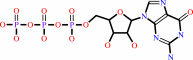 GTP
GTP
|
+
|
H2O
|
=
|
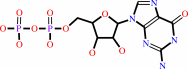 GDP
GDP
|
+
|
 phosphate
|
+
|
H(+)
|
|
|
|
|
|
|
|
|
|
|
|
|
Molecule diagrams generated from .mol files obtained from the
KEGG ftp site
|
|
|
|
|
|
|
|
|
|
|
|
|
|
 |
|
|
|
|
|
|
| |
|
|
| |
|
DOI no:
|
Science
303:373-377
(2004)
|
|
PubMed id:
|
|
|
|
|
|
| |
|
Heterodimeric GTPase core of the SRP targeting complex.
|
|
P.J.Focia,
I.V.Shepotinovskaya,
J.A.Seidler,
D.M.Freymann.
|
|
|
|
|
| |
ABSTRACT
|
|
|
|
| |
|
|
Two structurally homologous guanosine triphosphatase (GTPase) domains interact
directly during signal recognition particle (SRP)-mediated cotranslational
targeting of proteins to the membrane. The 2.05 angstrom structure of a complex
of the NG GTPase domains of Ffh and FtsY reveals a remarkably symmetric
heterodimer sequestering a composite active site that contains two bound
nucleotides. The structure explains the coordinate activation of the two
GTPases. Conformational changes coupled to formation of their extensive
interface may function allosterically to signal formation of the targeting
complex to the signal-sequence binding site and the translocon. We propose that
the complex represents a molecular "latch" and that its disengagement
is regulated by completion of assembly of the GTPase active site.
|
|
|
|
|
|
| |
Selected figure(s)
|
|
|
|
| |
|
|

|
|

|
|
Figure 2.
Fig. 2. An extensive interaction surface. (A) The molecular
surfaces of the Ffh monomer (left) and the FtsY monomer (right)
are shown, shaded by the change in accessible surface area at
each residue between the monomer and in the heterodimer. The
blue areas define the protein-protein contact. The GTP binding
motifs I to IV are indicated, and the Mg2+ nucleotide ligands
are shown in ball and stick representation. A symmetric
triangular contact region above the active site cavity is termed
the latch. The IBD regions of the two proteins contact one
another below the active site cleft. The packing orientation in
the complex can be visualized by rotating the monomers to
overlay the yellow asterisks. Arrows on the surface of the FtsY
monomer highlight the orientation of the Asp/Lys framework
(black) and the latch interface (pink) presented in the
following panels. (B) The framework formed by Asp229(219) of the
DGQ motif (see table S1) and Lys256(246) of motif IV from both
monomers is shown superimposed to emphasize the symmetry between
Ffh and FtsY in the complex. This symmetric interaction lies
approximately along the diagonal ridge located above the active
site clefts in (A). The lysine hydrogen bonds to both P-loops,
thus bridging the interface. In all figures, residues from FtsY
are labeled in gray italics font and from Ffh in black font. (C)
The symmetric latch interface between the N and G domains,
corresponding to the close loop contacts seen above the adjacent
P-loops in Fig. 1A. The conserved hydrophobic residues of the
ALLEADV motifs of the N domains (top) and the symmetric glycine
pair of the DGQ motifs of the G domains (bottom) are shown along
with the pair of bridging aspartate and glutamine residues.
|
|
Figure 3.
Fig. 3. Conformational changes generate the heterodimer
interface. (A) The structure of the Ffh NG domain with GMPPNP
bound (1JPJ [PDB]
.pdb) (in lighter colors) is superimposed with its structure in
the complex. The N domain moves as a rigid body toward helix
 3 of the G
domain; this shift, in turn, is coupled to conformational
rearrangement in the DGQ motif at the N terminus of 3,
enabling formation of the extensive heterodimeric contact there.
Helix 4 moves with the
N domain, accommodated by an 3 of the G
domain; this shift, in turn, is coupled to conformational
rearrangement in the DGQ motif at the N terminus of 3,
enabling formation of the extensive heterodimeric contact there.
Helix 4 moves with the
N domain, accommodated by an  2.9 Å
translation of the remainder of helix 3. Note the
concurrent reorientation of the C-terminal helix. (B) G-domain
conformational changes associated with complex formation are
limited to the loops of conserved sequence motifs. The magnitude
of the shifts are mapped so that the largest shifts ( 6.5
Å) are the darkest shaded regions. (C) Reorientation of
motifs II and III upon complex formation. The left panel shows
the Ffh NG GMPPNP structure, the right panel Ffh NG in the
complex. The side chain of motif III residue Leu192 moves to
insert into a pocket across the heterodimer interface, between
the guanine base and Gly259(249) that follows motif IV. Movement
of this leucine and the accompanying rearrangement of the motif
III backbone allows the P-loop to open sufficiently to
accommodate the nucleotide in an extended conformation (10).
Motif II residues Asp135 and Arg138 move into the catalytic
chamber. The same configuration is observed in FtsY. 2.9 Å
translation of the remainder of helix 3. Note the
concurrent reorientation of the C-terminal helix. (B) G-domain
conformational changes associated with complex formation are
limited to the loops of conserved sequence motifs. The magnitude
of the shifts are mapped so that the largest shifts ( 6.5
Å) are the darkest shaded regions. (C) Reorientation of
motifs II and III upon complex formation. The left panel shows
the Ffh NG GMPPNP structure, the right panel Ffh NG in the
complex. The side chain of motif III residue Leu192 moves to
insert into a pocket across the heterodimer interface, between
the guanine base and Gly259(249) that follows motif IV. Movement
of this leucine and the accompanying rearrangement of the motif
III backbone allows the P-loop to open sufficiently to
accommodate the nucleotide in an extended conformation (10).
Motif II residues Asp135 and Arg138 move into the catalytic
chamber. The same configuration is observed in FtsY.
|
|
|
|
|
|
| |
The above figures are
reprinted
by permission from the AAAs:
Science
(2004,
303,
373-377)
copyright 2004.
|
|
| |
Figures were
selected
by an automated process.
|
|
|
|
|
|
|
|
|
|
|
|
|
|
|
|
 |
 |
 |
|
Literature references that cite this PDB file's key reference
|
|
|
| |
PubMed id
|
|
Reference
|
|
|
|
|
|
K.Shen,
S.Arslan,
D.Akopian,
T.Ha,
and
S.O.Shan
(2012).
Activated GTPase movement on an RNA scaffold drives co-translational protein targeting.
|
| |
Nature,
492,
271-275.
|
|
|
|
|
|
|
W.Holtkamp,
S.Lee,
T.Bornemann,
T.Senyushkina,
M.V.Rodnina,
and
W.Wintermeyer
(2012).
Dynamic switch of the signal recognition particle from scanning to targeting.
|
| |
Nat Struct Mol Biol,
19,
1332-1337.
|
|
|
|
|
|
|
G.Bange,
N.Kümmerer,
P.Grudnik,
R.Lindner,
G.Petzold,
D.Kressler,
E.Hurt,
K.Wild,
and
I.Sinning
(2011).
Structural basis for the molecular evolution of SRP-GTPase activation by protein.
|
| |
Nat Struct Mol Biol,
18,
1376-1380.
|
|
|
PDB code:
|
|
|
|
|
|
|
|
I.Saraogi,
and
S.O.Shan
(2011).
Molecular mechanism of co-translational protein targeting by the signal recognition particle.
|
| |
Traffic,
12,
535-542.
|
|
|
|
|
|
|
L.F.Estrozi,
D.Boehringer,
S.O.Shan,
N.Ban,
and
C.Schaffitzel
(2011).
Cryo-EM structure of the E. coli translating ribosome in complex with SRP and its receptor.
|
| |
Nat Struct Mol Biol,
18,
88-90.
|
|
|
PDB code:
|
|
|
|
|
|
|
|
M.J.Yang,
and
X.Zhang
(2011).
Molecular dynamics simulations reveal structural coordination of Ffh-FtsY heterodimer toward GTPase activation.
|
| |
Proteins,
79,
1774-1785.
|
|
|
|
|
|
|
N.Pawlowski,
A.Khaminets,
J.P.Hunn,
N.Papic,
A.Schmidt,
R.C.Uthaiah,
R.Lange,
G.Vopper,
S.Martens,
E.Wolf,
and
J.C.Howard
(2011).
The activation mechanism of Irga6, an interferon-inducible GTPase contributing to mouse resistance against Toxoplasma gondii.
|
| |
BMC Biol,
9,
7.
|
|
|
|
|
|
|
P.Kuhn,
B.Weiche,
L.Sturm,
E.Sommer,
F.Drepper,
B.Warscheid,
V.Sourjik,
and
H.G.Koch
(2011).
The bacterial SRP receptor, SecA and the ribosome use overlapping binding sites on the SecY translocon.
|
| |
Traffic,
12,
563-578.
|
|
|
|
|
|
|
R.S.Hegde,
and
R.J.Keenan
(2011).
Tail-anchored membrane protein insertion into the endoplasmic reticulum.
|
| |
Nat Rev Mol Cell Biol,
12,
787-798.
|
|
|
|
|
|
|
S.F.Ataide,
N.Schmitz,
K.Shen,
A.Ke,
S.O.Shan,
J.A.Doudna,
and
N.Ban
(2011).
The crystal structure of the signal recognition particle in complex with its receptor.
|
| |
Science,
331,
881-886.
|
|
|
PDB code:
|
|
|
|
|
|
|
|
T.Hainzl,
S.Huang,
G.Meriläinen,
K.Brännström,
and
A.E.Sauer-Eriksson
(2011).
Structural basis of signal-sequence recognition by the signal recognition particle.
|
| |
Nat Struct Mol Biol,
18,
389-391.
|
|
|
PDB code:
|
|
|
|
|
|
|
|
D.Fabris,
and
E.T.Yu
(2010).
Elucidating the higher-order structure of biopolymers by structural probing and mass spectrometry: MS3D.
|
| |
J Mass Spectrom,
45,
841-860.
|
|
|
|
|
|
|
D.Guymer,
J.Maillard,
M.F.Agacan,
C.A.Brearley,
and
F.Sargent
(2010).
Intrinsic GTPase activity of a bacterial twin-arginine translocation proofreading chaperone induced by domain swapping.
|
| |
FEBS J,
277,
511-525.
|
|
|
|
|
|
|
K.Shen,
and
S.O.Shan
(2010).
Transient tether between the SRP RNA and SRP receptor ensures efficient cargo delivery during cotranslational protein targeting.
|
| |
Proc Natl Acad Sci U S A,
107,
7698-7703.
|
|
|
|
|
|
|
K.Wild,
G.Bange,
G.Bozkurt,
B.Segnitz,
A.Hendricks,
and
I.Sinning
(2010).
Structural insights into the assembly of the human and archaeal signal recognition particles.
|
| |
Acta Crystallogr D Biol Crystallogr,
66,
295-303.
|
|
|
PDB codes:
|
|
|
|
|
|
|
|
M.Mossalam,
A.S.Dixon,
and
C.S.Lim
(2010).
Controlling subcellular delivery to optimize therapeutic effect.
|
| |
Ther Deliv,
1,
169-193.
|
|
|
|
|
|
|
M.Yang,
X.Zhang,
and
K.Han
(2010).
Molecular dynamics simulation of SRP GTPases: towards an understanding of the complex formation from equilibrium fluctuations.
|
| |
Proteins,
78,
2222-2237.
|
|
|
|
|
|
|
S.Falk,
and
I.Sinning
(2010).
cpSRP43 is a novel chaperone specific for light-harvesting chlorophyll a,b-binding proteins.
|
| |
J Biol Chem,
285,
21655-21661.
|
|
|
|
|
|
|
S.J.Facey,
and
A.Kuhn
(2010).
Biogenesis of bacterial inner-membrane proteins.
|
| |
Cell Mol Life Sci,
67,
2343-2362.
|
|
|
|
|
|
|
V.Q.Lam,
D.Akopian,
M.Rome,
D.Henningsen,
and
S.O.Shan
(2010).
Lipid activation of the signal recognition particle receptor provides spatial coordination of protein targeting.
|
| |
J Cell Biol,
190,
623-635.
|
|
|
|
|
|
|
B.C.Cross,
I.Sinning,
J.Luirink,
and
S.High
(2009).
Delivering proteins for export from the cytosol.
|
| |
Nat Rev Mol Cell Biol,
10,
255-264.
|
|
|
|
|
|
|
I.A.Buskiewicz,
J.Jöckel,
M.V.Rodnina,
and
W.Wintermeyer
(2009).
Conformation of the signal recognition particle in ribosomal targeting complexes.
|
| |
RNA,
15,
44-54.
|
|
|
|
|
|
|
M.Balaban,
S.N.Joslin,
and
D.R.Hendrixson
(2009).
FlhF and its GTPase activity are required for distinct processes in flagellar gene regulation and biosynthesis in Campylobacter jejuni.
|
| |
J Bacteriol,
191,
6602-6611.
|
|
|
|
|
|
|
M.M.Meyer,
T.D.Ames,
D.P.Smith,
Z.Weinberg,
M.S.Schwalbach,
S.J.Giovannoni,
and
R.R.Breaker
(2009).
Identification of candidate structured RNAs in the marine organism 'Candidatus Pelagibacter ubique'.
|
| |
BMC Genomics,
10,
268.
|
|
|
|
|
|
|
M.Mircheva,
D.Boy,
B.Weiche,
F.Hucke,
P.Graumann,
and
H.G.Koch
(2009).
Predominant membrane localization is an essential feature of the bacterial signal recognition particle receptor.
|
| |
BMC Biol,
7,
76.
|
|
|
|
|
|
|
N.J.Marty,
D.Rajalingam,
A.D.Kight,
N.E.Lewis,
D.Fologea,
T.K.Kumar,
R.L.Henry,
and
R.L.Goforth
(2009).
The membrane-binding motif of the chloroplast signal recognition particle receptor (cpFtsY) regulates GTPase activity.
|
| |
J Biol Chem,
284,
14891-14903.
|
|
|
|
|
|
|
P.Grudnik,
G.Bange,
and
I.Sinning
(2009).
Protein targeting by the signal recognition particle.
|
| |
Biol Chem,
390,
775-782.
|
|
|
|
|
|
|
P.Jaru-Ampornpan,
T.X.Nguyen,
and
S.O.Shan
(2009).
A distinct mechanism to achieve efficient signal recognition particle (SRP)-SRP receptor interaction by the chloroplast srp pathway.
|
| |
Mol Biol Cell,
20,
3965-3973.
|
|
|
|
|
|
|
R.Gasper,
S.Meyer,
K.Gotthardt,
M.Sirajuddin,
and
A.Wittinghofer
(2009).
It takes two to tango: regulation of G proteins by dimerization.
|
| |
Nat Rev Mol Cell Biol,
10,
423-429.
|
|
|
|
|
|
|
S.Meyer,
S.Böhme,
A.Krüger,
H.J.Steinhoff,
J.P.Klare,
and
A.Wittinghofer
(2009).
Kissing G domains of MnmE monitored by X-ray crystallography and pulse electron paramagnetic resonance spectroscopy.
|
| |
PLoS Biol,
7,
e1000212.
|
|
|
PDB codes:
|
|
|
|
|
|
|
|
S.O.Shan,
S.L.Schmid,
and
X.Zhang
(2009).
Signal recognition particle (SRP) and SRP receptor: a new paradigm for multistate regulatory GTPases.
|
| |
Biochemistry,
48,
6696-6704.
|
|
|
|
|
|
|
V.Kriechbaumer,
R.Shaw,
J.Mukherjee,
C.G.Bowsher,
A.M.Harrison,
and
B.M.Abell
(2009).
Subcellular distribution of tail-anchored proteins in Arabidopsis.
|
| |
Traffic,
10,
1753-1764.
|
|
|
|
|
|
|
C.Kötting,
A.Kallenbach,
Y.Suveyzdis,
A.Wittinghofer,
and
K.Gerwert
(2008).
The GAP arginine finger movement into the catalytic site of Ras increases the activation entropy.
|
| |
Proc Natl Acad Sci U S A,
105,
6260-6265.
|
|
|
|
|
|
|
J.W.Rosch,
L.A.Vega,
J.M.Beyer,
A.Lin,
and
M.G.Caparon
(2008).
The signal recognition particle pathway is required for virulence in Streptococcus pyogenes.
|
| |
Infect Immun,
76,
2612-2619.
|
|
|
|
|
|
|
K.Gotthardt,
M.Weyand,
A.Kortholt,
P.J.Van Haastert,
and
A.Wittinghofer
(2008).
Structure of the Roc-COR domain tandem of C. tepidum, a prokaryotic homologue of the human LRRK2 Parkinson kinase.
|
| |
EMBO J,
27,
2239-2249.
|
|
|
PDB codes:
|
|
|
|
|
|
|
|
M.Oreb,
I.Tews,
and
E.Schleiff
(2008).
Policing Tic 'n' Toc, the doorway to chloroplasts.
|
| |
Trends Cell Biol,
18,
19-27.
|
|
|
|
|
|
|
P.F.Egea,
H.Tsuruta,
G.P.de Leon,
J.Napetschnig,
P.Walter,
and
R.M.Stroud
(2008).
Structures of the signal recognition particle receptor from the archaeon Pyrococcus furiosus: implications for the targeting step at the membrane.
|
| |
PLoS ONE,
3,
e3619.
|
|
|
PDB codes:
|
|
|
|
|
|
|
|
P.F.Egea,
J.Napetschnig,
P.Walter,
and
R.M.Stroud
(2008).
Structures of SRP54 and SRP19, the two proteins that organize the ribonucleic core of the signal recognition particle from Pyrococcus furiosus.
|
| |
PLoS ONE,
3,
e3528.
|
|
|
PDB codes:
|
|
|
|
|
|
|
|
P.Koenig,
M.Oreb,
A.Höfle,
S.Kaltofen,
K.Rippe,
I.Sinning,
E.Schleiff,
and
I.Tews
(2008).
The GTPase cycle of the chloroplast import receptors Toc33/Toc34: implications from monomeric and dimeric structures.
|
| |
Structure,
16,
585-596.
|
|
|
PDB codes:
|
|
|
|
|
|
|
|
S.B.Neher,
N.Bradshaw,
S.N.Floor,
J.D.Gross,
and
P.Walter
(2008).
SRP RNA controls a conformational switch regulating the SRP-SRP receptor interaction.
|
| |
Nat Struct Mol Biol,
15,
916-923.
|
|
|
|
|
|
|
U.D.Ramirez,
P.J.Focia,
and
D.M.Freymann
(2008).
Nucleotide-binding flexibility in ultrahigh-resolution structures of the SRP GTPase Ffh.
|
| |
Acta Crystallogr D Biol Crystallogr,
64,
1043-1053.
|
|
|
PDB codes:
|
|
|
|
|
|
|
|
Y.Jiang,
Z.Cheng,
E.C.Mandon,
and
R.Gilmore
(2008).
An interaction between the SRP receptor and the translocon is critical during cotranslational protein translocation.
|
| |
J Cell Biol,
180,
1149-1161.
|
|
|
|
|
|
|
C.L.Reyes,
E.Rutenber,
P.Walter,
and
R.M.Stroud
(2007).
X-ray structures of the signal recognition particle receptor reveal targeting cycle intermediates.
|
| |
PLoS ONE,
2,
e607.
|
|
|
PDB codes:
|
|
|
|
|
|
|
|
D.Barillà,
E.Carmelo,
and
F.Hayes
(2007).
The tail of the ParG DNA segregation protein remodels ParF polymers and enhances ATP hydrolysis via an arginine finger-like motif.
|
| |
Proc Natl Acad Sci U S A,
104,
1811-1816.
|
|
|
|
|
|
|
F.Y.Siu,
R.J.Spanggord,
and
J.A.Doudna
(2007).
SRP RNA provides the physiologically essential GTPase activation function in cotranslational protein targeting.
|
| |
RNA,
13,
240-250.
|
|
|
|
|
|
|
G.Bange,
G.Petzold,
K.Wild,
R.O.Parlitz,
and
I.Sinning
(2007).
The crystal structure of the third signal-recognition particle GTPase FlhF reveals a homodimer with bound GTP.
|
| |
Proc Natl Acad Sci U S A,
104,
13621-13625.
|
|
|
PDB codes:
|
|
|
|
|
|
|
|
G.Bange,
K.Wild,
and
I.Sinning
(2007).
Protein translocation: checkpoint role for SRP GTPase activation.
|
| |
Curr Biol,
17,
R980-R982.
|
|
|
|
|
|
|
J.Gawronski-Salerno,
and
D.M.Freymann
(2007).
Structure of the GMPPNP-stabilized NG domain complex of the SRP GTPases Ffh and FtsY.
|
| |
J Struct Biol,
158,
122-128.
|
|
|
PDB code:
|
|
|
|
|
|
|
|
J.Gawronski-Salerno,
J.S.Coon,
P.J.Focia,
and
D.M.Freymann
(2007).
X-ray structure of the T. aquaticus FtsY:GDP complex suggests functional roles for the C-terminal helix of the SRP GTPases.
|
| |
Proteins,
66,
984-995.
|
|
|
PDB code:
|
|
|
|
|
|
|
|
N.Bradshaw,
and
P.Walter
(2007).
The signal recognition particle (SRP) RNA links conformational changes in the SRP to protein targeting.
|
| |
Mol Biol Cell,
18,
2728-2734.
|
|
|
|
|
|
|
P.Jaru-Ampornpan,
S.Chandrasekar,
and
S.O.Shan
(2007).
Efficient interaction between two GTPases allows the chloroplast SRP pathway to bypass the requirement for an SRP RNA.
|
| |
Mol Biol Cell,
18,
2636-2645.
|
|
|
|
|
|
|
S.O.Shan,
S.Chandrasekar,
and
P.Walter
(2007).
Conformational changes in the GTPase modules of the signal reception particle and its receptor drive initiation of protein translocation.
|
| |
J Cell Biol,
178,
611-620.
|
|
|
|
|
|
|
T.Hainzl,
S.Huang,
and
A.E.Sauer-Eriksson
(2007).
Interaction of signal-recognition particle 54 GTPase domain and signal-recognition particle RNA in the free signal-recognition particle.
|
| |
Proc Natl Acad Sci U S A,
104,
14911-14916.
|
|
|
PDB code:
|
|
|
|
|
|
|
|
A.Ghosh,
G.J.Praefcke,
L.Renault,
A.Wittinghofer,
and
C.Herrmann
(2006).
How guanylate-binding proteins achieve assembly-stimulated processive cleavage of GTP to GMP.
|
| |
Nature,
440,
101-104.
|
|
|
PDB codes:
|
|
|
|
|
|
|
|
A.Scrima,
and
A.Wittinghofer
(2006).
Dimerisation-dependent GTPase reaction of MnmE: how potassium acts as GTPase-activating element.
|
| |
EMBO J,
25,
2940-2951.
|
|
|
PDB codes:
|
|
|
|
|
|
|
|
C.Kötting,
M.Blessenohl,
Y.Suveyzdis,
R.S.Goody,
A.Wittinghofer,
and
K.Gerwert
(2006).
A phosphoryl transfer intermediate in the GTPase reaction of Ras in complex with its GTPase-activating protein.
|
| |
Proc Natl Acad Sci U S A,
103,
13911-13916.
|
|
|
|
|
|
|
H.J.Dong,
S.M.Tao,
Y.Q.Li,
S.H.Chan,
X.L.Shen,
C.X.Wang,
and
W.J.Guan
(2006).
Analysis of the GTPase activity and active sites of the NG domains of FtsY and Ffh from Streptomyces coelicolor.
|
| |
Acta Biochim Biophys Sin (Shanghai),
38,
467-476.
|
|
|
|
|
|
|
I.L.Mainprize,
D.R.Beniac,
E.Falkovskaia,
R.M.Cleverley,
L.M.Gierasch,
F.P.Ottensmeyer,
and
D.W.Andrews
(2006).
The structure of Escherichia coli signal recognition particle revealed by scanning transmission electron microscopy.
|
| |
Mol Biol Cell,
17,
5063-5074.
|
|
|
|
|
|
|
J.R.Scott,
and
T.C.Barnett
(2006).
Surface proteins of gram-positive bacteria and how they get there.
|
| |
Annu Rev Microbiol,
60,
397-423.
|
|
|
|
|
|
|
K.Mitra,
J.Frank,
and
A.Driessen
(2006).
Co- and post-translational translocation through the protein-conducting channel: analogous mechanisms at work?
|
| |
Nat Struct Mol Biol,
13,
957-964.
|
|
|
|
|
|
|
K.Römisch,
F.W.Miller,
B.Dobberstein,
and
S.High
(2006).
Human autoantibodies against the 54 kDa protein of the signal recognition particle block function at multiple stages.
|
| |
Arthritis Res Ther,
8,
R39.
|
|
|
|
|
|
|
L.Cladière,
K.Hamze,
E.Madec,
V.M.Levdikov,
A.J.Wilkinson,
I.B.Holland,
and
S.J.Séror
(2006).
The GTPase, CpgA(YloQ), a putative translation factor, is implicated in morphogenesis in Bacillus subtilis.
|
| |
Mol Genet Genomics,
275,
409-420.
|
|
|
|
|
|
|
M.Halic,
M.Blau,
T.Becker,
T.Mielke,
M.R.Pool,
K.Wild,
I.Sinning,
and
R.Beckmann
(2006).
Following the signal sequence from ribosomal tunnel exit to signal recognition particle.
|
| |
Nature,
444,
507-511.
|
|
|
PDB codes:
|
|
|
|
|
|
|
|
T.U.Schwartz,
D.Schmidt,
S.G.Brohawn,
and
G.Blobel
(2006).
Homodimerization of the G protein SRbeta in the nucleotide-free state involves proline cis/trans isomerization in the switch II region.
|
| |
Proc Natl Acad Sci U S A,
103,
6823-6828.
|
|
|
PDB code:
|
|
|
|
|
|
|
|
U.D.Ramirez,
and
D.M.Freymann
(2006).
Analysis of protein hydration in ultrahigh-resolution structures of the SRP GTPase Ffh.
|
| |
Acta Crystallogr D Biol Crystallogr,
62,
1520-1534.
|
|
|
PDB codes:
|
|
|
|
|
|
|
|
A.Haddad,
R.W.Rose,
and
M.Pohlschröder
(2005).
The Haloferax volcanii FtsY homolog is critical for haloarchaeal growth but does not require the A domain.
|
| |
J Bacteriol,
187,
4015-4022.
|
|
|
|
|
|
|
E.van Anken,
and
I.Braakman
(2005).
Versatility of the endoplasmic reticulum protein folding factory.
|
| |
Crit Rev Biochem Mol Biol,
40,
191-228.
|
|
|
|
|
|
|
I.Buskiewicz,
A.Kubarenko,
F.Peske,
M.V.Rodnina,
and
W.Wintermeyer
(2005).
Domain rearrangement of SRP protein Ffh upon binding 4.5S RNA and the SRP receptor FtsY.
|
| |
RNA,
11,
947-957.
|
|
|
|
|
|
|
J.Luirink,
G.von Heijne,
E.Houben,
and
J.W.de Gier
(2005).
Biogenesis of inner membrane proteins in Escherichia coli.
|
| |
Annu Rev Microbiol,
59,
329-355.
|
|
|
|
|
|
|
M.Pohlschröder,
E.Hartmann,
N.J.Hand,
K.Dilks,
and
A.Haddad
(2005).
Diversity and evolution of protein translocation.
|
| |
Annu Rev Microbiol,
59,
91.
|
|
|
|
|
|
|
R.J.Spanggord,
F.Siu,
A.Ke,
and
J.A.Doudna
(2005).
RNA-mediated interaction between the peptide-binding and GTPase domains of the signal recognition particle.
|
| |
Nat Struct Mol Biol,
12,
1116-1122.
|
|
|
|
|
|
|
S.R.Ainavarapu,
L.Li,
C.L.Badilla,
and
J.M.Fernandez
(2005).
Ligand binding modulates the mechanical stability of dihydrofolate reductase.
|
| |
Biophys J,
89,
3337-3344.
|
|
|
|
|
|
|
T.A.Leonard,
P.J.Butler,
and
J.Löwe
(2005).
Bacterial chromosome segregation: structure and DNA binding of the Soj dimer--a conserved biological switch.
|
| |
EMBO J,
24,
270-282.
|
|
|
PDB codes:
|
|
|
|
|
|
|
|
B.M.Abell,
M.R.Pool,
O.Schlenker,
I.Sinning,
and
S.High
(2004).
Signal recognition particle mediates post-translational targeting in eukaryotes.
|
| |
EMBO J,
23,
2755-2764.
|
|
|
|
|
|
|
F.Chu,
S.O.Shan,
D.T.Moustakas,
F.Alber,
P.F.Egea,
R.M.Stroud,
P.Walter,
and
A.L.Burlingame
(2004).
Unraveling the interface of signal recognition particle and its receptor by using chemical cross-linking and tandem mass spectrometry.
|
| |
Proc Natl Acad Sci U S A,
101,
16454-16459.
|
|
|
|
|
|
|
J.A.Doudna,
and
R.T.Batey
(2004).
Structural insights into the signal recognition particle.
|
| |
Annu Rev Biochem,
73,
539-557.
|
|
|
|
|
|
|
K.Wild,
K.R.Rosendal,
and
I.Sinning
(2004).
A structural step into the SRP cycle.
|
| |
Mol Microbiol,
53,
357-363.
|
|
|
|
|
|
|
K.Wild,
M.Halic,
I.Sinning,
and
R.Beckmann
(2004).
SRP meets the ribosome.
|
| |
Nat Struct Mol Biol,
11,
1049-1053.
|
|
|
|
|
|
|
M.A.Oliva,
S.C.Cordell,
and
J.Löwe
(2004).
Structural insights into FtsZ protofilament formation.
|
| |
Nat Struct Mol Biol,
11,
1243-1250.
|
|
|
PDB codes:
|
|
|
|
|
|
|
|
S.H.White,
and
G.von Heijne
(2004).
The machinery of membrane protein assembly.
|
| |
Curr Opin Struct Biol,
14,
397-404.
|
|
|
|
|
|
|
S.O.Shan,
R.M.Stroud,
and
P.Walter
(2004).
Mechanism of association and reciprocal activation of two GTPases.
|
| |
PLoS Biol,
2,
e320.
|
|
|
|
|
|
|
Y.G.Ren,
K.W.Wagner,
D.A.Knee,
P.Aza-Blanc,
M.Nasoff,
and
Q.L.Deveraux
(2004).
Differential regulation of the TRAIL death receptors DR4 and DR5 by the signal recognition particle.
|
| |
Mol Biol Cell,
15,
5064-5074.
|
|
|
|
|
|
The most recent references are shown first.
Citation data come partly from CiteXplore and partly
from an automated harvesting procedure. Note that this is likely to be
only a partial list as not all journals are covered by
either method. However, we are continually building up the citation data
so more and more references will be included with time.
Where a reference describes a PDB structure, the PDB
code is
shown on the right.
|
 |


 Links
Links


