
|
|
|
|
|
 |
Contents |
 |
|
|
|
|
|
|
|
|
|
|
|
|
* Residue conservation analysis
|
|
|
|
|
|
PDB id:
|
|
|
|
| Name: |
|
Toxin,lyase/metal binding protein
|
|
|
Title:
|
|
Crystal structure of the adenylyl cyclase domain of anthrax edema factor (ef) in complex with calmodulin
|
|
Structure:
|
|
Calmodulin-sensitive adenylate cyclase. Chain: a, b, c. Engineered: yes. Calmodulin. Chain: d, e, f. Engineered: yes
|
|
Source:
|
|
Bacillus anthracis. Organism_taxid: 1392. Expressed in: escherichia coli bl21. Expression_system_taxid: 511693. Homo sapiens. Human. Organism_taxid: 9606.
|
|
Biol. unit:
|
|
 Dimer (from
)
Dimer (from
)
|
|
Resolution:
|
|
|
2.95Å
|
R-factor:
|
0.278
|
R-free:
|
0.315
|
|
|
Authors:
|
|
C.L.Drum,S.-Z.Yan,J.Bard,Y.-Q.Shen,D.Lu,S.Soelaiman,Z.Grabarek, A.Bohm,W.-J.Tang
|
Key ref:

|
|
C.L.Drum
et al.
(2002).
Structural basis for the activation of anthrax adenylyl cyclase exotoxin by calmodulin.
Nature,
415,
396-402.
PubMed id:
DOI:

|
|
|
Date:
|
|
|
26-Oct-01
|
Release date:
|
23-Jan-02
|
|
|
|
|
|
|
PROCHECK
|

|
|
|
|
|
Headers
|
|
|
|
References
|
|
|
|
|
|
|
|
|
|
|
|
Enzyme class:
|
|
Chains A, B, C:
E.C.4.6.1.1
- adenylate cyclase.
|
|
|
|
|
|
|
Reaction:
|
|
ATP = 3',5'-cyclic AMP + diphosphate
|
|
|
|
|
|
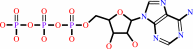 ATP
ATP
|
=
|
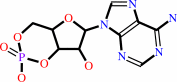 3',5'-cyclic AMP
|
+
|
 diphosphate
|
|
|
|
|
|
|
|
|
|
Cofactor:
|
|
Pyridoxal 5'-phosphate
|
|
|
|
|
|
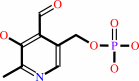 Pyridoxal 5'-phosphate
|
|
|
|
|
|
|
Molecule diagrams generated from .mol files obtained from the
KEGG ftp site
|
|
|
|
|
|
|
|
|
|
|
|
|
|
 |
|
|
|
|
|
|
| |
|
|
| |
|
DOI no:
|
Nature
415:396-402
(2002)
|
|
PubMed id:
|
|
|
|
|
|
| |
|
Structural basis for the activation of anthrax adenylyl cyclase exotoxin by calmodulin.
|
|
C.L.Drum,
S.Z.Yan,
J.Bard,
Y.Q.Shen,
D.Lu,
S.Soelaiman,
Z.Grabarek,
A.Bohm,
W.J.Tang.
|
|
|
|
|
| |
ABSTRACT
|
|
|
|
| |
|
|
Oedema factor, a calmodulin-activated adenylyl cyclase, is important in the
pathogenesis of anthrax. Here we report the X-ray structures of oedema factor
with and without bound calmodulin. Oedema factor shares no significant
structural homology with mammalian adenylyl cyclases or other proteins. In the
active site, 3'-deoxy-ATP and a single metal ion are well positioned for
catalysis with histidine 351 as the catalytic base. This mechanism differs from
the mechanism of two-metal-ion catalysis proposed for mammalian adenylyl
cyclases. Four discrete regions of oedema factor form a surface that recognizes
an extended conformation of calmodulin, which is very different from the
collapsed conformation observed in other structures of calmodulin bound to
effector peptides. On calmodulin binding, an oedema factor helical domain of
relative molecular mass 15,000 undergoes a 15 A translation and a 30 degrees
rotation away from the oedema factor catalytic core, which stabilizes a
disordered loop and leads to enzyme activation. These allosteric changes provide
the first molecular details of how calmodulin modulates one of its targets.
|
|
|
|
|
|
| |
Selected figure(s)
|
|
|
|
| |
|
|

|
|

|
|
Figure 3.
Figure 3: CPK representation of EF structures. a, EF alone;
b, CaM -EF. CaM-contacting residues are in red, and the atoms
for switch A, B and C are in cyan, orange and yellow,
respectively.
|
|
Figure 5.
Figure 5: The active site of EF and its comparison with mAC.
a, Ball-and-stick representation of the EF active site. b,
Proposed mechanism of catalysis of EF. For clarity, only
residues that are directly involved in 3' O- to P  nucleophilic
attack are shown. c, Ball-and-stick representation of the mAC
active site. d, Secondary structures of the EF catalytic core
and the mAC catalytic core with the same view as in a and c. The
nucleotide (3'dATP in EF -CaM and ATP- S
in mAC) and the metal ion are in black and grey, respectively.
The O4', C4' and P of
ATP- S
are shown in a similar position to those of 3'dATP in a for
comparison. C1a and C2a of mAC are in green and yellow,
respectively. nucleophilic
attack are shown. c, Ball-and-stick representation of the mAC
active site. d, Secondary structures of the EF catalytic core
and the mAC catalytic core with the same view as in a and c. The
nucleotide (3'dATP in EF -CaM and ATP- S
in mAC) and the metal ion are in black and grey, respectively.
The O4', C4' and P of
ATP- S
are shown in a similar position to those of 3'dATP in a for
comparison. C1a and C2a of mAC are in green and yellow,
respectively.
|
|
|
|
|
|
| |
The above figures are
reprinted
by permission from Macmillan Publishers Ltd:
Nature
(2002,
415,
396-402)
copyright 2002.
|
|
| |
Figures were
selected
by an automated process.
|
|
|
|
|
|
|
|
|
|
|
|
|
|
|
|
 |
 |
 |
|
Literature references that cite this PDB file's key reference
|
|
|
| |
PubMed id
|
|
Reference
|
|
|
|
|
|
L.Martínez,
T.E.Malliavin,
and
A.Blondel
(2011).
Mechanism of reactant and product dissociation from the anthrax edema factor: A locally enhanced sampling and steered molecular dynamics study.
|
| |
Proteins,
79,
1649-1661.
|
|
|
|
|
|
|
S.E.O'Donnell,
L.Yu,
C.A.Fowler,
and
M.A.Shea
(2011).
Recognition of β-calcineurin by the domains of calmodulin: Thermodynamic and structural evidence for distinct roles.
|
| |
Proteins,
79,
765-786.
|
|
|
|
|
|
|
Z.Grabarek
(2011).
Insights into modulation of calcium signaling by magnesium in calmodulin, troponin C and related EF-hand proteins.
|
| |
Biochim Biophys Acta,
1813,
913-921.
|
|
|
|
|
|
|
A.F.Kintzer,
H.J.Sterling,
I.I.Tang,
E.R.Williams,
and
B.A.Krantz
(2010).
Anthrax toxin receptor drives protective antigen oligomerization and stabilizes the heptameric and octameric oligomer by a similar mechanism.
|
| |
PLoS One,
5,
e13888.
|
|
|
|
|
|
|
E.Laine,
C.Goncalves,
J.C.Karst,
A.Lesnard,
S.Rault,
W.J.Tang,
T.E.Malliavin,
D.Ladant,
and
A.Blondel
(2010).
Use of allostery to identify inhibitors of calmodulin-induced activation of Bacillus anthracis edema factor.
|
| |
Proc Natl Acad Sci U S A,
107,
11277-11282.
|
|
|
|
|
|
|
F.P.Davis,
and
A.Sali
(2010).
The overlap of small molecule and protein binding sites within families of protein structures.
|
| |
PLoS Comput Biol,
6,
e1000668.
|
|
|
|
|
|
|
F.Rodríguez-Castañeda,
M.Maestre-Martínez,
N.Coudevylle,
K.Dimova,
H.Junge,
N.Lipstein,
D.Lee,
S.Becker,
N.Brose,
O.Jahn,
T.Carlomagno,
and
C.Griesinger
(2010).
Modular architecture of Munc13/calmodulin complexes: dual regulation by Ca2+ and possible function in short-term synaptic plasticity.
|
| |
EMBO J,
29,
680-691.
|
|
|
PDB code:
|
|
|
|
|
|
|
|
H.Tidow,
K.L.Hein,
L.Baekgaard,
M.G.Palmgren,
and
P.Nissen
(2010).
Expression, purification, crystallization and preliminary X-ray analysis of calmodulin in complex with the regulatory domain of the plasma-membrane Ca2+-ATPase ACA8.
|
| |
Acta Crystallogr Sect F Struct Biol Cryst Commun,
66,
361-363.
|
|
|
|
|
|
|
I.Zornetta,
L.Brandi,
B.Janowiak,
F.Dal Molin,
F.Tonello,
R.J.Collier,
and
C.Montecucco
(2010).
Imaging the cell entry of the anthrax oedema and lethal toxins with fluorescent protein chimeras.
|
| |
Cell Microbiol,
12,
1435-1445.
|
|
|
|
|
|
|
M.Maestre-Martínez,
K.Haupt,
F.Edlich,
G.Jahreis,
F.Jarczowski,
F.Erdmann,
G.Fischer,
and
C.Lücke
(2010).
New structural aspects of FKBP38 activation.
|
| |
Biol Chem,
391,
1157-1167.
|
|
|
|
|
|
|
M.Radjainia,
J.K.Hyun,
C.E.Leysath,
S.H.Leppla,
and
A.K.Mitra
(2010).
Anthrax toxin-neutralizing antibody reconfigures the protective antigen heptamer into a supercomplex.
|
| |
Proc Natl Acad Sci U S A,
107,
14070-14074.
|
|
|
|
|
|
|
D.B.Halling,
D.K.Georgiou,
D.J.Black,
G.Yang,
J.L.Fallon,
F.A.Quiocho,
S.E.Pedersen,
and
S.L.Hamilton
(2009).
Determinants in CaV1 channels that regulate the Ca2+ sensitivity of bound calmodulin.
|
| |
J Biol Chem,
284,
20041-20051.
|
|
|
PDB code:
|
|
|
|
|
|
|
|
D.Basilio,
S.J.Juris,
R.J.Collier,
and
A.Finkelstein
(2009).
Evidence for a proton-protein symport mechanism in the anthrax toxin channel.
|
| |
J Gen Physiol,
133,
307-314.
|
|
|
|
|
|
|
E.Laine,
A.Blondel,
and
T.E.Malliavin
(2009).
Dynamics and energetics: a consensus analysis of the impact of calcium on EF-CaM protein complex.
|
| |
Biophys J,
96,
1249-1263.
|
|
|
|
|
|
|
H.M.Taha,
J.Schmidt,
M.Göttle,
S.Suryanarayana,
Y.Shen,
W.J.Tang,
A.Gille,
J.Geduhn,
B.König,
S.Dove,
and
R.Seifert
(2009).
Molecular analysis of the interaction of anthrax adenylyl cyclase toxin, edema factor, with 2'(3')-O-(N-(methyl)anthraniloyl)-substituted purine and pyrimidine nucleotides.
|
| |
Mol Pharmacol,
75,
693-703.
|
|
|
|
|
|
|
J.N.Tournier,
R.G.Ulrich,
A.Quesnel-Hellmann,
M.Mohamadzadeh,
and
B.G.Stiles
(2009).
Anthrax, toxins and vaccines: a 125-year journey targeting Bacillus anthracis.
|
| |
Expert Rev Anti Infect Ther,
7,
219-236.
|
|
|
|
|
|
|
L.A.Yeager,
A.K.Chopra,
and
J.W.Peterson
(2009).
Bacillus anthracis edema toxin suppresses human macrophage phagocytosis and cytoskeletal remodeling via the protein kinase A and exchange protein activated by cyclic AMP pathways.
|
| |
Infect Immun,
77,
2530-2543.
|
|
|
|
|
|
|
L.Martínez,
E.Laine,
T.E.Malliavin,
M.Nilges,
and
A.Blondel
(2009).
ATP conformations and ion binding modes in the active site of anthrax edema factor: a computational analysis.
|
| |
Proteins,
77,
971-983.
|
|
|
|
|
|
|
M.L.Nguyen,
S.Terzyan,
J.D.Ballard,
J.A.James,
and
A.D.Farris
(2009).
The major neutralizing antibody responses to recombinant anthrax lethal and edema factors are directed to non-cross-reactive epitopes.
|
| |
Infect Immun,
77,
4714-4723.
|
|
|
|
|
|
|
R.J.Collier
(2009).
Membrane translocation by anthrax toxin.
|
| |
Mol Aspects Med,
30,
413-422.
|
|
|
|
|
|
|
S.Suryanarayana,
J.L.Wang,
M.Richter,
Y.Shen,
W.J.Tang,
G.H.Lushington,
and
R.Seifert
(2009).
Distinct interactions of 2'- and 3'-O-(N-methyl)anthraniloyl-isomers of ATP and GTP with the adenylyl cyclase toxin of Bacillus anthracis, edema factor.
|
| |
Biochem Pharmacol,
78,
224-230.
|
|
|
|
|
|
|
T.I.Evans,
and
M.A.Shea
(2009).
Energetics of calmodulin domain interactions with the calmodulin binding domain of CaMKII.
|
| |
Proteins,
76,
47-61.
|
|
|
|
|
|
|
W.J.Tang,
and
Q.Guo
(2009).
The adenylyl cyclase activity of anthrax edema factor.
|
| |
Mol Aspects Med,
30,
423-430.
|
|
|
|
|
|
|
Z.Chen,
M.Moayeri,
H.Zhao,
D.Crown,
S.H.Leppla,
and
R.H.Purcell
(2009).
Potent neutralization of anthrax edema toxin by a humanized monoclonal antibody that competes with calmodulin for edema factor binding.
|
| |
Proc Natl Acad Sci U S A,
106,
13487-13492.
|
|
|
|
|
|
|
B.J.Nablo,
K.M.Halverson,
J.W.Robertson,
T.L.Nguyen,
R.G.Panchal,
R.Gussio,
S.Bavari,
O.V.Krasilnikov,
and
J.J.Kasianowicz
(2008).
Sizing the Bacillus anthracis PA63 channel with nonelectrolyte poly(ethylene glycols).
|
| |
Biophys J,
95,
1157-1164.
|
|
|
|
|
|
|
D.Bandyopadhyay,
and
E.L.Mehler
(2008).
Quantitative expression of protein heterogeneity: Response of amino acid side chains to their local environment.
|
| |
Proteins,
72,
646-659.
|
|
|
|
|
|
|
D.Chen,
M.Misra,
L.Sower,
J.W.Peterson,
G.E.Kellogg,
and
C.H.Schein
(2008).
Novel inhibitors of anthrax edema factor.
|
| |
Bioorg Med Chem,
16,
7225-7233.
|
|
|
|
|
|
|
E.Laine,
J.D.Yoneda,
A.Blondel,
and
T.E.Malliavin
(2008).
The conformational plasticity of calmodulin upon calcium complexation gives a model of its interaction with the oedema factor of Bacillus anthracis.
|
| |
Proteins,
71,
1813-1829.
|
|
|
|
|
|
|
E.Y.Kim,
C.H.Rumpf,
Y.Fujiwara,
E.S.Cooley,
F.Van Petegem,
and
D.L.Minor
(2008).
Structures of CaV2 Ca2+/CaM-IQ domain complexes reveal binding modes that underlie calcium-dependent inactivation and facilitation.
|
| |
Structure,
16,
1455-1467.
|
|
|
PDB codes:
|
|
|
|
|
|
|
|
H.Y.Park,
S.A.Kim,
J.Korlach,
E.Rhoades,
L.W.Kwok,
W.R.Zipfel,
M.N.Waxham,
W.W.Webb,
and
L.Pollack
(2008).
Conformational changes of calmodulin upon Ca2+ binding studied with a microfluidic mixer.
|
| |
Proc Natl Acad Sci U S A,
105,
542-547.
|
|
|
|
|
|
|
I.E.Dick,
M.R.Tadross,
H.Liang,
L.H.Tay,
W.Yang,
and
D.T.Yue
(2008).
A modular switch for spatial Ca2+ selectivity in the calmodulin regulation of CaV channels.
|
| |
Nature,
451,
830-834.
|
|
|
|
|
|
|
J.L.Larabee,
K.DeGiusti,
J.L.Regens,
and
J.D.Ballard
(2008).
Bacillus anthracis edema toxin activates nuclear glycogen synthase kinase 3beta.
|
| |
Infect Immun,
76,
4895-4904.
|
|
|
|
|
|
|
M.I.Stefan,
S.J.Edelstein,
and
N.Le Novère
(2008).
An allosteric model of calmodulin explains differential activation of PP2B and CaMKII.
|
| |
Proc Natl Acad Sci U S A,
105,
10768-10773.
|
|
|
|
|
|
|
N.V.Valeyev,
D.G.Bates,
P.Heslop-Harrison,
I.Postlethwaite,
and
N.V.Kotov
(2008).
Elucidating the mechanisms of cooperative calcium-calmodulin interactions: a structural systems biology approach.
|
| |
BMC Syst Biol,
2,
48.
|
|
|
|
|
|
|
P.J.Chou,
C.A.Newton,
I.Perkins,
H.Friedman,
and
T.W.Klein
(2008).
Suppression of dendritic cell activation by anthrax lethal toxin and edema toxin depends on multiple factors including cell source, stimulus used, and function tested.
|
| |
DNA Cell Biol,
27,
637-648.
|
|
|
|
|
|
|
Q.Guo,
J.E.Jureller,
J.T.Warren,
E.Solomaha,
J.Florián,
and
W.J.Tang
(2008).
Protein-protein docking and analysis reveal that two homologous bacterial adenylyl cyclase toxins interact with calmodulin differently.
|
| |
J Biol Chem,
283,
23836-23845.
|
|
|
|
|
|
|
R.A.Newman,
W.S.Van Scyoc,
B.R.Sorensen,
O.R.Jaren,
and
M.A.Shea
(2008).
Interdomain cooperativity of calmodulin bound to melittin preferentially increases calcium affinity of sites I and II.
|
| |
Proteins,
71,
1792-1812.
|
|
|
|
|
|
|
T.Herman,
S.Colton,
and
M.Franzen
(2008).
Rethinking outreach: teaching the process of science through modeling.
|
| |
PLoS Biol,
6,
e86.
|
|
|
|
|
|
|
Y.Zhang,
H.Tan,
Z.Jia,
and
G.Chen
(2008).
Ligand-induced dimer formation of calmodulin.
|
| |
J Mol Recognit,
21,
267-274.
|
|
|
|
|
|
|
A.P.Yamniuk,
M.Rainaldi,
and
H.J.Vogel
(2007).
Calmodulin has the Potential to Function as a Ca-Dependent Adaptor Protein.
|
| |
Plant Signal Behav,
2,
354-357.
|
|
|
|
|
|
|
D.Chen,
G.Menche,
T.D.Power,
L.Sower,
J.W.Peterson,
and
C.H.Schein
(2007).
Accounting for ligand-bound metal ions in docking small molecules on adenylyl cyclase toxins.
|
| |
Proteins,
67,
593-605.
|
|
|
|
|
|
|
F.Edlich,
M.Maestre-Martínez,
F.Jarczowski,
M.Weiwad,
M.C.Moutty,
M.Malesević,
G.Jahreis,
G.Fischer,
and
C.Lücke
(2007).
A novel calmodulin-Ca2+ target recognition activates the Bcl-2 regulator FKBP38.
|
| |
J Biol Chem,
282,
36496-36504.
|
|
|
|
|
|
|
H.M.Scobie,
J.M.Marlett,
G.J.Rainey,
D.B.Lacy,
R.J.Collier,
and
J.A.Young
(2007).
Anthrax toxin receptor 2 determinants that dictate the pH threshold of toxin pore formation.
|
| |
PLoS ONE,
2,
e329.
|
|
|
|
|
|
|
J.N.Tournier,
A.Quesnel-Hellmann,
A.Cleret,
and
D.R.Vidal
(2007).
Contribution of toxins to the pathogenesis of inhalational anthrax.
|
| |
Cell Microbiol,
9,
555-565.
|
|
|
|
|
|
|
J.Tessier,
C.Green,
D.Padgett,
W.Zhao,
L.Schwartz,
M.Hughes,
and
E.Hewlett
(2007).
Contributions of histamine, prostanoids, and neurokinins to edema elicited by edema toxin from Bacillus anthracis.
|
| |
Infect Immun,
75,
1895-1903.
|
|
|
|
|
|
|
K.H.Chen,
S.Liu,
L.A.Bankston,
R.C.Liddington,
and
S.H.Leppla
(2007).
Selection of anthrax toxin protective antigen variants that discriminate between the cellular receptors TEM8 and CMG2 and achieve targeting of tumor cells.
|
| |
J Biol Chem,
282,
9834-9845.
|
|
|
|
|
|
|
C.T.Baldari,
F.Tonello,
S.R.Paccani,
and
C.Montecucco
(2006).
Anthrax toxins: A paradigm of bacterial immune suppression.
|
| |
Trends Immunol,
27,
434-440.
|
|
|
|
|
|
|
D.E.Spratt,
E.Newman,
J.Mosher,
D.K.Ghosh,
J.C.Salerno,
and
J.G.Guillemette
(2006).
Binding and activation of nitric oxide synthase isozymes by calmodulin EF hand pairs.
|
| |
FEBS J,
273,
1759-1771.
|
|
|
|
|
|
|
D.J.Stearns-Kurosawa,
F.Lupu,
F.B.Taylor,
G.Kinasewitz,
and
S.Kurosawa
(2006).
Sepsis and pathophysiology of anthrax in a nonhuman primate model.
|
| |
Am J Pathol,
169,
433-444.
|
|
|
|
|
|
|
F.Capozzi,
F.Casadei,
and
C.Luchinat
(2006).
EF-hand protein dynamics and evolution of calcium signal transduction: an NMR view.
|
| |
J Biol Inorg Chem,
11,
949-962.
|
|
|
|
|
|
|
G.Fiorin,
A.Pastore,
P.Carloni,
and
M.Parrinello
(2006).
Using metadynamics to understand the mechanism of calmodulin/target recognition at atomic detail.
|
| |
Biophys J,
91,
2768-2777.
|
|
|
|
|
|
|
H.M.Scobie,
D.J.Wigelsworth,
J.M.Marlett,
D.Thomas,
G.J.Rainey,
D.B.Lacy,
M.Manchester,
R.J.Collier,
and
J.A.Young
(2006).
Anthrax toxin receptor 2-dependent lethal toxin killing in vivo.
|
| |
PLoS Pathog,
2,
e111.
|
|
|
|
|
|
|
J.J.Barker
(2006).
Antibacterial drug discovery and structure-based design.
|
| |
Drug Discov Today,
11,
391-404.
|
|
|
|
|
|
|
J.Ruan,
K.Chen,
J.A.Tuszynski,
and
L.A.Kurgan
(2006).
Quantitative analysis of the conservation of the tertiary structure of protein segments.
|
| |
Protein J,
25,
301-315.
|
|
|
|
|
|
|
K.Chen,
J.Ruan,
and
L.A.Kurgan
(2006).
Prediction of three dimensional structure of calmodulin.
|
| |
Protein J,
25,
57-70.
|
|
|
|
|
|
|
M.Gao,
and
K.Schulten
(2006).
Onset of anthrax toxin pore formation.
|
| |
Biophys J,
90,
3267-3279.
|
|
|
|
|
|
|
M.Ikura,
and
J.B.Ames
(2006).
Genetic polymorphism and protein conformational plasticity in the calmodulin superfamily: two ways to promote multifunctionality.
|
| |
Proc Natl Acad Sci U S A,
103,
1159-1164.
|
|
|
|
|
|
|
A.M.Firoved,
G.F.Miller,
M.Moayeri,
R.Kakkar,
Y.Shen,
J.F.Wiggins,
E.M.McNally,
W.J.Tang,
and
S.H.Leppla
(2005).
Bacillus anthracis edema toxin causes extensive tissue lesions and rapid lethality in mice.
|
| |
Am J Pathol,
167,
1309-1320.
|
|
|
|
|
|
|
C.L.Chyan,
P.C.Huang,
T.H.Lin,
J.W.Huang,
S.S.Lin,
H.B.Huang,
and
Y.C.Chen
(2005).
Purification, crystallization and preliminary crystallographic studies of a calmodulin-OLFp hybrid molecule.
|
| |
Acta Crystallogr Sect F Struct Biol Cryst Commun,
61,
785-787.
|
|
|
|
|
|
|
H.M.Scobie,
and
J.A.Young
(2005).
Interactions between anthrax toxin receptors and protective antigen.
|
| |
Curr Opin Microbiol,
8,
106-112.
|
|
|
|
|
|
|
J.A.Doudna,
and
J.R.Lorsch
(2005).
Ribozyme catalysis: not different, just worse.
|
| |
Nat Struct Mol Biol,
12,
395-402.
|
|
|
|
|
|
|
J.C.Burnett,
E.A.Henchal,
A.L.Schmaljohn,
and
S.Bavari
(2005).
The evolving field of biodefence: therapeutic developments and diagnostics.
|
| |
Nat Rev Drug Discov,
4,
281-297.
|
|
|
|
|
|
|
J.L.Fallon,
D.B.Halling,
S.L.Hamilton,
and
F.A.Quiocho
(2005).
Structure of calmodulin bound to the hydrophobic IQ domain of the cardiac Ca(v)1.2 calcium channel.
|
| |
Structure,
13,
1881-1886.
|
|
|
PDB codes:
|
|
|
|
|
|
|
|
J.Y.Wang,
and
M.H.Roehrl
(2005).
Anthrax vaccine design: strategies to achieve comprehensive protection against spore, bacillus, and toxin.
|
| |
Med Immunol,
4,
4.
|
|
|
|
|
|
|
L.Abrami,
N.Reig,
and
F.G.van der Goot
(2005).
Anthrax toxin: the long and winding road that leads to the kill.
|
| |
Trends Microbiol,
13,
72-78.
|
|
|
|
|
|
|
Q.Guo,
Y.Shen,
Y.S.Lee,
C.S.Gibbs,
M.Mrksich,
and
W.J.Tang
(2005).
Structural basis for the interaction of Bordetella pertussis adenylyl cyclase toxin with calmodulin.
|
| |
EMBO J,
24,
3190-3201.
|
|
|
PDB codes:
|
|
|
|
|
|
|
|
R.Mabry,
M.Rani,
R.Geiger,
G.B.Hubbard,
R.Carrion,
K.Brasky,
J.L.Patterson,
G.Georgiou,
and
B.L.Iverson
(2005).
Passive protection against anthrax by using a high-affinity antitoxin antibody fragment lacking an Fc region.
|
| |
Infect Immun,
73,
8362-8368.
|
|
|
|
|
|
|
R.Nishi,
Y.Okuda,
E.Watanabe,
T.Mori,
S.Iwai,
C.Masutani,
K.Sugasawa,
and
F.Hanaoka
(2005).
Centrin 2 stimulates nucleotide excision repair by interacting with xeroderma pigmentosum group C protein.
|
| |
Mol Cell Biol,
25,
5664-5674.
|
|
|
|
|
|
|
S.R.Paccani,
F.Tonello,
R.Ghittoni,
M.Natale,
L.Muraro,
M.M.D'Elios,
W.J.Tang,
C.Montecucco,
and
C.T.Baldari
(2005).
Anthrax toxins suppress T lymphocyte activation by disrupting antigen receptor signaling.
|
| |
J Exp Med,
201,
325-331.
|
|
|
|
|
|
|
Y.Shen,
N.L.Zhukovskaya,
Q.Guo,
J.Florián,
and
W.J.Tang
(2005).
Calcium-independent calmodulin binding and two-metal-ion catalytic mechanism of anthrax edema factor.
|
| |
EMBO J,
24,
929-941.
|
|
|
PDB codes:
|
|
|
|
|
|
|
|
A.R.Shenoy,
K.Sivakumar,
A.Krupa,
N.Srinivasan,
and
S.S.Visweswariah
(2004).
A Survey of Nucleotide Cyclases in Actinobacteria: Unique Domain Organization and Expansion of the Class III Cyclase Family in Mycobacterium tuberculosis.
|
| |
Comp Funct Genomics,
5,
17-38.
|
|
|
|
|
|
|
C.H.Yun,
J.Bai,
D.Y.Sun,
D.F.Cui,
W.R.Chang,
and
D.C.Liang
(2004).
Structure of potato calmodulin PCM6: the first report of the three-dimensional structure of a plant calmodulin.
|
| |
Acta Crystallogr D Biol Crystallogr,
60,
1214-1219.
|
|
|
PDB code:
|
|
|
|
|
|
|
|
D.A.Baker,
and
J.M.Kelly
(2004).
Structure, function and evolution of microbial adenylyl and guanylyl cyclases.
|
| |
Mol Microbiol,
52,
1229-1242.
|
|
|
|
|
|
|
E.Newman,
D.E.Spratt,
J.Mosher,
B.Cheyne,
H.J.Montgomery,
D.L.Wilson,
J.B.Weinberg,
S.M.Smith,
J.C.Salerno,
D.K.Ghosh,
and
J.G.Guillemette
(2004).
Differential activation of nitric-oxide synthase isozymes by calmodulin-troponin C chimeras.
|
| |
J Biol Chem,
279,
33547-33557.
|
|
|
|
|
|
|
E.Y.Ahn,
S.T.Lim,
W.J.Cook,
and
J.M.McDonald
(2004).
Calmodulin binding to the Fas death domain. Regulation by Fas activation.
|
| |
J Biol Chem,
279,
5661-5666.
|
|
|
|
|
|
|
H.Barth,
K.Aktories,
M.R.Popoff,
and
B.G.Stiles
(2004).
Binary bacterial toxins: biochemistry, biology, and applications of common Clostridium and Bacillus proteins.
|
| |
Microbiol Mol Biol Rev,
68,
373.
|
|
|
|
|
|
|
J.Gallay,
M.Vincent,
I.M.Li de la Sierra,
H.Munier-Lehmann,
M.Renouard,
H.Sakamoto,
O.Bârzu,
and
A.M.Gilles
(2004).
Insight into the activation mechanism of Bordetella pertussis adenylate cyclase by calmodulin using fluorescence spectroscopy.
|
| |
Eur J Biochem,
271,
821-833.
|
|
|
|
|
|
|
J.Kim,
S.Ghosh,
D.A.Nunziato,
and
G.S.Pitt
(2004).
Identification of the components controlling inactivation of voltage-gated Ca2+ channels.
|
| |
Neuron,
41,
745-754.
|
|
|
|
|
|
|
J.Kim,
S.Ghosh,
H.Liu,
M.Tateyama,
R.S.Kass,
and
G.S.Pitt
(2004).
Calmodulin mediates Ca2+ sensitivity of sodium channels.
|
| |
J Biol Chem,
279,
45004-45012.
|
|
|
|
|
|
|
M.Gerstein,
and
N.Echols
(2004).
Exploring the range of protein flexibility, from a structural proteomics perspective.
|
| |
Curr Opin Chem Biol,
8,
14-19.
|
|
|
|
|
|
|
M.Matsubara,
T.Nakatsu,
H.Kato,
and
H.Taniguchi
(2004).
Crystal structure of a myristoylated CAP-23/NAP-22 N-terminal domain complexed with Ca2+/calmodulin.
|
| |
EMBO J,
23,
712-718.
|
|
|
PDB code:
|
|
|
|
|
|
|
|
Q.Guo,
Y.Shen,
N.L.Zhukovskaya,
J.Florián,
and
W.J.Tang
(2004).
Structural and kinetic analyses of the interaction of anthrax adenylyl cyclase toxin with reaction products cAMP and pyrophosphate.
|
| |
J Biol Chem,
279,
29427-29435.
|
|
|
PDB code:
|
|
|
|
|
|
|
|
T.Yang,
S.Chaudhuri,
L.Yang,
Y.Chen,
B.W.Poovaiah,
and
B.W.Poovaiah
(2004).
Calcium/calmodulin up-regulates a cytoplasmic receptor-like kinase in plants.
|
| |
J Biol Chem,
279,
42552-42559.
|
|
|
|
|
|
|
Y.S.Lee,
P.Bergson,
W.S.He,
M.Mrksich,
and
W.J.Tang
(2004).
Discovery of a small molecule that inhibits the interaction of anthrax edema factor with its cellular activator, calmodulin.
|
| |
Chem Biol,
11,
1139-1146.
|
|
|
|
|
|
|
Y.Shen,
N.L.Zhukovskaya,
M.I.Zimmer,
S.Soelaiman,
P.Bergson,
C.R.Wang,
C.S.Gibbs,
and
W.J.Tang
(2004).
Selective inhibition of anthrax edema factor by adefovir, a drug for chronic hepatitis B virus infection.
|
| |
Proc Natl Acad Sci U S A,
101,
3242-3247.
|
|
|
PDB code:
|
|
|
|
|
|
|
|
Z.Akyol,
J.A.Bartos,
M.A.Merrill,
L.A.Faga,
O.R.Jaren,
M.A.Shea,
and
J.W.Hell
(2004).
Apo-calmodulin binds with its C-terminal domain to the N-methyl-D-aspartate receptor NR1 C0 region.
|
| |
J Biol Chem,
279,
2166-2175.
|
|
|
|
|
|
|
A.Lee,
H.Zhou,
T.Scheuer,
and
W.A.Catterall
(2003).
Molecular determinants of Ca(2+)/calmodulin-dependent regulation of Ca(v)2.1 channels.
|
| |
Proc Natl Acad Sci U S A,
100,
16059-16064.
|
|
|
|
|
|
|
A.M.Weljie,
A.P.Yamniuk,
H.Yoshino,
Y.Izumi,
and
H.J.Vogel
(2003).
Protein conformational changes studied by diffusion NMR spectroscopy: application to helix-loop-helix calcium binding proteins.
|
| |
Protein Sci,
12,
228-236.
|
|
|
|
|
|
|
A.Popescu,
S.Miron,
Y.Blouquit,
P.Duchambon,
P.Christova,
and
C.T.Craescu
(2003).
Xeroderma pigmentosum group C protein possesses a high affinity binding site to human centrin 2 and calmodulin.
|
| |
J Biol Chem,
278,
40252-40261.
|
|
|
|
|
|
|
E.Yamauchi,
T.Nakatsu,
M.Matsubara,
H.Kato,
and
H.Taniguchi
(2003).
Crystal structure of a MARCKS peptide containing the calmodulin-binding domain in complex with Ca2+-calmodulin.
|
| |
Nat Struct Biol,
10,
226-231.
|
|
|
PDB code:
|
|
|
|
|
|
|
|
L.A.Faga,
B.R.Sorensen,
W.S.VanScyoc,
and
M.A.Shea
(2003).
Basic interdomain boundary residues in calmodulin decrease calcium affinity of sites I and II by stabilizing helix-helix interactions.
|
| |
Proteins,
50,
381-391.
|
|
|
|
|
|
|
L.Radnedge,
P.G.Agron,
K.K.Hill,
P.J.Jackson,
L.O.Ticknor,
P.Keim,
and
G.L.Andersen
(2003).
Genome differences that distinguish Bacillus anthracis from Bacillus cereus and Bacillus thuringiensis.
|
| |
Appl Environ Microbiol,
69,
2755-2764.
|
|
|
|
|
|
|
M.Aoyagi,
A.S.Arvai,
J.A.Tainer,
and
E.D.Getzoff
(2003).
Structural basis for endothelial nitric oxide synthase binding to calmodulin.
|
| |
EMBO J,
22,
766-775.
|
|
|
PDB code:
|
|
|
|
|
|
|
|
M.Mourez,
M.Yan,
D.B.Lacy,
L.Dillon,
L.Bentsen,
A.Marpoe,
C.Maurin,
E.Hotze,
D.Wigelsworth,
R.A.Pimental,
J.D.Ballard,
R.J.Collier,
and
R.K.Tweten
(2003).
Mapping dominant-negative mutations of anthrax protective antigen by scanning mutagenesis.
|
| |
Proc Natl Acad Sci U S A,
100,
13803-13808.
|
|
|
PDB code:
|
|
|
|
|
|
|
|
P.Prijatelj,
J.Sribar,
G.Ivanovski,
I.Krizaj,
F.Gubensek,
and
J.Pungercar
(2003).
Identification of a novel binding site for calmodulin in ammodytoxin A, a neurotoxic group IIA phospholipase A2.
|
| |
Eur J Biochem,
270,
3018-3025.
|
|
|
|
|
|
|
R.J.Collier,
and
J.A.Young
(2003).
Anthrax toxin.
|
| |
Annu Rev Cell Dev Biol,
19,
45-70.
|
|
|
|
|
|
|
S.Liu,
R.L.Schubert,
T.H.Bugge,
and
S.H.Leppla
(2003).
Anthrax toxin: structures, functions and tumour targeting.
|
| |
Expert Opin Biol Ther,
3,
843-853.
|
|
|
|
|
|
|
S.Soelaiman,
B.Q.Wei,
P.Bergson,
Y.S.Lee,
Y.Shen,
M.Mrksich,
B.K.Shoichet,
and
W.J.Tang
(2003).
Structure-based inhibitor discovery against adenylyl cyclase toxins from pathogenic bacteria that cause anthrax and whooping cough.
|
| |
J Biol Chem,
278,
25990-25997.
|
|
|
|
|
|
|
S.W.Vetter,
and
E.Leclerc
(2003).
Novel aspects of calmodulin target recognition and activation.
|
| |
Eur J Biochem,
270,
404-414.
|
|
|
|
|
|
|
T.S.Ulmer,
S.Soelaiman,
S.Li,
C.B.Klee,
W.J.Tang,
and
A.Bax
(2003).
Calcium dependence of the interaction between calmodulin and anthrax edema factor.
|
| |
J Biol Chem,
278,
29261-29266.
|
|
|
|
|
|
|
T.Yang,
B.W.Poovaiah,
and
B.W.Poovaiah
(2003).
Calcium/calmodulin-mediated signal network in plants.
|
| |
Trends Plant Sci,
8,
505-512.
|
|
|
|
|
|
|
Z.Li,
and
D.B.Sacks
(2003).
Elucidation of the interaction of calmodulin with the IQ motifs of IQGAP1.
|
| |
J Biol Chem,
278,
4347-4352.
|
|
|
|
|
|
|
A.J.Lawrence,
J.G.Coote,
Y.F.Kazi,
P.D.Lawrence,
J.MacDonald-Fyall,
B.M.Orr,
R.Parton,
M.Riehle,
J.Sinclair,
J.Young,
and
N.C.Price
(2002).
A direct pyrophosphatase-coupled assay provides new insights into the activation of the secreted adenylate cyclase from Bordetella pertussis by calmodulin.
|
| |
J Biol Chem,
277,
22289-22296.
|
|
|
|
|
|
|
C.B.Klee,
and
A.R.Means
(2002).
Keeping up with calcium: conference on calcium-binding proteins and calcium function in health and disease.
|
| |
EMBO Rep,
3,
823-827.
|
|
|
|
|
|
|
H.Ellerbrok,
H.Nattermann,
M.Ozel,
L.Beutin,
B.Appel,
and
G.Pauli
(2002).
Rapid and sensitive identification of pathogenic and apathogenic Bacillus anthracis by real-time PCR.
|
| |
FEMS Microbiol Lett,
214,
51-59.
|
|
|
|
|
|
|
J.K.Kranz,
E.K.Lee,
A.C.Nairn,
and
A.J.Wand
(2002).
A direct test of the reductionist approach to structural studies of calmodulin activity: relevance of peptide models of target proteins.
|
| |
J Biol Chem,
277,
16351-16354.
|
|
|
|
|
|
|
K.P.Hoeflich,
and
M.Ikura
(2002).
Calmodulin in action: diversity in target recognition and activation mechanisms.
|
| |
Cell,
108,
739-742.
|
|
|
|
|
|
|
M.Mourez,
D.B.Lacy,
K.Cunningham,
R.Legmann,
B.R.Sellman,
J.Mogridge,
and
R.J.Collier
(2002).
2001: a year of major advances in anthrax toxin research.
|
| |
Trends Microbiol,
10,
287-293.
|
|
|
|
|
|
|
M.T.Stubbs
(2002).
Anthrax X-rayed: new opportunities for biodefence.
|
| |
Trends Pharmacol Sci,
23,
539-541.
|
|
|
|
|
|
|
S.R.Martin,
and
P.M.Bayley
(2002).
Regulatory implications of a novel mode of interaction of calmodulin with a double IQ-motif target sequence from murine dilute myosin V.
|
| |
Protein Sci,
11,
2909-2923.
|
|
|
|
|
|
|
W.E.Meador,
and
F.A.Quiocho
(2002).
Man bites dog.
|
| |
Nat Struct Biol,
9,
156-158.
|
|
|
|
|
|
|
Y.Shen,
Y.S.Lee,
S.Soelaiman,
P.Bergson,
D.Lu,
A.Chen,
K.Beckingham,
Z.Grabarek,
M.Mrksich,
and
W.J.Tang
(2002).
Physiological calcium concentrations regulate calmodulin binding and catalysis of adenylyl cyclase exotoxins.
|
| |
EMBO J,
21,
6721-6732.
|
|
|
PDB code:
|
|
|
|
|
|
|
The most recent references are shown first.
Citation data come partly from CiteXplore and partly
from an automated harvesting procedure. Note that this is likely to be
only a partial list as not all journals are covered by
either method. However, we are continually building up the citation data
so more and more references will be included with time.
Where a reference describes a PDB structure, the PDB
code is
shown on the right.
|
 |


 Links
Links


