 |
PDBsum entry 1j53

|
|
|
|
|
 |
Contents |
 |
|
|
|
|
|
|
|
|
|
|
|
|
|
|
* Residue conservation analysis
|
|
|
|
|
|
|
|
|
|
|
Enzyme class:
|
|
E.C.2.7.7.7
- DNA-directed Dna polymerase.
|
|
|
|
|
|
|
Reaction:
|
|
DNA(n) + a 2'-deoxyribonucleoside 5'-triphosphate = DNA(n+1) + diphosphate
|
|
|
|
|
|
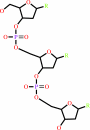 DNA(n)
|
+
|
2'-deoxyribonucleoside 5'-triphosphate
|
=
|
DNA(n+1)
|
+
|
 diphosphate
|
|
|
|
|
|
|
|
|
|
|
|
|
Molecule diagrams generated from .mol files obtained from the
KEGG ftp site
|
|
|
|
|
|
|
|
|
|
|
|
|
|
 |
|
|
|
|
|
|
| |
|
|
| |
|
DOI no:
|
Structure
10:535-546
(2002)
|
|
PubMed id:
|
|
|
|
|
|
| |
|
Structural basis for proofreading during replication of the Escherichia coli chromosome.
|
|
S.Hamdan,
P.D.Carr,
S.E.Brown,
D.L.Ollis,
N.E.Dixon.
|
|
|
|
|
| |
ABSTRACT
|
|
|
|
| |
|
|
The epsilon subunit of the Escherichia coli replicative DNA polymerase III is
the proofreading 3'-5' exonuclease. Structures of its catalytic N-terminal
domain (epsilon186) were determined at two pH values (5.8 and 8.5) at
resolutions of 1.7-1.8 A, in complex with two Mn(II) ions and a nucleotide
product of its reaction, thymidine 5'-monophosphate. The protein structure is
built around a core five-stranded beta sheet that is a common feature of members
of the DnaQ superfamily. The structures were identical, except for differences
in the way TMP and water molecules are coordinated to the binuclear metal center
in the active site. These data are used to develop a mechanism for epsilon and
to produce a plausible model of the complex of epsilon186 with DNA.
|
|
|
|
|
|
| |
Selected figure(s)
|
|
|
|
| |
|
|

|
|
Figure 3.
Figure 3. Structures of the Active Sites of  epsilon,
Greek 186 and Other Exonuclease Domains(A and B) Low- and
high-pH structures, respectively, of the active site of epsilon,
Greek 186. The two Mn(II) ions, Mn[A] and Mn[B] are shown (in
orange) coordinated to the 5'-phosphate of TMP. The remainder of
the TMP molecules are omitted for clarity (but see Figure 4).
Coordinated-water molecules are represented by red spheres.(C-E)
Comparative structures of the 3'-5' exonuclease active sites of
exonuclease I (PDB code 1FXX) [41], DNA polymerase I (1KRP)
[51], and bacteriophage T4 DNA polymerase (1NOY) [7]. Structures
were aligned as in Figure 2, and diagrams were drawn using
RIBBONS [78]. epsilon,
Greek 186 and Other Exonuclease Domains(A and B) Low- and
high-pH structures, respectively, of the active site of epsilon,
Greek 186. The two Mn(II) ions, Mn[A] and Mn[B] are shown (in
orange) coordinated to the 5'-phosphate of TMP. The remainder of
the TMP molecules are omitted for clarity (but see Figure 4).
Coordinated-water molecules are represented by red spheres.(C-E)
Comparative structures of the 3'-5' exonuclease active sites of
exonuclease I (PDB code 1FXX) [41], DNA polymerase I (1KRP)
[51], and bacteriophage T4 DNA polymerase (1NOY) [7]. Structures
were aligned as in Figure 2, and diagrams were drawn using
RIBBONS [78].
|
|
|
|
|
|
| |
The above figure is
reprinted
by permission from Cell Press:
Structure
(2002,
10,
535-546)
copyright 2002.
|
|
| |
Figure was
selected
by the author.
|
|
|
|
|
|
|
|
|
|
|
|
|
|
|
|
 |
 |
 |
|
Literature references that cite this PDB file's key reference
|
|
|
| |
PubMed id
|
|
Reference
|
|
|
|
|
|
V.M.Isabella,
and
V.L.Clark
(2011).
Deep sequencing-based analysis of the anaerobic stimulon in Neisseria gonorrhoeae.
|
| |
BMC Genomics,
12,
51.
|
|
|
|
|
|
|
W.Yang
(2011).
Nucleases: diversity of structure, function and mechanism.
|
| |
Q Rev Biophys,
44,
1.
|
|
|
|
|
|
|
Y.Y.Hsiao,
C.C.Yang,
C.L.Lin,
J.L.Lin,
Y.Duh,
and
H.S.Yuan
(2011).
Structural basis for RNA trimming by RNase T in stable RNA 3'-end maturation.
|
| |
Nat Chem Biol,
7,
236-243.
|
|
|
PDB codes:
|
|
|
|
|
|
|
|
G.Otting
(2010).
Protein NMR using paramagnetic ions.
|
| |
Annu Rev Biophys,
39,
387-405.
|
|
|
|
|
|
|
G.A.Cisneros,
L.Perera,
R.M.Schaaper,
L.C.Pedersen,
R.E.London,
L.G.Pedersen,
and
T.A.Darden
(2009).
Reaction mechanism of the epsilon subunit of E. coli DNA polymerase III: insights into active site metal coordination and catalytically significant residues.
|
| |
J Am Chem Soc,
131,
1550-1556.
|
|
|
|
|
|
|
M.Horiuchi,
K.Takeuchi,
N.Noda,
N.Muroya,
T.Suzuki,
T.Nakamura,
J.Kawamura-Tsuzuku,
K.Takahasi,
T.Yamamoto,
and
F.Inagaki
(2009).
Structural Basis for the Antiproliferative Activity of the Tob-hCaf1 Complex.
|
| |
J Biol Chem,
284,
13244-13255.
|
|
|
PDB code:
|
|
|
|
|
|
|
|
U.de Silva,
F.W.Perrino,
and
T.Hollis
(2009).
DNA binding induces active site conformational change in the human TREX2 3'-exonuclease.
|
| |
Nucleic Acids Res,
37,
2411-2417.
|
|
|
|
|
|
|
Y.Y.Hsiao,
A.Nakagawa,
Z.Shi,
S.Mitani,
D.Xue,
and
H.S.Yuan
(2009).
Crystal structure of CRN-4: implications for domain function in apoptotic DNA degradation.
|
| |
Mol Cell Biol,
29,
448-457.
|
|
|
PDB codes:
|
|
|
|
|
|
|
|
C.J.Jackson,
K.S.Hadler,
P.D.Carr,
A.J.Oakley,
S.Yip,
G.Schenk,
and
D.L.Ollis
(2008).
Malonate-bound structure of the glycerophosphodiesterase from Enterobacter aerogenes (GpdQ) and characterization of the native Fe2+ metal-ion preference.
|
| |
Acta Crystallogr Sect F Struct Biol Cryst Commun,
64,
681-685.
|
|
|
PDB codes:
|
|
|
|
|
|
|
|
D.Zhang,
H.Xiong,
J.Shan,
X.Xia,
and
V.L.Trudeau
(2008).
Functional insight into Maelstrom in the germline piRNA pathway: a unique domain homologous to the DnaQ-H 3'-5' exonuclease, its lineage-specific expansion/loss and evolutionarily active site switch.
|
| |
Biol Direct,
3,
48.
|
|
|
|
|
|
|
F.W.Perrino,
U.de Silva,
S.Harvey,
E.E.Pryor,
D.W.Cole,
and
T.Hollis
(2008).
Cooperative DNA binding and communication across the dimer interface in the TREX2 3' --> 5'-exonuclease.
|
| |
J Biol Chem,
283,
21441-21452.
|
|
|
|
|
|
|
K.Ozawa,
S.Jergic,
A.Y.Park,
N.E.Dixon,
and
G.Otting
(2008).
The proofreading exonuclease subunit epsilon of Escherichia coli DNA polymerase III is tethered to the polymerase subunit alpha via a flexible linker.
|
| |
Nucleic Acids Res,
36,
5074-5082.
|
|
|
PDB codes:
|
|
|
|
|
|
|
|
M.Brucet,
J.Querol-Audí,
K.Bertlik,
J.Lloberas,
I.Fita,
and
A.Celada
(2008).
Structural and biochemical studies of TREX1 inhibition by metals. Identification of a new active histidine conserved in DEDDh exonucleases.
|
| |
Protein Sci,
17,
2059-2069.
|
|
|
PDB codes:
|
|
|
|
|
|
|
|
R.D.Busam
(2008).
Structure of Escherichia coli exonuclease I in complex with thymidine 5'-monophosphate.
|
| |
Acta Crystallogr D Biol Crystallogr,
64,
206-210.
|
|
|
PDB code:
|
|
|
|
|
|
|
|
A.T.Jonstrup,
K.R.Andersen,
L.B.Van,
and
D.E.Brodersen
(2007).
The 1.4-A crystal structure of the S. pombe Pop2p deadenylase subunit unveils the configuration of an active enzyme.
|
| |
Nucleic Acids Res,
35,
3153-3164.
|
|
|
PDB code:
|
|
|
|
|
|
|
|
J.M.Choi,
S.Y.Kang,
W.J.Bae,
K.S.Jin,
M.Ree,
and
Y.Cho
(2007).
Probing the roles of active site residues in the 3'-5' exonuclease of the Werner syndrome protein.
|
| |
J Biol Chem,
282,
9941-9951.
|
|
|
|
|
|
|
M.Brucet,
J.Querol-Audí,
M.Serra,
X.Ramirez-Espain,
K.Bertlik,
L.Ruiz,
J.Lloberas,
M.J.Macias,
I.Fita,
and
A.Celada
(2007).
Structure of the dimeric exonuclease TREX1 in complex with DNA displays a proline-rich binding site for WW Domains.
|
| |
J Biol Chem,
282,
14547-14557.
|
|
|
PDB codes:
|
|
|
|
|
|
|
|
M.John,
and
G.Otting
(2007).
Strategies for measurements of pseudocontact shifts in protein NMR spectroscopy.
|
| |
Chemphyschem,
8,
2309-2313.
|
|
|
|
|
|
|
M.John,
M.J.Headlam,
N.E.Dixon,
and
G.Otting
(2007).
Assignment of paramagnetic (15)N-HSQC spectra by heteronuclear exchange spectroscopy.
|
| |
J Biomol NMR,
37,
43-51.
|
|
|
|
|
|
|
M.Maiti,
H.C.Lee,
and
Y.Liu
(2007).
QIP, a putative exonuclease, interacts with the Neurospora Argonaute protein and facilitates conversion of duplex siRNA into single strands.
|
| |
Genes Dev,
21,
590-600.
|
|
|
|
|
|
|
U.de Silva,
S.Choudhury,
S.L.Bailey,
S.Harvey,
F.W.Perrino,
and
T.Hollis
(2007).
The crystal structure of TREX1 explains the 3' nucleotide specificity and reveals a polyproline II helix for protein partnering.
|
| |
J Biol Chem,
282,
10537-10543.
|
|
|
PDB codes:
|
|
|
|
|
|
|
|
X.C.Su,
S.Jergic,
M.A.Keniry,
N.E.Dixon,
and
G.Otting
(2007).
Solution structure of Domains IVa and V of the tau subunit of Escherichia coli DNA polymerase III and interaction with the alpha subunit.
|
| |
Nucleic Acids Res,
35,
2825-2832.
|
|
|
PDB code:
|
|
|
|
|
|
|
|
Y.Zuo,
H.Zheng,
Y.Wang,
M.Chruszcz,
M.Cymborowski,
T.Skarina,
A.Savchenko,
A.Malhotra,
and
W.Minor
(2007).
Crystal structure of RNase T, an exoribonuclease involved in tRNA maturation and end turnover.
|
| |
Structure,
15,
417-428.
|
|
|
PDB codes:
|
|
|
|
|
|
|
|
A.K.Chikova,
and
R.M.Schaaper
(2006).
Mutator and antimutator effects of the bacteriophage P1 hot gene product.
|
| |
J Bacteriol,
188,
5831-5838.
|
|
|
|
|
|
|
A.Wieczorek,
and
C.S.McHenry
(2006).
The NH2-terminal php domain of the alpha subunit of the Escherichia coli replicase binds the epsilon proofreading subunit.
|
| |
J Biol Chem,
281,
12561-12567.
|
|
|
|
|
|
|
C.Schmitz,
M.John,
A.Y.Park,
N.E.Dixon,
G.Otting,
G.Pintacuda,
and
T.Huber
(2006).
Efficient chi-tensor determination and NH assignment of paramagnetic proteins.
|
| |
J Biomol NMR,
35,
79-87.
|
|
|
|
|
|
|
J.L.Beck,
T.Urathamakul,
S.J.Watt,
M.M.Sheil,
P.M.Schaeffer,
and
N.E.Dixon
(2006).
Proteomic dissection of DNA polymerization.
|
| |
Expert Rev Proteomics,
3,
197-211.
|
|
|
|
|
|
|
J.M.Kupsco,
M.J.Wu,
W.F.Marzluff,
R.Thapar,
and
R.J.Duronio
(2006).
Genetic and biochemical characterization of Drosophila Snipper: A promiscuous member of the metazoan 3'hExo/ERI-1 family of 3' to 5' exonucleases.
|
| |
RNA,
12,
2103-2117.
|
|
|
|
|
|
|
K.H.Chin,
C.Y.Yang,
C.C.Chou,
A.H.Wang,
and
S.H.Chou
(2006).
The crystal structure of XC847 from Xanthomonas campestris: a 3'-5' oligoribonuclease of DnaQ fold family with a novel opposingly shifted helix.
|
| |
Proteins,
65,
1036-1040.
|
|
|
PDB code:
|
|
|
|
|
|
|
|
M.A.Keniry,
A.Y.Park,
E.A.Owen,
S.M.Hamdan,
G.Pintacuda,
G.Otting,
and
N.E.Dixon
(2006).
Structure of the theta subunit of Escherichia coli DNA polymerase III in complex with the epsilon subunit.
|
| |
J Bacteriol,
188,
4464-4473.
|
|
|
PDB code:
|
|
|
|
|
|
|
|
T.W.Kirby,
S.Harvey,
E.F.DeRose,
S.Chalov,
A.K.Chikova,
F.W.Perrino,
R.M.Schaaper,
R.E.London,
and
L.C.Pedersen
(2006).
Structure of the Escherichia coli DNA polymerase III epsilon-HOT proofreading complex.
|
| |
J Biol Chem,
281,
38466-38471.
|
|
|
PDB code:
|
|
|
|
|
|
|
|
A.Johnson,
and
M.O'Donnell
(2005).
Cellular DNA replicases: components and dynamics at the replication fork.
|
| |
Annu Rev Biochem,
74,
283-315.
|
|
|
|
|
|
|
A.K.Chikova,
and
R.M.Schaaper
(2005).
The bacteriophage P1 hot gene product can substitute for the Escherichia coli DNA polymerase III {theta} subunit.
|
| |
J Bacteriol,
187,
5528-5536.
|
|
|
|
|
|
|
F.W.Perrino,
S.Harvey,
S.McMillin,
and
T.Hollis
(2005).
The human TREX2 3' -> 5'-exonuclease structure suggests a mechanism for efficient nonprocessive DNA catalysis.
|
| |
J Biol Chem,
280,
15212-15218.
|
|
|
PDB code:
|
|
|
|
|
|
|
|
M.Wu,
M.Reuter,
H.Lilie,
Y.Liu,
E.Wahle,
and
H.Song
(2005).
Structural insight into poly(A) binding and catalytic mechanism of human PARN.
|
| |
EMBO J,
24,
4082-4093.
|
|
|
PDB codes:
|
|
|
|
|
|
|
|
E.F.Derose,
T.W.Kirby,
G.A.Mueller,
A.K.Chikova,
R.M.Schaaper,
and
R.E.London
(2004).
Phage like it HOT: solution structure of the bacteriophage P1-encoded HOT protein, a homolog of the theta subunit of E. coli DNA polymerase III.
|
| |
Structure,
12,
2221-2231.
|
|
|
PDB code:
|
|
|
|
|
|
|
|
R.Gupta,
S.M.Hamdan,
N.E.Dixon,
M.M.Sheil,
and
J.L.Beck
(2004).
Application of electrospray ionization mass spectrometry to study the hydrophobic interaction between the epsilon and theta subunits of DNA polymerase III.
|
| |
Protein Sci,
13,
2878-2887.
|
|
|
|
|
|
|
S.A.Taft-Benz,
and
R.M.Schaaper
(2004).
The theta subunit of Escherichia coli DNA polymerase III: a role in stabilizing the epsilon proofreading subunit.
|
| |
J Bacteriol,
186,
2774-2780.
|
|
|
|
|
|
|
T.J.Fiedler,
H.A.Vincent,
Y.Zuo,
O.Gavrialov,
and
A.Malhotra
(2004).
Purification and crystallization of Escherichia coli oligoribonuclease.
|
| |
Acta Crystallogr D Biol Crystallogr,
60,
736-739.
|
|
|
|
|
|
|
Y.Shen,
X.F.Tang,
H.Yokoyama,
E.Matsui,
and
I.Matsui
(2004).
A 21-amino acid peptide from the cysteine cluster II of the family D DNA polymerase from Pyrococcus horikoshii stimulates its nuclease activity which is Mre11-like and prefers manganese ion as the cofactor.
|
| |
Nucleic Acids Res,
32,
158-168.
|
|
|
|
|
|
The most recent references are shown first.
Citation data come partly from CiteXplore and partly
from an automated harvesting procedure. Note that this is likely to be
only a partial list as not all journals are covered by
either method. However, we are continually building up the citation data
so more and more references will be included with time.
Where a reference describes a PDB structure, the PDB
codes are
shown on the right.
|
|


 Links
Links


