
|
|
|
|
|
 |
Contents |
 |
|
|
|
|
|
|
|
|
|
|
|

 129 a.a.
|
|
|
|
|
|
|
|
|
|
|
 211 a.a.
|
|
|
|
|
|
|
|
|
|
|
 196 a.a.
|
|
|
|
|
|
|
|
|
* Residue conservation analysis
|
|
|
|
|
|
PDB id:
|
|
|
|
| Name: |
|
Growth factor/growth factor receptor
|
|
|
Title:
|
|
Crystal structure of a ternary fgf2-fgfr1-heparin complex
|
|
Structure:
|
|
Fibroblast growth factor 2. Chain: a, b. Fragment: the b-trefoil core of fibroblast growth factor 2 (fgf2). Synonym: fgf2. Engineered: yes. Mutation: yes. Fibroblast growth factor receptor 1. Chain: c, d. Fragment: extracellular ligand binding domain of fgf receptor 1
|
|
Source:
|
|
Homo sapiens. Human. Organism_taxid: 9606. Expressed in: escherichia coli. Expression_system_taxid: 562. Expression_system_taxid: 562
|
|
Biol. unit:
|
|
 Octamer (from
)
Octamer (from
)
|
|
Resolution:
|
|
|
3.00Å
|
R-factor:
|
0.229
|
R-free:
|
0.282
|
|
|
Authors:
|
|
J.Schlessinger,A.N.Plotnikov,O.A.Ibrahimi,A.V.Eliseenkova,B.K.Yeh, A.Yayon,R.J.Linhardt,M.Mohammadi
|
Key ref:

|
|
J.Schlessinger
et al.
(2000).
Crystal structure of a ternary FGF-FGFR-heparin complex reveals a dual role for heparin in FGFR binding and dimerization.
Mol Cell,
6,
743-750.
PubMed id:
DOI:

|
|
|
Date:
|
|
|
04-Sep-00
|
Release date:
|
27-Sep-00
|
|
|
|
|
|
|
PROCHECK
|

|
|
|
|
|
Headers
|
|
|
|
References
|
|
|
|
|
|

|
|
P09038
(FGF2_HUMAN) -
Fibroblast growth factor 2 from Homo sapiens
|
|
|
|
Seq:
Struc:
|
|
|
|
288 a.a.
129 a.a.*
|
|

|

|

|
|
|
|
|
|
|
|
|
|
|
|
|
|
|
|
|
Enzyme class:
|
|
Chains C, D:
E.C.2.7.10.1
- receptor protein-tyrosine kinase.
|
|
|
|
|
|
|
Reaction:
|
|
L-tyrosyl-[protein] + ATP = O-phospho-L-tyrosyl-[protein] + ADP + H+
|
|
|
|
|
|
L-tyrosyl-[protein]
|
+
|
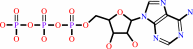 ATP
ATP
|
=
|
O-phospho-L-tyrosyl-[protein]
|
+
|
 ADP
ADP
|
+
|
H(+)
|
|
|
|
|
|
|
|
|
|
|
|
|
Molecule diagrams generated from .mol files obtained from the
KEGG ftp site
|
|
|
|
|
|
|
|
|
|
|
|
|
|
 |
|
|
|
|
|
|
| |
|
|
| |
|
DOI no:
|
Mol Cell
6:743-750
(2000)
|
|
PubMed id:
|
|
|
|
|
|
| |
|
Crystal structure of a ternary FGF-FGFR-heparin complex reveals a dual role for heparin in FGFR binding and dimerization.
|
|
J.Schlessinger,
A.N.Plotnikov,
O.A.Ibrahimi,
A.V.Eliseenkova,
B.K.Yeh,
A.Yayon,
R.J.Linhardt,
M.Mohammadi.
|
|
|
|
|
| |
ABSTRACT
|
|
|
|
| |
|
|
The crystal structure of a dimeric 2:2:2 FGF:FGFR:heparin ternary complex at 3 A
resolution has been determined. Within each 1:1 FGF:FGFR complex, heparin makes
numerous contacts with both FGF and FGFR, thereby augmenting FGF-FGFR binding.
Heparin also interacts with FGFR in the adjoining 1:1 FGF:FGFR complex to
promote FGFR dimerization. The 6-O-sulfate group of heparin plays a pivotal role
in mediating both interactions. The unexpected stoichiometry of heparin binding
in the structure led us to propose a revised model for FGFR dimerization.
Biochemical data in support of this model are also presented. This model
provides a structural basis for FGFR activation by small molecule heparin
analogs and may facilitate the design of heparin mimetics capable of modulating
FGF signaling.
|
|
|
|
|
|
| |
Selected figure(s)
|
|
|
|
| |
|
|

|
|

|
|
Figure 1.
Figure 1. Electron Density Map of Decasaccharides Soaked
into Preformed Crystals of an FGF2-FGFR1 Complex(A) Location of
decasaccharides in the dimeric assemblage. Only the C[α] traces
of D2s (cyan) and FGFs (orange) are shown. The decasaccharides
are rendered in white sticks.(B) Stereo view of F[o] −F[c]
electron density map computed after simulated annealing with
decasaccharide omitted from the atomic model. The map is
computed at 3.0 Å resolution and contoured at 1.8 σ.
Sugar rings are labeled A through H starting at the nonreducing
end of the decasaccharide. Atom coloring is as follows: oxygens
in red, sulfurs in yellow, nitrogens in blue, and carbons in
gray. This figure was made using Bobscript ([4]).
|
|
Figure 4.
Figure 4. The Two-End ModelMolecular surface representation
of the dimeric 2:2:2 FGF2-FGFR1-heparin ternary complex. The
view is from the top (same view as Figure 1A ) looking down into
the heparin binding canyon. Surface coloring is as follows: FGF2
in orange and D2 in green. Only the first six sugar rings of the
decasaccharides are rendered in ball-and-stick, and the
nonreducing and reducing ends are labeled. This figure was
created with GRASP ( [20]).
|
|
|
|
|
|
| |
The above figures are
reprinted
by permission from Cell Press:
Mol Cell
(2000,
6,
743-750)
copyright 2000.
|
|
| |
Figures were
selected
by an automated process.
|
|
|
|
|
|
|
|
|
|
|
|
|
|
|
|
 |
 |
 |
|
Literature references that cite this PDB file's key reference
|
|
|
| |
PubMed id
|
|
Reference
|
|
|
|
|
|
R.Goetz,
and
M.Mohammadi
(2013).
Exploring mechanisms of FGF signalling through the lens of structural biology.
|
| |
Nat Rev Mol Cell Biol,
14,
166-180.
|
|
|
|
|
|
|
C.Thomas,
J.F.Bazan,
and
K.C.Garcia
(2012).
Structure of the activating IL-1 receptor signaling complex.
|
| |
Nat Struct Mol Biol,
19,
455-457.
|
|
|
PDB code:
|
|
|
|
|
|
|
|
M.F.Baietti,
Z.Zhang,
E.Mortier,
A.Melchior,
G.Degeest,
A.Geeraerts,
Y.Ivarsson,
F.Depoortere,
C.Coomans,
E.Vermeiren,
P.Zimmermann,
and
G.David
(2012).
Syndecan-syntenin-ALIX regulates the biogenesis of exosomes.
|
| |
Nat Cell Biol,
14,
677-685.
|
|
|
|
|
|
|
A.Langsdorf,
V.Schumacher,
X.Shi,
T.Tran,
J.Zaia,
S.Jain,
M.Taglienti,
J.A.Kreidberg,
A.Fine,
and
X.Ai
(2011).
Expression regulation and function of heparan sulfate 6-O-endosulfatases in the spermatogonial stem cell niche.
|
| |
Glycobiology,
21,
152-161.
|
|
|
|
|
|
|
A.Ruggiero,
F.Squeglia,
D.Marasco,
R.Marchetti,
A.Molinaro,
and
R.Berisio
(2011).
X-ray structural studies of the entire extracellular region of the serine/threonine kinase PrkC from Staphylococcus aureus.
|
| |
Biochem J,
435,
33-41.
|
|
|
PDB code:
|
|
|
|
|
|
|
|
B.H.Biersmith,
M.Hammel,
E.R.Geisbrecht,
and
S.Bouyain
(2011).
The Immunoglobulin-like Domains 1 and 2 of the Protein Tyrosine Phosphatase LAR Adopt an Unusual Horseshoe-like Conformation.
|
| |
J Mol Biol,
408,
616-627.
|
|
|
PDB codes:
|
|
|
|
|
|
|
|
G.O.Staples,
X.Shi,
and
J.Zaia
(2011).
Glycomics Analysis of Mammalian Heparan Sulfates Modified by the Human Extracellular Sulfatase HSulf2.
|
| |
PLoS One,
6,
e16689.
|
|
|
|
|
|
|
G.S.Schultz,
J.M.Davidson,
R.S.Kirsner,
P.Bornstein,
and
I.M.Herman
(2011).
Dynamic reciprocity in the wound microenvironment.
|
| |
Wound Repair Regen,
19,
134-148.
|
|
|
|
|
|
|
J.Gupte,
L.Yang,
X.Wu,
J.Weiszmann,
R.Hecht,
B.Lemon,
R.Lindberg,
Z.Wang,
and
Y.Li
(2011).
The FGFR D3 domain determines receptor selectivity for fibroblast growth factor 21.
|
| |
J Mol Biol,
408,
491-502.
|
|
|
|
|
|
|
J.M.Dreyfuss,
C.Jacobs,
Y.Gindin,
G.Benson,
G.O.Staples,
and
J.Zaia
(2011).
Targeted analysis of glycomics liquid chromatography/mass spectrometry data.
|
| |
Anal Bioanal Chem,
399,
727-735.
|
|
|
|
|
|
|
K.Rose
(2011).
Interaction of ATP with fibroblast growth factor 2: biochemical characterization and consequence for growth factor stability.
|
| |
BMC Biochem,
12,
14.
|
|
|
|
|
|
|
N.A.Sunmonu,
K.Li,
and
J.Y.Li
(2011).
Numerous isoforms of Fgf8 reflect its multiple roles in the developing brain.
|
| |
J Cell Physiol,
226,
1722-1726.
|
|
|
|
|
|
|
A.K.Powell,
Y.A.Ahmed,
E.A.Yates,
and
J.E.Turnbull
(2010).
Generating heparan sulfate saccharide libraries for glycomics applications.
|
| |
Nat Protoc,
5,
821-833.
|
|
|
|
|
|
|
A.L.Ellis,
W.Pan,
G.Yang,
K.Jones,
C.Chuang,
J.M.Whitelock,
and
A.A.DeCarlo
(2010).
Similarity of recombinant human perlecan domain 1 by alternative expression systems bioactive heterogenous recombinant human perlecan D1.
|
| |
BMC Biotechnol,
10,
66.
|
|
|
|
|
|
|
B.C.Heng,
P.P.Bezerra,
Q.R.Meng,
D.W.Chin,
L.B.Koh,
H.Li,
H.Zhang,
P.R.Preiser,
F.Y.Boey,
and
S.S.Venkatraman
(2010).
Adhesion, proliferation, and gene expression profile of human umbilical vein endothelial cells cultured on bilayered polyelectrolyte coatings composed of glycosaminoglycans.
|
| |
Biointerphases,
5,
FA53-FA62.
|
|
|
|
|
|
|
B.Eckes,
R.Nischt,
and
T.Krieg
(2010).
Cell-matrix interactions in dermal repair and scarring.
|
| |
Fibrogenesis Tissue Repair,
3,
4.
|
|
|
|
|
|
|
B.Zhao,
C.Zhang,
K.Forsten-Williams,
J.Zhang,
and
M.Fannon
(2010).
Endothelial cell capture of heparin-binding growth factors under flow.
|
| |
PLoS Comput Biol,
6,
e1000971.
|
|
|
|
|
|
|
C.R.Degnin,
M.B.Laederich,
and
W.A.Horton
(2010).
FGFs in endochondral skeletal development.
|
| |
J Cell Biochem,
110,
1046-1057.
|
|
|
|
|
|
|
D.Leali,
R.Bianchi,
A.Bugatti,
S.Nicoli,
S.Mitola,
L.Ragona,
S.Tomaselli,
G.Gallo,
S.Catello,
V.Rivieccio,
L.Zetta,
and
M.Presta
(2010).
Fibroblast growth factor 2-antagonist activity of a long-pentraxin 3-derived anti-angiogenic pentapeptide.
|
| |
J Cell Mol Med,
14,
2109-2121.
|
|
|
|
|
|
|
G.Ren,
J.Yin,
W.Wang,
L.Li,
and
D.Li
(2010).
Fibroblast growth factor (FGF)-21 signals through both FGF receptor-1 and 2.
|
| |
Sci China Life Sci,
53,
1000-1008.
|
|
|
|
|
|
|
G.Zimmer,
S.M.Schanuel,
S.Bürger,
F.Weth,
A.Steinecke,
J.Bolz,
and
R.Lent
(2010).
Chondroitin sulfate acts in concert with semaphorin 3A to guide tangential migration of cortical interneurons in the ventral telencephalon.
|
| |
Cereb Cortex,
20,
2411-2422.
|
|
|
|
|
|
|
H.Zhu,
L.Duchesne,
P.S.Rudland,
and
D.G.Fernig
(2010).
The heparan sulfate co-receptor and the concentration of fibroblast growth factor-2 independently elicit different signalling patterns from the fibroblast growth factor receptor.
|
| |
Cell Commun Signal,
8,
14.
|
|
|
|
|
|
|
J.Azzi,
A.S.Geara,
S.El-Sayegh,
and
R.Abdi
(2010).
Immunological aspects of pancreatic islet cell transplantation.
|
| |
Expert Rev Clin Immunol,
6,
111-124.
|
|
|
|
|
|
|
J.Dong,
S.Yao,
X.Zhou,
L.Zhang,
and
Y.Xu
(2010).
Synthesis of N-heteroaroyl aminosaccharide derivatives as fibroblast growth factor 2 signaling modulators.
|
| |
Chem Pharm Bull (Tokyo),
58,
1210-1215.
|
|
|
|
|
|
|
J.Gutiérrez,
and
E.Brandan
(2010).
A novel mechanism of sequestering fibroblast growth factor 2 by glypican in lipid rafts, allowing skeletal muscle differentiation.
|
| |
Mol Cell Biol,
30,
1634-1649.
|
|
|
|
|
|
|
J.Ratelade,
C.Arrondel,
G.Hamard,
S.Garbay,
S.Harvey,
N.Biebuyck,
H.Schulz,
N.Hastie,
M.Pontoglio,
M.C.Gubler,
C.Antignac,
and
L.Heidet
(2010).
A murine model of Denys-Drash syndrome reveals novel transcriptional targets of WT1 in podocytes.
|
| |
Hum Mol Genet,
19,
1.
|
|
|
|
|
|
|
M.J.Webber,
X.Han,
S.N.Murthy,
K.Rajangam,
S.I.Stupp,
and
J.W.Lomasney
(2010).
Capturing the stem cell paracrine effect using heparin-presenting nanofibres to treat cardiovascular diseases.
|
| |
J Tissue Eng Regen Med,
4,
600-610.
|
|
|
|
|
|
|
M.Kuro-o
(2010).
Overview of the FGF23-Klotho axis.
|
| |
Pediatr Nephrol,
25,
583-590.
|
|
|
|
|
|
|
M.Kuro-o
(2010).
A potential link between phosphate and aging--lessons from Klotho-deficient mice.
|
| |
Mech Ageing Dev,
131,
270-275.
|
|
|
|
|
|
|
M.Ly,
T.N.Laremore,
and
R.J.Linhardt
(2010).
Proteoglycomics: recent progress and future challenges.
|
| |
OMICS,
14,
389-399.
|
|
|
|
|
|
|
O.J.Park,
H.J.Kim,
K.M.Woo,
J.H.Baek,
and
H.M.Ryoo
(2010).
FGF2-activated ERK mitogen-activated protein kinase enhances Runx2 acetylation and stabilization.
|
| |
J Biol Chem,
285,
3568-3574.
|
|
|
|
|
|
|
R.Gill,
L.Hitchins,
F.Fletcher,
and
G.K.Dhoot
(2010).
Sulf1A and HGF regulate satellite-cell growth.
|
| |
J Cell Sci,
123,
1873-1883.
|
|
|
|
|
|
|
T.Kobayashi,
H.Habuchi,
K.Nogami,
S.Ashikari-Hada,
K.Tamura,
H.Ide,
and
K.Kimata
(2010).
Functional analysis of chick heparan sulfate 6-O-sulfotransferases in limb bud development.
|
| |
Dev Growth Differ,
52,
146-156.
|
|
|
|
|
|
|
W.J.Kuo,
M.A.Digman,
and
A.D.Lander
(2010).
Heparan sulfate acts as a bone morphogenetic protein coreceptor by facilitating ligand-induced receptor hetero-oligomerization.
|
| |
Mol Biol Cell,
21,
4028-4041.
|
|
|
|
|
|
|
X.Wu,
H.Ge,
B.Lemon,
S.Vonderfecht,
H.Baribault,
J.Weiszmann,
J.Gupte,
J.Gardner,
R.Lindberg,
Z.Wang,
and
Y.Li
(2010).
Separating mitogenic and metabolic activities of fibroblast growth factor 19 (FGF19).
|
| |
Proc Natl Acad Sci U S A,
107,
14158-14163.
|
|
|
|
|
|
|
Y.Hu,
and
P.M.Bouloux
(2010).
Novel insights in FGFR1 regulation: lessons from Kallmann syndrome.
|
| |
Trends Endocrinol Metab,
21,
385-393.
|
|
|
|
|
|
|
A.Beenken,
and
M.Mohammadi
(2009).
The FGF family: biology, pathophysiology and therapy.
|
| |
Nat Rev Drug Discov,
8,
235-253.
|
|
|
|
|
|
|
B.C.Melnik,
G.Schmitz,
and
C.C.Zouboulis
(2009).
Anti-acne agents attenuate FGFR2 signal transduction in acne.
|
| |
J Invest Dermatol,
129,
1868-1877.
|
|
|
|
|
|
|
E.V.Grigor'eva,
A.I.Shevchenko,
N.A.Mazurok,
E.A.Elisaphenko,
A.I.Zhelezova,
A.G.Shilov,
P.A.Dyban,
A.P.Dyban,
E.M.Noniashvili,
S.Y.Slobodyanyuk,
T.B.Nesterova,
N.Brockdorff,
and
S.M.Zakian
(2009).
FGF4 independent derivation of trophoblast stem cells from the common vole.
|
| |
PLoS One,
4,
e7161.
|
|
|
|
|
|
|
F.Zong,
E.Fthenou,
N.Wolmer,
P.Hollósi,
I.Kovalszky,
L.Szilák,
C.Mogler,
G.Nilsonne,
G.Tzanakakis,
and
K.Dobra
(2009).
Syndecan-1 and FGF-2, but not FGF receptor-1, share a common transport route and co-localize with heparanase in the nuclei of mesenchymal tumor cells.
|
| |
PLoS One,
4,
e7346.
|
|
|
|
|
|
|
H.Ijiri,
F.Coulibaly,
G.Nishimura,
D.Nakai,
E.Chiu,
C.Takenaka,
K.Ikeda,
H.Nakazawa,
N.Hamada,
E.Kotani,
P.Metcalf,
S.Kawamata,
and
H.Mori
(2009).
Structure-based targeting of bioactive proteins into cypovirus polyhedra and application to immobilized cytokines for mammalian cell culture.
|
| |
Biomaterials,
30,
4297-4308.
|
|
|
|
|
|
|
H.P.Makarenkova,
M.P.Hoffman,
A.Beenken,
A.V.Eliseenkova,
R.Meech,
C.Tsau,
V.N.Patel,
R.A.Lang,
and
M.Mohammadi
(2009).
Differential interactions of FGFs with heparan sulfate control gradient formation and branching morphogenesis.
|
| |
Sci Signal,
2,
ra55.
|
|
|
|
|
|
|
I.Kalus,
B.Salmen,
C.Viebahn,
K.von Figura,
D.Schmitz,
R.D'Hooge,
and
T.Dierks
(2009).
Differential involvement of the extracellular 6-O-endosulfatases Sulf1 and Sulf2 in brain development and neuronal and behavioural plasticity.
|
| |
J Cell Mol Med,
13,
4505-4521.
|
|
|
|
|
|
|
J.Gattineni,
C.Bates,
K.Twombley,
V.Dwarakanath,
M.L.Robinson,
R.Goetz,
M.Mohammadi,
and
M.Baum
(2009).
FGF23 decreases renal NaPi-2a and NaPi-2c expression and induces hypophosphatemia in vivo predominantly via FGF receptor 1.
|
| |
Am J Physiol Renal Physiol,
297,
F282-F291.
|
|
|
|
|
|
|
J.Jia,
M.Maccarana,
X.Zhang,
M.Bespalov,
U.Lindahl,
and
J.P.Li
(2009).
Lack of L-iduronic acid in heparan sulfate affects interaction with growth factors and cell signaling.
|
| |
J Biol Chem,
284,
15942-15950.
|
|
|
|
|
|
|
J.Kalinina,
S.A.Byron,
H.P.Makarenkova,
S.K.Olsen,
A.V.Eliseenkova,
W.J.Larochelle,
M.Dhanabal,
S.Blais,
D.M.Ornitz,
L.A.Day,
T.A.Neubert,
P.M.Pollock,
and
M.Mohammadi
(2009).
Homodimerization controls the fibroblast growth factor 9 subfamily's receptor binding and heparan sulfate-dependent diffusion in the extracellular matrix.
|
| |
Mol Cell Biol,
29,
4663-4678.
|
|
|
PDB code:
|
|
|
|
|
|
|
|
J.Moreaux,
A.C.Sprynski,
S.R.Dillon,
K.Mahtouk,
M.Jourdan,
A.Ythier,
P.Moine,
N.Robert,
E.Jourdan,
J.F.Rossi,
and
B.Klein
(2009).
APRIL and TACI interact with syndecan-1 on the surface of multiple myeloma cells to form an essential survival loop.
|
| |
Eur J Haematol,
83,
119-129.
|
|
|
|
|
|
|
J.N.Cash,
C.A.Rejon,
A.C.McPherron,
D.J.Bernard,
and
T.B.Thompson
(2009).
The structure of myostatin:follistatin 288: insights into receptor utilization and heparin binding.
|
| |
EMBO J,
28,
2662-2676.
|
|
|
PDB code:
|
|
|
|
|
|
|
|
M.Harada,
H.Murakami,
A.Okawa,
N.Okimoto,
S.Hiraoka,
T.Nakahara,
R.Akasaka,
Y.Shiraishi,
N.Futatsugi,
Y.Mizutani-Koseki,
A.Kuroiwa,
M.Shirouzu,
S.Yokoyama,
M.Taiji,
S.Iseki,
D.M.Ornitz,
and
H.Koseki
(2009).
FGF9 monomer-dimer equilibrium regulates extracellular matrix affinity and tissue diffusion.
|
| |
Nat Genet,
41,
289-298.
|
|
|
|
|
|
|
M.Zakrzewska,
A.Wiedlocha,
A.Szlachcic,
D.Krowarsch,
J.Otlewski,
and
S.Olsnes
(2009).
Increased protein stability of FGF1 can compensate for its reduced affinity for heparin.
|
| |
J Biol Chem,
284,
25388-25403.
|
|
|
|
|
|
|
O.Gorbenko,
G.Ovcharenko,
T.Klymenko,
O.Zhyvoloup,
N.Gaman,
D.Volkova,
I.Gout,
and
V.Filonenko
(2009).
Generation of monoclonal antibody targeting fibroblast growth factor receptor 3.
|
| |
Hybridoma (Larchmt),
28,
295-300.
|
|
|
|
|
|
|
Q.Zheng,
Y.Zhang,
Y.Chen,
N.Yang,
X.J.Wang,
and
D.Zhu
(2009).
Systematic identification of genes involved in divergent skeletal muscle growth rates of broiler and layer chickens.
|
| |
BMC Genomics,
10,
87.
|
|
|
|
|
|
|
S.Ashikari-Hada,
H.Habuchi,
N.Sugaya,
T.Kobayashi,
and
K.Kimata
(2009).
Specific inhibition of FGF-2 signaling with 2-O-sulfated octasaccharides of heparan sulfate.
|
| |
Glycobiology,
19,
644-654.
|
|
|
|
|
|
|
S.Ghanaati,
M.J.Webber,
R.E.Unger,
C.Orth,
J.F.Hulvat,
S.E.Kiehna,
M.Barbeck,
A.Rasic,
S.I.Stupp,
and
C.J.Kirkpatrick
(2009).
Dynamic in vivo biocompatibility of angiogenic peptide amphiphile nanofibers.
|
| |
Biomaterials,
30,
6202-6212.
|
|
|
|
|
|
|
S.Li,
C.Christensen,
L.B.Køhler,
V.V.Kiselyov,
V.Berezin,
and
E.Bock
(2009).
Agonists of fibroblast growth factor receptor induce neurite outgrowth and survival of cerebellar granule neurons.
|
| |
Dev Neurobiol,
69,
837-854.
|
|
|
|
|
|
|
Y.Chen,
M.Mohammadi,
and
J.G.Flanagan
(2009).
Graded levels of FGF protein span the midbrain and can instruct graded induction and repression of neural mapping labels.
|
| |
Neuron,
62,
773-780.
|
|
|
|
|
|
|
Y.Hadari,
and
J.Schlessinger
(2009).
FGFR3-targeted mAb therapy for bladder cancer and multiple myeloma.
|
| |
J Clin Invest,
119,
1077-1079.
|
|
|
|
|
|
|
Y.Hu,
S.E.Guimond,
P.Travers,
S.Cadman,
E.Hohenester,
J.E.Turnbull,
S.H.Kim,
and
P.M.Bouloux
(2009).
Novel mechanisms of fibroblast growth factor receptor 1 regulation by extracellular matrix protein anosmin-1.
|
| |
J Biol Chem,
284,
29905-29920.
|
|
|
|
|
|
|
Y.Luo,
C.Yang,
C.Jin,
R.Xie,
F.Wang,
and
W.L.McKeehan
(2009).
Novel phosphotyrosine targets of FGFR2IIIb signaling.
|
| |
Cell Signal,
21,
1370-1378.
|
|
|
|
|
|
|
A.Beermann,
and
R.Schröder
(2008).
Sites of Fgf signalling and perception during embryogenesis of the beetle Tribolium castaneum.
|
| |
Dev Genes Evol,
218,
153-167.
|
|
|
|
|
|
|
D.G.Seidler,
and
R.Dreier
(2008).
Decorin and its galactosaminoglycan chain: extracellular regulator of cellular function?
|
| |
IUBMB Life,
60,
729-733.
|
|
|
|
|
|
|
J.Falardeau,
W.C.Chung,
A.Beenken,
T.Raivio,
L.Plummer,
Y.Sidis,
E.E.Jacobson-Dickman,
A.V.Eliseenkova,
J.Ma,
A.Dwyer,
R.Quinton,
S.Na,
J.E.Hall,
C.Huot,
N.Alois,
S.H.Pearce,
L.W.Cole,
V.Hughes,
M.Mohammadi,
P.Tsai,
and
N.Pitteloud
(2008).
Decreased FGF8 signaling causes deficiency of gonadotropin-releasing hormone in humans and mice.
|
| |
J Clin Invest,
118,
2822-2831.
|
|
|
|
|
|
|
J.P.Lai,
J.R.Thompson,
D.S.Sandhu,
and
L.R.Roberts
(2008).
Heparin-degrading sulfatases in hepatocellular carcinoma: roles in pathogenesis and therapy targets.
|
| |
Future Oncol,
4,
803-814.
|
|
|
|
|
|
|
K.M.Ferguson
(2008).
Structure-based view of epidermal growth factor receptor regulation.
|
| |
Annu Rev Biophys,
37,
353-373.
|
|
|
|
|
|
|
K.R.Catlow,
J.A.Deakin,
Z.Wei,
M.Delehedde,
D.G.Fernig,
E.Gherardi,
J.T.Gallagher,
M.S.Pavão,
and
M.Lyon
(2008).
Interactions of hepatocyte growth factor/scatter factor with various glycosaminoglycans reveal an important interplay between the presence of iduronate and sulfate density.
|
| |
J Biol Chem,
283,
5235-5248.
|
|
|
|
|
|
|
K.Rajangam,
M.S.Arnold,
M.A.Rocco,
and
S.I.Stupp
(2008).
Peptide amphiphile nanostructure-heparin interactions and their relationship to bioactivity.
|
| |
Biomaterials,
29,
3298-3305.
|
|
|
|
|
|
|
K.Rose,
S.Pallast,
S.Klumpp,
and
J.Krieglstein
(2008).
ATP-binding on fibroblast growth factor 2 partially overlaps with the heparin-binding domain.
|
| |
J Biochem,
144,
343-347.
|
|
|
|
|
|
|
K.Tan,
M.Duquette,
J.H.Liu,
K.Shanmugasundaram,
A.Joachimiak,
J.T.Gallagher,
A.C.Rigby,
J.H.Wang,
and
J.Lawler
(2008).
Heparin-induced cis- and trans-dimerization modes of the thrombospondin-1 N-terminal domain.
|
| |
J Biol Chem,
283,
3932-3941.
|
|
|
PDB codes:
|
|
|
|
|
|
|
|
M.Kuro-o
(2008).
Endocrine FGFs and Klothos: emerging concepts.
|
| |
Trends Endocrinol Metab,
19,
239-245.
|
|
|
|
|
|
|
N.Fukuhara,
J.A.Howitt,
S.A.Hussain,
and
E.Hohenester
(2008).
Structural and functional analysis of slit and heparin binding to immunoglobulin-like domains 1 and 2 of Drosophila Robo.
|
| |
J Biol Chem,
283,
16226-16234.
|
|
|
PDB codes:
|
|
|
|
|
|
|
|
N.Kulahin,
V.Kiselyov,
A.Kochoyan,
O.Kristensen,
J.S.Kastrup,
V.Berezin,
E.Bock,
and
M.Gajhede
(2008).
Dimerization effect of sucrose octasulfate on rat FGF1.
|
| |
Acta Crystallogr Sect F Struct Biol Cryst Commun,
64,
448-452.
|
|
|
PDB code:
|
|
|
|
|
|
|
|
N.S.Gandhi,
and
R.L.Mancera
(2008).
The structure of glycosaminoglycans and their interactions with proteins.
|
| |
Chem Biol Drug Des,
72,
455-482.
|
|
|
|
|
|
|
N.Sugaya,
H.Habuchi,
N.Nagai,
S.Ashikari-Hada,
and
K.Kimata
(2008).
6-O-sulfation of heparan sulfate differentially regulates various fibroblast growth factor-dependent signalings in culture.
|
| |
J Biol Chem,
283,
10366-10376.
|
|
|
|
|
|
|
S.Hussain,
M.Slevin,
S.Matou,
N.Ahmed,
M.I.Choudhary,
R.Ranjit,
D.West,
and
J.Gaffney
(2008).
Anti-angiogenic activity of sesterterpenes; natural product inhibitors of FGF-2-induced angiogenesis.
|
| |
Angiogenesis,
11,
245-256.
|
|
|
|
|
|
|
S.J.Goodger,
C.J.Robinson,
K.J.Murphy,
N.Gasiunas,
N.J.Harmer,
T.L.Blundell,
D.A.Pye,
and
J.T.Gallagher
(2008).
Evidence that heparin saccharides promote FGF2 mitogenesis through two distinct mechanisms.
|
| |
J Biol Chem,
283,
13001-13008.
|
|
|
|
|
|
|
S.Nadanaka,
M.Ishida,
M.Ikegami,
and
H.Kitagawa
(2008).
Chondroitin 4-O-Sulfotransferase-1 Modulates Wnt-3a Signaling through Control of E Disaccharide Expression of Chondroitin Sulfate.
|
| |
J Biol Chem,
283,
27333-27343.
|
|
|
|
|
|
|
S.R.Pallerla,
R.Lawrence,
L.Lewejohann,
Y.Pan,
T.Fischer,
U.Schlomann,
X.Zhang,
J.D.Esko,
and
K.Grobe
(2008).
Altered heparan sulfate structure in mice with deleted NDST3 gene function.
|
| |
J Biol Chem,
283,
16885-16894.
|
|
|
|
|
|
|
V.N.Patel,
K.M.Likar,
S.Zisman-Rozen,
S.N.Cowherd,
K.S.Lassiter,
I.Sher,
E.A.Yates,
J.E.Turnbull,
D.Ron,
and
M.P.Hoffman
(2008).
Specific heparan sulfate structures modulate FGF10-mediated submandibular gland epithelial morphogenesis and differentiation.
|
| |
J Biol Chem,
283,
9308-9317.
|
|
|
|
|
|
|
W.M.Abdel-Rahman,
J.Kalinina,
S.Shoman,
S.Eissa,
M.Ollikainen,
O.Elomaa,
A.V.Eliseenkova,
R.Bützow,
M.Mohammadi,
and
P.Peltomäki
(2008).
Somatic FGF9 mutations in colorectal and endometrial carcinomas associated with membranous beta-catenin.
|
| |
Hum Mutat,
29,
390-397.
|
|
|
|
|
|
|
W.Zhang,
Y.Chen,
M.R.Swift,
E.Tassi,
D.C.Stylianou,
K.A.Gibby,
A.T.Riegel,
and
A.Wellstein
(2008).
Effect of FGF-binding Protein 3 on Vascular Permeability.
|
| |
J Biol Chem,
283,
28329-28337.
|
|
|
|
|
|
|
X.Yue,
X.Li,
H.T.Nguyen,
D.R.Chin,
D.E.Sullivan,
and
J.A.Lasky
(2008).
Transforming growth factor-beta1 induces heparan sulfate 6-O-endosulfatase 1 expression in vitro and in vivo.
|
| |
J Biol Chem,
283,
20397-20407.
|
|
|
|
|
|
|
Y.Yamazaki,
T.Tamada,
N.Kasai,
I.Urakawa,
Y.Aono,
H.Hasegawa,
T.Fujita,
R.Kuroki,
T.Yamashita,
S.Fukumoto,
and
T.Shimada
(2008).
Anti-FGF23 neutralizing antibodies show the physiological role and structural features of FGF23.
|
| |
J Bone Miner Res,
23,
1509-1518.
|
|
|
|
|
|
|
Y.Yang,
S.Yuzawa,
and
J.Schlessinger
(2008).
Contacts between membrane proximal regions of the PDGF receptor ectodomain are required for receptor activation but not for receptor dimerization.
|
| |
Proc Natl Acad Sci U S A,
105,
7681-7686.
|
|
|
|
|
|
|
B.C.Lin,
M.Wang,
C.Blackmore,
and
L.R.Desnoyers
(2007).
Liver-specific activities of FGF19 require Klotho beta.
|
| |
J Biol Chem,
282,
27277-27284.
|
|
|
|
|
|
|
C.Morlot,
N.M.Thielens,
R.B.Ravelli,
W.Hemrika,
R.A.Romijn,
P.Gros,
S.Cusack,
and
A.A.McCarthy
(2007).
Structural insights into the Slit-Robo complex.
|
| |
Proc Natl Acad Sci U S A,
104,
14923-14928.
|
|
|
PDB codes:
|
|
|
|
|
|
|
|
C.R.Holst,
H.Bou-Reslan,
B.B.Gore,
K.Wong,
D.Grant,
S.Chalasani,
R.A.Carano,
G.D.Frantz,
M.Tessier-Lavigne,
B.Bolon,
D.M.French,
and
A.Ashkenazi
(2007).
Secreted sulfatases Sulf1 and Sulf2 have overlapping yet essential roles in mouse neonatal survival.
|
| |
PLoS ONE,
2,
e575.
|
|
|
|
|
|
|
C.W.Vander Kooi,
M.A.Jusino,
B.Perman,
D.B.Neau,
H.D.Bellamy,
and
D.J.Leahy
(2007).
Structural basis for ligand and heparin binding to neuropilin B domains.
|
| |
Proc Natl Acad Sci U S A,
104,
6152-6157.
|
|
|
PDB codes:
|
|
|
|
|
|
|
|
E.Gemma,
A.N.Hulme,
A.Jahnke,
L.Jin,
M.Lyon,
R.M.Müller,
and
D.Uhrín
(2007).
DMT-MM mediated functionalisation of the non-reducing end of glycosaminoglycans.
|
| |
Chem Commun (Camb),
(),
2686-2688.
|
|
|
|
|
|
|
E.L.Shipp,
and
L.C.Hsieh-Wilson
(2007).
Profiling the sulfation specificities of glycosaminoglycan interactions with growth factors and chemotactic proteins using microarrays.
|
| |
Chem Biol,
14,
195-208.
|
|
|
|
|
|
|
G.Su,
S.A.Blaine,
D.Qiao,
and
A.Friedl
(2007).
Shedding of syndecan-1 by stromal fibroblasts stimulates human breast cancer cell proliferation via FGF2 activation.
|
| |
J Biol Chem,
282,
14906-14915.
|
|
|
|
|
|
|
G.Turashvili,
J.Bouchal,
K.Baumforth,
W.Wei,
M.Dziechciarkova,
J.Ehrmann,
J.Klein,
E.Fridman,
J.Skarda,
J.Srovnal,
M.Hajduch,
P.Murray,
and
Z.Kolar
(2007).
Novel markers for differentiation of lobular and ductal invasive breast carcinomas by laser microdissection and microarray analysis.
|
| |
BMC Cancer,
7,
55.
|
|
|
|
|
|
|
H.Mori,
C.Shukunami,
A.Furuyama,
H.Notsu,
Y.Nishizaki,
and
Y.Hiraki
(2007).
Immobilization of bioactive fibroblast growth factor-2 into cubic proteinous microcrystals (Bombyx mori cypovirus polyhedra) that are insoluble in a physiological cellular environment.
|
| |
J Biol Chem,
282,
17289-17296.
|
|
|
|
|
|
|
I.Shams,
E.Rohmann,
V.P.Eswarakumar,
E.D.Lew,
S.Yuzawa,
B.Wollnik,
J.Schlessinger,
and
I.Lax
(2007).
Lacrimo-auriculo-dento-digital syndrome is caused by reduced activity of the fibroblast growth factor 10 (FGF10)-FGF receptor 2 signaling pathway.
|
| |
Mol Cell Biol,
27,
6903-6912.
|
|
|
|
|
|
|
J.L.de Paz,
C.Noti,
F.Böhm,
S.Werner,
and
P.H.Seeberger
(2007).
Potentiation of fibroblast growth factor activity by synthetic heparin oligosaccharide glycodendrimers.
|
| |
Chem Biol,
14,
879-887.
|
|
|
|
|
|
|
M.A.Lemmon,
and
K.M.Ferguson
(2007).
A new twist in the transmembrane signaling tool-kit.
|
| |
Cell,
130,
213-215.
|
|
|
|
|
|
|
M.Roghani,
and
D.Moscatelli
(2007).
Prostate cells express two isoforms of fibroblast growth factor receptor 1 with different affinities for fibroblast growth factor-2.
|
| |
Prostate,
67,
115-124.
|
|
|
|
|
|
|
N.Kulahin,
V.Kiselyov,
A.Kochoyan,
O.Kristensen,
J.S.Kastrup,
V.Berezin,
E.Bock,
and
M.Gajhede
(2007).
Structure of rat acidic fibroblast growth factor at 1.4 A resolution.
|
| |
Acta Crystallogr Sect F Struct Biol Cryst Commun,
63,
65-68.
|
|
|
PDB code:
|
|
|
|
|
|
|
|
P.M.Smallwood,
J.Williams,
Q.Xu,
D.J.Leahy,
and
J.Nathans
(2007).
Mutational analysis of Norrin-Frizzled4 recognition.
|
| |
J Biol Chem,
282,
4057-4068.
|
|
|
|
|
|
|
R.Goetz,
A.Beenken,
O.A.Ibrahimi,
J.Kalinina,
S.K.Olsen,
A.V.Eliseenkova,
C.Xu,
T.A.Neubert,
F.Zhang,
R.J.Linhardt,
X.Yu,
K.E.White,
T.Inagaki,
S.A.Kliewer,
M.Yamamoto,
H.Kurosu,
Y.Ogawa,
M.Kuro-o,
B.Lanske,
M.S.Razzaque,
and
M.Mohammadi
(2007).
Molecular insights into the klotho-dependent, endocrine mode of action of fibroblast growth factor 19 subfamily members.
|
| |
Mol Cell Biol,
27,
3417-3428.
|
|
|
PDB codes:
|
|
|
|
|
|
|
|
T.J.Kamerzell,
S.B.Joshi,
D.McClean,
L.Peplinskie,
K.Toney,
D.Papac,
M.Li,
and
C.R.Middaugh
(2007).
Parathyroid hormone is a heparin/polyanion binding protein: binding energetics and structure modification.
|
| |
Protein Sci,
16,
1193-1203.
|
|
|
|
|
|
|
T.Kobayashi,
H.Habuchi,
K.Tamura,
H.Ide,
and
K.Kimata
(2007).
Essential role of heparan sulfate 2-O-sulfotransferase in chick limb bud patterning and development.
|
| |
J Biol Chem,
282,
19589-19597.
|
|
|
|
|
|
|
V.P.Eswarakumar,
and
J.Schlessinger
(2007).
Skeletal overgrowth is mediated by deficiency in a specific isoform of fibroblast growth factor receptor 3.
|
| |
Proc Natl Acad Sci U S A,
104,
3937-3942.
|
|
|
|
|
|
|
V.Vreys,
and
G.David
(2007).
Mammalian heparanase: what is the message?
|
| |
J Cell Mol Med,
11,
427-452.
|
|
|
|
|
|
|
W.D.Tolbert,
J.Daugherty,
C.Gao,
Q.Xie,
C.Miranti,
E.Gherardi,
G.V.Woude,
and
H.E.Xu
(2007).
A mechanistic basis for converting a receptor tyrosine kinase agonist to an antagonist.
|
| |
Proc Natl Acad Sci U S A,
104,
14592-14597.
|
|
|
PDB codes:
|
|
|
|
|
|
|
|
Y.Arai,
M.Fujita,
A.Marui,
K.Hirose,
H.Sakaguchi,
T.Ikeda,
Y.Tabata,
and
M.Komeda
(2007).
Combined treatment with sustained-release basic fibroblast growth factor and heparin enhances neovascularization in hypercholesterolemic mouse hindlimb ischemia.
|
| |
Circ J,
71,
412-417.
|
|
|
|
|
|
|
A.Canales,
R.Lozano,
B.López-Méndez,
J.Angulo,
R.Ojeda,
P.M.Nieto,
M.Martín-Lomas,
G.Giménez-Gallego,
and
J.Jiménez-Barbero
(2006).
Solution NMR structure of a human FGF-1 monomer, activated by a hexasaccharide heparin-analogue.
|
| |
FEBS J,
273,
4716-4727.
|
|
|
PDB code:
|
|
|
|
|
|
|
|
A.Canales-Mayordomo,
R.Fayos,
J.Angulo,
R.Ojeda,
M.Martín-Pastor,
P.M.Nieto,
M.Martín-Lomas,
R.Lozano,
G.Giménez-Gallego,
and
J.Jiménez-Barbero
(2006).
Backbone dynamics of a biologically active human FGF-1 monomer, complexed to a hexasaccharide heparin-analogue, by 15N NMR relaxation methods.
|
| |
J Biomol NMR,
35,
225-239.
|
|
|
|
|
|
|
A.Raghuraman,
P.D.Mosier,
and
U.R.Desai
(2006).
Finding a needle in a haystack: development of a combinatorial virtual screening approach for identifying high specificity heparin/heparan sulfate sequence(s).
|
| |
J Med Chem,
49,
3553-3562.
|
|
|
|
|
|
|
E.Sanchez-Heras,
F.V.Howell,
G.Williams,
and
P.Doherty
(2006).
The fibroblast growth factor receptor acid box is essential for interactions with N-cadherin and all of the major isoforms of neural cell adhesion molecule.
|
| |
J Biol Chem,
281,
35208-35216.
|
|
|
|
|
|
|
F.Baba,
K.Swartz,
R.van Buren,
J.Eickhoff,
Y.Zhang,
W.Wolberg,
and
A.Friedl
(2006).
Syndecan-1 and syndecan-4 are overexpressed in an estrogen receptor-negative, highly proliferative breast carcinoma subtype.
|
| |
Breast Cancer Res Treat,
98,
91-98.
|
|
|
|
|
|
|
G.Su,
K.Meyer,
C.D.Nandini,
D.Qiao,
S.Salamat,
and
A.Friedl
(2006).
Glypican-1 is frequently overexpressed in human gliomas and enhances FGF-2 signaling in glioma cells.
|
| |
Am J Pathol,
168,
2014-2026.
|
|
|
|
|
|
|
J.Kreuger,
D.Spillmann,
J.P.Li,
and
U.Lindahl
(2006).
Interactions between heparan sulfate and proteins: the concept of specificity.
|
| |
J Cell Biol,
174,
323-327.
|
|
|
|
|
|
|
K.Kamimura,
T.Koyama,
H.Habuchi,
R.Ueda,
M.Masu,
K.Kimata,
and
H.Nakato
(2006).
Specific and flexible roles of heparan sulfate modifications in Drosophila FGF signaling.
|
| |
J Cell Biol,
174,
773-778.
|
|
|
|
|
|
|
L.Duchesne,
B.Tissot,
T.R.Rudd,
A.Dell,
and
D.G.Fernig
(2006).
N-glycosylation of fibroblast growth factor receptor 1 regulates ligand and heparan sulfate co-receptor binding.
|
| |
J Biol Chem,
281,
27178-27189.
|
|
|
|
|
|
|
L.M.McDowell,
B.A.Frazier,
D.R.Studelska,
K.Giljum,
J.Chen,
J.Liu,
K.Yu,
D.M.Ornitz,
and
L.Zhang
(2006).
Inhibition or activation of Apert syndrome FGFR2 (S252W) signaling by specific glycosaminoglycans.
|
| |
J Biol Chem,
281,
6924-6930.
|
|
|
|
|
|
|
M.A.Dupree,
S.R.Pollack,
E.M.Levine,
and
C.T.Laurencin
(2006).
Fibroblast growth factor 2 induced proliferation in osteoblasts and bone marrow stromal cells: a whole cell model.
|
| |
Biophys J,
91,
3097-3112.
|
|
|
|
|
|
|
M.A.Weinreich,
I.Lintmaer,
L.Wang,
H.D.Liggitt,
M.A.Harkey,
and
C.A.Blau
(2006).
Growth factor receptors as regulators of hematopoiesis.
|
| |
Blood,
108,
3713-3721.
|
|
|
|
|
|
|
M.Ida,
T.Shuo,
K.Hirano,
Y.Tokita,
K.Nakanishi,
F.Matsui,
S.Aono,
H.Fujita,
Y.Fujiwara,
T.Kaji,
and
A.Oohira
(2006).
Identification and functions of chondroitin sulfate in the milieu of neural stem cells.
|
| |
J Biol Chem,
281,
5982-5991.
|
|
|
|
|
|
|
N.Jastrebova,
M.Vanwildemeersch,
A.C.Rapraeger,
G.Giménez-Gallego,
U.Lindahl,
and
D.Spillmann
(2006).
Heparan sulfate-related oligosaccharides in ternary complex formation with fibroblast growth factors 1 and 2 and their receptors.
|
| |
J Biol Chem,
281,
26884-26892.
|
|
|
|
|
|
|
N.Pitteloud,
J.S.Acierno,
A.Meysing,
A.V.Eliseenkova,
J.Ma,
O.A.Ibrahimi,
D.L.Metzger,
F.J.Hayes,
A.A.Dwyer,
V.A.Hughes,
M.Yialamas,
J.E.Hall,
E.Grant,
M.Mohammadi,
and
W.F.Crowley
(2006).
Mutations in fibroblast growth factor receptor 1 cause both Kallmann syndrome and normosmic idiopathic hypogonadotropic hypogonadism.
|
| |
Proc Natl Acad Sci U S A,
103,
6281-6286.
|
|
|
|
|
|
|
R.Sasisekharan,
R.Raman,
and
V.Prabhakar
(2006).
Glycomics approach to structure-function relationships of glycosaminoglycans.
|
| |
Annu Rev Biomed Eng,
8,
181-231.
|
|
|
|
|
|
|
R.Villanueva,
N.Morales-Peza,
I.Castelán-Sánchez,
E.García-Villa,
R.Tapia,
A.Cid-Arregui,
A.García-Carrancá,
E.López-Bayghen,
and
P.Gariglio
(2006).
Heparin (GAG-hed) inhibits LCR activity of human papillomavirus type 18 by decreasing AP1 binding.
|
| |
BMC Cancer,
6,
218.
|
|
|
|
|
|
|
S.A.Hussain,
M.Piper,
N.Fukuhara,
L.Strochlic,
G.Cho,
J.A.Howitt,
Y.Ahmed,
A.K.Powell,
J.E.Turnbull,
C.E.Holt,
and
E.Hohenester
(2006).
A molecular mechanism for the heparan sulfate dependence of slit-robo signaling.
|
| |
J Biol Chem,
281,
39693-39698.
|
|
|
|
|
|
|
S.K.Olsen,
J.Y.Li,
C.Bromleigh,
A.V.Eliseenkova,
O.A.Ibrahimi,
Z.Lao,
F.Zhang,
R.J.Linhardt,
A.L.Joyner,
and
M.Mohammadi
(2006).
Structural basis by which alternative splicing modulates the organizer activity of FGF8 in the brain.
|
| |
Genes Dev,
20,
185-198.
|
|
|
PDB code:
|
|
|
|
|
|
|
|
T.Maeda,
J.Desouky,
and
A.Friedl
(2006).
Syndecan-1 expression by stromal fibroblasts promotes breast carcinoma growth in vivo and stimulates tumor angiogenesis.
|
| |
Oncogene,
25,
1408-1412.
|
|
|
|
|
|
|
V.P.Eswarakumar,
F.Ozcan,
E.D.Lew,
J.H.Bae,
F.Tomé,
C.J.Booth,
D.J.Adams,
I.Lax,
and
J.Schlessinger
(2006).
Attenuation of signaling pathways stimulated by pathologically activated FGF-receptor 2 mutants prevents craniosynostosis.
|
| |
Proc Natl Acad Sci U S A,
103,
18603-18608.
|
|
|
|
|
|
|
V.V.Kiselyov,
A.Kochoyan,
F.M.Poulsen,
E.Bock,
and
V.Berezin
(2006).
Elucidation of the mechanism of the regulatory function of the Ig1 module of the fibroblast growth factor receptor 1.
|
| |
Protein Sci,
15,
2318-2322.
|
|
|
|
|
|
|
V.V.Kiselyov,
E.Bock,
V.Berezin,
and
F.M.Poulsen
(2006).
NMR structure of the first Ig module of mouse FGFR1.
|
| |
Protein Sci,
15,
1512-1515.
|
|
|
PDB code:
|
|
|
|
|
|
|
|
W.Zhang,
R.Swanson,
Y.Xiong,
B.Richard,
and
S.T.Olson
(2006).
Antiangiogenic antithrombin blocks the heparan sulfate-dependent binding of proangiogenic growth factors to their endothelial cell receptors: evidence for differential binding of antiangiogenic and anticoagulant forms of antithrombin to proangiogenic heparan sulfate domains.
|
| |
J Biol Chem,
281,
37302-37310.
|
|
|
|
|
|
|
Y.Luo,
S.Ye,
M.Kan,
and
W.L.McKeehan
(2006).
Control of fibroblast growth factor (FGF) 7- and FGF1-induced mitogenesis and downstream signaling by distinct heparin octasaccharide motifs.
|
| |
J Biol Chem,
281,
21052-21061.
|
|
|
|
|
|
|
Y.Luo,
S.Ye,
M.Kan,
and
W.L.McKeehan
(2006).
Structural specificity in a FGF7-affinity purified heparin octasaccharide required for formation of a complex with FGF7 and FGFR2IIIb.
|
| |
J Cell Biochem,
97,
1241-1258.
|
|
|
|
|
|
|
Y.Y.Shao,
L.Wang,
and
R.T.Ballock
(2006).
Thyroid hormone and the growth plate.
|
| |
Rev Endocr Metab Disord,
7,
265-271.
|
|
|
|
|
|
|
A.Naggi,
B.Casu,
M.Perez,
G.Torri,
G.Cassinelli,
S.Penco,
C.Pisano,
G.Giannini,
R.Ishai-Michaeli,
and
I.Vlodavsky
(2005).
Modulation of the heparanase-inhibiting activity of heparin through selective desulfation, graded N-acetylation, and glycol splitting.
|
| |
J Biol Chem,
280,
12103-12113.
|
|
|
|
|
|
|
A.Sebollela,
T.C.Cagliari,
G.S.Limaverde,
A.Chapeaurouge,
M.H.Sorgine,
T.Coelho-Sampaio,
C.H.Ramos,
and
S.T.Ferreira
(2005).
Heparin-binding sites in granulocyte-macrophage colony-stimulating factor. Localization and regulation by histidine ionization.
|
| |
J Biol Chem,
280,
31949-31956.
|
|
|
|
|
|
|
C.E.Holt,
and
B.J.Dickson
(2005).
Sugar codes for axons?
|
| |
Neuron,
46,
169-172.
|
|
|
|
|
|
|
C.I.Gama,
and
L.C.Hsieh-Wilson
(2005).
Chemical approaches to deciphering the glycosaminoglycan code.
|
| |
Curr Opin Chem Biol,
9,
609-619.
|
|
|
|
|
|
|
C.J.Robinson,
N.J.Harmer,
S.J.Goodger,
T.L.Blundell,
and
J.T.Gallagher
(2005).
Cooperative dimerization of fibroblast growth factor 1 (FGF1) upon a single heparin saccharide may drive the formation of 2:2:1 FGF1.FGFR2c.heparin ternary complexes.
|
| |
J Biol Chem,
280,
42274-42282.
|
|
|
|
|
|
|
D.Rathore,
R.Nagarkatti,
D.Jani,
R.Chattopadhyay,
P.de la Vega,
S.Kumar,
and
T.F.McCutchan
(2005).
An immunologically cryptic epitope of Plasmodium falciparum circumsporozoite protein facilitates liver cell recognition and induces protective antibodies that block liver cell invasion.
|
| |
J Biol Chem,
280,
20524-20529.
|
|
|
|
|
|
|
G.Sajnani,
A.R.Aricescu,
E.Y.Jones,
J.Gallagher,
D.Alete,
and
A.Stoker
(2005).
PTPsigma promotes retinal neurite outgrowth non-cell-autonomously.
|
| |
J Neurobiol,
65,
59-71.
|
|
|
|
|
|
|
J.A.Joyce,
C.Freeman,
N.Meyer-Morse,
C.R.Parish,
and
D.Hanahan
(2005).
A functional heparan sulfate mimetic implicates both heparanase and heparan sulfate in tumor angiogenesis and invasion in a mouse model of multistage cancer.
|
| |
Oncogene,
24,
4037-4051.
|
|
|
|
|
|
|
J.Li,
J.Kleeff,
I.Abiatari,
H.Kayed,
N.A.Giese,
K.Felix,
T.Giese,
M.W.Büchler,
and
H.Friess
(2005).
Enhanced levels of Hsulf-1 interfere with heparin-binding growth factor signaling in pancreatic cancer.
|
| |
Mol Cancer,
4,
14.
|
|
|
|
|
|
|
K.Ingold,
A.Zumsteg,
A.Tardivel,
B.Huard,
Q.G.Steiner,
T.G.Cachero,
F.Qiang,
L.Gorelik,
S.L.Kalled,
H.Acha-Orbea,
P.D.Rennert,
J.Tschopp,
and
P.Schneider
(2005).
Identification of proteoglycans as the APRIL-specific binding partners.
|
| |
J Exp Med,
201,
1375-1383.
|
|
|
|
|
|
|
K.McDonnell,
E.T.Bowden,
R.Cabal-Manzano,
B.Hoxter,
A.T.Riegel,
and
A.Wellstein
(2005).
Vascular leakage in chick embryos after expression of a secreted binding protein for fibroblast growth factors.
|
| |
Lab Invest,
85,
747-755.
|
|
|
|
|
|
|
L.Dailey,
D.Ambrosetti,
A.Mansukhani,
and
C.Basilico
(2005).
Mechanisms underlying differential responses to FGF signaling.
|
| |
Cytokine Growth Factor Rev,
16,
233-247.
|
|
|
|
|
|
|
L.Jin,
P.E.Barran,
J.A.Deakin,
M.Lyon,
and
D.Uhrín
(2005).
Conformation of glycosaminoglycans by ion mobility mass spectrometry and molecular modelling.
|
| |
Phys Chem Chem Phys,
7,
3464-3471.
|
|
|
|
|
|
|
M.Goldfarb
(2005).
Fibroblast growth factor homologous factors: evolution, structure, and function.
|
| |
Cytokine Growth Factor Rev,
16,
215-220.
|
|
|
|
|
|
|
M.Mohammadi,
S.K.Olsen,
and
O.A.Ibrahimi
(2005).
Structural basis for fibroblast growth factor receptor activation.
|
| |
Cytokine Growth Factor Rev,
16,
107-137.
|
|
|
|
|
|
|
M.Mohammadi,
S.K.Olsen,
and
R.Goetz
(2005).
A protein canyon in the FGF-FGF receptor dimer selects from an à la carte menu of heparan sulfate motifs.
|
| |
Curr Opin Struct Biol,
15,
506-516.
|
|
|
|
|
|
|
M.Morimoto-Tomita,
K.Uchimura,
A.Bistrup,
D.H.Lum,
M.Egeblad,
N.Boudreau,
Z.Werb,
and
S.D.Rosen
(2005).
Sulf-2, a proangiogenic heparan sulfate endosulfatase, is upregulated in breast cancer.
|
| |
Neoplasia,
7,
1001-1010.
|
|
|
|
|
|
|
O.A.Ibrahimi,
B.K.Yeh,
A.V.Eliseenkova,
F.Zhang,
S.K.Olsen,
M.Igarashi,
S.A.Aaronson,
R.J.Linhardt,
and
M.Mohammadi
(2005).
Analysis of mutations in fibroblast growth factor (FGF) and a pathogenic mutation in FGF receptor (FGFR) provides direct evidence for the symmetric two-end model for FGFR dimerization.
|
| |
Mol Cell Biol,
25,
671-684.
|
|
|
|
|
|
|
T.M.Handel,
Z.Johnson,
S.E.Crown,
E.K.Lau,
and
A.E.Proudfoot
(2005).
Regulation of protein function by glycosaminoglycans--as exemplified by chemokines.
|
| |
Annu Rev Biochem,
74,
385-410.
|
|
|
|
|
|
|
V.P.Eswarakumar,
I.Lax,
and
J.Schlessinger
(2005).
Cellular signaling by fibroblast growth factor receptors.
|
| |
Cytokine Growth Factor Rev,
16,
139-149.
|
|
|
|
|
|
|
Z.L.Wu,
and
M.Lech
(2005).
Characterizing the non-reducing end structure of heparan sulfate.
|
| |
J Biol Chem,
280,
33749-33755.
|
|
|
|
|
|
|
C.Dodé,
and
J.P.Hardelin
(2004).
Kallmann syndrome: fibroblast growth factor signaling insufficiency?
|
| |
J Mol Med,
82,
725-734.
|
|
|
|
|
|
|
J.Angulo,
R.Ojeda,
J.L.de Paz,
R.Lucas,
P.M.Nieto,
R.M.Lozano,
M.Redondo-Horcajo,
G.Giménez-Gallego,
and
M.Martín-Lomas
(2004).
The activation of fibroblast growth factors (FGFs) by glycosaminoglycans: influence of the sulfation pattern on the biological activity of FGF-1.
|
| |
Chembiochem,
5,
55-61.
|
|
|
|
|
|
|
J.P.Lai,
J.R.Chien,
D.R.Moser,
J.K.Staub,
I.Aderca,
D.P.Montoya,
T.A.Matthews,
D.M.Nagorney,
J.M.Cunningham,
D.I.Smith,
E.L.Greene,
V.Shridhar,
and
L.R.Roberts
(2004).
hSulf1 Sulfatase promotes apoptosis of hepatocellular cancer cells by decreasing heparin-binding growth factor signaling.
|
| |
Gastroenterology,
126,
231-248.
|
|
|
|
|
|
|
J.S.Lee,
and
C.B.Chien
(2004).
When sugars guide axons: insights from heparan sulphate proteoglycan mutants.
|
| |
Nat Rev Genet,
5,
923-935.
|
|
|
|
|
|
|
J.Y.Cho,
C.Guo,
M.Torello,
G.P.Lunstrum,
T.Iwata,
C.Deng,
and
W.A.Horton
(2004).
Defective lysosomal targeting of activated fibroblast growth factor receptor 3 in achondroplasia.
|
| |
Proc Natl Acad Sci U S A,
101,
609-614.
|
|
|
|
|
|
|
K.Nakano,
Y.Okada,
K.Saito,
and
Y.Tanaka
(2004).
Induction of RANKL expression and osteoclast maturation by the binding of fibroblast growth factor 2 to heparan sulfate proteoglycan on rheumatoid synovial fibroblasts.
|
| |
Arthritis Rheum,
50,
2450-2458.
|
|
|
|
|
|
|
K.Nogami,
H.Suzuki,
H.Habuchi,
N.Ishiguro,
H.Iwata,
and
K.Kimata
(2004).
Distinctive expression patterns of heparan sulfate O-sulfotransferases and regional differences in heparan sulfate structure in chick limb buds.
|
| |
J Biol Chem,
279,
8219-8229.
|
|
|
|
|
|
|
M.Banerjee,
J.Copp,
D.Vuga,
M.Marino,
T.Chapman,
P.van der Geer,
and
P.Ghosh
(2004).
GW domains of the Listeria monocytogenes invasion protein InlB are required for potentiation of Met activation.
|
| |
Mol Microbiol,
52,
257-271.
|
|
|
|
|
|
|
R.J.Linhardt
(2004).
Heparin-induced cancer cell death.
|
| |
Chem Biol,
11,
420-422.
|
|
|
|
|
|
|
R.T.Böttcher,
N.Pollet,
H.Delius,
and
C.Niehrs
(2004).
The transmembrane protein XFLRT3 forms a complex with FGF receptors and promotes FGF signalling.
|
| |
Nat Cell Biol,
6,
38-44.
|
|
|
|
|
|
|
S.K.Olsen,
O.A.Ibrahimi,
A.Raucci,
F.Zhang,
A.V.Eliseenkova,
A.Yayon,
C.Basilico,
R.J.Linhardt,
J.Schlessinger,
and
M.Mohammadi
(2004).
Insights into the molecular basis for fibroblast growth factor receptor autoinhibition and ligand-binding promiscuity.
|
| |
Proc Natl Acad Sci U S A,
101,
935-940.
|
|
|
PDB code:
|
|
|
|
|
|
|
|
S.R.Hanson,
M.D.Best,
and
C.H.Wong
(2004).
Sulfatases: structure, mechanism, biological activity, inhibition, and synthetic utility.
|
| |
Angew Chem Int Ed Engl,
43,
5736-5763.
|
|
|
|
|
|
|
S.Shaunak,
S.Thomas,
E.Gianasi,
A.Godwin,
E.Jones,
I.Teo,
K.Mireskandari,
P.Luthert,
R.Duncan,
S.Patterson,
P.Khaw,
and
S.Brocchini
(2004).
Polyvalent dendrimer glucosamine conjugates prevent scar tissue formation.
|
| |
Nat Biotechnol,
22,
977-984.
|
|
|
|
|
|
|
S.Wang,
X.Ai,
S.D.Freeman,
M.E.Pownall,
Q.Lu,
D.S.Kessler,
and
C.P.Emerson
(2004).
QSulf1, a heparan sulfate 6-O-endosulfatase, inhibits fibroblast growth factor signaling in mesoderm induction and angiogenesis.
|
| |
Proc Natl Acad Sci U S A,
101,
4833-4838.
|
|
|
|
|
|
|
V.K.Ganesh,
S.A.Smith,
G.J.Kotwal,
and
K.H.Murthy
(2004).
Structure of vaccinia complement protein in complex with heparin and potential implications for complement regulation.
|
| |
Proc Natl Acad Sci U S A,
101,
8924-8929.
|
|
|
PDB code:
|
|
|
|
|
|
|
|
Z.Shriver,
S.Raguram,
and
R.Sasisekharan
(2004).
Glycomics: a pathway to a class of new and improved therapeutics.
|
| |
Nat Rev Drug Discov,
3,
863-873.
|
|
|
|
|
|
|
A.Facchiano,
K.Russo,
A.M.Facchiano,
F.De Marchis,
F.Facchiano,
D.Ribatti,
M.S.Aguzzi,
and
M.C.Capogrossi
(2003).
Identification of a novel domain of fibroblast growth factor 2 controlling its angiogenic properties.
|
| |
J Biol Chem,
278,
8751-8760.
|
|
|
|
|
|
|
B.K.Yeh,
M.Igarashi,
A.V.Eliseenkova,
A.N.Plotnikov,
I.Sher,
D.Ron,
S.A.Aaronson,
and
M.Mohammadi
(2003).
Structural basis by which alternative splicing confers specificity in fibroblast growth factor receptors.
|
| |
Proc Natl Acad Sci U S A,
100,
2266-2271.
|
|
|
PDB code:
|
|
|
|
|
|
|
|
C.Ito,
Y.Saitoh,
Y.Fujita,
Y.Yamazaki,
T.Imamura,
S.Oka,
and
S.Suzuki
(2003).
Decapeptide with fibroblast growth factor (FGF)-5 partial sequence inhibits hair growth suppressing activity of FGF-5.
|
| |
J Cell Physiol,
197,
272-283.
|
|
|
|
|
|
|
D.Qiao,
K.Meyer,
C.Mundhenke,
S.A.Drew,
and
A.Friedl
(2003).
Heparan sulfate proteoglycans as regulators of fibroblast growth factor-2 signaling in brain endothelial cells. Specific role for glypican-1 in glioma angiogenesis.
|
| |
J Biol Chem,
278,
16045-16053.
|
|
|
|
|
|
|
D.Rathore,
S.C.Hrstka,
J.B.Sacci,
P.De la Vega,
R.J.Linhardt,
S.Kumar,
and
T.F.McCutchan
(2003).
Molecular mechanism of host specificity in Plasmodium falciparum infection: role of circumsporozoite protein.
|
| |
J Biol Chem,
278,
40905-40910.
|
|
|
|
|
|
|
J.H.Bassett,
and
G.R.Williams
(2003).
The molecular actions of thyroid hormone in bone.
|
| |
Trends Endocrinol Metab,
14,
356-364.
|
|
|
|
|
|
|
J.Schlessinger
(2003).
Signal transduction. Autoinhibition control.
|
| |
Science,
300,
750-752.
|
|
|
|
|
|
|
K.L.Kramer,
and
H.J.Yost
(2003).
Heparan sulfate core proteins in cell-cell signaling.
|
| |
Annu Rev Genet,
37,
461-484.
|
|
|
|
|
|
|
K.M.Ferguson,
M.B.Berger,
J.M.Mendrola,
H.S.Cho,
D.J.Leahy,
and
M.A.Lemmon
(2003).
EGF activates its receptor by removing interactions that autoinhibit ectodomain dimerization.
|
| |
Mol Cell,
11,
507-517.
|
|
|
PDB code:
|
|
|
|
|
|
|
|
M.Borgenström,
M.Jalkanen,
and
M.Salmivirta
(2003).
Sulfated derivatives of Escherichia coli K5 polysaccharides as modulators of fibroblast growth factor signaling.
|
| |
J Biol Chem,
278,
49882-49889.
|
|
|
|
|
|
|
M.J.García-García,
and
K.V.Anderson
(2003).
Essential role of glycosaminoglycans in Fgf signaling during mouse gastrulation.
|
| |
Cell,
114,
727-737.
|
|
|
|
|
|
|
M.P.Machner,
S.Frese,
W.D.Schubert,
V.Orian-Rousseau,
E.Gherardi,
J.Wehland,
H.H.Niemann,
and
D.W.Heinz
(2003).
Aromatic amino acids at the surface of InlB are essential for host cell invasion by Listeria monocytogenes.
|
| |
Mol Microbiol,
48,
1525-1536.
|
|
|
|
|
|
|
R.Raman,
G.Venkataraman,
S.Ernst,
V.Sasisekharan,
and
R.Sasisekharan
(2003).
Structural specificity of heparin binding in the fibroblast growth factor family of proteins.
|
| |
Proc Natl Acad Sci U S A,
100,
2357-2362.
|
|
|
|
|
|
|
S.K.Olsen,
M.Garbi,
N.Zampieri,
A.V.Eliseenkova,
D.M.Ornitz,
M.Goldfarb,
and
M.Mohammadi
(2003).
Fibroblast growth factor (FGF) homologous factors share structural but not functional homology with FGFs.
|
| |
J Biol Chem,
278,
34226-34236.
|
|
|
PDB code:
|
|
|
|
|
|
|
|
T.Merkulova-Rainon,
P.England,
S.Ding,
C.Demerens,
and
G.Tobelem
(2003).
The N-terminal domain of hepatocyte growth factor inhibits the angiogenic behavior of endothelial cells independently from binding to the c-met receptor.
|
| |
J Biol Chem,
278,
37400-37408.
|
|
|
|
|
|
|
W.Nickel
(2003).
The mystery of nonclassical protein secretion. A current view on cargo proteins and potential export routes.
|
| |
Eur J Biochem,
270,
2109-2119.
|
|
|
|
|
|
|
X.Ai,
A.T.Do,
O.Lozynska,
M.Kusche-Gullberg,
U.Lindahl,
and
C.P.Emerson
(2003).
QSulf1 remodels the 6-O sulfation states of cell surface heparan sulfate proteoglycans to promote Wnt signaling.
|
| |
J Cell Biol,
162,
341-351.
|
|
|
|
|
|
|
X.Coumoul,
and
C.X.Deng
(2003).
Roles of FGF receptors in mammalian development and congenital diseases.
|
| |
Birth Defects Res C Embryo Today,
69,
286-304.
|
|
|
|
|
|
|
Z.Kato,
J.Jee,
H.Shikano,
M.Mishima,
I.Ohki,
H.Ohnishi,
A.Li,
K.Hashimoto,
E.Matsukuma,
K.Omoya,
Y.Yamamoto,
T.Yoneda,
T.Hara,
N.Kondo,
and
M.Shirakawa
(2003).
The structure and binding mode of interleukin-18.
|
| |
Nat Struct Biol,
10,
966-971.
|
|
|
PDB code:
|
|
|
|
|
|
|
|
Z.L.Wu,
L.Zhang,
T.Yabe,
B.Kuberan,
D.L.Beeler,
A.Love,
and
R.D.Rosenberg
(2003).
The involvement of heparan sulfate (HS) in FGF1/HS/FGFR1 signaling complex.
|
| |
J Biol Chem,
278,
17121-17129.
|
|
|
|
|
|
|
A.I.Arunkumar,
S.Srisailam,
T.K.Kumar,
K.M.Kathir,
Y.H.Chi,
H.M.Wang,
G.G.Chang,
I.Chiu,
and
C.Yu
(2002).
Structure and stability of an acidic fibroblast growth factor from Notophthalmus viridescens.
|
| |
J Biol Chem,
277,
46424-46432.
|
|
|
PDB code:
|
|
|
|
|
|
|
|
A.I.Arunkumar,
T.K.Kumar,
K.M.Kathir,
S.Srisailam,
H.M.Wang,
P.S.Leena,
Y.H.Chi,
H.C.Chen,
C.H.Wu,
R.T.Wu,
G.G.Chang,
I.M.Chiu,
and
C.Yu
(2002).
Oligomerization of acidic fibroblast growth factor is not a prerequisite for its cell proliferation activity.
|
| |
Protein Sci,
11,
1050-1061.
|
|
|
|
|
|
|
A.K.Powell,
D.G.Fernig,
and
J.E.Turnbull
(2002).
Fibroblast growth factor receptors 1 and 2 interact differently with heparin/heparan sulfate. Implications for dynamic assembly of a ternary signaling complex.
|
| |
J Biol Chem,
277,
28554-28563.
|
|
|
|
|
|
|
A.R.Aricescu,
I.W.McKinnell,
W.Halfter,
and
A.W.Stoker
(2002).
Heparan sulfate proteoglycans are ligands for receptor protein tyrosine phosphatase sigma.
|
| |
Mol Cell Biol,
22,
1881-1892.
|
|
|
|
|
|
|
B.K.Yeh,
A.V.Eliseenkova,
A.N.Plotnikov,
D.Green,
J.Pinnell,
T.Polat,
A.Gritli-Linde,
R.J.Linhardt,
and
M.Mohammadi
(2002).
Structural basis for activation of fibroblast growth factor signaling by sucrose octasulfate.
|
| |
Mol Cell Biol,
22,
7184-7192.
|
|
|
|
|
|
|
B.M.Loo,
and
M.Salmivirta
(2002).
Heparin/Heparan sulfate domains in binding and signaling of fibroblast growth factor 8b.
|
| |
J Biol Chem,
277,
32616-32623.
|
|
|
|
|
|
|
D.Rathore,
J.B.Sacci,
P.de la Vega,
and
T.F.McCutchan
(2002).
Binding and invasion of liver cells by Plasmodium falciparum sporozoites. Essential involvement of the amino terminus of circumsporozoite protein.
|
| |
J Biol Chem,
277,
7092-7098.
|
|
|
|
|
|
|
H.Ogiso,
R.Ishitani,
O.Nureki,
S.Fukai,
M.Yamanaka,
J.H.Kim,
K.Saito,
A.Sakamoto,
M.Inoue,
M.Shirouzu,
and
S.Yokoyama
(2002).
Crystal structure of the complex of human epidermal growth factor and receptor extracellular domains.
|
| |
Cell,
110,
775-787.
|
|
|
PDB code:
|
|
|
|
|
|
|
|
I.Capila,
and
R.J.Linhardt
(2002).
Heparin-protein interactions.
|
| |
Angew Chem Int Ed Engl,
41,
391-412.
|
|
|
|
|
|
|
J.D.Esko,
and
S.B.Selleck
(2002).
Order out of chaos: assembly of ligand binding sites in heparan sulfate.
|
| |
Annu Rev Biochem,
71,
435-471.
|
|
|
|
|
|
|
J.Kreuger,
T.Matsumoto,
M.Vanwildemeersch,
T.Sasaki,
R.Timpl,
L.Claesson-Welsh,
D.Spillmann,
and
U.Lindahl
(2002).
Role of heparan sulfate domain organization in endostatin inhibition of endothelial cell function.
|
| |
EMBO J,
21,
6303-6311.
|
|
|
|
|
|
|
J.Liu,
and
S.C.Thorp
(2002).
Cell surface heparan sulfate and its roles in assisting viral infections.
|
| |
Med Res Rev,
22,
1.
|
|
|
|
|
|
|
J.M.Trowbridge,
J.A.Rudisill,
D.Ron,
and
R.L.Gallo
(2002).
Dermatan sulfate binds and potentiates activity of keratinocyte growth factor (FGF-7).
|
| |
J Biol Chem,
277,
42815-42820.
|
|
|
|
|
|
|
M.M.Belcheva,
P.D.Haas,
Y.Tan,
V.M.Heaton,
and
C.J.Coscia
(2002).
The fibroblast growth factor receptor is at the site of convergence between mu-opioid receptor and growth factor signaling pathways in rat C6 glioma cells.
|
| |
J Pharmacol Exp Ther,
303,
909-918.
|
|
|
|
|
|
|
R.Köhl,
M.Antoine,
K.Reimers,
and
P.Kiefer
(2002).
FGF3 attached to a phosholipid membrane anchor gains a high transforming capacity. Implications of microdomains for FGF3 cell transformation.
|
| |
J Biol Chem,
277,
32760-32767.
|
|
|
|
|
|
|
R.Sasisekharan,
Z.Shriver,
G.Venkataraman,
and
U.Narayanasami
(2002).
Roles of heparan-sulphate glycosaminoglycans in cancer.
|
| |
Nat Rev Cancer,
2,
521-528.
|
|
|
|
|
|
|
S.Javerzat,
P.Auguste,
and
A.Bikfalvi
(2002).
The role of fibroblast growth factors in vascular development.
|
| |
Trends Mol Med,
8,
483-489.
|
|
|
|
|
|
|
S.Winkler,
R.C.Stahl,
D.J.Carey,
and
R.Bansal
(2002).
Syndecan-3 and perlecan are differentially expressed by progenitors and mature oligodendrocytes and accumulate in the extracellular matrix.
|
| |
J Neurosci Res,
69,
477-487.
|
|
|
|
|
|
|
T.P.Garrett,
N.M.McKern,
M.Lou,
T.C.Elleman,
T.E.Adams,
G.O.Lovrecz,
H.J.Zhu,
F.Walker,
M.J.Frenkel,
P.A.Hoyne,
R.N.Jorissen,
E.C.Nice,
A.W.Burgess,
and
C.W.Ward
(2002).
Crystal structure of a truncated epidermal growth factor receptor extracellular domain bound to transforming growth factor alpha.
|
| |
Cell,
110,
763-773.
|
|
|
PDB code:
|
|
|
|
|
|
|
|
T.Srimathi,
T.K.Kumar,
Y.H.Chi,
I.M.Chiu,
and
C.Yu
(2002).
Characterization of the structure and dynamics of a near-native equilibrium intermediate in the unfolding pathway of an all beta-barrel protein.
|
| |
J Biol Chem,
277,
47507-47516.
|
|
|
|
|
|
|
B.Cao,
Y.Su,
M.Oskarsson,
P.Zhao,
E.J.Kort,
R.J.Fisher,
L.M.Wang,
and
G.F.Vande Woude
(2001).
Neutralizing monoclonal antibodies to hepatocyte growth factor/scatter factor (HGF/SF) display antitumor activity in animal models.
|
| |
Proc Natl Acad Sci U S A,
98,
7443-7448.
|
|
|
|
|
|
|
B.L.Allen,
M.S.Filla,
and
A.C.Rapraeger
(2001).
Role of heparan sulfate as a tissue-specific regulator of FGF-4 and FGF receptor recognition.
|
| |
J Cell Biol,
155,
845-858.
|
|
|
|
|
|
|
B.Mulloy,
and
R.J.Linhardt
(2001).
Order out of complexity--protein structures that interact with heparin.
|
| |
Curr Opin Struct Biol,
11,
623-628.
|
|
|
|
|
|
|
C.W.Mandl,
H.Kroschewski,
S.L.Allison,
R.Kofler,
H.Holzmann,
T.Meixner,
and
F.X.Heinz
(2001).
Adaptation of tick-borne encephalitis virus to BHK-21 cells results in the formation of multiple heparan sulfate binding sites in the envelope protein and attenuation in vivo.
|
| |
J Virol,
75,
5627-5637.
|
|
|
|
|
|
|
C.Z.Borland,
J.L.Schutzman,
and
M.J.Stern
(2001).
Fibroblast growth factor signaling in Caenorhabditis elegans.
|
| |
Bioessays,
23,
1120-1130.
|
|
|
|
|
|
|
D.Lietha,
D.Y.Chirgadze,
B.Mulloy,
T.L.Blundell,
and
E.Gherardi
(2001).
Crystal structures of NK1-heparin complexes reveal the basis for NK1 activity and enable engineering of potent agonists of the MET receptor.
|
| |
EMBO J,
20,
5543-5555.
|
|
|
PDB codes:
|
|
|
|
|
|
|
|
D.M.Ornitz,
and
N.Itoh
(2001).
Fibroblast growth factors.
|
| |
Genome Biol,
2,
REVIEWS3005.
|
|
|
|
|
|
|
E.J.Williams,
G.Williams,
F.V.Howell,
S.D.Skaper,
F.S.Walsh,
and
P.Doherty
(2001).
Identification of an N-cadherin motif that can interact with the fibroblast growth factor receptor and is required for axonal growth.
|
| |
J Biol Chem,
276,
43879-43886.
|
|
|
|
|
|
|
J.T.Gallagher
(2001).
Heparan sulfate: growth control with a restricted sequence menu.
|
| |
J Clin Invest,
108,
357-361.
|
|
|
|
|
|
|
J.Turnbull,
A.Powell,
and
S.Guimond
(2001).
Heparan sulfate: decoding a dynamic multifunctional cell regulator.
|
| |
Trends Cell Biol,
11,
75-82.
|
|
|
|
|
|
|
K.H.Murthy,
S.A.Smith,
V.K.Ganesh,
K.W.Judge,
N.Mullin,
P.N.Barlow,
C.M.Ogata,
and
G.J.Kotwal
(2001).
Crystal structure of a complement control protein that regulates both pathways of complement activation and binds heparan sulfate proteoglycans.
|
| |
Cell,
104,
301-311.
|
|
|
PDB codes:
|
|
|
|
|
|
|
|
L.Pellegrini
(2001).
Role of heparan sulfate in fibroblast growth factor signalling: a structural view.
|
| |
Curr Opin Struct Biol,
11,
629-634.
|
|
|
|
|
|
|
O.A.Ibrahimi,
A.V.Eliseenkova,
A.N.Plotnikov,
K.Yu,
D.M.Ornitz,
and
M.Mohammadi
(2001).
Structural basis for fibroblast growth factor receptor 2 activation in Apert syndrome.
|
| |
Proc Natl Acad Sci U S A,
98,
7182-7187.
|
|
|
PDB codes:
|
|
|
|
|
|
|
|
P.Bellosta,
A.Iwahori,
A.N.Plotnikov,
A.V.Eliseenkova,
C.Basilico,
and
M.Mohammadi
(2001).
Identification of receptor and heparin binding sites in fibroblast growth factor 4 by structure-based mutagenesis.
|
| |
Mol Cell Biol,
21,
5946-5957.
|
|
|
PDB code:
|
|
|
|
|
|
|
|
Z.Zhang,
C.Coomans,
and
G.David
(2001).
Membrane heparan sulfate proteoglycan-supported FGF2-FGFR1 signaling: evidence in support of the "cooperative end structures" model.
|
| |
J Biol Chem,
276,
41921-41929.
|
|
|
|
|
|
|
J.Schlessinger
(2000).
Cell signaling by receptor tyrosine kinases.
|
| |
Cell,
103,
211-225.
|
|
|
|
|
|
The most recent references are shown first.
Citation data come partly from CiteXplore and partly
from an automated harvesting procedure. Note that this is likely to be
only a partial list as not all journals are covered by
either method. However, we are continually building up the citation data
so more and more references will be included with time.
Where a reference describes a PDB structure, the PDB
code is
shown on the right.
|
 |
|


 Links
Links


