
|
|
|
|
|
 |
Contents |
 |
|
|
|
|
|
|
|
|
|
|
* Residue conservation analysis
|
|
|
|
|
|
|
|
|
|
Enzyme class:
|
|
Chains P, R:
E.C.2.7.10.1
- receptor protein-tyrosine kinase.
|
|
|
|
|
|
|
Reaction:
|
|
L-tyrosyl-[protein] + ATP = O-phospho-L-tyrosyl-[protein] + ADP + H+
|
|
|
|
|
|
L-tyrosyl-[protein]
|
+
|
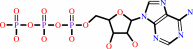 ATP
ATP
|
=
|
O-phospho-L-tyrosyl-[protein]
|
+
|
 ADP
ADP
|
+
|
H(+)
|
|
|
|
|
|
|
|
|
|
|
|
|
Molecule diagrams generated from .mol files obtained from the
KEGG ftp site
|
|
|
|
|
|
|
|
|
|
|
|
|
|
 |
|
|
|
|
|
|
| |
|
|
| |
|
|
Genes Dev
20:185-198
(2006)
|
|
PubMed id:
|
|
|
|
|
|
| |
|
Structural basis by which alternative splicing modulates the organizer activity of FGF8 in the brain.
|
|
S.K.Olsen,
J.Y.Li,
C.Bromleigh,
A.V.Eliseenkova,
O.A.Ibrahimi,
Z.Lao,
F.Zhang,
R.J.Linhardt,
A.L.Joyner,
M.Mohammadi.
|
|
|
|
|
| |
ABSTRACT
|
|
|
|
| |
|
|
Two of the four human FGF8 splice isoforms, FGF8a and FGF8b, are expressed in
the mid-hindbrain region during development. Although the only difference
between these isoforms is the presence of an additional 11 amino acids at the N
terminus of FGF8b, these isoforms possess remarkably different abilities to
pattern the midbrain and anterior hindbrain. To reveal the structural basis by
which alternative splicing modulates the organizing activity of FGF8, we solved
the crystal structure of FGF8b in complex with the "c" splice isoform of FGF
receptor 2 (FGFR2c). Using surface plasmon resonance (SPR), we also
characterized the receptor-binding specificity of FGF8a and FGF8b, the "b"
isoform of FGF17 (FGF17b), and FGF18. The FGF8b-FGFR2c structure shows that
alternative splicing permits a single additional contact between phenylalanine
32 (F32) of FGF8b and a hydrophobic groove within Ig domain 3 of the receptor
that is also present in FGFR1c, FGFR3c, and FGFR4. Consistent with the
structure, mutation of F32 to alanine reduces the affinity of FGF8b toward all
these receptors to levels characteristic of FGF8a. More importantly, analysis of
the mid-hindbrain patterning ability of the FGF8b(F32A) mutant in chick embryos
and murine midbrain explants shows that this mutation functionally converts
FGF8b to FGF8a. Moreover, our data suggest that the intermediate
receptor-binding affinities of FGF17b and FGF18, relative to FGF8a and FGF8b,
also account for the distinct patterning abilities of these two ligands. We also
show that the mode of FGF8 receptor-binding specificity is distinct from that of
other FGFs and provide the first biochemical evidence for a physiological
FGF8b-FGFR1c interaction during mid-hindbrain development. Consistent with the
indispensable role of FGF8 in embryonic development, we show that the FGF8 mode
of receptor binding appeared as early as in nematodes and has been preserved
throughout evolution.
|
|
|
|
|
|
|
|
|
|
|
|
|
|
|
|
|
|
 |
 |
 |
|
Literature references that cite this PDB file's key reference
|
|
|
| |
PubMed id
|
|
Reference
|
|
|
|
|
|
R.Goetz,
and
M.Mohammadi
(2013).
Exploring mechanisms of FGF signalling through the lens of structural biology.
|
| |
Nat Rev Mol Cell Biol,
14,
166-180.
|
|
|
|
|
|
|
B.Yang,
K.Solakyildirim,
Y.Chang,
and
R.J.Linhardt
(2011).
Hyphenated techniques for the analysis of heparin and heparan sulfate.
|
| |
Anal Bioanal Chem,
399,
541-557.
|
|
|
|
|
|
|
J.M.Peterslund,
and
P.Serup
(2011).
Activation of FGFR(IIIc) isoforms promotes activin-induced mesendoderm development in mouse embryonic stem cells and reduces Sox17 coexpression in EpCAM+ cells.
|
| |
Stem Cell Res,
6,
262-275.
|
|
|
|
|
|
|
N.A.Sunmonu,
K.Li,
and
J.Y.Li
(2011).
Numerous isoforms of Fgf8 reflect its multiple roles in the developing brain.
|
| |
J Cell Physiol,
226,
1722-1726.
|
|
|
|
|
|
|
S.J.Glatt,
O.S.Cohen,
S.V.Faraone,
and
M.T.Tsuang
(2011).
Dysfunctional gene splicing as a potential contributor to neuropsychiatric disorders.
|
| |
Am J Med Genet B Neuropsychiatr Genet,
156,
382-392.
|
|
|
|
|
|
|
V.W.Lui,
D.M.Yau,
C.S.Cheung,
S.C.Wong,
A.K.Chan,
Q.Zhou,
E.Y.Wong,
C.P.Lau,
E.K.Lam,
E.P.Hui,
B.Hong,
C.W.Hui,
A.S.Chan,
P.K.Ng,
Y.K.Ng,
K.W.Lo,
C.M.Tsang,
S.K.Tsui,
S.W.Tsao,
and
A.T.Chan
(2011).
FGF8b oncogene mediates proliferation and invasion of Epstein-Barr virus-associated nasopharyngeal carcinoma cells: implication for viral-mediated FGF8b upregulation.
|
| |
Oncogene,
30,
1518-1530.
|
|
|
|
|
|
|
D.C.Tomlinson,
and
M.A.Knowles
(2010).
Altered splicing of FGFR1 is associated with high tumor grade and stage and leads to increased sensitivity to FGF1 in bladder cancer.
|
| |
Am J Pathol,
177,
2379-2386.
|
|
|
|
|
|
|
Q.Guo,
K.Li,
N.A.Sunmonu,
and
J.Y.Li
(2010).
Fgf8b-containing spliceforms, but not Fgf8a, are essential for Fgf8 function during development of the midbrain and cerebellum.
|
| |
Dev Biol,
338,
183-192.
|
|
|
|
|
|
|
R.F.Arauz,
B.D.Solomon,
D.E.Pineda-Alvarez,
A.L.Gropman,
J.A.Parsons,
E.Roessler,
and
M.Muenke
(2010).
A Hypomorphic Allele in the FGF8 Gene Contributes to Holoprosencephaly and Is Allelic to Gonadotropin-Releasing Hormone Deficiency in Humans.
|
| |
Mol Syndromol,
1,
59-66.
|
|
|
|
|
|
|
T.Revil,
D.Gaffney,
C.Dias,
J.Majewski,
and
L.A.Jerome-Majewska
(2010).
Alternative splicing is frequent during early embryonic development in mouse.
|
| |
BMC Genomics,
11,
399.
|
|
|
|
|
|
|
H.P.Makarenkova,
M.P.Hoffman,
A.Beenken,
A.V.Eliseenkova,
R.Meech,
C.Tsau,
V.N.Patel,
R.A.Lang,
and
M.Mohammadi
(2009).
Differential interactions of FGFs with heparan sulfate control gradient formation and branching morphogenesis.
|
| |
Sci Signal,
2,
ra55.
|
|
|
|
|
|
|
J.H.Seo,
A.Suenaga,
M.Hatakeyama,
M.Taiji,
and
A.Imamoto
(2009).
Structural and functional basis of a role for CRKL in a fibroblast growth factor 8-induced feed-forward loop.
|
| |
Mol Cell Biol,
29,
3076-3087.
|
|
|
|
|
|
|
J.Ries,
S.R.Yu,
M.Burkhardt,
M.Brand,
and
P.Schwille
(2009).
Modular scanning FCS quantifies receptor-ligand interactions in living multicellular organisms.
|
| |
Nat Methods,
6,
643-645.
|
|
|
|
|
|
|
J.Vyas,
M.R.Gryk,
and
M.R.Schiller
(2009).
VENN, a tool for titrating sequence conservation onto protein structures.
|
| |
Nucleic Acids Res,
37,
e124.
|
|
|
|
|
|
|
L.Z.Holland
(2009).
Chordate roots of the vertebrate nervous system: expanding the molecular toolkit.
|
| |
Nat Rev Neurosci,
10,
736-746.
|
|
|
|
|
|
|
M.P.Valta,
J.Tuomela,
H.Vuorikoski,
N.Loponen,
R.M.Väänänen,
K.Pettersson,
H.K.Väänänen,
and
P.L.Härkönen
(2009).
FGF-8b induces growth and rich vascularization in an orthotopic PC-3 model of prostate cancer.
|
| |
J Cell Biochem,
107,
769-784.
|
|
|
|
|
|
|
T.N.Laremore,
F.Zhang,
J.S.Dordick,
J.Liu,
and
R.J.Linhardt
(2009).
Recent progress and applications in glycosaminoglycan and heparin research.
|
| |
Curr Opin Chem Biol,
13,
633-640.
|
|
|
|
|
|
|
T.Sato,
and
A.L.Joyner
(2009).
The duration of Fgf8 isthmic organizer expression is key to patterning different tectal-isthmo-cerebellum structures.
|
| |
Development,
136,
3617-3626.
|
|
|
|
|
|
|
Y.Chen,
M.Mohammadi,
and
J.G.Flanagan
(2009).
Graded levels of FGF protein span the midbrain and can instruct graded induction and repression of neural mapping labels.
|
| |
Neuron,
62,
773-780.
|
|
|
|
|
|
|
H.H.Potula,
S.R.Kathuria,
A.K.Ghosh,
T.K.Maiti,
and
S.Dey
(2008).
Transient expression, purification and characterization of bioactive human fibroblast growth factor 8b in tobacco plants.
|
| |
Transgenic Res,
17,
19-32.
|
|
|
|
|
|
|
H.Nakamura,
T.Sato,
and
A.Suzuki-Hirano
(2008).
Isthmus organizer for mesencephalon and metencephalon.
|
| |
Dev Growth Differ,
50,
S113-S118.
|
|
|
|
|
|
|
J.Falardeau,
W.C.Chung,
A.Beenken,
T.Raivio,
L.Plummer,
Y.Sidis,
E.E.Jacobson-Dickman,
A.V.Eliseenkova,
J.Ma,
A.Dwyer,
R.Quinton,
S.Na,
J.E.Hall,
C.Huot,
N.Alois,
S.H.Pearce,
L.W.Cole,
V.Hughes,
M.Mohammadi,
P.Tsai,
and
N.Pitteloud
(2008).
Decreased FGF8 signaling causes deficiency of gonadotropin-releasing hormone in humans and mice.
|
| |
J Clin Invest,
118,
2822-2831.
|
|
|
|
|
|
|
J.Xi,
and
S.C.Zhang
(2008).
Stem cells in development of therapeutics for Parkinson's disease: a perspective.
|
| |
J Cell Biochem,
105,
1153-1160.
|
|
|
|
|
|
|
M.A.Basson,
D.Echevarria,
C.P.Ahn,
A.Sudarov,
A.L.Joyner,
I.J.Mason,
S.Martinez,
and
G.R.Martin
(2008).
Specific regions within the embryonic midbrain and cerebellum require different levels of FGF signaling during development.
|
| |
Development,
135,
889-898.
|
|
|
|
|
|
|
M.P.Valta,
J.Tuomela,
A.Bjartell,
E.Valve,
H.K.Väänänen,
and
P.Härkönen
(2008).
FGF-8 is involved in bone metastasis of prostate cancer.
|
| |
Int J Cancer,
123,
22-31.
|
|
|
|
|
|
|
U.Borello,
I.Cobos,
J.E.Long,
C.Murre,
and
J.L.Rubenstein
(2008).
FGF15 promotes neurogenesis and opposes FGF8 function during neocortical development.
|
| |
Neural Develop,
3,
17.
|
|
|
|
|
|
|
B.M.Riley,
M.A.Mansilla,
J.Ma,
S.Daack-Hirsch,
B.S.Maher,
L.M.Raffensperger,
E.T.Russo,
A.R.Vieira,
C.Dodé,
M.Mohammadi,
M.L.Marazita,
and
J.C.Murray
(2007).
Impaired FGF signaling contributes to cleft lip and palate.
|
| |
Proc Natl Acad Sci U S A,
104,
4512-4517.
|
|
|
|
|
|
|
I.Mason
(2007).
Initiation to end point: the multiple roles of fibroblast growth factors in neural development.
|
| |
Nat Rev Neurosci,
8,
583-596.
|
|
|
|
|
|
|
J.A.Cholfin,
and
J.L.Rubenstein
(2007).
Patterning of frontal cortex subdivisions by Fgf17.
|
| |
Proc Natl Acad Sci U S A,
104,
7652-7657.
|
|
|
|
|
|
|
J.Partanen
(2007).
FGF signalling pathways in development of the midbrain and anterior hindbrain.
|
| |
J Neurochem,
101,
1185-1193.
|
|
|
|
|
|
|
N.Pitteloud,
R.Quinton,
S.Pearce,
T.Raivio,
J.Acierno,
A.Dwyer,
L.Plummer,
V.Hughes,
S.Seminara,
Y.Z.Cheng,
W.P.Li,
G.Maccoll,
A.V.Eliseenkova,
S.K.Olsen,
O.A.Ibrahimi,
F.J.Hayes,
P.Boepple,
J.E.Hall,
P.Bouloux,
M.Mohammadi,
and
W.Crowley
(2007).
Digenic mutations account for variable phenotypes in idiopathic hypogonadotropic hypogonadism.
|
| |
J Clin Invest,
117,
457-463.
|
|
|
|
|
|
|
Q.Guo,
and
J.Y.Li
(2007).
Distinct functions of the major Fgf8 spliceform, Fgf8b, before and during mouse gastrulation.
|
| |
Development,
134,
2251-2260.
|
|
|
|
|
|
|
Q.Li,
J.A.Lee,
and
D.L.Black
(2007).
Neuronal regulation of alternative pre-mRNA splicing.
|
| |
Nat Rev Neurosci,
8,
819-831.
|
|
|
|
|
|
|
R.Goetz,
A.Beenken,
O.A.Ibrahimi,
J.Kalinina,
S.K.Olsen,
A.V.Eliseenkova,
C.Xu,
T.A.Neubert,
F.Zhang,
R.J.Linhardt,
X.Yu,
K.E.White,
T.Inagaki,
S.A.Kliewer,
M.Yamamoto,
H.Kurosu,
Y.Ogawa,
M.Kuro-o,
B.Lanske,
M.S.Razzaque,
and
M.Mohammadi
(2007).
Molecular insights into the klotho-dependent, endocrine mode of action of fibroblast growth factor 19 subfamily members.
|
| |
Mol Cell Biol,
27,
3417-3428.
|
|
|
PDB codes:
|
|
|
|
|
|
|
|
R.L.Rich,
and
D.G.Myszka
(2007).
Survey of the year 2006 commercial optical biosensor literature.
|
| |
J Mol Recognit,
20,
300-366.
|
|
|
|
|
|
|
S.R.Hubbard,
and
W.T.Miller
(2007).
Receptor tyrosine kinases: mechanisms of activation and signaling.
|
| |
Curr Opin Cell Biol,
19,
117-123.
|
|
|
|
|
|
|
A.Lepilina,
A.N.Coon,
K.Kikuchi,
J.E.Holdway,
R.W.Roberts,
C.G.Burns,
and
K.D.Poss
(2006).
A dynamic epicardial injury response supports progenitor cell activity during zebrafish heart regeneration.
|
| |
Cell,
127,
607-619.
|
|
|
|
|
|
|
F.Inoue,
S.Nagayoshi,
S.Ota,
M.E.Islam,
N.Tonou-Fujimori,
Y.Odaira,
K.Kawakami,
and
K.Yamasu
(2006).
Genomic organization, alternative splicing, and multiple regulatory regions of the zebrafish fgf8 gene.
|
| |
Dev Growth Differ,
48,
447-462.
|
|
|
|
|
|
|
X.Zhang,
O.A.Ibrahimi,
S.K.Olsen,
H.Umemori,
M.Mohammadi,
and
D.M.Ornitz
(2006).
Receptor specificity of the fibroblast growth factor family. The complete mammalian FGF family.
|
| |
J Biol Chem,
281,
15694-15700.
|
|
|
|
|
|
The most recent references are shown first.
Citation data come partly from CiteXplore and partly
from an automated harvesting procedure. Note that this is likely to be
only a partial list as not all journals are covered by
either method. However, we are continually building up the citation data
so more and more references will be included with time.
Where a reference describes a PDB structure, the PDB
codes are
shown on the right.
|
 |


 Links
Links


