 |
PDBsum entry 1dvr

|
|
|
|
|
|

|

|

|

|
|

|
|

|
|

|
|

|
|

|
|
|
 |

|

|
|
|
|
|
|
|
|
|
|
|
|
|
|
|
|
|
|
|
|
|
|
|
|
|
|
|
|
|
|
|
|
|
|
Transferase (phosphotransferase)
|
PDB id
|
|
|
|
1dvr
|
|
|
|
|
|
|
|
|
|
|
|
|
|
|

|

|

|
|
|
|
|
|
|
|
 |
Contents |
 |
|
|
|
|
|
|
|
|
|
|
|
|
* Residue conservation analysis
|
|
|
|
|
|
|
|
|
|
|
Enzyme class:
|
|
E.C.2.7.4.3
- adenylate kinase.
|
|
|
|
|
|
|
Reaction:
|
|
AMP + ATP = 2 ADP
|
|
|
|
|
|
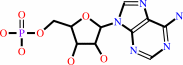 AMP
AMP
|
+
|
 ATP
ATP
|
=
|
2
×
ADP
Bound ligand (Het Group name = )
matches with 76.47% similarity
|
|
|
|
|
|
|
|
|
|
|
|
|
Molecule diagrams generated from .mol files obtained from the
KEGG ftp site
|
|
|
|
|
|
|
|
|
|
|
|
|
|
 |
|
|
|
|
|
|
| |
|
|
| |
|
DOI no:
|
J Mol Biol
256:223-227
(1996)
|
|
PubMed id:
|
|
|
|
|
|
| |
|
Structure of a mutant adenylate kinase ligated with an ATP-analogue showing domain closure over ATP.
|
|
G.J.Schlauderer,
K.Proba,
G.E.Schulz.
|
|
|
|
|
| |
ABSTRACT
|
|
|
|
| |
|
|
Structural studies on unligated and ligated adenylate kinases have shown that
two domains, LID and NMPbind, close over the bound substrates, ATP and AMP,
respectively. These motions can be, but need not be independent from each other.
Up to now, the known structures display only the states "both domains open",
"both closed" and "NMP bind closed". In spite of numerous cocrystallization
attempts with ATP, a crystalline state "LID closed" has not yet been produced.
These experiences suggested that LID closure depends on a bound AMP molecule, in
contrast to enzyme kinetic studies indicating a random-bi-bi mechanism. Using an
inactive mutant of yeast adenylate kinase together with the ATP analogue
AMPPCF2P, however, we have now crystallized an adenylate kinase in the LID
closed state. The structure was established at 2.36 A resolution; it indicates
that the domain motions occur largely independent from each other in agreement
with the kinetic studies. As a side-result, we report the protein environment of
the fluorine atoms of the bound ATP analogue.
|
|
|
|
|
|
| |
Selected figure(s)
|
|
|
|
| |
|
|

|
|

|
|
Figure 1.
Figure 1. Superposition of molecule I of AKyst (D89V, R165I):AMPPCF2 P (thick lines, some residues labeled) with the
complex AKyst :Ap5A:Mg (thin lines, Mg
2+
marked by a cross) on the CORE domains. Both LID domains are closed
whereas the NMPbind domain conformations differ. The NMPbind domain of the reported structure is open.
|
|
Figure 3.
Figure 3. Local symmetry in the crystal structure of AK yst(D89V, R165I):AMPPCF2P. The stereoview is along the
non-crystallographic 2-fold axis and approximately the same as in Figure 1. Some residues are labeled. The side-chains
of the mutated residues as well as AMPPCF2P are depicted and emphasized in both molecules.
|
|
|
|
|
|
| |
The above figures are
reprinted
by permission from Elsevier:
J Mol Biol
(1996,
256,
223-227)
copyright 1996.
|
|
| |
Figures were
selected
by an automated process.
|
|
|
|
|
|
|
|
|
|
|
|
|
|
|
|
 |
 |
 |
|
Literature references that cite this PDB file's key reference
|
|
|
| |
PubMed id
|
|
Reference
|
|
|
|
|
|
A.Ahmed,
S.Villinger,
and
H.Gohlke
(2010).
Large-scale comparison of protein essential dynamics from molecular dynamics simulations and coarse-grained normal mode analyses.
|
| |
Proteins,
78,
3341-3352.
|
|
|
|
|
|
|
J.B.Brokaw,
and
J.W.Chu
(2010).
On the roles of substrate binding and hinge unfolding in conformational changes of adenylate kinase.
|
| |
Biophys J,
99,
3420-3429.
|
|
|
|
|
|
|
U.Olsson,
and
M.Wolf-Watz
(2010).
Overlap between folding and functional energy landscapes for adenylate kinase conformational change.
|
| |
Nat Commun,
1,
111.
|
|
|
|
|
|
|
A.Korkut,
and
W.A.Hendrickson
(2009).
Computation of conformational transitions in proteins by virtual atom molecular mechanics as validated in application to adenylate kinase.
|
| |
Proc Natl Acad Sci U S A,
106,
15673-15678.
|
|
|
|
|
|
|
M.Sagermann,
R.R.Chapleau,
E.DeLorimier,
and
M.Lei
(2009).
Using affinity chromatography to engineer and characterize pH-dependent protein switches.
|
| |
Protein Sci,
18,
217-228.
|
|
|
PDB codes:
|
|
|
|
|
|
|
|
O.Beckstein,
E.J.Denning,
J.R.Perilla,
and
T.B.Woolf
(2009).
Zipping and unzipping of adenylate kinase: atomistic insights into the ensemble of open<-->closed transitions.
|
| |
J Mol Biol,
394,
160-176.
|
|
|
|
|
|
|
R.Liu,
A.L.Ström,
J.Zhai,
J.Gal,
S.Bao,
W.Gong,
and
H.Zhu
(2009).
Enzymatically inactive adenylate kinase 4 interacts with mitochondrial ADP/ATP translocase.
|
| |
Int J Biochem Cell Biol,
41,
1371-1380.
|
|
|
|
|
|
|
U.Pannicke,
M.Hönig,
I.Hess,
C.Friesen,
K.Holzmann,
E.M.Rump,
T.F.Barth,
M.T.Rojewski,
A.Schulz,
T.Boehm,
W.Friedrich,
and
K.Schwarz
(2009).
Reticular dysgenesis (aleukocytosis) is caused by mutations in the gene encoding mitochondrial adenylate kinase 2.
|
| |
Nat Genet,
41,
101-105.
|
|
|
|
|
|
|
N.Kantarci-Carsibasi,
T.Haliloglu,
and
P.Doruker
(2008).
Conformational transition pathways explored by Monte Carlo simulation integrated with collective modes.
|
| |
Biophys J,
95,
5862-5873.
|
|
|
|
|
|
|
P.C.Whitford,
S.Gosavi,
and
J.N.Onuchic
(2008).
Conformational Transitions in Adenylate Kinase: ALLOSTERIC COMMUNICATION REDUCES MISLIGATION.
|
| |
J Biol Chem,
283,
2042-2048.
|
|
|
|
|
|
|
J.A.Runquist,
and
H.M.Miziorko
(2006).
Functional contribution of a conserved, mobile loop histidine of phosphoribulokinase.
|
| |
Protein Sci,
15,
837-842.
|
|
|
|
|
|
|
M.B.Berry,
E.Bae,
T.R.Bilderback,
M.Glaser,
and
G.N.Phillips
(2006).
Crystal structure of ADP/AMP complex of Escherichia coli adenylate kinase.
|
| |
Proteins,
62,
555-556.
|
|
|
PDB code:
|
|
|
|
|
|
|
|
H.Krishnamurthy,
H.Lou,
A.Kimple,
C.Vieille,
and
R.I.Cukier
(2005).
Associative mechanism for phosphoryl transfer: a molecular dynamics simulation of Escherichia coli adenylate kinase complexed with its substrates.
|
| |
Proteins,
58,
88.
|
|
|
|
|
|
|
S.Li,
Q.R.Zhang,
W.H.Xu,
and
D.A.Schooley
(2005).
Juvenile hormone diol kinase, a calcium-binding protein with kinase activity, from the silkworm, Bombyx mori.
|
| |
Insect Biochem Mol Biol,
35,
1235-1248.
|
|
|
|
|
|
|
N.A.Temiz,
E.Meirovitch,
and
I.Bahar
(2004).
Escherichia coli adenylate kinase dynamics: comparison of elastic network model modes with mode-coupling (15)N-NMR relaxation data.
|
| |
Proteins,
57,
468-480.
|
|
|
|
|
|
|
L.Yu,
J.Mack,
P.J.Hajduk,
S.J.Kakavas,
A.Y.Saiki,
C.G.Lerner,
and
E.T.Olejniczak
(2003).
Solution structure and function of an essential CMP kinase of Streptococcus pneumoniae.
|
| |
Protein Sci,
12,
2613-2621.
|
|
|
PDB code:
|
|
|
|
|
|
|
|
R.A.Maxwell,
W.H.Welch,
F.M.Horodyski,
K.M.Schegg,
and
D.A.Schooley
(2002).
Juvenile hormone diol kinase. II. Sequencing, cloning, and molecular modeling of juvenile hormone-selective diol kinase from Manduca sexta.
|
| |
J Biol Chem,
277,
21882-21890.
|
|
|
|
|
|
|
T.Okajima,
D.Kitaguchi,
K.Fujii,
H.Matsuoka,
S.Goto,
S.Uchiyama,
Y.Kobayashi,
and
K.Tanizawa
(2002).
Novel trimeric adenylate kinase from an extremely thermoacidophilic archaeon, Sulfolobus solfataricus: molecular cloning, nucleotide sequencing, expression in Escherichia coli, and characterization of the recombinant enzyme.
|
| |
Biosci Biotechnol Biochem,
66,
2112-2124.
|
|
|
|
|
|
|
D.J.Jacobs,
A.J.Rader,
L.A.Kuhn,
and
M.F.Thorpe
(2001).
Protein flexibility predictions using graph theory.
|
| |
Proteins,
44,
150-165.
|
|
|
|
|
|
|
I.J.MacRae,
I.H.Segel,
and
A.J.Fisher
(2001).
Crystal structure of ATP sulfurylase from Penicillium chrysogenum: insights into the allosteric regulation of sulfate assimilation.
|
| |
Biochemistry,
40,
6795-6804.
|
|
|
PDB code:
|
|
|
|
|
|
|
|
S.Kumar,
Y.Y.Sham,
C.J.Tsai,
and
R.Nussinov
(2001).
Protein folding and function: the N-terminal fragment in adenylate kinase.
|
| |
Biophys J,
80,
2439-2454.
|
|
|
|
|
|
|
I.J.MacRae,
I.H.Segel,
and
A.J.Fisher
(2000).
Crystal structure of adenosine 5'-phosphosulfate kinase from Penicillium chrysogenum.
|
| |
Biochemistry,
39,
1613-1621.
|
|
|
PDB code:
|
|
|
|
|
|
|
|
I.M.Li de La Sierra,
J.Gallay,
M.Vincent,
T.Bertrand,
P.Briozzo,
O.Bârzu,
and
A.M.Gilles
(2000).
Substrate-induced fit of the ATP binding site of cytidine monophosphate kinase from Escherichia coli: time-resolved fluorescence of 3'-anthraniloyl-2'-deoxy-ADP and molecular modeling.
|
| |
Biochemistry,
39,
15870-15878.
|
|
|
|
|
|
|
Y.Lin,
and
B.D.Nageswara Rao
(2000).
Structural characterization of adenine nucleotides bound to Escherichia coli adenylate kinase. 1. Adenosine conformations by proton two-dimensional transferred nuclear Overhauser effect spectroscopy.
|
| |
Biochemistry,
39,
3636-3646.
|
|
|
|
|
|
|
Y.Lin,
and
B.D.Nageswara Rao
(2000).
Structural characterization of adenine nucleotides bound to Escherichia coli adenylate kinase. 2. 31P and 13C relaxation measurements in the presence of cobalt(II) and manganese(II).
|
| |
Biochemistry,
39,
3647-3655.
|
|
|
|
|
|
|
C.E.Bystrom,
D.W.Pettigrew,
B.P.Branchaud,
P.O'Brien,
and
S.J.Remington
(1999).
Crystal structures of Escherichia coli glycerol kinase variant S58-->W in complex with nonhydrolyzable ATP analogues reveal a putative active conformation of the enzyme as a result of domain motion.
|
| |
Biochemistry,
38,
3508-3518.
|
|
|
PDB codes:
|
|
|
|
|
|
|
|
S.Kumar,
B.Ma,
C.J.Tsai,
H.Wolfson,
and
R.Nussinov
(1999).
Folding funnels and conformational transitions via hinge-bending motions.
|
| |
Cell Biochem Biophys,
31,
141-164.
|
|
|
|
|
|
|
D.H.Harrison,
J.A.Runquist,
A.Holub,
and
H.M.Miziorko
(1998).
The crystal structure of phosphoribulokinase from Rhodobacter sphaeroides reveals a fold similar to that of adenylate kinase.
|
| |
Biochemistry,
37,
5074-5085.
|
|
|
PDB code:
|
|
|
|
|
|
|
|
H.J.Zhang,
X.R.Sheng,
W.D.Niu,
X.M.Pan,
and
J.M.Zhou
(1998).
Evidence for at least two native forms of rabbit muscle adenylate kinase in equilibrium in aqueous solution.
|
| |
J Biol Chem,
273,
7448-7456.
|
|
|
|
|
|
|
J.A.Runquist,
D.H.Harrison,
and
H.M.Miziorko
(1998).
Functional evaluation of invariant arginines situated in the mobile lid domain of phosphoribulokinase.
|
| |
Biochemistry,
37,
1221-1226.
|
|
|
|
|
|
|
M.B.Berry,
and
G.N.Phillips
(1998).
Crystal structures of Bacillus stearothermophilus adenylate kinase with bound Ap5A, Mg2+ Ap5A, and Mn2+ Ap5A reveal an intermediate lid position and six coordinate octahedral geometry for bound Mg2+ and Mn2+.
|
| |
Proteins,
32,
276-288.
|
|
|
PDB codes:
|
|
|
|
|
|
|
|
K.Wild,
R.Grafmüller,
E.Wagner,
and
G.E.Schulz
(1997).
Structure, catalysis and supramolecular assembly of adenylate kinase from maize.
|
| |
Eur J Biochem,
250,
326-331.
|
|
|
PDB code:
|
|
|
|
|
|
|
The most recent references are shown first.
Citation data come partly from CiteXplore and partly
from an automated harvesting procedure. Note that this is likely to be
only a partial list as not all journals are covered by
either method. However, we are continually building up the citation data
so more and more references will be included with time.
Where a reference describes a PDB structure, the PDB
codes are
shown on the right.
|
|


 Links
Links


