
|
|
|
|
|
 |
Contents |
 |
|
|
|
|
|
|
|
|
|
|
|
 185 a.a.*
|
|
|
|
|
|
|
|
|
|
|
 285 a.a.*
|
|
|
|
|
|
|
|
|
|
|
 252 a.a.*
|
|
|
|
|
|
|
|
|
|
|
 238 a.a.*
|
|
|
|
|
|
|
|
|
|
|
 29 a.a.*
|
|
|
|
|
|
|
* Residue conservation analysis
|
|
* C-alpha coords only
|
|
|
|
|
|
PDB id:
|
|
|
|
| Name: |
|
Virus/receptor
|
|
|
Title:
|
|
Cryo-em structure of human rhinovirus 16 (hrv16) complexed with a two- domain fragment of its cellular receptor, intercellular adhesion molecule-1 (d1d2-icam-1). Implications for virus-receptor interactions. Alpha carbons only
|
|
Structure:
|
|
Protein (intercellular adhesion molecule-1). Chain: i. Fragment: first two domains, residues 1-185. Synonym: d1d2-icam-1. Protein (rhinovirus 16 coat protein vp1). Chain: 1. Synonym: hrv16 vp1. Protein (rhinovirus 16 coat protein vp2). Chain: 2.
|
|
Source:
|
|
Fragment: 1 - 185. Homo sapiens. Human. Organism_taxid: 9606. Human rhinovirus sp.. Organism_taxid: 169066. Strain: serotype 16. Strain: serotype 16
|
|
Authors:
|
|
J.Bella,M.G.Rossmann
|
Key ref:

|
|
P.R.Kolatkar
et al.
(1999).
Structural studies of two rhinovirus serotypes complexed with fragments of their cellular receptor.
EMBO J,
18,
6249-6259.
PubMed id:
DOI:

|
|
|
Date:
|
|
|
29-Sep-99
|
Release date:
|
19-Jan-00
|
|
|
|
|
|
|
|
Headers
|
|
|
|
References
|
|
|
|
|
|

|
|
P05362
(ICAM1_HUMAN) -
Intercellular adhesion molecule 1 from Homo sapiens
|
|
|
|
Seq:
Struc:
|
|
|
|
532 a.a.
185 a.a.
|
|

|

|
|
|
|
|
|
|
|
|
|
|
|
|

|
|
Q82122
(POLG_HRV16) -
Genome polyprotein from Human rhinovirus 16
|
|
|
|
Seq:
Struc:
|
|
|
|
2153 a.a.
285 a.a.*
|
|
|

|
|
|
|
|
|
|
|
|
|
|
|
|

|
|
Q82122
(POLG_HRV16) -
Genome polyprotein from Human rhinovirus 16
|
|
|
|
Seq:
Struc:
|
|
|
|
2153 a.a.
252 a.a.*
|
|
|

|
|
|
|
|
|
|
|
|
|
|
|
|
|
|
|
|
|
Enzyme class 2:
|
|
Chains 1, 2, 3, 4:
E.C.2.7.7.48
- RNA-directed Rna polymerase.
|
|
|
|
|
|
|
Reaction:
|
|
RNA(n) + a ribonucleoside 5'-triphosphate = RNA(n+1) + diphosphate
|
|
|
|
|
|
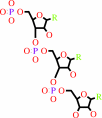 RNA(n)
|
+
|
ribonucleoside 5'-triphosphate
|
=
|
RNA(n+1)
|
+
|
 diphosphate
|
|
|
|
|
|
|
|
|
|
Enzyme class 3:
|
|
Chains 1, 2, 3, 4:
E.C.3.4.22.28
- picornain 3C.
|
|
|
|
|
|
|
Reaction:
|
|
Selective cleavage of Gln-|-Gly bond in the poliovirus polyprotein. In other picornavirus reactions Glu may be substituted for Gln, and Ser or Thr for Gly.
|
|
|
|
|
|
Enzyme class 4:
|
|
Chains 1, 2, 3, 4:
E.C.3.4.22.29
- picornain 2A.
|
|
|
|
|
|
|
Reaction:
|
|
Selective cleavage of Tyr-|-Gly bond in the picornavirus polyprotein. In other picornavirus reactions Glu may be substituted for Gln, and Ser or Thr for Gly.
|
|
|
|
|
|
Enzyme class 5:
|
|
Chains 1, 2, 3, 4:
E.C.3.6.1.15
- nucleoside-triphosphate phosphatase.
|
|
|
|
|
|
|
Reaction:
|
|
a ribonucleoside 5'-triphosphate + H2O = a ribonucleoside 5'-diphosphate + phosphate + H+
|
|
|
|
|
|
ribonucleoside 5'-triphosphate
|
+
|
H2O
|
=
|
ribonucleoside 5'-diphosphate
|
+
|
 phosphate
|
+
|
H(+)
|
|
|
|
|
|
|
|
|
|
|
|
|
Note, where more than one E.C. class is given (as above), each may
correspond to a different protein domain or, in the case of polyprotein
precursors, to a different mature protein.
|
|
|
|
Molecule diagrams generated from .mol files obtained from the
KEGG ftp site
|
|
|
|
|
|
|
|
|
|
|
|
|
|
 |
|
|
|
|
|
|
| |
|
|
| |
|
DOI no:
|
EMBO J
18:6249-6259
(1999)
|
|
PubMed id:
|
|
|
|
|
|
| |
|
Structural studies of two rhinovirus serotypes complexed with fragments of their cellular receptor.
|
|
P.R.Kolatkar,
J.Bella,
N.H.Olson,
C.M.Bator,
T.S.Baker,
M.G.Rossmann.
|
|
|
|
|
| |
ABSTRACT
|
|
|
|
| |
|
|
Two human rhinovirus serotypes complexed with two- and five-domain soluble
fragments of the cellular receptor, intercellular adhesion molecule-1, have been
investigated by X-ray crystallographic analyses of the individual components and
by cryo-electron microscopy of the complexes. The three-dimensional image
reconstructions provide a molecular envelope within which the crystal structures
of the viruses and the receptor fragments can be positioned with accuracy. The
N-terminal domain of the receptor binds to the rhinovirus 'canyon' surrounding
the icosahedral 5-fold axes. Fitting of molecular models into the image
reconstruction density identified the residues on the virus that interact with
those on the receptor surface, demonstrating complementarity of the
electrostatic patterns for the tip of the N-terminal receptor domain and the
floor of the canyon. The complexes seen in the image reconstructions probably
represent the first stage of a multistep binding process. A mechanism is
proposed for the subsequent viral uncoating process.
|
|
|
|
|
|
| |
Selected figure(s)
|
|
|
|
| |
|
|

|
|

|
|
Figure 5.
Figure 5 Roadmap representation (Chapman, 1993) showing the
amino acids within the ICAM-1 footprint (thick outline) on the
surface of (A) HRV16 and (B) HRV14. The figure shows one
icosahedral asymmetric unit with a 5-fold axis at the top and
3-fold axes to the left and right at the bottom. Residues closer
than 145 Å to the viral center, shaded in gray, outline the
central and deepest region of the canyon.
|
|
Figure 6.
Figure 6 Stereo representations of electrostatic charge
distribution in the canyon region of HRV16 (top), HRV14 (bottom)
and the tip of ICAM-1. Charge distributions are represented by
the usual colors. Residues that show charge complementarity are
indicated and connected with dashed lines.
|
|
|
|
|
|
| |
The above figures are
reprinted
from an Open Access publication published by Macmillan Publishers Ltd:
EMBO J
(1999,
18,
6249-6259)
copyright 1999.
|
|
| |
Figures were
selected
by an automated process.
|
|
|
|
|
|
|
|
|
|
|
|
|
|
|
|
 |
 |
 |
|
Literature references that cite this PDB file's key reference
|
|
|
| |
PubMed id
|
|
Reference
|
|
|
|
|
|
J.M.Hogle
(2012).
A 3D framework for understanding enterovirus 71.
|
| |
Nat Struct Mol Biol,
19,
367-368.
|
|
|
|
|
|
|
J.M.Rollinger,
and
M.Schmidtke
(2011).
The human rhinovirus: human-pathological impact, mechanisms of antirhinoviral agents, and strategies for their discovery.
|
| |
Med Res Rev,
31,
42-92.
|
|
|
|
|
|
|
L.B.Ochola,
B.R.Siddondo,
H.Ocholla,
S.Nkya,
E.N.Kimani,
T.N.Williams,
J.O.Makale,
A.Liljander,
B.C.Urban,
P.C.Bull,
T.Szestak,
K.Marsh,
and
A.G.Craig
(2011).
Specific receptor usage in Plasmodium falciparum cytoadherence is associated with disease outcome.
|
| |
PLoS One,
6,
e14741.
|
|
|
|
|
|
|
J.Seitsonen,
P.Susi,
O.Heikkilä,
R.S.Sinkovits,
P.Laurinmäki,
T.Hyypiä,
and
S.J.Butcher
(2010).
Interaction of alphaVbeta3 and alphaVbeta6 integrins with human parechovirus 1.
|
| |
J Virol,
84,
8509-8519.
|
|
|
|
|
|
|
R.Fuchs,
and
D.Blaas
(2010).
Uncoating of human rhinoviruses.
|
| |
Rev Med Virol,
20,
281-297.
|
|
|
|
|
|
|
J.Y.Lin,
T.C.Chen,
K.F.Weng,
S.C.Chang,
L.L.Chen,
and
S.R.Shih
(2009).
Viral and host proteins involved in picornavirus life cycle.
|
| |
J Biomed Sci,
16,
103.
|
|
|
|
|
|
|
N.Lewis-Rogers,
M.L.Bendall,
and
K.A.Crandall
(2009).
Phylogenetic relationships and molecular adaptation dynamics of human rhinoviruses.
|
| |
Mol Biol Evol,
26,
969-981.
|
|
|
|
|
|
|
S.Blomqvist,
C.Savolainen-Kopra,
A.Paananen,
T.Hovi,
and
M.Roivainen
(2009).
Molecular characterization of human rhinovirus field strains isolated during surveillance of enteroviruses.
|
| |
J Gen Virol,
90,
1371-1381.
|
|
|
|
|
|
|
S.Lindert,
M.Silvestry,
T.M.Mullen,
G.R.Nemerow,
and
P.L.Stewart
(2009).
Cryo-electron microscopy structure of an adenovirus-integrin complex indicates conformational changes in both penton base and integrin.
|
| |
J Virol,
83,
11491-11501.
|
|
|
|
|
|
|
D.Bubeck,
D.J.Filman,
M.Kuzmin,
S.D.Fuller,
and
J.M.Hogle
(2008).
Post-imaging fiducial markers aid in the orientation determination of complexes with mixed or unknown symmetry.
|
| |
J Struct Biol,
162,
480-490.
|
|
|
|
|
|
|
P.McErlean,
L.A.Shackelton,
E.Andrews,
D.R.Webster,
S.B.Lambert,
M.D.Nissen,
T.P.Sloots,
and
I.M.Mackay
(2008).
Distinguishing molecular features and clinical characteristics of a putative new rhinovirus species, human rhinovirus C (HRV C).
|
| |
PLoS ONE,
3,
e1847.
|
|
|
|
|
|
|
P.Zhang,
S.Mueller,
M.C.Morais,
C.M.Bator,
V.D.Bowman,
S.Hafenstein,
E.Wimmer,
and
M.G.Rossmann
(2008).
Crystal structure of CD155 and electron microscopic studies of its complexes with polioviruses.
|
| |
Proc Natl Acad Sci U S A,
105,
18284-18289.
|
|
|
PDB codes:
|
|
|
|
|
|
|
|
C.Xiao,
and
M.G.Rossmann
(2007).
Interpretation of electron density with stereographic roadmap projections.
|
| |
J Struct Biol,
158,
182-187.
|
|
|
|
|
|
|
M.G.Rossmann,
F.Arisaka,
A.J.Battisti,
V.D.Bowman,
P.R.Chipman,
A.Fokine,
S.Hafenstein,
S.Kanamaru,
V.A.Kostyuchenko,
V.V.Mesyanzhinov,
M.M.Shneider,
M.C.Morais,
P.G.Leiman,
L.M.Palermo,
C.R.Parrish,
and
C.Xiao
(2007).
From structure of the complex to understanding of the biology.
|
| |
Acta Crystallogr D Biol Crystallogr,
63,
9.
|
|
|
|
|
|
|
M.S.Kim,
and
V.R.Racaniello
(2007).
Enterovirus 70 receptor utilization is controlled by capsid residues that also regulate host range and cytopathogenicity.
|
| |
J Virol,
81,
8648-8655.
|
|
|
|
|
|
|
S.Hafenstein,
V.D.Bowman,
P.R.Chipman,
C.M.Bator Kelly,
F.Lin,
M.E.Medof,
and
M.G.Rossmann
(2007).
Interaction of decay-accelerating factor with coxsackievirus B3.
|
| |
J Virol,
81,
12927-12935.
|
|
|
PDB codes:
|
|
|
|
|
|
|
|
D.M.Pettigrew,
D.T.Williams,
D.Kerrigan,
D.J.Evans,
S.M.Lea,
and
D.Bhella
(2006).
Structural and functional insights into the interaction of echoviruses and decay-accelerating factor.
|
| |
J Biol Chem,
281,
5169-5177.
|
|
|
PDB code:
|
|
|
|
|
|
|
|
D.Bubeck,
D.J.Filman,
and
J.M.Hogle
(2005).
Cryo-electron microscopy reconstruction of a poliovirus-receptor-membrane complex.
|
| |
Nat Struct Mol Biol,
12,
615-618.
|
|
|
|
|
|
|
D.Bubeck,
D.J.Filman,
N.Cheng,
A.C.Steven,
J.M.Hogle,
and
D.M.Belnap
(2005).
The structure of the poliovirus 135S cell entry intermediate at 10-angstrom resolution reveals the location of an externalized polypeptide that binds to membranes.
|
| |
J Virol,
79,
7745-7755.
|
|
|
PDB code:
|
|
|
|
|
|
|
|
D.Jiménez,
P.Roda-Navarro,
T.A.Springer,
and
J.M.Casasnovas
(2005).
Contribution of N-linked glycans to the conformation and function of intercellular adhesion molecules (ICAMs).
|
| |
J Biol Chem,
280,
5854-5861.
|
|
|
|
|
|
|
L.Wang,
and
D.L.Smith
(2005).
Capsid structure and dynamics of a human rhinovirus probed by hydrogen exchange mass spectrometry.
|
| |
Protein Sci,
14,
1661-1672.
|
|
|
|
|
|
|
M.G.Rossmann,
M.C.Morais,
P.G.Leiman,
and
W.Zhang
(2005).
Combining X-ray crystallography and electron microscopy.
|
| |
Structure,
13,
355-362.
|
|
|
|
|
|
|
A.T.Dufresne,
and
M.Gromeier
(2004).
A nonpolio enterovirus with respiratory tropism causes poliomyelitis in intercellular adhesion molecule 1 transgenic mice.
|
| |
Proc Natl Acad Sci U S A,
101,
13636-13641.
|
|
|
|
|
|
|
C.Xiao,
T.J.Tuthill,
C.M.Bator Kelly,
L.J.Challinor,
P.R.Chipman,
R.A.Killington,
D.J.Rowlands,
A.Craig,
and
M.G.Rossmann
(2004).
Discrimination among rhinovirus serotypes for a variant ICAM-1 receptor molecule.
|
| |
J Virol,
78,
10034-10044.
|
|
|
|
|
|
|
D.Bhella,
I.G.Goodfellow,
P.Roversi,
D.Pettigrew,
Y.Chaudhry,
D.J.Evans,
and
S.M.Lea
(2004).
The structure of echovirus type 12 bound to a two-domain fragment of its cellular attachment protein decay-accelerating factor (CD 55).
|
| |
J Biol Chem,
279,
8325-8332.
|
|
|
PDB code:
|
|
|
|
|
|
|
|
E.A.Hewat,
and
D.Blaas
(2004).
Cryoelectron microscopy analysis of the structural changes associated with human rhinovirus type 14 uncoating.
|
| |
J Virol,
78,
2935-2942.
|
|
|
|
|
|
|
E.S.Johansson,
L.Xing,
R.H.Cheng,
and
D.R.Shafren
(2004).
Enhanced cellular receptor usage by a bioselected variant of coxsackievirus a21.
|
| |
J Virol,
78,
12603-12612.
|
|
|
|
|
|
|
H.Duque,
M.LaRocco,
W.T.Golde,
and
B.Baxt
(2004).
Interactions of foot-and-mouth disease virus with soluble bovine alphaVbeta3 and alphaVbeta6 integrins.
|
| |
J Virol,
78,
9773-9781.
|
|
|
|
|
|
|
M.J.Grubman,
and
B.Baxt
(2004).
Foot-and-mouth disease.
|
| |
Clin Microbiol Rev,
17,
465-493.
|
|
|
|
|
|
|
M.T.Tse,
K.Chakrabarti,
C.Gray,
C.E.Chitnis,
and
A.Craig
(2004).
Divergent binding sites on intercellular adhesion molecule-1 (ICAM-1) for variant Plasmodium falciparum isolates.
|
| |
Mol Microbiol,
51,
1039-1049.
|
|
|
|
|
|
|
S.C.Blacklow
(2004).
Catching the common cold.
|
| |
Nat Struct Mol Biol,
11,
388-390.
|
|
|
|
|
|
|
Y.Zhang,
A.A.Simpson,
R.M.Ledford,
C.M.Bator,
S.Chakravarty,
G.A.Skochko,
T.M.Demenczuk,
A.Watanyar,
D.C.Pevear,
and
M.G.Rossmann
(2004).
Structural and virological studies of the stages of virus replication that are affected by antirhinovirus compounds.
|
| |
J Virol,
78,
11061-11069.
|
|
|
PDB codes:
|
|
|
|
|
|
|
|
A.A.Simpson,
N.Nandhagopal,
J.L.Van Etten,
and
M.G.Rossmann
(2003).
Structural analyses of Phycodnaviridae and Iridoviridae.
|
| |
Acta Crystallogr D Biol Crystallogr,
59,
2053-2059.
|
|
|
|
|
|
|
A.P.Mould,
E.J.Symonds,
P.A.Buckley,
J.G.Grossmann,
P.A.McEwan,
S.J.Barton,
J.A.Askari,
S.E.Craig,
J.Bella,
and
M.J.Humphries
(2003).
Structure of an integrin-ligand complex deduced from solution x-ray scattering and site-directed mutagenesis.
|
| |
J Biol Chem,
278,
39993-39999.
|
|
|
|
|
|
|
E.E.Fry,
N.J.Knowles,
J.W.Newman,
G.Wilsden,
Z.Rao,
A.M.King,
and
D.I.Stuart
(2003).
Crystal structure of Swine vesicular disease virus and implications for host adaptation.
|
| |
J Virol,
77,
5475-5486.
|
|
|
PDB code:
|
|
|
|
|
|
|
|
E.Neumann,
R.Moser,
L.Snyers,
D.Blaas,
and
E.A.Hewat
(2003).
A cellular receptor of human rhinovirus type 2, the very-low-density lipoprotein receptor, binds to two neighboring proteins of the viral capsid.
|
| |
J Virol,
77,
8504-8511.
|
|
|
|
|
|
|
G.Nurani,
B.Lindqvist,
and
J.M.Casasnovas
(2003).
Receptor priming of major group human rhinoviruses for uncoating and entry at mild low-pH environments.
|
| |
J Virol,
77,
11985-11991.
|
|
|
|
|
|
|
J.C.Forrest,
J.A.Campbell,
P.Schelling,
T.Stehle,
and
T.S.Dermody
(2003).
Structure-function analysis of reovirus binding to junctional adhesion molecule 1. Implications for the mechanism of reovirus attachment.
|
| |
J Biol Chem,
278,
48434-48444.
|
|
|
|
|
|
|
L.Vijgen,
M.Van Essche,
and
M.Van Ranst
(2003).
Absence of the Kilifi mutation in the rhinovirus-binding domain of ICAM-1 in a Caucasian population.
|
| |
Genet Test,
7,
159-161.
|
|
|
|
|
|
|
L.Xing,
J.M.Casasnovas,
and
R.H.Cheng
(2003).
Structural analysis of human rhinovirus complexed with ICAM-1 reveals the dynamics of receptor-mediated virus uncoating.
|
| |
J Virol,
77,
6101-6107.
|
|
|
|
|
|
|
M.Bomsel,
and
A.Alfsen
(2003).
Entry of viruses through the epithelial barrier: pathogenic trickery.
|
| |
Nat Rev Mol Cell Biol,
4,
57-68.
|
|
|
|
|
|
|
M.Brabec,
G.Baravalle,
D.Blaas,
and
R.Fuchs
(2003).
Conformational changes, plasma membrane penetration, and infection by human rhinovirus type 2: role of receptors and low pH.
|
| |
J Virol,
77,
5370-5377.
|
|
|
|
|
|
|
M.Vlasak,
S.Blomqvist,
T.Hovi,
E.Hewat,
and
D.Blaas
(2003).
Sequence and structure of human rhinoviruses reveal the basis of receptor discrimination.
|
| |
J Virol,
77,
6923-6930.
|
|
|
|
|
|
|
N.Verdaguer,
M.A.Jimenez-Clavero,
I.Fita,
and
V.Ley
(2003).
Structure of swine vesicular disease virus: mapping of changes occurring during adaptation of human coxsackie B5 virus to infect swine.
|
| |
J Virol,
77,
9780-9789.
|
|
|
PDB code:
|
|
|
|
|
|
|
|
Y.He,
S.Mueller,
P.R.Chipman,
C.M.Bator,
X.Peng,
V.D.Bowman,
S.Mukhopadhyay,
E.Wimmer,
R.J.Kuhn,
and
M.G.Rossmann
(2003).
Complexes of poliovirus serotypes with their common cellular receptor, CD155.
|
| |
J Virol,
77,
4827-4835.
|
|
|
PDB code:
|
|
|
|
|
|
|
|
A.D.Stuart,
H.E.Eustace,
T.A.McKee,
and
T.D.Brown
(2002).
A novel cell entry pathway for a DAF-using human enterovirus is dependent on lipid rafts.
|
| |
J Virol,
76,
9307-9322.
|
|
|
|
|
|
|
A.D.Stuart,
T.A.McKee,
P.A.Williams,
C.Harley,
S.Shen,
D.I.Stuart,
T.D.Brown,
and
S.M.Lea
(2002).
Determination of the structure of a decay accelerating factor-binding clinical isolate of echovirus 11 allows mapping of mutants with altered receptor requirements for infection.
|
| |
J Virol,
76,
7694-7704.
|
|
|
PDB code:
|
|
|
|
|
|
|
|
C.Santiago,
E.Björling,
T.Stehle,
and
J.M.Casasnovas
(2002).
Distinct kinetics for binding of the CD46 and SLAM receptors to overlapping sites in the measles virus hemagglutinin protein.
|
| |
J Biol Chem,
277,
32294-32301.
|
|
|
|
|
|
|
E.A.Hewat,
E.Neumann,
and
D.Blaas
(2002).
The concerted conformational changes during human rhinovirus 2 uncoating.
|
| |
Mol Cell,
10,
317-326.
|
|
|
|
|
|
|
J.M.Hogle
(2002).
Poliovirus cell entry: common structural themes in viral cell entry pathways.
|
| |
Annu Rev Microbiol,
56,
677-702.
|
|
|
|
|
|
|
J.Wang
(2002).
Protein recognition by cell surface receptors: physiological receptors versus virus interactions.
|
| |
Trends Biochem Sci,
27,
122-126.
|
|
|
|
|
|
|
K.Tan,
B.D.Zelus,
R.Meijers,
J.H.Liu,
J.M.Bergelson,
N.Duke,
R.Zhang,
A.Joachimiak,
K.V.Holmes,
and
J.H.Wang
(2002).
Crystal structure of murine sCEACAM1a[1,4]: a coronavirus receptor in the CEA family.
|
| |
EMBO J,
21,
2076-2086.
|
|
|
PDB code:
|
|
|
|
|
|
|
|
M.G.Rossmann,
Y.He,
and
R.J.Kuhn
(2002).
Picornavirus-receptor interactions.
|
| |
Trends Microbiol,
10,
324-331.
|
|
|
|
|
|
|
M.Reithmayer,
A.Reischl,
L.Snyers,
and
D.Blaas
(2002).
Species-specific receptor recognition by a minor-group human rhinovirus (HRV): HRV serotype 1A distinguishes between the murine and the human low-density lipoprotein receptor.
|
| |
J Virol,
76,
6957-6965.
|
|
|
|
|
|
|
Y.He,
F.Lin,
P.R.Chipman,
C.M.Bator,
T.S.Baker,
M.Shoham,
R.J.Kuhn,
M.E.Medof,
and
M.G.Rossmann
(2002).
Structure of decay-accelerating factor bound to echovirus 7: a virus-receptor complex.
|
| |
Proc Natl Acad Sci U S A,
99,
10325-10329.
|
|
|
PDB code:
|
|
|
|
|
|
|
|
A.Reischl,
M.Reithmayer,
G.Winsauer,
R.Moser,
I.Gösler,
and
D.Blaas
(2001).
Viral evolution toward change in receptor usage: adaptation of a major group human rhinovirus to grow in ICAM-1-negative cells.
|
| |
J Virol,
75,
9312-9319.
|
|
|
|
|
|
|
C.Xiao,
C.M.Bator,
V.D.Bowman,
E.Rieder,
Y.He,
B.Hébert,
J.Bella,
T.S.Baker,
E.Wimmer,
R.J.Kuhn,
and
M.G.Rossmann
(2001).
Interaction of coxsackievirus A21 with its cellular receptor, ICAM-1.
|
| |
J Virol,
75,
2444-2451.
|
|
|
|
|
|
|
M.E.Bloom,
S.M.Best,
S.F.Hayes,
R.D.Wells,
J.B.Wolfinbarger,
R.McKenna,
and
M.Agbandje-McKenna
(2001).
Identification of aleutian mink disease parvovirus capsid sequences mediating antibody-dependent enhancement of infection, virus neutralization, and immune complex formation.
|
| |
J Virol,
75,
11116-11127.
|
|
|
|
|
|
|
Y.He,
P.R.Chipman,
J.Howitt,
C.M.Bator,
M.A.Whitt,
T.S.Baker,
R.J.Kuhn,
C.W.Anderson,
P.Freimuth,
and
M.G.Rossmann
(2001).
Interaction of coxsackievirus B3 with the full length coxsackievirus-adenovirus receptor.
|
| |
Nat Struct Biol,
8,
874-878.
|
|
|
PDB code:
|
|
|
|
|
|
|
|
A.M.Roseman
(2000).
Docking structures of domains into maps from cryo-electron microscopy using local correlation.
|
| |
Acta Crystallogr D Biol Crystallogr,
56,
1332-1340.
|
|
|
|
|
|
|
D.M.Belnap,
B.M.McDermott,
D.J.Filman,
N.Cheng,
B.L.Trus,
H.J.Zuccola,
V.R.Racaniello,
J.M.Hogle,
and
A.C.Steven
(2000).
Three-dimensional structure of poliovirus receptor bound to poliovirus.
|
| |
Proc Natl Acad Sci U S A,
97,
73-78.
|
|
|
|
|
|
|
E.A.Hewat,
E.Neumann,
J.F.Conway,
R.Moser,
B.Ronacher,
T.C.Marlovits,
and
D.Blaas
(2000).
The cellular receptor to human rhinovirus 2 binds around the 5-fold axis and not in the canyon: a structural view.
|
| |
EMBO J,
19,
6317-6325.
|
|
|
|
|
|
|
E.J.Mancini,
and
S.D.Fuller
(2000).
Supplanting crystallography or supplementing microscopy? A combined approach to the study of an enveloped virus.
|
| |
Acta Crystallogr D Biol Crystallogr,
56,
1278-1287.
|
|
|
|
|
|
|
J.Bella,
and
M.G.Rossmann
(2000).
The dynamics of receptor recognition by human rhinoviruses: response
|
| |
Trends Microbiol,
8,
254.
|
|
|
|
|
|
|
J.M.Casasnovas
(2000).
The dynamics of receptor recognition by human rhinoviruses.
|
| |
Trends Microbiol,
8,
251-254.
|
|
|
|
|
|
|
M.G.Rossmann
(2000).
Fitting atomic models into electron-microscopy maps.
|
| |
Acta Crystallogr D Biol Crystallogr,
56,
1341-1349.
|
|
|
|
|
|
|
P.D.Kwong,
R.Wyatt,
S.Majeed,
J.Robinson,
R.W.Sweet,
J.Sodroski,
and
W.A.Hendrickson
(2000).
Structures of HIV-1 gp120 envelope glycoproteins from laboratory-adapted and primary isolates.
|
| |
Structure,
8,
1329-1339.
|
|
|
PDB codes:
|
|
|
|
|
|
|
|
Y.He,
V.D.Bowman,
S.Mueller,
C.M.Bator,
J.Bella,
X.Peng,
T.S.Baker,
E.Wimmer,
R.J.Kuhn,
and
M.G.Rossmann
(2000).
Interaction of the poliovirus receptor with poliovirus.
|
| |
Proc Natl Acad Sci U S A,
97,
79-84.
|
|
|
PDB code:
|
|
|
|
|
|
|
|
Y.Tao,
and
W.Zhang
(2000).
Recent developments in cryo-electron microscopy reconstruction of single particles.
|
| |
Curr Opin Struct Biol,
10,
616-622.
|
|
|
|
|
|
The most recent references are shown first.
Citation data come partly from CiteXplore and partly
from an automated harvesting procedure. Note that this is likely to be
only a partial list as not all journals are covered by
either method. However, we are continually building up the citation data
so more and more references will be included with time.
Where a reference describes a PDB structure, the PDB
codes are
shown on the right.
|

| |


 Links
Links










