 |
PDBsum entry 1a0b

|
|
|
|
|
|

|

|

|

|
|

|
|

|
|

|
|
|
 |

|

|
|
|
|
|
|
|
|
|
|
|
|
|
|
|
|
|
|
|
|
|
|
|
|
|
|
|
|
|
|
|
|
Histidine kinase
|
PDB id
|
|
|
|
1a0b
|
|
|
|
|
|
|
|
|
|
|
|
|
|
|

|

|

|
|
|
|
|
|
|
|
 |
Contents |
 |
|
|
|
|
|
|
|
|
|
|
|
|
* Residue conservation analysis
|
|
|
|
|
|
|
|
|
|
|
Enzyme class:
|
|
E.C.2.7.13.3
- histidine kinase.
|
|
|
|
|
|
|
Reaction:
|
|
ATP + protein L-histidine = ADP + protein N-phospho-L-histidine
|
|
|
|
|
|
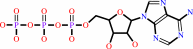 ATP
ATP
|
+
|
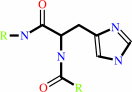 protein L-histidine
|
=
|
 ADP
ADP
|
+
|
protein N-phospho-L-histidine
|
|
|
|
|
|
|
|
|
|
|
|
|
Molecule diagrams generated from .mol files obtained from the
KEGG ftp site
|
|
|
|
|
|
|
|
|
|
|
|
|
|
 |
|
|
|
|
|
|
| |
|
|
| |
|
DOI no:
|
Cell
88:717-723
(1997)
|
|
PubMed id:
|
|
|
|
|
|
| |
|
Insights into multistep phosphorelay from the crystal structure of the C-terminal HPt domain of ArcB.
|
|
M.Kato,
T.Mizuno,
T.Shimizu,
T.Hakoshima.
|
|
|
|
|
| |
ABSTRACT
|
|
|
|
| |
|
|
The histidine-containing phosphotransfer (HPt) domain is a novel protein module
with an active histidine residue that mediates phosphotransfer reactions in the
two-component signaling systems. A multistep phosphorelay involving the HPt
domain has been suggested for these signaling pathways. The crystal structure of
the HPt domain of the anaerobic sensor kinase ArcB has been determined at 2.06 A
resolution. The domain consists of six alpha helices containing a four-helix
bundle-folding. The pattern of sequence similarity of the HPt domains of ArcB
and components in other signaling systems can be interpreted in light of the
three-dimensional structure and supports the conclusion that the HPt domains
have a common structural motif both in prokaryotes and eukaryotes.
|
|
|
|
|
|
| |
Selected figure(s)
|
|
|
|
| |
|
|

|
|

|
|
Figure 4.
Figure 4. Helix Structure and Sequence Alignment of HPt
DomainsSide-view of helix D of the HPt domain of ArcB using a
ball-and-stick model with the 2F[o]-F[c] electron density map.
The imidazole ring makes a hydrogen bond to a water molecule (W).
|
|
Figure 5.
Figure 5. Comparison of HPt and P1 DomainsStructural
comparison of the HPt domain of ArcB (right) and the P1 domain
of CheA (left). The main chain is drawn as a ribbon in red for
helices D and E of the HPt domain of ArcB and the corresponding
part of CheA. The side chain of active His-717 of the HPt domain
and the location of the corresponding histidine in the P1 domain
are shown in green.
|
|
|
|
|
|
| |
The above figures are
reprinted
by permission from Cell Press:
Cell
(1997,
88,
717-723)
copyright 1997.
|
|
| |
Figures were
selected
by an automated process.
|
|
|
|
|
|
|
|
|
|
|
|
|
|
|
|
 |
 |
 |
|
Literature references that cite this PDB file's key reference
|
|
|
| |
PubMed id
|
|
Reference
|
|
|
|
|
|
I.Maslennikov,
C.Klammt,
E.Hwang,
G.Kefala,
M.Okamura,
L.Esquivies,
K.Mörs,
C.Glaubitz,
W.Kwiatkowski,
Y.H.Jeon,
and
S.Choe
(2010).
Membrane domain structures of three classes of histidine kinase receptors by cell-free expression and rapid NMR analysis.
|
| |
Proc Natl Acad Sci U S A,
107,
10902-10907.
|
|
|
PDB codes:
|
|
|
|
|
|
|
|
J.A.Doebbler,
and
R.B.Von Dreele
(2009).
Application of molecular replacement to protein powder data from image plates.
|
| |
Acta Crystallogr D Biol Crystallogr,
65,
348-355.
|
|
|
|
|
|
|
Q.Xu,
D.Carlton,
M.D.Miller,
M.A.Elsliger,
S.S.Krishna,
P.Abdubek,
T.Astakhova,
P.Burra,
H.J.Chiu,
T.Clayton,
M.C.Deller,
L.Duan,
Y.Elias,
J.Feuerhelm,
J.C.Grant,
A.Grzechnik,
S.K.Grzechnik,
G.W.Han,
L.Jaroszewski,
K.K.Jin,
H.E.Klock,
M.W.Knuth,
P.Kozbial,
A.Kumar,
D.Marciano,
D.McMullan,
A.T.Morse,
E.Nigoghossian,
L.Okach,
S.Oommachen,
J.Paulsen,
R.Reyes,
C.L.Rife,
N.Sefcovic,
C.Trame,
C.V.Trout,
H.van den Bedem,
D.Weekes,
K.O.Hodgson,
J.Wooley,
A.M.Deacon,
A.Godzik,
S.A.Lesley,
and
I.A.Wilson
(2009).
Crystal structure of histidine phosphotransfer protein ShpA, an essential regulator of stalk biogenesis in Caulobacter crescentus.
|
| |
J Mol Biol,
390,
686-698.
|
|
|
PDB code:
|
|
|
|
|
|
|
|
R.Gao,
and
A.M.Stock
(2009).
Biological insights from structures of two-component proteins.
|
| |
Annu Rev Microbiol,
63,
133-154.
|
|
|
|
|
|
|
S.Jagadeesan,
P.Mann,
C.W.Schink,
and
P.I.Higgs
(2009).
A Novel "Four-component" Two-component Signal Transduction Mechanism Regulates Developmental Progression in Myxococcus xanthus.
|
| |
J Biol Chem,
284,
21435-21445.
|
|
|
|
|
|
|
J.L.Hsu,
H.C.Chen,
H.L.Peng,
and
H.Y.Chang
(2008).
Characterization of the histidine-containing phosphotransfer protein B-mediated multistep phosphorelay system in Pseudomonas aeruginosa PAO1.
|
| |
J Biol Chem,
283,
9933-9944.
|
|
|
|
|
|
|
H.Tan,
F.Janiak-Spens,
and
A.H.West
(2007).
Functional characterization of the phosphorelay protein Mpr1p from Schizosaccharomyces pombe.
|
| |
FEMS Yeast Res,
7,
912-921.
|
|
|
|
|
|
|
K.Wuichet,
R.P.Alexander,
and
I.B.Zhulin
(2007).
Comparative genomic and protein sequence analyses of a complex system controlling bacterial chemotaxis.
|
| |
Methods Enzymol,
422,
1.
|
|
|
|
|
|
|
E.G.Biondi,
J.M.Skerker,
M.Arif,
M.S.Prasol,
B.S.Perchuk,
and
M.T.Laub
(2006).
A phosphorelay system controls stalk biogenesis during cell cycle progression in Caulobacter crescentus.
|
| |
Mol Microbiol,
59,
386-401.
|
|
|
|
|
|
|
M.Y.Galperin
(2006).
Structural classification of bacterial response regulators: diversity of output domains and domain combinations.
|
| |
J Bacteriol,
188,
4169-4182.
|
|
|
|
|
|
|
R.Malpica,
G.R.Sandoval,
C.Rodríguez,
B.Franco,
and
D.Georgellis
(2006).
Signaling by the arc two-component system provides a link between the redox state of the quinone pool and gene expression.
|
| |
Antioxid Redox Signal,
8,
781-795.
|
|
|
|
|
|
|
W.Zhang,
D.E.Culley,
G.Wu,
and
F.J.Brockman
(2006).
Two-component signal transduction systems of Desulfovibrio vulgaris: structural and phylogenetic analysis and deduction of putative cognate pairs.
|
| |
J Mol Evol,
62,
473-487.
|
|
|
|
|
|
|
C.M.Quezada,
D.J.Hamel,
C.Gradinaru,
A.M.Bilwes,
F.W.Dahlquist,
B.R.Crane,
and
M.I.Simon
(2005).
Structural and chemical requirements for histidine phosphorylation by the chemotaxis kinase CheA.
|
| |
J Biol Chem,
280,
30581-30585.
|
|
|
|
|
|
|
H.Sugawara,
Y.Kawano,
T.Hatakeyama,
T.Yamaya,
N.Kamiya,
and
H.Sakakibara
(2005).
Crystal structure of the histidine-containing phosphotransfer protein ZmHP2 from maize.
|
| |
Protein Sci,
14,
202-208.
|
|
|
PDB code:
|
|
|
|
|
|
|
|
J.A.Gralnick,
C.T.Brown,
and
D.K.Newman
(2005).
Anaerobic regulation by an atypical Arc system in Shewanella oneidensis.
|
| |
Mol Microbiol,
56,
1347-1357.
|
|
|
|
|
|
|
K.Hamada,
M.Kato,
T.Shimizu,
K.Ihara,
T.Mizuno,
and
T.Hakoshima
(2005).
Crystal structure of the protein histidine phosphatase SixA in the multistep His-Asp phosphorelay.
|
| |
Genes Cells,
10,
1.
|
|
|
PDB codes:
|
|
|
|
|
|
|
|
K.Stephenson,
and
R.J.Lewis
(2005).
Molecular insights into the initiation of sporulation in Gram-positive bacteria: new technologies for an old phenomenon.
|
| |
FEMS Microbiol Rev,
29,
281-301.
|
|
|
|
|
|
|
T.Mizuno
(2005).
Two-component phosphorelay signal transduction systems in plants: from hormone responses to circadian rhythms.
|
| |
Biosci Biotechnol Biochem,
69,
2263-2276.
|
|
|
|
|
|
|
C.B.Whitchurch,
A.J.Leech,
M.D.Young,
D.Kennedy,
J.L.Sargent,
J.J.Bertrand,
A.B.Semmler,
A.S.Mellick,
P.R.Martin,
R.A.Alm,
M.Hobbs,
S.A.Beatson,
B.Huang,
L.Nguyen,
J.C.Commolli,
J.N.Engel,
A.Darzins,
and
J.S.Mattick
(2004).
Characterization of a complex chemosensory signal transduction system which controls twitching motility in Pseudomonas aeruginosa.
|
| |
Mol Microbiol,
52,
873-893.
|
|
|
|
|
|
|
R.Hõrak,
H.Ilves,
P.Pruunsild,
M.Kuljus,
and
M.Kivisaar
(2004).
The ColR-ColS two-component signal transduction system is involved in regulation of Tn4652 transposition in Pseudomonas putida under starvation conditions.
|
| |
Mol Microbiol,
54,
795-807.
|
|
|
|
|
|
|
M.E.Castelli,
A.Cauerhff,
M.Amongero,
F.C.Soncini,
and
E.G.Vescovi
(2003).
The H box-harboring domain is key to the function of the Salmonella enterica PhoQ Mg2+-sensor in the recognition of its partner PhoP.
|
| |
J Biol Chem,
278,
23579-23585.
|
|
|
|
|
|
|
T.Kakimoto
(2003).
Perception and signal transduction of cytokinins.
|
| |
Annu Rev Plant Biol,
54,
605-627.
|
|
|
|
|
|
|
A.H.West,
and
A.M.Stock
(2001).
Histidine kinases and response regulator proteins in two-component signaling systems.
|
| |
Trends Biochem Sci,
26,
369-376.
|
|
|
|
|
|
|
J.A.Hoch,
and
K.I.Varughese
(2001).
Keeping signals straight in phosphorelay signal transduction.
|
| |
J Bacteriol,
183,
4941-4949.
|
|
|
|
|
|
|
S.Takeda,
Y.Fujisawa,
M.Matsubara,
H.Aiba,
and
T.Mizuno
(2001).
A novel feature of the multistep phosphorelay in Escherichia coli: a revised model of the RcsC --> YojN --> RcsB signalling pathway implicated in capsular synthesis and swarming behaviour.
|
| |
Mol Microbiol,
40,
440-450.
|
|
|
|
|
|
|
A.M.Stock,
V.L.Robinson,
and
P.N.Goudreau
(2000).
Two-component signal transduction.
|
| |
Annu Rev Biochem,
69,
183-215.
|
|
|
|
|
|
|
A.Rodrigue,
Y.Quentin,
A.Lazdunski,
V.Méjean,
and
M.Foglino
(2000).
Two-component systems in Pseudomonas aeruginosa: why so many?
|
| |
Trends Microbiol,
8,
498-504.
|
|
|
|
|
|
|
F.Janiak-Spens,
and
A.H.West
(2000).
Functional roles of conserved amino acid residues surrounding the phosphorylatable histidine of the yeast phosphorelay protein YPD1.
|
| |
Mol Microbiol,
37,
136-144.
|
|
|
|
|
|
|
M.Matsubara,
S.I.Kitaoka,
S.I.Takeda,
and
T.Mizuno
(2000).
Tuning of the porin expression under anaerobic growth conditions by his-to-Asp cross-phosphorelay through both the EnvZ-osmosensor and ArcB-anaerosensor in Escherichia coli.
|
| |
Genes Cells,
5,
555-569.
|
|
|
|
|
|
|
O.Kwon,
D.Georgellis,
A.S.Lynch,
D.Boyd,
and
E.C.Lin
(2000).
The ArcB sensor kinase of Escherichia coli: genetic exploration of the transmembrane region.
|
| |
J Bacteriol,
182,
2960-2966.
|
|
|
|
|
|
|
O.Kwon,
D.Georgellis,
and
E.C.Lin
(2000).
Phosphorelay as the sole physiological route of signal transmission by the arc two-component system of Escherichia coli.
|
| |
J Bacteriol,
182,
3858-3862.
|
|
|
|
|
|
|
S.Alexeeva,
B.de Kort,
G.Sawers,
K.J.Hellingwerf,
and
M.J.de Mattos
(2000).
Effects of limited aeration and of the ArcAB system on intermediary pyruvate catabolism in Escherichia coli.
|
| |
J Bacteriol,
182,
4934-4940.
|
|
|
|
|
|
|
T.Doerks,
P.Bork,
E.Kamberov,
O.Makarova,
S.Muecke,
and
B.Margolis
(2000).
L27, a novel heterodimerization domain in receptor targeting proteins Lin-2 and Lin-7.
|
| |
Trends Biochem Sci,
25,
317-318.
|
|
|
|
|
|
|
A.L.Perraud,
V.Weiss,
and
R.Gross
(1999).
Signalling pathways in two-component phosphorelay systems.
|
| |
Trends Microbiol,
7,
115-120.
|
|
|
|
|
|
|
A.M.Bilwes,
L.A.Alex,
B.R.Crane,
and
M.I.Simon
(1999).
Structure of CheA, a signal-transducing histidine kinase.
|
| |
Cell,
96,
131-141.
|
|
|
PDB code:
|
|
|
|
|
|
|
|
B.L.Taylor,
and
I.B.Zhulin
(1999).
PAS domains: internal sensors of oxygen, redox potential, and light.
|
| |
Microbiol Mol Biol Rev,
63,
479-506.
|
|
|
|
|
|
|
C.E.Bauer,
S.Elsen,
and
T.H.Bird
(1999).
Mechanisms for redox control of gene expression.
|
| |
Annu Rev Microbiol,
53,
495-523.
|
|
|
|
|
|
|
F.Janiak-Spens,
J.M.Sparling,
M.Gurfinkel,
and
A.H.West
(1999).
Differential stabilities of phosphorylated response regulator domains reflect functional roles of the yeast osmoregulatory SLN1 and SSK1 proteins.
|
| |
J Bacteriol,
181,
411-417.
|
|
|
|
|
|
|
G.Sawers
(1999).
The aerobic/anaerobic interface.
|
| |
Curr Opin Microbiol,
2,
181-187.
|
|
|
|
|
|
|
J.J.Hilliard,
R.M.Goldschmidt,
L.Licata,
E.Z.Baum,
and
K.Bush
(1999).
Multiple mechanisms of action for inhibitors of histidine protein kinases from bacterial two-component systems.
|
| |
Antimicrob Agents Chemother,
43,
1693-1699.
|
|
|
|
|
|
|
K.Hamada,
M.Kato,
T.Mizuno,
and
T.Hakoshima
(1999).
Crystallographic characterization of a novel protein SixA which exhibits phospho-histidine phosphatase activity in the multistep His-Asp phosphorelay.
|
| |
Acta Crystallogr D Biol Crystallogr,
55,
269-271.
|
|
|
|
|
|
|
M.C.Pirrung
(1999).
Histidine kinases and two-component signal transduction systems.
|
| |
Chem Biol,
6,
R167-R175.
|
|
|
|
|
|
|
M.G.Lee,
J.Y.Lee,
H.K.Song,
and
S.W.Suh
(1999).
Crystallization and preliminary X-ray analysis of Saccharomyces cerevisiae Ypd1p, a key intermediate in phosphorelay signal transduction.
|
| |
Acta Crystallogr D Biol Crystallogr,
55,
1219-1221.
|
|
|
|
|
|
|
M.Kato,
T.Mizuno,
T.Shimizu,
and
T.Hakoshima
(1999).
Refined structure of the histidine-containing phosphotransfer (HPt) domain of the anaerobic sensor kinase ArcB from Escherichia coli at 1.57 A resolution.
|
| |
Acta Crystallogr D Biol Crystallogr,
55,
1842-1849.
|
|
|
PDB code:
|
|
|
|
|
|
|
|
M.Kato,
T.Shimizu,
T.Mizuno,
and
T.Hakoshima
(1999).
Structure of the histidine-containing phosphotransfer (HPt) domain of the anaerobic sensor protein ArcB complexed with the chemotaxis response regulator CheY.
|
| |
Acta Crystallogr D Biol Crystallogr,
55,
1257-1263.
|
|
|
PDB code:
|
|
|
|
|
|
|
|
Q.Xu,
V.Nguyen,
and
A.H.West
(1999).
Purification, crystallization and preliminary X-ray diffraction analysis of the yeast phosphorelay protein YPD1.
|
| |
Acta Crystallogr D Biol Crystallogr,
55,
291-293.
|
|
|
|
|
|
|
R.Dutta,
L.Qin,
and
M.Inouye
(1999).
Histidine kinases: diversity of domain organization.
|
| |
Mol Microbiol,
34,
633-640.
|
|
|
|
|
|
|
V.L.Robinson,
and
A.M.Stock
(1999).
High energy exchange: proteins that make or break phosphoramidate bonds.
|
| |
Structure,
7,
R47-R53.
|
|
|
|
|
|
|
A.Imamura,
N.Hanaki,
H.Umeda,
A.Nakamura,
T.Suzuki,
C.Ueguchi,
and
T.Mizuno
(1998).
Response regulators implicated in His-to-Asp phosphotransfer signaling in Arabidopsis.
|
| |
Proc Natl Acad Sci U S A,
95,
2691-2696.
|
|
|
|
|
|
|
A.L.Perraud,
B.Kimmel,
V.Weiss,
and
R.Gross
(1998).
Specificity of the BvgAS and EvgAS phosphorelay is mediated by the C-terminal HPt domains of the sensor proteins.
|
| |
Mol Microbiol,
27,
875-887.
|
|
|
|
|
|
|
A.Matsushika,
and
T.Mizuno
(1998).
A dual-signaling mechanism mediated by the ArcB hybrid sensor kinase containing the histidine-containing phosphotransfer domain in Escherichia coli.
|
| |
J Bacteriol,
180,
3973-3977.
|
|
|
|
|
|
|
A.Matsushika,
and
T.Mizuno
(1998).
Mutational analysis of the histidine-containing phosphotransfer (HPt) signaling domain of the ArcB sensor in Escherichia coli.
|
| |
Biosci Biotechnol Biochem,
62,
2236-2238.
|
|
|
|
|
|
|
D.Georgellis,
O.Kwon,
P.De Wulf,
and
E.C.Lin
(1998).
Signal decay through a reverse phosphorelay in the Arc two-component signal transduction system.
|
| |
J Biol Chem,
273,
32864-32869.
|
|
|
|
|
|
|
M.Kato,
T.Mizuno,
and
T.Hakoshima
(1998).
Crystallization of a complex between a novel C-terminal transmitter, HPt domain, of the anaerobic sensor kinase ArcB and the chemotaxis response regulator CheY.
|
| |
Acta Crystallogr D Biol Crystallogr,
54,
140-142.
|
|
|
|
|
|
|
M.Singh,
B.Berger,
P.S.Kim,
J.M.Berger,
and
A.G.Cochran
(1998).
Computational learning reveals coiled coil-like motifs in histidine kinase linker domains.
|
| |
Proc Natl Acad Sci U S A,
95,
2738-2743.
|
|
|
|
|
|
|
P.N.Goudreau,
and
A.M.Stock
(1998).
Signal transduction in bacteria: molecular mechanisms of stimulus-response coupling.
|
| |
Curr Opin Microbiol,
1,
160-169.
|
|
|
|
|
|
|
T.Kakimoto
(1998).
Cytokinin signaling.
|
| |
Curr Opin Plant Biol,
1,
399-403.
|
|
|
|
|
|
|
T.Ogino,
M.Matsubara,
N.Kato,
Y.Nakamura,
and
T.Mizuno
(1998).
An Escherichia coli protein that exhibits phosphohistidine phosphatase activity towards the HPt domain of the ArcB sensor involved in the multistep His-Asp phosphorelay.
|
| |
Mol Microbiol,
27,
573-585.
|
|
|
|
|
|
|
Y.L.Tzeng,
X.Z.Zhou,
and
J.A.Hoch
(1998).
Phosphorylation of the Spo0B response regulator phosphotransferase of the phosphorelay initiating development in Bacillus subtilis.
|
| |
J Biol Chem,
273,
23849-23855.
|
|
|
|
|
|
|
M.M.McEvoy,
and
F.W.Dahlquist
(1997).
Phosphohistidines in bacterial signaling.
|
| |
Curr Opin Struct Biol,
7,
793-797.
|
|
|
|
|
|
The most recent references are shown first.
Citation data come partly from CiteXplore and partly
from an automated harvesting procedure. Note that this is likely to be
only a partial list as not all journals are covered by
either method. However, we are continually building up the citation data
so more and more references will be included with time.
Where a reference describes a PDB structure, the PDB
codes are
shown on the right.
|
|


 Links
Links


