 |
PDBsum entry 1wns

|
|
|
|
|
 |
Contents |
 |
|
|
|
|
|
|
|
|
* Residue conservation analysis
|
|
|
|
|
|
|
|
|
|
|
Enzyme class 2:
|
|
E.C.2.7.7.7
- DNA-directed Dna polymerase.
|
|
|
|
|
|
|
Reaction:
|
|
DNA(n) + a 2'-deoxyribonucleoside 5'-triphosphate = DNA(n+1) + diphosphate
|
|
|
|
|
|
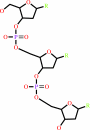 DNA(n)
|
+
|
2'-deoxyribonucleoside 5'-triphosphate
|
=
|
DNA(n+1)
|
+
|
 diphosphate
|
|
|
|
|
|
|
|
|
|
Enzyme class 3:
|
|
E.C.3.1.-.-
|
|
|
|
|
|
|
|
|
|
Note, where more than one E.C. class is given (as above), each may
correspond to a different protein domain or, in the case of polyprotein
precursors, to a different mature protein.
|
|
|
|
Molecule diagrams generated from .mol files obtained from the
KEGG ftp site
|
|
|
|
|
|
|
|
|
|
|
|
|
|
 |
|
|
|
|
|
|
| |
|
|
| |
|
DOI no:
|
J Mol Biol
306:469-477
(2001)
|
|
PubMed id:
|
|
|
|
|
|
| |
|
Crystal structure of DNA polymerase from hyperthermophilic archaeon Pyrococcus kodakaraensis KOD1.
|
|
H.Hashimoto,
M.Nishioka,
S.Fujiwara,
M.Takagi,
T.Imanaka,
T.Inoue,
Y.Kai.
|
|
|
|
|
| |
ABSTRACT
|
|
|
|
| |
|
|
The crystal structure of family B DNA polymerase from the hyperthermophilic
archaeon Pyrococcus kodakaraensis KOD1 (KOD DNA polymerase) was determined. KOD
DNA polymerase exhibits the highest known extension rate, processivity and
fidelity. We carried out the structural analysis of KOD DNA polymerase in order
to clarify the mechanisms of those enzymatic features. Structural comparison of
DNA polymerases from hyperthermophilic archaea highlighted the conformational
difference in Thumb domains. The Thumb domain of KOD DNA polymerase shows an
"opened" conformation. The fingers subdomain possessed many basic
residues at the side of the polymerase active site. The residues are considered
to be accessible to the incoming dNTP by electrostatic interaction. A
beta-hairpin motif (residues 242-249) extends from the Exonuclease (Exo) domain
as seen in the editing complex of the RB69 DNA polymerase from bacteriophage
RB69. Many arginine residues are located at the forked-point (the junction of
the template-binding and editing clefts) of KOD DNA polymerase, suggesting that
the basic environment is suitable for partitioning of the primer and template
DNA duplex and for stabilizing the partially melted DNA structure in the
high-temperature environments. The stabilization of the melted DNA structure at
the forked-point may be correlated with the high PCR performance of KOD DNA
polymerase, which is due to low error rate, high elongation rate and
processivity.
|
|
|
|
|
|
| |
Selected figure(s)
|
|
|
|
| |
|
|

|
|

|
|
Figure 1.
Figure 1. (a) Overall structure of
KOD DNA polymerase. The struc-
ture is composed of domains and
subdomains, which are N-terminal
(N-ter, violet), Exonuclease (Exo,
blue), Polymerase (Pol) domain
including the Palm (brown) and
Fingers (green) subdomains and
the Thumb domain (red), including
the Thumb-1 and Thumb-2 subdo-
mains. Conserved carboxylate
residues in Polymerase and Exonu-
clease active site are shown by ball-
and-stick models. (b) Confor-
mational comparison of Thumb
domains among three archaeal
DNA polymerases. Red, KOD
DNA polymerase; blue, Tgo DNA
polymerase; and green, 9°N-7 DNA
polymerase. The comparison shows
that the Thumb domain of KOD
DNA polymerase displays the most
``opened'' conformation.
|
|
Figure 4.
Figure 4. Molecular surface with electrostatic potential
map around the forked-point. The red and blue surfaces
are acidic and basic regions, respectively. Domains and
subdomains are labeled with orange letters. Polymerase
and Exonuclease active sites are labeled with P and E,
respectively. The b-hairpin is labeled with b.
|
|
|
|
|
|
| |
The above figures are
reprinted
by permission from Elsevier:
J Mol Biol
(2001,
306,
469-477)
copyright 2001.
|
|
| |
Figures were
selected
by an automated process.
|
|
|
|
|
|
|
|
|
|
|
|
|
|
|
|
 |
 |
 |
|
Literature references that cite this PDB file's key reference
|
|
|
| |
PubMed id
|
|
Reference
|
|
|
|
|
|
C.J.Hansen,
L.Wu,
J.D.Fox,
B.Arezi,
and
H.H.Hogrefe
(2011).
Engineered split in Pfu DNA polymerase fingers domain improves incorporation of nucleotide gamma-phosphate derivative.
|
| |
Nucleic Acids Res,
39,
1801-1810.
|
|
|
|
|
|
|
K.Mayanagi,
S.Kiyonari,
H.Nishida,
M.Saito,
D.Kohda,
Y.Ishino,
T.Shirai,
and
K.Morikawa
(2011).
Architecture of the DNA polymerase B-proliferating cell nuclear antigen (PCNA)-DNA ternary complex.
|
| |
Proc Natl Acad Sci U S A,
108,
1845-1849.
|
|
|
|
|
|
|
E.Johansson,
and
S.A.Macneill
(2010).
The eukaryotic replicative DNA polymerases take shape.
|
| |
Trends Biochem Sci,
35,
339-347.
|
|
|
|
|
|
|
I.del Olmo,
L.López-González,
M.M.Martín-Trillo,
J.M.Martínez-Zapater,
M.Piñeiro,
and
J.A.Jarillo
(2010).
EARLY IN SHORT DAYS 7 (ESD7) encodes the catalytic subunit of DNA polymerase epsilon and is required for flowering repression through a mechanism involving epigenetic gene silencing.
|
| |
Plant J,
61,
623-636.
|
|
|
|
|
|
|
J.G.Song,
E.J.Kil,
S.S.Cho,
I.H.Kim,
and
S.T.Kwon
(2010).
An amino acid residue in the middle of the fingers subdomain is involved in Neq DNA polymerase processivity: enhanced processivity of engineered Neq DNA polymerase and its PCR application.
|
| |
Protein Eng Des Sel,
23,
835-842.
|
|
|
|
|
|
|
H.Matsukawa,
T.Yamagami,
Y.Kawarabayasi,
Y.Miyashita,
M.Takahashi,
and
Y.Ishino
(2009).
A useful strategy to construct DNA polymerases with different properties by using genetic resources from environmental DNA.
|
| |
Genes Genet Syst,
84,
3.
|
|
|
|
|
|
|
I.Rodríguez,
J.M.Lázaro,
M.Salas,
and
M.de Vega
(2009).
Involvement of the TPR2 subdomain movement in the activities of phi29 DNA polymerase.
|
| |
Nucleic Acids Res,
37,
193-203.
|
|
|
|
|
|
|
R.N.Veedu,
B.Vester,
and
J.Wengel
(2009).
Efficient enzymatic synthesis of LNA-modified DNA duplexes using KOD DNA polymerase.
|
| |
Org Biomol Chem,
7,
1404-1409.
|
|
|
|
|
|
|
M.Kuwahara,
S.Obika,
J.Nagashima,
Y.Ohta,
Y.Suto,
H.Ozaki,
H.Sawai,
and
T.Imanishi
(2008).
Systematic analysis of enzymatic DNA polymerization using oligo-DNA templates and triphosphate analogs involving 2',4'-bridged nucleosides.
|
| |
Nucleic Acids Res,
36,
4257-4265.
|
|
|
|
|
|
|
R.Raghavan,
L.D.Hicks,
and
M.F.Minnick
(2008).
Toxic introns and parasitic intein in Coxiella burnetii: legacies of a promiscuous past.
|
| |
J Bacteriol,
190,
5934-5943.
|
|
|
|
|
|
|
A.P.Silverman,
Q.Jiang,
M.F.Goodman,
and
E.T.Kool
(2007).
Steric and electrostatic effects in DNA synthesis by the SOS-induced DNA polymerases II and IV of Escherichia coli.
|
| |
Biochemistry,
46,
13874-13881.
|
|
|
|
|
|
|
M.Hogg,
P.Aller,
W.Konigsberg,
S.S.Wallace,
and
S.Doublié
(2007).
Structural and biochemical investigation of the role in proofreading of a beta hairpin loop found in the exonuclease domain of a replicative DNA polymerase of the B family.
|
| |
J Biol Chem,
282,
1432-1444.
|
|
|
PDB code:
|
|
|
|
|
|
|
|
M.Kuwahara,
J.Nagashima,
M.Hasegawa,
T.Tamura,
R.Kitagata,
K.Hanawa,
S.Hososhima,
T.Kasamatsu,
H.Ozaki,
and
H.Sawai
(2006).
Systematic characterization of 2'-deoxynucleoside- 5'-triphosphate analogs as substrates for DNA polymerases by polymerase chain reaction and kinetic studies on enzymatic production of modified DNA.
|
| |
Nucleic Acids Res,
34,
5383-5394.
|
|
|
|
|
|
|
R.Shi,
A.Azzi,
C.Gilbert,
G.Boivin,
and
S.X.Lin
(2006).
Three-dimensional modeling of cytomegalovirus DNA polymerase and preliminary analysis of drug resistance.
|
| |
Proteins,
64,
301-307.
|
|
|
|
|
|
|
H.Ogata,
D.Raoult,
and
J.M.Claverie
(2005).
A new example of viral intein in Mimivirus.
|
| |
Virol J,
2,
8.
|
|
|
|
|
|
|
I.Rodríguez,
J.M.Lázaro,
L.Blanco,
S.Kamtekar,
A.J.Berman,
J.Wang,
T.A.Steitz,
M.Salas,
and
M.de Vega
(2005).
A specific subdomain in phi29 DNA polymerase confers both processivity and strand-displacement capacity.
|
| |
Proc Natl Acad Sci U S A,
102,
6407-6412.
|
|
|
|
|
|
|
K.Egorova,
and
G.Antranikian
(2005).
Industrial relevance of thermophilic Archaea.
|
| |
Curr Opin Microbiol,
8,
649-655.
|
|
|
|
|
|
|
T.Ohbayashi,
M.Kuwahara,
M.Hasegawa,
T.Kasamatsu,
T.Tamura,
and
H.Sawai
(2005).
Expansion of repertoire of modified DNAs prepared by PCR using KOD Dash DNA polymerase.
|
| |
Org Biomol Chem,
3,
2463-2468.
|
|
|
|
|
|
|
A.F.Gardner,
C.M.Joyce,
and
W.E.Jack
(2004).
Comparative kinetics of nucleotide analog incorporation by vent DNA polymerase.
|
| |
J Biol Chem,
279,
11834-11842.
|
|
|
|
|
|
|
A.R.Pavlov,
N.V.Pavlova,
S.A.Kozyavkin,
and
A.I.Slesarev
(2004).
Recent developments in the optimization of thermostable DNA polymerases for efficient applications.
|
| |
Trends Biotechnol,
22,
253-260.
|
|
|
|
|
|
|
B.D.Biles,
and
B.A.Connolly
(2004).
Low-fidelity Pyrococcus furiosus DNA polymerase mutants useful in error-prone PCR.
|
| |
Nucleic Acids Res,
32,
e176.
|
|
|
|
|
|
|
D.Das,
and
M.M.Georgiadis
(2004).
The crystal structure of the monomeric reverse transcriptase from Moloney murine leukemia virus.
|
| |
Structure,
12,
819-829.
|
|
|
PDB codes:
|
|
|
|
|
|
|
|
E.Freisinger,
A.P.Grollman,
H.Miller,
and
C.Kisker
(2004).
Lesion (in)tolerance reveals insights into DNA replication fidelity.
|
| |
EMBO J,
23,
1494-1505.
|
|
|
PDB codes:
|
|
|
|
|
|
|
|
M.Hogg,
S.S.Wallace,
and
S.Doublié
(2004).
Crystallographic snapshots of a replicative DNA polymerase encountering an abasic site.
|
| |
EMBO J,
23,
1483-1493.
|
|
|
PDB codes:
|
|
|
|
|
|
|
|
V.Truniger,
J.M.Lázaro,
and
M.Salas
(2004).
Function of the C-terminus of phi29 DNA polymerase in DNA and terminal protein binding.
|
| |
Nucleic Acids Res,
32,
361-370.
|
|
|
|
|
|
|
Y.T.Hwang,
H.J.Zuccola,
Q.Lu,
and
C.B.Hwang
(2004).
A point mutation within conserved region VI of herpes simplex virus type 1 DNA polymerase confers altered drug sensitivity and enhances replication fidelity.
|
| |
J Virol,
78,
650-657.
|
|
|
|
|
|
|
B.Grabowski,
and
Z.Kelman
(2003).
Archeal DNA replication: eukaryal proteins in a bacterial context.
|
| |
Annu Rev Microbiol,
57,
487-516.
|
|
|
|
|
|
|
T.Kanai,
S.Ito,
and
T.Imanaka
(2003).
Characterization of a cytosolic NiFe-hydrogenase from the hyperthermophilic archaeon Thermococcus kodakaraensis KOD1.
|
| |
J Bacteriol,
185,
1705-1711.
|
|
|
|
|
|
|
H.Atomi
(2002).
Microbial enzymes involved in carbon dioxide fixation.
|
| |
J Biosci Bioeng,
94,
497-505.
|
|
|
|
|
|
|
M.J.Fogg,
L.H.Pearl,
and
B.A.Connolly
(2002).
Structural basis for uracil recognition by archaeal family B DNA polymerases.
|
| |
Nat Struct Biol,
9,
922-927.
|
|
|
|
|
|
|
M.Kitabayashi,
Y.Nishiya,
M.Esaka,
M.Itakura,
and
T.Imanaka
(2002).
Gene cloning and polymerase chain reaction with proliferating cell nuclear antigen from Thermococcus kodakaraensis KOD1.
|
| |
Biosci Biotechnol Biochem,
66,
2194-2200.
|
|
|
|
|
|
|
R.Eisenbrandt,
J.M.Lázaro,
M.Salas,
and
M.de Vega
(2002).
Phi29 DNA polymerase residues Tyr59, His61 and Phe69 of the highly conserved ExoII motif are essential for interaction with the terminal protein.
|
| |
Nucleic Acids Res,
30,
1379-1386.
|
|
|
|
|
|
|
T.Fukui,
T.Eguchi,
H.Atomi,
and
T.Imanaka
(2002).
A membrane-bound archaeal Lon protease displays ATP-independent proteolytic activity towards unfolded proteins and ATP-dependent activity for folded proteins.
|
| |
J Bacteriol,
184,
3689-3698.
|
|
|
|
|
|
|
T.Imanaka,
and
H.Atomi
(2002).
Catalyzing "hot" reactions: enzymes from hyperthermophilic Archaea.
|
| |
Chem Rec,
2,
149-163.
|
|
|
|
|
|
|
V.Truniger,
J.M.Lázaro,
F.J.Esteban,
L.Blanco,
and
M.Salas
(2002).
A positively charged residue of phi29 DNA polymerase, highly conserved in DNA polymerases from families A and B, is involved in binding the incoming nucleotide.
|
| |
Nucleic Acids Res,
30,
1483-1492.
|
|
|
|
|
|
|
I.D.Kerr,
R.I.Wadsworth,
W.Blankenfeldt,
A.G.Staines,
M.F.White,
and
J.H.Naismith
(2001).
Overexpression, purification, crystallization and data collection of a single-stranded DNA-binding protein from Sulfolobus solfataricus.
|
| |
Acta Crystallogr D Biol Crystallogr,
57,
1290-1292.
|
|
|
|
|
|
The most recent references are shown first.
Citation data come partly from CiteXplore and partly
from an automated harvesting procedure. Note that this is likely to be
only a partial list as not all journals are covered by
either method. However, we are continually building up the citation data
so more and more references will be included with time.
Where a reference describes a PDB structure, the PDB
code is
shown on the right.
|
|


 Links
Links


