 |
PDBsum entry 1cqq

|
|
|
|
|
 |
Contents |
 |
|
|
|
|
|
|
|
|
|
|
|
|
* Residue conservation analysis
|
|
|
|
|
|
|
|
|
|
|
Enzyme class 2:
|
|
E.C.2.7.7.48
- RNA-directed Rna polymerase.
|
|
|
|
|
|
|
Reaction:
|
|
RNA(n) + a ribonucleoside 5'-triphosphate = RNA(n+1) + diphosphate
|
|
|
|
|
|
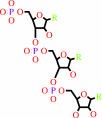 RNA(n)
|
+
|
ribonucleoside 5'-triphosphate
|
=
|
RNA(n+1)
|
+
|
 diphosphate
|
|
|
|
|
|
|
|
|
|
Enzyme class 3:
|
|
E.C.3.4.22.28
- picornain 3C.
|
|
|
|
|
|
|
Reaction:
|
|
Selective cleavage of Gln-|-Gly bond in the poliovirus polyprotein. In other picornavirus reactions Glu may be substituted for Gln, and Ser or Thr for Gly.
|
|
|
|
|
|
Enzyme class 4:
|
|
E.C.3.4.22.29
- picornain 2A.
|
|
|
|
|
|
|
Reaction:
|
|
Selective cleavage of Tyr-|-Gly bond in the picornavirus polyprotein. In other picornavirus reactions Glu may be substituted for Gln, and Ser or Thr for Gly.
|
|
|
|
|
|
Enzyme class 5:
|
|
E.C.3.6.1.15
- nucleoside-triphosphate phosphatase.
|
|
|
|
|
|
|
Reaction:
|
|
a ribonucleoside 5'-triphosphate + H2O = a ribonucleoside 5'-diphosphate + phosphate + H+
|
|
|
|
|
|
ribonucleoside 5'-triphosphate
|
+
|
H2O
|
=
|
ribonucleoside 5'-diphosphate
|
+
|
 phosphate
|
+
|
H(+)
|
|
|
|
|
|
|
|
|
|
|
|
|
Note, where more than one E.C. class is given (as above), each may
correspond to a different protein domain or, in the case of polyprotein
precursors, to a different mature protein.
|
|
|
|
Molecule diagrams generated from .mol files obtained from the
KEGG ftp site
|
|
|
|
|
|
|
|
|
|
|
|
|
|
 |
|
|
|
|
|
|
| |
|
|
| |
|
DOI no:
|
Proc Natl Acad Sci U S A
96:11000-11007
(1999)
|
|
PubMed id:
|
|
|
|
|
|
| |
|
Structure-assisted design of mechanism-based irreversible inhibitors of human rhinovirus 3C protease with potent antiviral activity against multiple rhinovirus serotypes.
|
|
D.A.Matthews,
P.S.Dragovich,
S.E.Webber,
S.A.Fuhrman,
A.K.Patick,
L.S.Zalman,
T.F.Hendrickson,
R.A.Love,
T.J.Prins,
J.T.Marakovits,
R.Zhou,
J.Tikhe,
C.E.Ford,
J.W.Meador,
R.A.Ferre,
E.L.Brown,
S.L.Binford,
M.A.Brothers,
D.M.DeLisle,
S.T.Worland.
|
|
|
|
|
| |
ABSTRACT
|
|
|
|
| |
|
|
Human rhinoviruses, the most important etiologic agents of the common cold, are
messenger-active single-stranded monocistronic RNA viruses that have evolved a
highly complex cascade of proteolytic processing events to control viral gene
expression and replication. Most maturation cleavages within the precursor
polyprotein are mediated by rhinovirus 3C protease (or its immediate precursor,
3CD), a cysteine protease with a trypsin-like polypeptide fold. High-resolution
crystal structures of the enzyme from three viral serotypes have been used for
the design and elaboration of 3C protease inhibitors representing different
structural and chemical classes. Inhibitors having alpha,beta-unsaturated
carbonyl groups combined with peptidyl-binding elements specific for 3C protease
undergo a Michael reaction mediated by nucleophilic addition of the enzyme's
catalytic Cys-147, resulting in covalent-bond formation and irreversible
inactivation of the viral protease. Direct inhibition of 3C proteolytic activity
in virally infected cells treated with these compounds can be inferred from
dose-dependent accumulations of viral precursor polyproteins as determined by
SDS/PAGE analysis of radiolabeled proteins. Cocrystal-structure-assisted
optimization of 3C-protease-directed Michael acceptors has yielded molecules
having extremely rapid in vitro inactivation of the viral protease, potent
antiviral activity against multiple rhinovirus serotypes and low cellular
toxicity. Recently, one compound in this series, AG7088, has entered clinical
trials.
|
|
|
|
|
|
| |
Selected figure(s)
|
|
|
|
| |
|
|

|
|

|
|
Figure 1.
Fig. 1. Rhinovirus 3C protease inhibitors. K[i],
inhibition constant; k[obs], observed rate of inactivation; I,
inhibitor concentration.
|
|
Figure 3.
Fig. 3. Compound III bound to serotype 2 human rhinovirus
3C protease. Color coding is the same as in Fig. 2.
|
|
|
|
| |
Figures were
selected
by an automated process.
|
|
|
|
|
|
|
|
|
|
|
|
|
|
|
|
 |
 |
 |
|
Literature references that cite this PDB file's key reference
|
|
|
| |
PubMed id
|
|
Reference
|
|
|
|
|
|
J.M.Rollinger,
and
M.Schmidtke
(2011).
The human rhinovirus: human-pathological impact, mechanisms of antirhinoviral agents, and strategies for their discovery.
|
| |
Med Res Rev,
31,
42-92.
|
|
|
|
|
|
|
R.J.Hussey,
L.Coates,
R.S.Gill,
P.T.Erskine,
S.F.Coker,
E.Mitchell,
J.B.Cooper,
S.Wood,
R.Broadbridge,
I.N.Clarke,
P.R.Lambden,
and
P.M.Shoolingin-Jordan
(2011).
A Structural Study of Norovirus 3C Protease Specificity: Binding of a Designed Active Site-Directed Peptide Inhibitor.
|
| |
Biochemistry,
50,
240-249.
|
|
|
PDB code:
|
|
|
|
|
|
|
|
S.Cui,
J.Wang,
T.Fan,
B.Qin,
L.Guo,
X.Lei,
J.Wang,
M.Wang,
and
Q.Jin
(2011).
Crystal structure of human enterovirus 71 3C protease.
|
| |
J Mol Biol,
408,
449-461.
|
|
|
PDB code:
|
|
|
|
|
|
|
|
H.M.Wang,
and
P.H.Liang
(2010).
Picornaviral 3C protease inhibitors and the dual 3C protease/coronaviral 3C-like protease inhibitors.
|
| |
Expert Opin Ther Pat,
20,
59-71.
|
|
|
|
|
|
|
X.N.Zhang,
Z.G.Song,
T.Jiang,
B.S.Shi,
Y.W.Hu,
and
Z.H.Yuan
(2010).
Rupintrivir is a promising candidate for treating severe cases of Enterovirus-71 infection.
|
| |
World J Gastroenterol,
16,
201-209.
|
|
|
|
|
|
|
C.C.Lee,
C.J.Kuo,
T.P.Ko,
M.F.Hsu,
Y.C.Tsui,
S.C.Chang,
S.Yang,
S.J.Chen,
H.C.Chen,
M.C.Hsu,
S.R.Shih,
P.H.Liang,
and
A.H.Wang
(2009).
Structural basis of inhibition specificities of 3C and 3C-like proteases by zinc-coordinating and peptidomimetic compounds.
|
| |
J Biol Chem,
284,
7646-7655.
|
|
|
PDB codes:
|
|
|
|
|
|
|
|
D.S.Libich,
M.Schwalbe,
S.Kate,
H.Venugopal,
J.K.Claridge,
P.J.Edwards,
K.Dutta,
and
S.M.Pascal
(2009).
Intrinsic disorder and coiled-coil formation in prostate apoptosis response factor 4.
|
| |
FEBS J,
276,
3710-3728.
|
|
|
|
|
|
|
G.Lefas,
and
G.Chaconas
(2009).
High-throughput screening identifies three inhibitor classes of the telomere resolvase from the lyme disease spirochete.
|
| |
Antimicrob Agents Chemother,
53,
4441-4449.
|
|
|
|
|
|
|
K.Takashima,
N.Matsunaga,
M.Yoshimatsu,
K.Hazeki,
T.Kaisho,
M.Uekata,
O.Hazeki,
S.Akira,
Y.Iizawa,
and
M.Ii
(2009).
Analysis of binding site for the novel small-molecule TLR4 signal transduction inhibitor TAK-242 and its therapeutic effect on mouse sepsis model.
|
| |
Br J Pharmacol,
157,
1250-1262.
|
|
|
|
|
|
|
M.T.Tsai,
Y.H.Cheng,
Y.N.Liu,
N.C.Liao,
W.W.Lu,
and
S.H.Kung
(2009).
Real-time monitoring of human enterovirus (HEV)-infected cells and anti-HEV 3C protease potency by fluorescence resonance energy transfer.
|
| |
Antimicrob Agents Chemother,
53,
748-755.
|
|
|
|
|
|
|
N.Lewis-Rogers,
M.L.Bendall,
and
K.A.Crandall
(2009).
Phylogenetic relationships and molecular adaptation dynamics of human rhinoviruses.
|
| |
Mol Biol Evol,
26,
969-981.
|
|
|
|
|
|
|
L.M.Hales,
N.J.Knowles,
P.S.Reddy,
L.Xu,
C.Hay,
and
P.L.Hallenbeck
(2008).
Complete genome sequence analysis of Seneca Valley virus-001, a novel oncolytic picornavirus.
|
| |
J Gen Virol,
89,
1265-1275.
|
|
|
|
|
|
|
Q.Zhao,
S.Li,
F.Xue,
Y.Zou,
C.Chen,
M.Bartlam,
and
Z.Rao
(2008).
Structure of the main protease from a global infectious human coronavirus, HCoV-HKU1.
|
| |
J Virol,
82,
8647-8655.
|
|
|
PDB code:
|
|
|
|
|
|
|
|
S.de Breyne,
J.M.Bonderoff,
K.M.Chumakov,
R.E.Lloyd,
and
C.U.Hellen
(2008).
Cleavage of eukaryotic initiation factor eIF5B by enterovirus 3C proteases.
|
| |
Virology,
378,
118-122.
|
|
|
|
|
|
|
A.K.Ghosh,
K.Xi,
M.E.Johnson,
S.C.Baker,
and
A.D.Mesecar
(2007).
Progress in Anti-SARS Coronavirus Chemistry, Biology and Chemotherapy.
|
| |
Annu Rep Med Chem,
41,
183-196.
|
|
|
|
|
|
|
A.K.Ghosh,
K.Xi,
V.Grum-Tokars,
X.Xu,
K.Ratia,
W.Fu,
K.V.Houser,
S.C.Baker,
M.E.Johnson,
and
A.D.Mesecar
(2007).
Structure-based design, synthesis, and biological evaluation of peptidomimetic SARS-CoV 3CLpro inhibitors.
|
| |
Bioorg Med Chem Lett,
17,
5876-5880.
|
|
|
PDB code:
|
|
|
|
|
|
|
|
C.Chennubhotla,
and
I.Bahar
(2007).
Signal propagation in proteins and relation to equilibrium fluctuations.
|
| |
PLoS Comput Biol,
3,
1716-1726.
|
|
|
|
|
|
|
P.Darkins,
B.F.Gilmore,
S.J.Hawthorne,
A.Healy,
H.Moncrieff,
N.McCarthy,
M.A.McKervey,
D.Brömme,
M.Pagano,
and
B.Walker
(2007).
Synthesis of peptidyl ene diones: selective inactivators of the cysteine proteinases.
|
| |
Chem Biol Drug Des,
69,
170-179.
|
|
|
|
|
|
|
P.Liu,
L.Li,
J.J.Millership,
H.Kang,
J.L.Leibowitz,
and
D.P.Giedroc
(2007).
A U-turn motif-containing stem-loop in the coronavirus 5' untranslated region plays a functional role in replication.
|
| |
RNA,
13,
763-780.
|
|
|
|
|
|
|
S.Curry,
N.Roqué-Rosell,
P.A.Zunszain,
and
R.J.Leatherbarrow
(2007).
Foot-and-mouth disease virus 3C protease: recent structural and functional insights into an antiviral target.
|
| |
Int J Biochem Cell Biol,
39,
1-6.
|
|
|
|
|
|
|
S.L.Binford,
P.T.Weady,
F.Maldonado,
M.A.Brothers,
D.A.Matthews,
and
A.K.Patick
(2007).
In vitro resistance study of rupintrivir, a novel inhibitor of human rhinovirus 3C protease.
|
| |
Antimicrob Agents Chemother,
51,
4366-4373.
|
|
|
|
|
|
|
S.Sacquin-Mora,
E.Laforet,
and
R.Lavery
(2007).
Locating the active sites of enzymes using mechanical properties.
|
| |
Proteins,
67,
350-359.
|
|
|
|
|
|
|
T.Oka,
M.Yamamoto,
M.Yokoyama,
S.Ogawa,
G.S.Hansman,
K.Katayama,
K.Miyashita,
H.Takagi,
Y.Tohya,
H.Sato,
and
N.Takeda
(2007).
Highly conserved configuration of catalytic amino acid residues among calicivirus-encoded proteases.
|
| |
J Virol,
81,
6798-6806.
|
|
|
|
|
|
|
T.R.Sweeney,
N.Roqué-Rosell,
J.R.Birtley,
R.J.Leatherbarrow,
and
S.Curry
(2007).
Structural and mutagenic analysis of foot-and-mouth disease virus 3C protease reveals the role of the beta-ribbon in proteolysis.
|
| |
J Virol,
81,
115-124.
|
|
|
PDB code:
|
|
|
|
|
|
|
|
C.A.Bottoms,
T.A.White,
and
J.J.Tanner
(2006).
Exploring structurally conserved solvent sites in protein families.
|
| |
Proteins,
64,
404-421.
|
|
|
|
|
|
|
C.E.Zeitler,
M.K.Estes,
and
B.V.Venkataram Prasad
(2006).
X-ray crystallographic structure of the Norwalk virus protease at 1.5-A resolution.
|
| |
J Virol,
80,
5050-5058.
|
|
|
PDB codes:
|
|
|
|
|
|
|
|
L.Deszcz,
R.Cencic,
C.Sousa,
E.Kuechler,
and
T.Skern
(2006).
An antiviral peptide inhibitor that is active against picornavirus 2A proteinases but not cellular caspases.
|
| |
J Virol,
80,
9619-9627.
|
|
|
|
|
|
|
S.L.Smits,
E.J.Snijder,
and
R.J.de Groot
(2006).
Characterization of a torovirus main proteinase.
|
| |
J Virol,
80,
4157-4167.
|
|
|
|
|
|
|
A.K.Patick,
M.A.Brothers,
F.Maldonado,
S.Binford,
O.Maldonado,
S.Fuhrman,
A.Petersen,
G.J.Smith,
L.S.Zalman,
L.A.Burns-Naas,
and
J.Q.Tran
(2005).
In vitro antiviral activity and single-dose pharmacokinetics in humans of a novel, orally bioavailable inhibitor of human rhinovirus 3C protease.
|
| |
Antimicrob Agents Chemother,
49,
2267-2275.
|
|
|
|
|
|
|
D.A.Groneberg,
R.Hilgenfeld,
and
P.Zabel
(2005).
Molecular mechanisms of severe acute respiratory syndrome (SARS).
|
| |
Respir Res,
6,
8.
|
|
|
|
|
|
|
H.Yang,
W.Xie,
X.Xue,
K.Yang,
J.Ma,
W.Liang,
Q.Zhao,
Z.Zhou,
D.Pei,
J.Ziebuhr,
R.Hilgenfeld,
K.Y.Yuen,
L.Wong,
G.Gao,
S.Chen,
Z.Chen,
D.Ma,
M.Bartlam,
and
Z.Rao
(2005).
Design of wide-spectrum inhibitors targeting coronavirus main proteases.
|
| |
PLoS Biol,
3,
e324.
|
|
|
PDB codes:
|
|
|
|
|
|
|
|
L.A.Burns-Naas,
C.Lee,
W.Evering,
L.Ahern,
S.Webber,
and
M.Zorbas
(2005).
Lack of Respiratory and Contact Sensitizing Potential of the Intranasal Antiviral Drug Candidate Rupintrivir (AG7088): A Weight-of-the-Evidence Evaluation.
|
| |
J Immunotoxicol,
2,
123-139.
|
|
|
|
|
|
|
L.W.Yang,
and
I.Bahar
(2005).
Coupling between catalytic site and collective dynamics: a requirement for mechanochemical activity of enzymes.
|
| |
Structure,
13,
893-904.
|
|
|
|
|
|
|
S.L.Binford,
F.Maldonado,
M.A.Brothers,
P.T.Weady,
L.S.Zalman,
J.W.Meador,
D.A.Matthews,
and
A.K.Patick
(2005).
Conservation of amino acids in human rhinovirus 3C protease correlates with broad-spectrum antiviral activity of rupintrivir, a novel human rhinovirus 3C protease inhibitor.
|
| |
Antimicrob Agents Chemother,
49,
619-626.
|
|
|
|
|
|
|
T.C.Appleby,
H.Luecke,
J.H.Shim,
J.Z.Wu,
I.W.Cheney,
W.Zhong,
L.Vogeley,
Z.Hong,
and
N.Yao
(2005).
Crystal structure of complete rhinovirus RNA polymerase suggests front loading of protein primer.
|
| |
J Virol,
79,
277-288.
|
|
|
PDB code:
|
|
|
|
|
|
|
|
A.Hillisch,
L.F.Pineda,
and
R.Hilgenfeld
(2004).
Utility of homology models in the drug discovery process.
|
| |
Drug Discov Today,
9,
659-669.
|
|
|
|
|
|
|
D.L.Barnard,
V.D.Hubbard,
D.F.Smee,
R.W.Sidwell,
K.G.Watson,
S.P.Tucker,
and
P.A.Reece
(2004).
In vitro activity of expanded-spectrum pyridazinyl oxime ethers related to pirodavir: novel capsid-binding inhibitors with potent antipicornavirus activity.
|
| |
Antimicrob Agents Chemother,
48,
1766-1772.
|
|
|
|
|
|
|
J.E.Blanchard,
N.H.Elowe,
C.Huitema,
P.D.Fortin,
J.D.Cechetto,
L.D.Eltis,
and
E.D.Brown
(2004).
High-throughput screening identifies inhibitors of the SARS coronavirus main proteinase.
|
| |
Chem Biol,
11,
1445-1453.
|
|
|
|
|
|
|
S.R.Shih,
C.Chiang,
T.C.Chen,
C.N.Wu,
J.T.Hsu,
J.C.Lee,
M.J.Hwang,
M.L.Li,
G.W.Chen,
and
M.S.Ho
(2004).
Mutations at KFRDI and VGK domains of enterovirus 71 3C protease affect its RNA binding and proteolytic activities.
|
| |
J Biomed Sci,
11,
239-248.
|
|
|
|
|
|
|
J.Ziebuhr,
S.Bayer,
J.A.Cowley,
and
A.E.Gorbalenya
(2003).
The 3C-like proteinase of an invertebrate nidovirus links coronavirus and potyvirus homologs.
|
| |
J Virol,
77,
1415-1426.
|
|
|
|
|
|
|
E.De Clercq
(2002).
Strategies in the design of antiviral drugs.
|
| |
Nat Rev Drug Discov,
1,
13-25.
|
|
|
|
|
|
|
K.Anand,
G.J.Palm,
J.R.Mesters,
S.G.Siddell,
J.Ziebuhr,
and
R.Hilgenfeld
(2002).
Structure of coronavirus main proteinase reveals combination of a chymotrypsin fold with an extra alpha-helical domain.
|
| |
EMBO J,
21,
3213-3224.
|
|
|
PDB code:
|
|
|
|
|
|
|
|
R.Zell,
K.Sidigi,
E.Bucci,
A.Stelzner,
and
M.Görlach
(2002).
Determinants of the recognition of enteroviral cloverleaf RNA by coxsackievirus B3 proteinase 3C.
|
| |
RNA,
8,
188-201.
|
|
|
|
|
|
|
A.C.Schmidt,
R.B.Couch,
G.J.Galasso,
F.G.Hayden,
J.Mills,
B.R.Murphy,
and
R.M.Chanock
(2001).
Current research on respiratory viral infections: Third International Symposium.
|
| |
Antiviral Res,
50,
157-196.
|
|
|
|
|
|
|
P.D.Griffiths
(2001).
Antiviral drugs with extra-cellular sites of action.
|
| |
Rev Med Virol,
11,
273-275.
|
|
|
|
|
|
|
R.B.Turner
(2001).
The treatment of rhinovirus infections: progress and potential.
|
| |
Antiviral Res,
49,
1.
|
|
|
|
|
|
|
A.M.Petros,
D.G.Nettesheim,
Y.Wang,
E.T.Olejniczak,
R.P.Meadows,
J.Mack,
K.Swift,
E.D.Matayoshi,
H.Zhang,
C.B.Thompson,
and
S.W.Fesik
(2000).
Rationale for Bcl-xL/Bad peptide complex formation from structure, mutagenesis, and biophysical studies.
|
| |
Protein Sci,
9,
2528-2534.
|
|
|
PDB code:
|
|
|
|
|
|
|
|
L.Kaiser,
C.E.Crump,
and
F.G.Hayden
(2000).
In vitro activity of pleconaril and AG7088 against selected serotypes and clinical isolates of human rhinoviruses.
|
| |
Antiviral Res,
47,
215-220.
|
|
|
|
|
|
|
L.S.Zalman,
M.A.Brothers,
P.S.Dragovich,
R.Zhou,
T.J.Prins,
S.T.Worland,
and
A.K.Patick
(2000).
Inhibition of human rhinovirus-induced cytokine production by AG7088, a human rhinovirus 3C protease inhibitor.
|
| |
Antimicrob Agents Chemother,
44,
1236-1241.
|
|
|
|
|
|
|
P.J.Gane,
and
P.M.Dean
(2000).
Recent advances in structure-based rational drug design.
|
| |
Curr Opin Struct Biol,
10,
401-404.
|
|
|
|
|
|
The most recent references are shown first.
Citation data come partly from CiteXplore and partly
from an automated harvesting procedure. Note that this is likely to be
only a partial list as not all journals are covered by
either method. However, we are continually building up the citation data
so more and more references will be included with time.
Where a reference describes a PDB structure, the PDB
code is
shown on the right.
|
|


 Links
Links


