|
PDBsum entry 7b8h
 |
|
|
|
|
|
|
Enzyme class:
|
|
E.C.2.7.11.1
- non-specific serine/threonine protein kinase.
|
|
|
|
|
|
|
Reaction:
|
|
|
1.
|
L-seryl-[protein] + ATP = O-phospho-L-seryl-[protein] + ADP + H+
|
|
2.
|
L-threonyl-[protein] + ATP = O-phospho-L-threonyl-[protein] + ADP + H+
|
|
|
|
|
|
|
L-seryl-[protein]
|
+
|
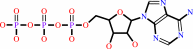 ATP
ATP
|
=
|
O-phospho-L-seryl-[protein]
|
+
|
 ADP
ADP
|
+
|
H(+)
|
|
|
|
|
|
|
L-threonyl-[protein]
|
+
|
ATP
|
=
|
O-phospho-L-threonyl-[protein]
|
+
|
ADP
|
+
|
H(+)
|
|
|
|
|
|
|
|
|
|
|
|
|
Molecule diagrams generated from .mol files obtained from the
KEGG ftp site
|
|
|
|
|
|
|
|
|
|
|
|
|
|
 |
|
|
|
|
|
|
| |
|
|
| |
|
DOI no:
|
Eur J Med Chem
214:113223
(2021)
|
|
PubMed id:
|
|
|
|
|
|
| |
|
Structural basis for the design of bisubstrate inhibitors of protein kinase CK2 provided by complex structures with the substrate-competitive inhibitor heparin.
|
|
A.Schnitzler,
K.Niefind.
|
|
|
|
|
| |
ABSTRACT
|
|
|
|
| |
|
|
The Ser/Thr kinase CK2, a member of the superfamily of eukaryotic protein
kinases, has an acidophilic substrate profile with the substrate recognition
sequence S/T-D/E-X-D/E, and it is inhibited by polyanionic substances like
heparin. The latter, a highly sulphated glucosamino glycan composed mainly of
repeating 2-O-sulpho-α-l-idopyranuronic acid/N,O6-disulpho-α-d-glucosamine
disaccharide units, is the longest known substrate-competitive CK2 inhibitor.
The structural basis of CK2's preference for anionic substrates and
substrate-competitive inhibitors is only vaguely known which limits the value of
the substrate-binding region for the structure-based development of CK2
bisubstrate inhibitors. Here, a tetragonal and a monoclinic co-crystal structure
of CK2α, the catalytic subunit of CK2, with a decameric heparin fragment are
described. In the tetragonal structure, the heparin molecule binds to the
polybasic stretch at the beginning of CK2α's helix αC, whereas in the
monoclinic structure it occupies the central substrate-recognition region around
the P+1 loop. Together, the structures rationalize the inhibitory efficacy of
heparin fragments as a function of chain length. The monoclinic CK2α/heparin
structure, in which the heparin fragment is particularly well defined, is the
first CK2 structure with an anionic inhibitor of considerable size at the
central part of the substrate-recognition site. The bound heparin fragment is so
close to the binding site of ATP-competitive inhibitors that it can guide the
design of linkers and pave the way to efficient CK2 bisubstrate inhibitors in
the future.
|
|
|
|
|
|
|
|
|
|
|
|
|
|
|
|
|
|
 |
 |
 |
|


 Links
Links