 |
PDBsum entry 6wp5
|
|

|
|
PDB id:
|
|
|
|
| Name: |
|
Transferase
|
|
|
Title:
|
|
Pyruvate kinase m2 mutant-s37d
|
|
Structure:
|
|
Pyruvate kinase pkm. Chain: b, a, c, d. Synonym: cytosolic thyroid hormone-binding protein,cthbp,opa- interacting protein 3,oip-3,pyruvate kinase 2/3,pyruvate kinase muscle isozyme,thyroid hormone-binding protein 1,thbp1,tumor m2-pk, p58. Engineered: yes. Mutation: yes
|
|
Source:
|
|
Homo sapiens. Human. Organism_taxid: 9606. Gene: pkm, oip3, pk2, pk3, pkm2. Expressed in: escherichia coli. Expression_system_taxid: 562
|
|
Resolution:
|
|
|
2.17Å
|
R-factor:
|
0.219
|
R-free:
|
0.260
|
|
|
Authors:
|
|
S.Nandi,M.Razzaghi,D.Srivastava,M.Dey
|
|
Key ref:
|
|
S.Nandi
et al.
(2020).
Structural basis for allosteric regulation of pyruvate kinase M2 by phosphorylation and acetylation.
J Biol Chem,
295,
17425-17440.
PubMed id:
DOI:
|
|
|
Date:
|
|
|
26-Apr-20
|
Release date:
|
30-Sep-20
|
|
|
|
|
|
|
PROCHECK
|

|
|
|
|
|
Headers
|
|
|
|
References
|
|
|
|
|
|
|
|
|
|
|
|
Enzyme class:
|
|
Chains B, A, C, D:
E.C.2.7.1.40
- pyruvate kinase.
|
|
|
|
|
|
|
Reaction:
|
|
pyruvate + ATP = phosphoenolpyruvate + ADP + H+
|
|
|
|
|
|
 pyruvate
|
+
|
ATP
Bound ligand (Het Group name = )
matches with 71.43% similarity
|
=
|
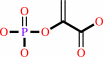 phosphoenolpyruvate
|
+
|
 ADP
ADP
|
+
|
H(+)
|
|
|
|
|
|
|
|
|
|
|
|
|
Molecule diagrams generated from .mol files obtained from the
KEGG ftp site
|
|
|
|
|
|
|
|
|
|
|
|
|
|
 |
|
|
|
|
|
|
| |
|
|
| |
|
DOI no:
|
J Biol Chem
295:17425-17440
(2020)
|
|
PubMed id:
|
|
|
|
|
|
| |
|
Structural basis for allosteric regulation of pyruvate kinase M2 by phosphorylation and acetylation.
|
|
S.Nandi,
M.Razzaghi,
D.Srivastava,
M.Dey.
|
|
|
|
|
| |
ABSTRACT
|
|
|
|
| |
|
|
Pyruvate kinase muscle isoform 2 (PKM2) is a key glycolytic enzyme and
transcriptional coactivator and is critical for tumor metabolism. In cancer
cells, native tetrameric PKM2 is phosphorylated or acetylated, which initiates a
switch to a dimeric/monomeric form that translocates into the nucleus, causing
oncogene transcription. However, it is not known how these post-translational
modifications (PTMs) disrupt the oligomeric state of PKM2. We explored this
question via crystallographic and biophysical analyses of PKM2 mutants
containing residues that mimic phosphorylation and acetylation. We find that the
PTMs elicit major structural reorganization of the fructose 1,6-bisphosphate
(FBP), an allosteric activator, binding site, impacting the interaction with FBP
and causing a disruption in oligomerization. To gain insight into how these
modifications might cause unique outcomes in cancer cells, we examined the
impact of increasing the intracellular pH (pHi) from ∼7.1 (in
normal cells) to ∼7.5 (in cancer cells). Biochemical studies of WT PKM2
(wtPKM2) and the two mimetic variants demonstrated that the activity decreases
as the pH is increased from 7.0 to 8.0, and wtPKM2 is optimally active and
amenable to FBP-mediated allosteric regulation at pHi 7.5. However,
the PTM mimetics exist as a mixture of tetramer and dimer, indicating that
physiologically dimeric fraction is important and might be necessary for the
modified PKM2 to translocate into the nucleus. Thus, our findings provide
insight into how PTMs and pH regulate PKM2 and offer a broader understanding of
its intricate allosteric regulation mechanism by phosphorylation or acetylation.
|
|
|
|
|
|
|
|
|
|
|
|
|
|
|
|
|
|
 |
 |
 |
|
|


 Links
Links


