 |
PDBsum entry 6btf

|
|
|
|
|
|

|

|

|

|
|

|
|

|
|

|
|

|
|

|
|

|
|
|
 |

|

|
|
|
|
|
|
|
|
|
|
|
|
|
|
|
|
|
|
|
|
|
|
|
|
|
|
|
|
|
|
|
|
|
|
|
Transferase,lyase/DNA
|
PDB id
|
|
|
|
6btf
|
|
|
|
|
|
|
|
|
|
|
|
|
|
|

|

|

|
|
|
|
|
|
|
|
|
Enzyme class 1:
|
|
E.C.2.7.7.7
- DNA-directed Dna polymerase.
|
|
|
|
|
|
|
Reaction:
|
|
DNA(n) + a 2'-deoxyribonucleoside 5'-triphosphate = DNA(n+1) + diphosphate
|
|
|
|
|
|
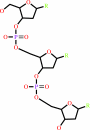 DNA(n)
|
+
|
2'-deoxyribonucleoside 5'-triphosphate
|
=
|
DNA(n+1)
|
+
|
 diphosphate
|
|
|
|
|
|
|
|
|
|
Enzyme class 2:
|
|
E.C.4.2.99.-
- ?????
|
|
|
|
|
|
|
Enzyme class 3:
|
|
E.C.4.2.99.18
- DNA-(apurinic or apyrimidinic site) lyase.
|
|
|
|
|
|
|
Reaction:
|
|
2'-deoxyribonucleotide-(2'-deoxyribose 5'-phosphate)- 2'-deoxyribonucleotide-DNA = a 3'-end 2'-deoxyribonucleotide-(2,3- dehydro-2,3-deoxyribose 5'-phosphate)-DNA + a 5'-end 5'-phospho- 2'-deoxyribonucleoside-DNA + H+
|
|
|
|
|
|
|
|
|
Note, where more than one E.C. class is given (as above), each may
correspond to a different protein domain or, in the case of polyprotein
precursors, to a different mature protein.
|
|
|
|
Molecule diagrams generated from .mol files obtained from the
KEGG ftp site
|
|
|
|
|
|
|
|
|
|
|
|
|
|
 |
|
|
|
|
|
|
| |
|
|
| |
|
DOI no:
|
Nucleic Acids Res
46:10740-10756
(2018)
|
|
PubMed id:
|
|
|
|
|
|
| |
|
I260Q DNA polymerase β highlights precatalytic conformational rearrangements critical for fidelity.
|
|
C.Liptak,
M.M.Mahmoud,
B.E.Eckenroth,
M.V.Moreno,
K.East,
K.S.Alnajjar,
J.Huang,
J.B.Towle-Weicksel,
S.Doublié,
J.P.Loria,
J.B.Sweasy.
|
|
|
|
|
| |
ABSTRACT
|
|
|
|
| |
|
|
DNA polymerase β (pol β) fills single nucleotide gaps in DNA during base
excision repair and non-homologous end-joining. Pol β must select the correct
nucleotide from among a pool of four nucleotides with similar structures and
properties in order to maintain genomic stability during DNA repair. Here, we
use a combination of X-ray crystallography, fluorescence resonance energy
transfer and nuclear magnetic resonance to show that pol β's ability to access
the appropriate conformations both before and upon binding to nucleotide
substrates is integral to its fidelity. Importantly, we also demonstrate that
the inability of the I260Q mutator variant of pol β to properly navigate this
conformational landscape results in error-prone DNA synthesis. Our work reveals
that precatalytic conformational rearrangements themselves are an important
underlying mechanism of substrate selection by DNA pol β.
|
|
|
|
|
|
|
|
|
|
|
|
|
|
|
|
|
|
 |
 |
 |
|


 Links
Links


