 |
PDBsum entry 5ytc

|
|
|
|
|
|

|

|

|

|
|

|
|

|
|

|
|

|
|

|
|

|
|

|
|
|
 |

|

|
|
|
|
|
|
|
|
|
|
|
|
|
|
|
|
|
|
|
|
|
|
|
|
|
|
|
|
|
|
|
|
|
|
|
|
Transferase/DNA
|
PDB id
|
|
|
|
5ytc
|
|
|
|
|
|
|
|
|
|
|
|
|
|
|

|

|

|
|
|
|
|
|
|
PDB id:
|
|
|
|
| Name: |
|
Transferase/DNA
|
|
|
Title:
|
|
Large fragment of DNA polymerase i from thermus aquaticus in a closed ternary complex with the unnatural base m-fc pair with datp in the active site
|
|
Structure:
|
|
DNA polymerase i, thermostable. Chain: a. Fragment: large fragment. Synonym: taq polymerase 1. Engineered: yes. DNA (5'-d( Gp Ap Cp Cp Ap Cp Gp Gp Cp Gp Cp (Doc)p (Doc))- 3'). Chain: b. Engineered: yes.
|
|
Source:
|
|
Thermus aquaticus. Organism_taxid: 271. Gene: pola, pol1. Expressed in: escherichia coli. Expression_system_taxid: 562. Synthetic: yes. Synthetic construct. Organism_taxid: 32630. Organism_taxid: 32630
|
|
Resolution:
|
|
|
2.28Å
|
R-factor:
|
0.197
|
R-free:
|
0.258
|
|
|
Authors:
|
|
H.Zeng,M.Mondal,R.Y.Song,J.Zhang,B.Xia,C.Q.Yi
|
|
Key ref:
|
|
H.Zeng
et al.
(2019).
Unnatural Cytosine Bases Recognized as Thymines by DNA Polymerases by the Formation of the Watson-Crick Geometry.
Angew Chem Int Ed Engl,
58,
130-133.
PubMed id:
DOI:
|
|
|
Date:
|
|
|
17-Nov-17
|
Release date:
|
21-Nov-18
|
|
|
|
|
|
|
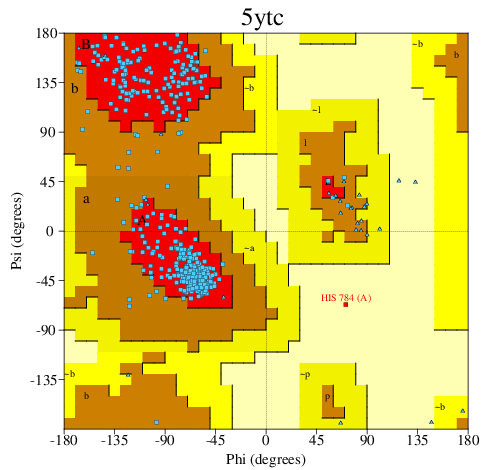
PROCHECK
|
|
|
|
|
|
Headers
|
|
|
|
References
|
|
|
|
|
|

|
|
P19821
(DPO1_THEAQ) -
DNA polymerase I, thermostable from Thermus aquaticus
|
|
|
|
Seq:
Struc:
|
|
|
|
832 a.a.
539 a.a.
|
|

|

|

|
|
|
|
|
|
|
|
|
|
|
Key: |
 |
PfamA domain |
|
|
 |
Secondary structure |
|
|
|
|
|
|
|
|

|
|
|
|
G-A-C-C-A-C-G-G-C-G-C-DOC
12 bases
|
|
|
|
A-A-A-92F-G-G-C-G-C-C-G-T-G-G-T-C
16 bases
|
|
|
|
|
|
|
|
|
|
|
|
|
|
Enzyme class:
|
|
E.C.2.7.7.7
- DNA-directed Dna polymerase.
|
|
|
|
|
|
|
Reaction:
|
|
DNA(n) + a 2'-deoxyribonucleoside 5'-triphosphate = DNA(n+1) + diphosphate
|
|
|
|
|
|
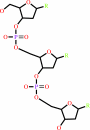 DNA(n)
|
+
|
2'-deoxyribonucleoside 5'-triphosphate
|
=
|
DNA(n+1)
|
+
|
 diphosphate
|
|
|
|
|
|
|
|
|
|
|
|
|
Molecule diagrams generated from .mol files obtained from the
KEGG ftp site
|
|
|
|
|
|
|
|
|
|
|
|
|
|
 |
|
|
|
|
|
|
| |
|
|
| |
|
DOI no:
|
Angew Chem Int Ed Engl
58:130-133
(2019)
|
|
PubMed id:
|
|
|
|
|
|
| |
|
Unnatural Cytosine Bases Recognized as Thymines by DNA Polymerases by the Formation of the Watson-Crick Geometry.
|
|
H.Zeng,
M.Mondal,
R.Song,
J.Zhang,
B.Xia,
M.Liu,
C.Zhu,
B.He,
Y.Q.Gao,
C.Yi.
|
|
|
|
|
| |
ABSTRACT
|
|
|
|
| |
|
|
The emergence of unnatural DNA bases provides opportunities to demystify the
mechanisms by which DNA polymerases faithfully decode chemical information on
the template. It was previously shown that two unnatural cytosine bases (termed
"M-fC" and "I-fC"), which are chemical labeling adducts of
the epigenetic base 5-formylcytosine, can induce C-to-T transition during DNA
amplification. However, how DNA polymerases recognize such unnatural cytosine
bases remains enigmatic. Herein, crystal structures of unnatural cytosine bases
pairing to dA/dG in the KlenTaq polymerase-host-guest complex system and pairing
to dATP in the KlenTaq polymerase active site were determined. Both M-fC and
I-fC base pair with dA/dATP, but not with dG, in a Watson-Crick geometry. This
study reveals that the formation of the Watson-Crick geometry, which may be
enabled by the A-rule, is important for the recognition of unnatural cytosines.
|
|
|
|
|
|
|
|
|
|
|
|
|
|
|
|
|
|
 |
 |
 |
|


 Links
Links


