|
PDBsum entry 5isp

|
|
|
|
|
|

|

|

|

|
|

|
|

|
|

|
|

|
|
|
 |

|

|
|
|
|
|
|
|
|
|
|
|
|
|
|
|
|
|
|
|
|
|
|
|
|
|
|
|
|
|
|
|
|
|
Oxidoreductase
|
PDB id
|
|
|
|
5isp
|
|
|
|
|
|
|
|
|
|
|
|
|
|
|

|

|

|
|
|
|
|
|
|
|
|
Enzyme class:
|
|
E.C.1.5.1.3
- dihydrofolate reductase.
|
|
|
|
|
|
|
Pathway:
|
|
Folate Coenzymes
|
|
|
|
|
|
Reaction:
|
|
(6S)-5,6,7,8-tetrahydrofolate + NADP+ = 7,8-dihydrofolate + NADPH + H+
|
|
|
|
|
|
(6S)-5,6,7,8-tetrahydrofolate
|
+
|
NADP(+)
Bound ligand (Het Group name = )
corresponds exactly
|
=
|
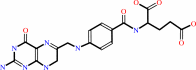 7,8-dihydrofolate
|
+
|
 NADPH
NADPH
|
+
|
H(+)
|
|
|
|
|
|
|
|
|
|
|
|
|
Molecule diagrams generated from .mol files obtained from the
KEGG ftp site
|
|
|
|
|
|
|
|
|
|
|
|
|
|
 |
|
|
|
|
|
|
| |
|
|
| |
|
|
J Med Chem
59:6493-6500
(2016)
|
|
PubMed id:
|
|
|
|
|
|
| |
|
Charged Propargyl-Linked Antifolates Reveal Mechanisms of Antifolate Resistance and Inhibit Trimethoprim-Resistant MRSA Strains Possessing Clinically Relevant Mutations.
|
|
S.M.Reeve,
E.Scocchera,
J.J.Ferreira,
N.G-Dayanandan,
S.Keshipeddy,
D.L.Wright,
A.C.Anderson.
|
|
|
|
|
| |
ABSTRACT
|
|
|
|
| |
|
|
Drug-resistant enzymes must balance catalytic function with inhibitor
destabilization to provide a fitness advantage. This sensitive balance, often
involving very subtle structural changes, must be achieved through a selection
process involving a minimal number of eligible point mutations. As part of a
program to design propargyl-linked antifolates (PLAs) against
trimethoprim-resistant dihydrofolate reductase (DHFR) from Staphylococcus
aureus, we have conducted a thorough study of several clinically observed
chromosomal mutations in the enzyme at the cellular, biochemical, and structural
levels. Through this work, we have identified a promising lead series that
displays significantly greater activity against these mutant enzymes and strains
than TMP. The best inhibitors have enzyme inhibition and MIC values near or
below that of trimethoprim against wild-type S. aureus. Moreover, these studies
employ a series of crystal structures of several mutant enzymes bound to the
same inhibitor; analysis of the structures reveals a more detailed molecular
understanding of drug resistance in this important enzyme.
|
|
|
|
|
|
|
|
|
|
|
|
|
|
|
|
|
|
 |
 |
 |
|


 Links
Links