 |
PDBsum entry 4x7q

|
|
|
|
|
|

|

|

|

|
|

|
|

|
|

|
|

|
|

|
|

|
|
|
 |

|

|
|
|
|
|
|
|
|
|
|
|
|
|
|
|
|
|
|
|
|
|
|
|
|
|
|
|
|
|
|
|
|
|
|
|
Transferase/transferase inhibitor
|
PDB id
|
|
|
|
4x7q
|
|
|
|
|
|
|
|
|
|
|
|
|
|
|

|

|

|
|
|
|
|
|
|
|
|
|
|
Enzyme class:
|
|
Chains B, A:
E.C.2.7.11.1
- non-specific serine/threonine protein kinase.
|
|
|
|
|
|
|
Reaction:
|
|
|
1.
|
L-seryl-[protein] + ATP = O-phospho-L-seryl-[protein] + ADP + H+
|
|
2.
|
L-threonyl-[protein] + ATP = O-phospho-L-threonyl-[protein] + ADP + H+
|
|
|
|
|
|
|
L-seryl-[protein]
|
+
|
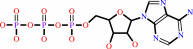 ATP
ATP
|
=
|
O-phospho-L-seryl-[protein]
|
+
|
 ADP
ADP
|
+
|
H(+)
|
|
|
|
|
|
|
L-threonyl-[protein]
|
+
|
ATP
|
=
|
O-phospho-L-threonyl-[protein]
|
+
|
ADP
|
+
|
H(+)
|
|
|
|
|
|
|
|
|
|
|
|
|
Molecule diagrams generated from .mol files obtained from the
KEGG ftp site
|
|
|
|
|
|
|
|
|
|
|
|
|
|
 |
|
|
|
|
|
|
| |
|
|
| |
|
DOI no:
|
Bioorg Med Chem Lett
25:474-480
(2015)
|
|
PubMed id:
|
|
|
|
|
|
| |
|
Structure-based design of low-nanomolar PIM kinase inhibitors.
|
|
A.Ishchenko,
L.Zhang,
J.Y.Le Brazidec,
J.Fan,
J.H.Chong,
A.Hingway,
A.Raditsis,
L.Singh,
B.Elenbaas,
V.S.Hong,
D.Marcotte,
L.Silvian,
I.Enyedy,
J.Chao.
|
|
|
|
|
| |
ABSTRACT
|
|
|
|
| |
|
|
PIM kinases are implicated in variety of cancers by promoting cell survival and
proliferation and are targets of interest for therapeutic intervention. We have
identified a low-nanomolar pan-PIM inhibitor (PIM1/2/3 potency 5:14:2nM) using
structure based modeling. The crystal structure of this compound with PIM1
confirmed the predicted binding mode and protein-ligand interactions except
those in the acidic ribose pocket. We show the SAR suggesting the importance of
having a hydrogen bond donor in this pocket for inhibiting PIM2; however, this
interaction is not important for inhibiting PIM1 or PIM3. In addition, we report
the discovery of a new class of PIM inhibitors by using computational de novo
design tool implemented in MOE software (Chemical Computing Group). These
inhibitors have a different interaction profile.
|
|
|
|
|
|
|
|
|
|
|
|
|
|
|
|
|
|
 |
 |
 |
|
|


 Links
Links


