 |
PDBsum entry 4ubc

|
|
|
|
|
|

|

|

|

|
|

|
|

|
|

|
|

|
|

|
|

|
|

|
|
|
 |

|

|
|
|
|
|
|
|
|
|
|
|
|
|
|
|
|
|
|
|
|
|
|
|
|
|
|
|
|
|
|
|
|
|
|
|
|
Transferase, lyase/DNA
|
PDB id
|
|
|
|
4ubc
|
|
|
|
|
|
|
|
|
|
|
|
|
|
|

|

|

|
|
|
|
|
|
|
|
|
Enzyme class 1:
|
|
E.C.2.7.7.7
- DNA-directed Dna polymerase.
|
|
|
|
|
|
|
Reaction:
|
|
DNA(n) + a 2'-deoxyribonucleoside 5'-triphosphate = DNA(n+1) + diphosphate
|
|
|
|
|
|
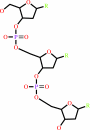 DNA(n)
|
+
|
2'-deoxyribonucleoside 5'-triphosphate
|
=
|
DNA(n+1)
|
+
|
 diphosphate
|
|
|
|
|
|
|
|
|
|
Enzyme class 2:
|
|
E.C.4.2.99.-
- ?????
|
|
|
|
|
|
|
Enzyme class 3:
|
|
E.C.4.2.99.18
- DNA-(apurinic or apyrimidinic site) lyase.
|
|
|
|
|
|
|
Reaction:
|
|
2'-deoxyribonucleotide-(2'-deoxyribose 5'-phosphate)- 2'-deoxyribonucleotide-DNA = a 3'-end 2'-deoxyribonucleotide-(2,3- dehydro-2,3-deoxyribose 5'-phosphate)-DNA + a 5'-end 5'-phospho- 2'-deoxyribonucleoside-DNA + H+
|
|
|
|
|
|
|
|
|
Note, where more than one E.C. class is given (as above), each may
correspond to a different protein domain or, in the case of polyprotein
precursors, to a different mature protein.
|
|
|
|
Molecule diagrams generated from .mol files obtained from the
KEGG ftp site
|
|
|
|
|
|
|
|
|
|
|
|
|
|
 |
|
|
|
|
|
|
| |
|
|
| |
|
DOI no:
|
Nature
517:635-639
(2015)
|
|
PubMed id:
|
|
|
|
|
|
| |
|
Uncovering the polymerase-induced cytotoxicity of an oxidized nucleotide.
|
|
B.D.Freudenthal,
W.A.Beard,
L.Perera,
D.D.Shock,
T.Kim,
T.Schlick,
S.H.Wilson.
|
|
|
|
|
| |
ABSTRACT
|
|
|
|
| |
|
|
Oxidative stress promotes genomic instability and human diseases. A common
oxidized nucleoside is 8-oxo-7,8-dihydro-2'-deoxyguanosine, which is found both
in DNA (8-oxo-G) and as a free nucleotide (8-oxo-dGTP). Nucleotide pools are
especially vulnerable to oxidative damage. Therefore cells encode an enzyme
(MutT/MTH1) that removes free oxidized nucleotides. This cleansing function is
required for cancer cell survival and to modulate Escherichia coli antibiotic
sensitivity in a DNA polymerase (pol)-dependent manner. How polymerases
discriminate between damaged and non-damaged nucleotides is not well understood.
This analysis is essential given the role of oxidized nucleotides in
mutagenesis, cancer therapeutics, and bacterial antibiotics. Even with cellular
sanitizing activities, nucleotide pools contain enough 8-oxo-dGTP to promote
mutagenesis. This arises from the dual coding potential where 8-oxo-dGTP(anti)
base pairs with cytosine and 8-oxo-dGTP(syn) uses its Hoogsteen edge to base
pair with adenine. Here we use time-lapse crystallography to follow 8-oxo-dGTP
insertion opposite adenine or cytosine with human pol β, to reveal that
insertion is accommodated in either the syn- or anti-conformation, respectively.
For 8-oxo-dGTP(anti) insertion, a novel divalent metal relieves repulsive
interactions between the adducted guanine base and the triphosphate of the
oxidized nucleotide. With either templating base, hydrogen-bonding interactions
between the bases are lost as the enzyme reopens after catalysis, leading to a
cytotoxic nicked DNA repair intermediate. Combining structural snapshots with
kinetic and computational analysis reveals how 8-oxo-dGTP uses charge modulation
during insertion that can lead to a blocked DNA repair intermediate.
|
|
|
|
|
|
|
|
|
|
|
|
|
|
|
|
|
|
 |
 |
 |
|


 Links
Links


