 |
PDBsum entry 4rt2

|
|
|
|
|
|

|

|

|

|
|

|
|

|
|

|
|

|
|

|
|

|
|

|
|
|
 |

|

|
|
|
|
|
|
|
|
|
|
|
|
|
|
|
|
|
|
|
|
|
|
|
|
|
|
|
|
|
|
|
|
|
|
|
|
Transferase/DNA
|
PDB id
|
|
|
|
4rt2
|
|
|
|
|
|
|
|
|
|
|
|
|
|
|

|

|

|
|
|
|
|
|
|
|
|
Enzyme class 1:
|
|
E.C.2.7.7.7
- DNA-directed Dna polymerase.
|
|
|
|
|
|
|
Reaction:
|
|
DNA(n) + a 2'-deoxyribonucleoside 5'-triphosphate = DNA(n+1) + diphosphate
|
|
|
|
|
|
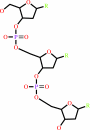 DNA(n)
|
+
|
2'-deoxyribonucleoside 5'-triphosphate
|
=
|
DNA(n+1)
|
+
|
 diphosphate
|
|
|
|
|
|
|
|
|
|
Enzyme class 2:
|
|
E.C.4.2.99.-
- ?????
|
|
|
|
|
|
|
Enzyme class 3:
|
|
E.C.4.2.99.18
- DNA-(apurinic or apyrimidinic site) lyase.
|
|
|
|
|
|
|
Reaction:
|
|
2'-deoxyribonucleotide-(2'-deoxyribose 5'-phosphate)- 2'-deoxyribonucleotide-DNA = a 3'-end 2'-deoxyribonucleotide-(2,3- dehydro-2,3-deoxyribose 5'-phosphate)-DNA + a 5'-end 5'-phospho- 2'-deoxyribonucleoside-DNA + H+
|
|
|
|
|
|
|
|
|
Note, where more than one E.C. class is given (as above), each may
correspond to a different protein domain or, in the case of polyprotein
precursors, to a different mature protein.
|
|
|
|
Molecule diagrams generated from .mol files obtained from the
KEGG ftp site
|
|
|
|
|
|
|
|
|
|
|
|
|
|
 |
|
|
|
|
|
|
| |
|
|
| |
|
DOI no:
|
Org Lett
17:2586-2589
(2015)
|
|
PubMed id:
|
|
|
|
|
|
| |
|
Two Scaffolds from Two Flips: (α,β)/(β,γ) CH2/NH "Met-Im" Analogues of dTTP.
|
|
A.P.Kadina,
B.A.Kashemirov,
K.Oertell,
V.K.Batra,
S.H.Wilson,
M.F.Goodman,
C.E.McKenna.
|
|
|
|
|
| |
ABSTRACT
|
|
|
|
| |
|
|
Novel α,β-CH2 and β,γ-NH (1a) or α,β-NH and β,γ-CH2 (1b)
"Met-Im" dTTPs were synthesized via monodemethylation of
triethyl-dimethyl phosphorimido-bisphosphonate synthons (4a, 4b), formed via a
base-induced [1,3]-rearrangement of precursors (3a, 3b) in a reaction with
dimethyl or diethyl phosphochloridate. Anomerization during final
bromotrimethylsilane (BTMS) deprotection after Mitsunobu conjugation with dT was
avoided by microwave conditions. 1a was 9-fold more potent in inhibiting DNA
polymerase β, attributed to an NH-group interaction with R183 in the active
site.
|
|
|
|
|
|
|
|
|
|
|
|
|
|
|
|
|
|
 |
 |
 |
|


 Links
Links


