 |
PDBsum entry 4o5c

|
|
|
|
|
|

|

|

|

|
|

|
|

|
|

|
|

|
|

|
|

|
|
|
 |

|

|
|
|
|
|
|
|
|
|
|
|
|
|
|
|
|
|
|
|
|
|
|
|
|
|
|
|
|
|
|
|
|
|
|
|
Transferase, lyase/DNA
|
PDB id
|
|
|
|
4o5c
|
|
|
|
|
|
|
|
|
|
|
|
|
|
|

|

|

|
|
|
|
|
|
|
|
|
Enzyme class 1:
|
|
E.C.2.7.7.7
- DNA-directed Dna polymerase.
|
|
|
|
|
|
|
Reaction:
|
|
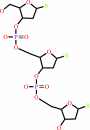
DNA(n) + a 2'-deoxyribonucleoside 5'-triphosphate = DNA(n+1) + diphosphate
|
|
|
|
|
|
 DNA(n)
|
+
|
2'-deoxyribonucleoside 5'-triphosphate
|
=
|
DNA(n+1)
|
+
|
 diphosphate
|
|
|
|
|
|
|
|
|
|
Enzyme class 2:
|
|
E.C.4.2.99.-
- ?????
|
|
|
|
|
|
|
Enzyme class 3:
|
|
E.C.4.2.99.18
- DNA-(apurinic or apyrimidinic site) lyase.
|
|
|
|
|
|
|
Reaction:
|
|
2'-deoxyribonucleotide-(2'-deoxyribose 5'-phosphate)- 2'-deoxyribonucleotide-DNA = a 3'-end 2'-deoxyribonucleotide-(2,3- dehydro-2,3-deoxyribose 5'-phosphate)-DNA + a 5'-end 5'-phospho- 2'-deoxyribonucleoside-DNA + H+
|
|
|
|
|
|
|
|
|
Note, where more than one E.C. class is given (as above), each may
correspond to a different protein domain or, in the case of polyprotein
precursors, to a different mature protein.
|
|
|
|
Molecule diagrams generated from .mol files obtained from the
KEGG ftp site
|
|
|
|
|
|
|
|
|
|
|
|
|
|
 |
|
|
|
|
|
|
| |
|
|
| |
|
DOI no:
|
Nucleic Acids Res
42:8755-8766
(2014)
|
|
PubMed id:
|
|
|
|
|
|
| |
|
Transition-state destabilization reveals how human DNA polymerase β proceeds across the chemically unstable lesion N7-methylguanine.
|
|
M.C.Koag,
Y.Kou,
H.Ouzon-Shubeita,
S.Lee.
|
|
|
|
|
| |
ABSTRACT
|
|
|
|
| |
|
|
N7-Methyl-2'-deoxyguanosine (m7dG) is the predominant lesion formed by
methylating agents. A systematic investigation on the effect of m7dG on DNA
replication has been difficult due to the chemical instability of m7dG. To gain
insights into the m7dG effect, we employed a 2'-fluorine-mediated
transition-state destabilzation strategy. Specifically, we determined kinetic
parameters for dCTP insertion opposite a chemically stable m7dG analogue,
2'-fluoro-m7dG (Fm7dG), by human DNA polymerase β (polβ) and solved three
X-ray structures of polβ in complex with the templating Fm7dG paired with
incoming dCTP or dTTP analogues. The kinetic studies reveal that the templating
Fm7dG slows polβ catalysis ∼300-fold, suggesting that m7dG in genomic DNA may
impede replication by some DNA polymerases. The structural analysis reveals that
Fm7dG forms a canonical Watson-Crick base pair with dCTP, but metal ion
coordination is suboptimal for catalysis in the polβ-Fm7dG:dCTP complex, which
partially explains the slow insertion of dCTP opposite Fm7dG by polβ. In
addition, the polβ-Fm7dG:dTTP structure shows open protein conformations and
staggered base pair conformations, indicating that N7-methylation of dG does not
promote a promutagenic replication. Overall, the first systematic studies on the
effect of m7dG on DNA replication reveal that polβ catalysis across m7dG is
slow, yet highly accurate.
|
|
|
|
|
|
|
|
|
|
|
|
|
|
|
|
|
|
 |
 |
 |
|


 Links
Links


