|
PDBsum entry 4mo4
 |
|
|
|
|
|
|
Enzyme class:
|
|
E.C.2.7.1.170
- anhydro-N-acetylmuramic acid kinase.
|
|
|
|
|
|
|
Reaction:
|
|
1,6-anhydro-N-acetyl-beta-muramate + ATP + H2O = N-acetyl-D-muramate 6-phosphate + ADP + H+
|
|
|
|
|
|
1,6-anhydro-N-acetyl-beta-muramate
|
+
|
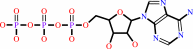 ATP
ATP
|
+
|
H2O
|
=
|
N-acetyl-D-muramate 6-phosphate
Bound ligand (Het Group name = )
matches with 92.86% similarity
|
+
|
 ADP
ADP
|
+
|
H(+)
|
|
|
|
|
|
|
|
|
|
|
|
|
Molecule diagrams generated from .mol files obtained from the
KEGG ftp site
|
|
|
|
|
|
|
|
|
|
|
|
|
|
 |
|
|
|
|
|
|
| |
|
|
| |
|
DOI no:
|
J Biol Chem
289:4504-4514
(2014)
|
|
PubMed id:
|
|
|
|
|
|
| |
|
Conformational itinerary of Pseudomonas aeruginosa 1,6-anhydro-N-acetylmuramic acid kinase during its catalytic cycle.
|
|
J.P.Bacik,
M.Tavassoli,
T.R.Patel,
S.A.McKenna,
D.J.Vocadlo,
M.Khajehpour,
B.L.Mark.
|
|
|
|
|
| |
ABSTRACT
|
|
|
|
| |
|
|
Anhydro-sugar kinases are unique from other sugar kinases in that they must
cleave the 1,6-anhydro ring of their sugar substrate to phosphorylate it using
ATP. Here we show that the peptidoglycan recycling enzyme
1,6-anhydro-N-acetylmuramic acid kinase (AnmK) from Pseudomonas aeruginosa
undergoes large conformational changes during its catalytic cycle, with its two
domains rotating apart by up to 32° around two hinge regions to expose an
active site cleft into which the substrates 1,6-anhydroMurNAc and ATP can bind.
X-ray structures of the open state bound to a nonhydrolyzable ATP analog
(AMPPCP) and 1,6-anhydroMurNAc provide detailed insight into a ternary complex
that forms preceding an operative Michaelis complex. Structural analysis of the
hinge regions demonstrates a role for nucleotide binding and possible cross-talk
between the bound ligands to modulate the opening and closing of AnmK. Although
AnmK was found to exhibit similar binding affinities for ATP, ADP, and AMPPCP
according to fluorescence spectroscopy, small angle x-ray scattering analyses
revealed that AnmK adopts an open conformation in solution in the absence of
ligand and that it remains in this open state after binding AMPPCP, as we had
observed for our crystal structure of this complex. In contrast, the enzyme
favored a closed conformation when bound to ADP in solution, consistent with a
previous crystal structure of this complex. Together, our findings show that the
open conformation of AnmK facilitates binding of both the sugar and nucleotide
substrates and that large structural rearrangements must occur upon closure of
the enzyme to correctly align the substrates and residues of the enzyme for
catalysis.
|
|
|
|
|
|
|
|
|
|
|
|
|
|
|
|
|
|
 |
 |
 |
|


 Links
Links