 |
PDBsum entry 4lm5

|
|
|
|
|
|

|

|

|

|
|

|
|

|
|

|
|

|
|

|
|
|
 |

|

|
|
|
|
|
|
|
|
|
|
|
|
|
|
|
|
|
|
|
|
|
|
|
|
|
|
|
|
|
|
|
|
|
|
Transferase/transferase inhibitor
|
PDB id
|
|
|
|
4lm5
|
|
|
|
|
|
|
|
|
|
|
|
|
|
|

|

|

|
|
|
|
|
|
|
|
|
Enzyme class:
|
|
E.C.2.7.11.1
- non-specific serine/threonine protein kinase.
|
|
|
|
|
|
|
Reaction:
|
|
|
1.
|
L-seryl-[protein] + ATP = O-phospho-L-seryl-[protein] + ADP + H+
|
|
2.
|
L-threonyl-[protein] + ATP = O-phospho-L-threonyl-[protein] + ADP + H+
|
|
|
|
|
|
|
L-seryl-[protein]
|
+
|
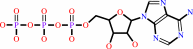 ATP
ATP
|
=
|
O-phospho-L-seryl-[protein]
|
+
|
 ADP
ADP
|
+
|
H(+)
|
|
|
|
|
|
|
L-threonyl-[protein]
|
+
|
ATP
|
=
|
O-phospho-L-threonyl-[protein]
|
+
|
ADP
|
+
|
H(+)
|
|
|
|
|
|
|
|
|
|
|
|
|
Molecule diagrams generated from .mol files obtained from the
KEGG ftp site
|
|
|
|
|
|
|
|
|
|
|
|
|
|
 |
|
|
|
|
|
|
| |
|
|
| |
|
DOI no:
|
Acta Crystallogr D Biol Crystallogr
70:392-404
(2014)
|
|
PubMed id:
|
|
|
|
|
|
| |
|
Kinase crystal identification and ATP-competitive inhibitor screening using the fluorescent ligand SKF86002.
|
|
L.J.Parker,
S.Taruya,
K.Tsuganezawa,
N.Ogawa,
J.Mikuni,
K.Honda,
Y.Tomabechi,
N.Handa,
M.Shirouzu,
S.Yokoyama,
A.Tanaka.
|
|
|
|
|
| |
ABSTRACT
|
|
|
|
| |
|
|
The small kinase inhibitor SKF86002 lacks intrinsic fluorescence but becomes
fluorescent upon binding to the ATP-binding sites of p38 mitogen-activated
protein kinase (p38α). It was found that co-crystals of this compound with
various kinases were distinguishable by their strong fluorescence. The
co-crystals of SKF86002 with p38α, Pim1, ASK1, HCK and AMPK were fluorescent.
Addition of SKF86002, which binds to the ATP site, to the co-crystallization
solution of HCK promoted protein stability and thus facilitated the production
of crystals that otherwise would not grow in the apo form. It was further
demonstrated that the fluorescence of SKF86002 co-crystals can be applied to
screen for candidate kinase inhibitors. When a compound binds competitively to
the ATP-binding site of a kinase crystallized with SKF86002, it displaces the
fluorescent SKF86002 and the crystal loses its fluorescence. Lower fluorescent
signals were reported after soaking SKF86002-Pim1 and SKF86002-HCK co-crystals
with the inhibitors quercetin, a quinazoline derivative and A-419259.
Determination of the SKF86002-Pim1 and SKF86002-HCK co-crystal structures
confirmed that SKF86002 interacts with the ATP-binding sites of Pim1 and HCK.
The structures of Pim1-SKF86002 crystals soaked with the inhibitors quercetin
and a quinazoline derivative and of HCK-SKF86002 crystals soaked with A-419259
were determined. These structures were virtually identical to the deposited
crystal structures of the same complexes. A KINOMEscan assay revealed that
SKF86002 binds a wide variety of kinases. Thus, for a broad range of kinases,
SKF86002 is useful as a crystal marker, a crystal stabilizer and a marker to
identify ligand co-crystals for structural analysis.
|
|
|
|
|
|
|
|
|
|
|
|
|
|
|
|
|
|
 |
 |
 |
|


 Links
Links


