|
PDBsum entry 4jv1

|
|
|
|
|
|

|

|

|

|
|

|
|

|
|

|
|

|
|

|
|

|
|
|
 |

|

|
|
|
|
|
|
|
|
|
|
|
|
|
|
|
|
|
|
|
|
|
|
|
|
|
|
|
|
|
|
|
|
|
|
|
Transferase/DNA
|
PDB id
|
|
|
|
4jv1
|
|
|
|
|
|
|
|
|
|
|
|
|
|
|

|

|

|
|
|
|
|
|
|
|
|
Enzyme class:
|
|
E.C.2.7.7.7
- DNA-directed Dna polymerase.
|
|
|
|
|
|
|
Reaction:
|
|
DNA(n) + a 2'-deoxyribonucleoside 5'-triphosphate = DNA(n+1) + diphosphate
|
|
|
|
|
|
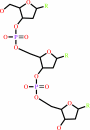 DNA(n)
|
+
|
2'-deoxyribonucleoside 5'-triphosphate
|
=
|
DNA(n+1)
|
+
|
 diphosphate
|
|
|
|
|
|
|
|
|
|
|
|
|
Molecule diagrams generated from .mol files obtained from the
KEGG ftp site
|
|
|
|
|
|
|
|
|
|
|
|
|
|
 |
|
|
|
|
|
|
| |
|
|
| |
|
DOI no:
|
Chem Res Toxicol
26:1348-1360
(2013)
|
|
PubMed id:
|
|
|
|
|
|
| |
|
Ring-opening of the γ-OH-PdG adduct promotes error-free bypass by the Sulfolobus solfataricus DNA polymerase Dpo4.
|
|
G.Shanmugam,
I.G.Minko,
S.Banerjee,
P.P.Christov,
I.D.Kozekov,
C.J.Rizzo,
R.S.Lloyd,
M.Egli,
M.P.Stone.
|
|
|
|
|
| |
ABSTRACT
|
|
|
|
| |
|
|
Acrolein, a mutagenic aldehyde, reacts with deoxyguanosine (dG) to form
3-(2'-deoxy-β-d-erythro-pentofuranosyl)-5,6,7,8-tetrahydro-8-hydroxypyrimido[1,2-a]
purin-10(3H)-one (γ-OH-PdG). When placed opposite deoxycytosine (dC) in DNA,
γ-OH-PdG undergoes ring-opening to the N(2)-(3-oxopropyl)-dG. Ring-opening of
the adduct has been hypothesized to facilitate nonmutagenic bypass, particularly
by DNA polymerases of the Y family. This study examined the bypass of γ-OH-PdG
by Sulfolobus solfataricus Dpo4, the prototypic Y-family DNA polymerase, using
templates that contained the adduct in either the 5'-CXG-3' or the 5'-TXG-3'
sequence context. Although γ-OH-PdG partially blocked Dpo4-catalyzed DNA
synthesis, full primer extension was observed, and the majority of bypass
products were error-free. Conversion of the adduct into an irreversibly
ring-opened derivative prior to reaction facilitated bypass and further improved
the fidelity. Structures of ternary Dpo4·DNA·dNTP complexes were determined
with primers that either were positioned immediately upstream of the lesion
(preinsertion complexes) or had a 3'-terminal dC opposite the lesion
(postinsertion complexes); the incoming nucleotides, either dGTP or dATP, were
complementary to the template 5'-neighbor nucleotide. In both postinsertion
complexes, the adduct existed as ring-opened species, and the resulting
base-pair featured Watson-Crick hydrogen bonding. The incoming nucleotide paired
with the 5'-neighbor template, while the primer 3'-hydroxyl was positioned to
facilitate extension. In contrast, γ-OH-PdG was in the ring-closed form in both
preinsertion complexes, and the overall structure did not favor catalysis. These
data provide insights into γ-OH-PdG chemistry during replication bypass by the
Dpo4 DNA polymerase and may explain why γ-OH-PdG-induced mutations due to
primer-template misalignment are uncommon.
|
|
|
|
|
|
|
|
|
|
|
|
|
|
|
|
|
|
 |
 |
 |
|


 Links
Links