|
PDBsum entry 3glg

|
|
|
|
|
|

|

|

|

|
|

|
|

|
|

|
|

|
|

|
|

|
|
|
 |

|

|
|
|
|
|
|
|
|
|
|
|
|
|
|
|
|
|
|
|
|
|
|
|
|
|
|
|
|
|
|
|
|
|
|
|
Transferase/DNA
|
PDB id
|
|
|
|
3glg
|
|
|
|
|
|
|
|
|
|
|
|
|
|
|

|

|

|
|
|
|
|
|
|
|
 |
Contents |
 |
|
|
|
|
|
|
|
|
|
|
|

 333 a.a.
|
|
|
|
|
|
|
|
|
|
|


 (+ 0 more)
364 a.a.
(+ 0 more)
364 a.a.
|
|
|
|
|
|
|
|
|
|
|

 334 a.a.
|
|
|
|
|
|
|
|
|
|
|
|
|
* Residue conservation analysis
|
|
|
|
|
|
PDB id:
|
|
|
|
| Name: |
|
Transferase/DNA
|
|
|
Title:
|
|
Crystal structure of a mutant (gammat157a) e. Coli clamp loader bound to primer-template DNA
|
|
Structure:
|
|
DNA polymerase iii subunit delta. Chain: a, f. Engineered: yes. DNA polymerase iii subunit tau. Chain: b, c, d, g, h, i. Fragment: unp residues 1-373. Synonym: DNA polymerase iii subunit gamma. Engineered: yes. Mutation: yes.
|
|
Source:
|
|
Escherichia coli. Organism_taxid: 83333. Strain: k-12. Gene: hola, b0640, jw0635. Expressed in: escherichia coli. Expression_system_taxid: 562. Gene: dnax, dnaz, dnazx, b0470, jw0459. Gene: holb, b1099, jw1085. Synthetic: yes.
|
|
Resolution:
|
|
|
3.25Å
|
R-factor:
|
0.226
|
R-free:
|
0.263
|
|
|
Authors:
|
|
K.R.Simonetta,S.N.Seyedin,J.Kuriyan
|
|
Key ref:
|
|
K.R.Simonetta
et al.
(2009).
The mechanism of ATP-dependent primer-template recognition by a clamp loader complex.
Cell,
137,
659-671.
PubMed id:
|
|
|
Date:
|
|
|
12-Mar-09
|
Release date:
|
26-May-09
|
|
|
|
|
|
|
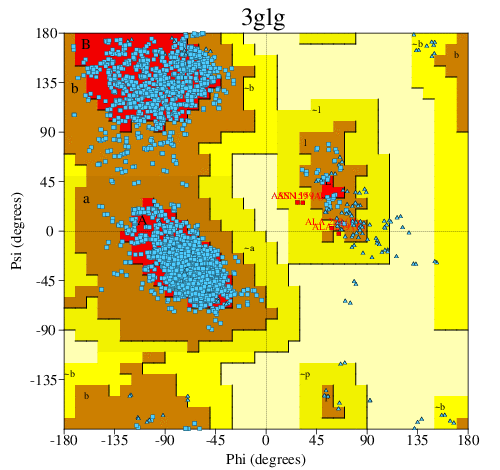
PROCHECK
|
|
|
|
|
|
Headers
|
|
|
|
References
|
|
|
|
|
|

|
|
P28630
(HOLA_ECOLI) -
DNA polymerase III subunit delta from Escherichia coli (strain K12)
|
|
|
|
Seq:
Struc:
|
|
|
|
343 a.a.
333 a.a.
|
|

|

|

|
|
|
|
|
|
|
|
|
|
|
|
|
|
|
|
|
Enzyme class:
|
|
Chains A, B, C, D, E, F, G, H, I, J:
E.C.2.7.7.7
- DNA-directed Dna polymerase.
|
|
|
|
|
|
|
Reaction:
|
|
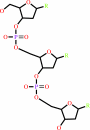
DNA(n) + a 2'-deoxyribonucleoside 5'-triphosphate = DNA(n+1) + diphosphate
|
|
|
|
|
|
 DNA(n)
|
+
|
2'-deoxyribonucleoside 5'-triphosphate
|
=
|
DNA(n+1)
|
+
|
 diphosphate
|
|
|
|
|
|
|
|
|
|
|
|
|
Molecule diagrams generated from .mol files obtained from the
KEGG ftp site
|
|
|
|
|
|
|
|
|
|
|
|
|
|
 |
|
|
|
|
|
|
| |
|
|
| |
|
|
Cell
137:659-671
(2009)
|
|
PubMed id:
|
|
|
|
|
|
| |
|
The mechanism of ATP-dependent primer-template recognition by a clamp loader complex.
|
|
K.R.Simonetta,
S.L.Kazmirski,
E.R.Goedken,
A.J.Cantor,
B.A.Kelch,
R.McNally,
S.N.Seyedin,
D.L.Makino,
M.O'Donnell,
J.Kuriyan.
|
|
|
|
|
| |
ABSTRACT
|
|
|
|
| |
|
|
Clamp loaders load sliding clamps onto primer-template DNA. The structure of the
E. coli clamp loader bound to DNA reveals the formation of an ATP-dependent
spiral of ATPase domains that tracks only the template strand, allowing
recognition of both RNA and DNA primers. Unlike hexameric helicases, in which
DNA translocation requires distinct conformations of the ATPase domains, the
clamp loader spiral is symmetric and is set up to trigger release upon DNA
recognition. Specificity for primed DNA arises from blockage of the end of the
primer and accommodation of the emerging template along a surface groove. A
related structure reveals how the psi protein, essential for coupling the clamp
loader to single-stranded DNA-binding protein (SSB), binds to the clamp loader.
By stabilizing a conformation of the clamp loader that is consistent with the
ATPase spiral observed upon DNA binding, psi binding promotes the clamp-loading
activity of the complex.
|
|
|
|
|
|
|
|
|
|
|
|
|
|
|
|
|
|
 |
 |
 |
|
Literature references that cite this PDB file's key reference
|
|
|
| |
PubMed id
|
|
Reference
|
|
|
|
|
|
S.E.Glynn,
A.R.Nager,
T.A.Baker,
and
R.T.Sauer
(2012).
Dynamic and static components power unfolding in topologically closed rings of a AAA+ proteolytic machine.
|
| |
Nat Struct Mol Biol,
19,
616-622.
|
|
|
|
|
|
|
K.E.Duderstadt,
K.Chuang,
and
J.M.Berger
(2011).
DNA stretching by bacterial initiators promotes replication origin opening.
|
| |
Nature,
478,
209-213.
|
|
|
PDB code:
|
|
|
|
|
|
|
The most recent references are shown first.
Citation data come partly from CiteXplore and partly
from an automated harvesting procedure. Note that this is likely to be
only a partial list as not all journals are covered by
either method. However, we are continually building up the citation data
so more and more references will be included with time.
Where a reference describes a PDB structure, the PDB
code is
shown on the right.
|
|
| |


 Links
Links