 |
PDBsum entry 3e4z

|
|
|
|
|
|

|

|

|

|
|

|
|

|
|

|
|

|
|

|
|

|
|

|
|

|
|
|
 |

|

|
|
|
|
|
|
|
|
|
|
|
|
|
|
|
|
|
|
|
|
|
|
|
|
|
|
|
|
|
|
|
|
|
|
|
|
|
Hydrolase/hormone
|
PDB id
|
|
|
|
3e4z
|
|
|
|
|
|
|
|
|
|
|
|
|
|
|

|

|

|
|
|
|
|
|
|
|
 |
Contents |
 |
|
|
|
|
|
|
|
|
|
|
|
|
|
|
* Residue conservation analysis
|
|
|
|
|
|
PDB id:
|
|
|
|
| Name: |
|
Hydrolase/hormone
|
|
|
Title:
|
|
Crystal structure of human insulin degrading enzyme in complex with insulin-like growth factor ii
|
|
Structure:
|
|
Insulin-degrading enzyme. Chain: a, b. Fragment: unp residues 42-1019. Synonym: insulin protease,insulinase,insulysin. Engineered: yes. Mutation: yes. Insulin-like growth factor ii. Chain: c, d. Fragment: unp residues 25-91.
|
|
Source:
|
|
Homo sapiens. Human. Organism_taxid: 9606. Strain: bl21(de3)pubs520. Gene: ide. Expressed in: escherichia coli. Gene: igf2. Expressed in: escherichia coli
|
|
Resolution:
|
|
|
2.28Å
|
R-factor:
|
0.197
|
R-free:
|
0.230
|
|
|
Authors:
|
|
Q.Guo,M.Manolopoulou,W.-J.Tang
|
|
Key ref:
|
|
Q.Guo
et al.
(2010).
Molecular basis for the recognition and cleavages of IGF-II, TGF-alpha, and amylin by human insulin-degrading enzyme.
J Mol Biol,
395,
430-443.
PubMed id:
|
|
|
Date:
|
|
|
12-Aug-08
|
Release date:
|
18-Aug-09
|
|
|
|
|
|
|
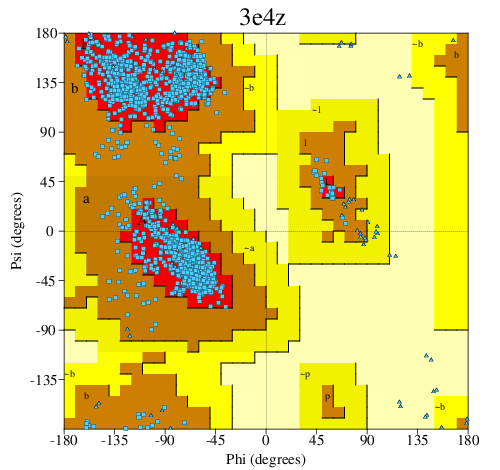
PROCHECK
|
|
|
|
|
|
Headers
|
|
|
|
References
|
|
|
|
|
|

|
|
P14735
(IDE_HUMAN) -
Insulin-degrading enzyme from Homo sapiens
|
|
|
|
Seq:
Struc:
|
|
|
|
1019 a.a.
953 a.a.*
|
|

|

|

|
|
|
|
|
|
|
|
|
|
|
Key: |
 |
PfamA domain |
|
|
 |
Secondary structure |
|
 |
CATH domain |
|
|
*
PDB and UniProt seqs differ
at 13 residue positions (black
crosses)
|
|
|
|
|
|
|
|
|
|
|
|
|
Enzyme class:
|
|
E.C.3.4.24.56
- insulysin.
|
|
|
|
|
|
|
Reaction:
|
|
Degradation of insulin, glucagon and other polypeptides. No action on proteins.
|
|
|
|
|
|
Cofactor:
|
|
Zn(2+)
|
|
|
|
|
|
|
|
|
|
|
|
|
|
|
|
|
|
 |
|
|
|
|
|
|
| |
|
|
J Mol Biol
395:430-443
(2010)
|
|
PubMed id:
|
|
|
|
|
|
| |
|
Molecular basis for the recognition and cleavages of IGF-II, TGF-alpha, and amylin by human insulin-degrading enzyme.
|
|
Q.Guo,
M.Manolopoulou,
Y.Bian,
A.B.Schilling,
W.J.Tang.
|
|
|
|
|
| |
ABSTRACT
|
|
|
|
| |
|
|
Insulin-degrading enzyme (IDE) is involved in the clearance of many bioactive
peptide substrates, including insulin and amyloid-beta, peptides vital to the
development of diabetes and Alzheimer's disease, respectively. IDE can also
rapidly degrade hormones that are held together by intramolecular disulfide
bond(s) without their reduction. Furthermore, IDE exhibits a remarkable ability
to preferentially degrade structurally similar peptides such as the selective
degradation of insulin-like growth factor (IGF)-II and transforming growth
factor-alpha (TGF-alpha) over IGF-I and epidermal growth factor, respectively.
Here, we used high-accuracy mass spectrometry to identify the cleavage sites of
human IGF-II, TGF-alpha, amylin, reduced amylin, and amyloid-beta by human IDE.
We also determined the structures of human IDE-IGF-II and IDE-TGF-alpha at 2.3 A
and IDE-amylin at 2.9 A. We found that IDE cleaves its substrates at multiple
sites in a biased stochastic manner. Furthermore, the presence of a disulfide
bond in amylin allows IDE to cut at an additional site in the middle of the
peptide (amino acids 18-19). Our amylin-bound IDE structure offers insight into
how the structural constraint from a disulfide bond in amylin can alter IDE
cleavage sites. Together with NMR structures of amylin and the IGF and epidermal
growth factor families, our work also reveals the structural basis of how the
high dipole moment of substrates complements the charge distribution of the IDE
catalytic chamber for the substrate selectivity. In addition, we show how the
ability of substrates to properly anchor their N-terminus to the exosite of IDE
and undergo a conformational switch upon binding to the catalytic chamber of IDE
can also contribute to the selective degradation of structurally related growth
factors.
|
|
|
|
|
|
|
|
|
|
|
|
|
|
|
|
|
|
 |
 |
 |
|
Literature references that cite this PDB file's key reference
|
|
|
| |
PubMed id
|
|
Reference
|
|
|
|
|
|
G.Grasso,
A.Pietropaolo,
G.Spoto,
G.Pappalardo,
G.R.Tundo,
C.Ciaccio,
M.Coletta,
and
E.Rizzarelli
(2011).
Copper(I) and Copper(II) Inhibit Aβ Peptides Proteolysis by Insulin-Degrading Enzyme Differently: Implications for Metallostasis Alteration in Alzheimer's Disease.
|
| |
Chemistry,
17,
2752-2762.
|
|
|
|
|
|
|
M.Ren,
Q.Guo,
L.Guo,
M.Lenz,
F.Qian,
R.R.Koenen,
H.Xu,
A.B.Schilling,
C.Weber,
R.D.Ye,
A.R.Dinner,
and
W.J.Tang
(2010).
Polymerization of MIP-1 chemokine (CCL3 and CCL4) and clearance of MIP-1 by insulin-degrading enzyme.
|
| |
EMBO J,
29,
3952-3966.
|
|
|
PDB codes:
|
|
|
|
|
|
|
The most recent references are shown first.
Citation data come partly from CiteXplore and partly
from an automated harvesting procedure. Note that this is likely to be
only a partial list as not all journals are covered by
either method. However, we are continually building up the citation data
so more and more references will be included with time.
Where a reference describes a PDB structure, the PDB
codes are
shown on the right.
|
|


 Links
Links



