
|
|
|
|
|
 |
Contents |
 |
|
|
|
|
|
|
|
|
|
|
|
|
* Residue conservation analysis
|
|
|
|
|
|
|
|
|
|
Enzyme class:
|
|
Chains A, B:
E.C.2.7.13.3
- histidine kinase.
|
|
|
|
|
|
|
Reaction:
|
|
ATP + protein L-histidine = ADP + protein N-phospho-L-histidine
|
|
|
|
|
|
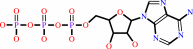 ATP
ATP
|
+
|
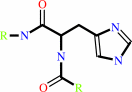 protein L-histidine
|
=
|
ADP
Bound ligand (Het Group name = )
corresponds exactly
|
+
|
protein N-phospho-L-histidine
|
|
|
|
|
|
|
|
|
|
|
|
|
Molecule diagrams generated from .mol files obtained from the
KEGG ftp site
|
|
|
|
|
|
|
|
|
|
|
|
|
|
 |
|
|
|
|
|
|
| |
|
|
| |
|
DOI no:
|
Cell
139:325-336
(2009)
|
|
PubMed id:
|
|
|
|
|
|
| |
|
Structural insight into partner specificity and phosphoryl transfer in two-component signal transduction.
|
|
P.Casino,
V.Rubio,
A.Marina.
|
|
|
|
|
| |
ABSTRACT
|
|
|
|
| |
|
|
The chief mechanism used by bacteria for sensing their environment is based on
two conserved proteins: a sensor histidine kinase (HK) and an effector response
regulator (RR). The signal transduction process involves highly conserved
domains of both proteins that mediate autokinase, phosphotransfer, and
phosphatase activities whose output is a finely tuned RR phosphorylation level.
Here, we report the structure of the complex between the entire cytoplasmic
portion of Thermotoga maritima class I HK853 and its cognate, RR468, as well as
the structure of the isolated RR468, both free and BeF(3)(-) bound. Our results
provide insight into partner specificity in two-component systems, recognition
of the phosphorylation state of each partner, and the catalytic mechanism of the
phosphatase reaction. Biochemical analysis shows that the HK853-catalyzed
autokinase reaction proceeds by a cis autophosphorylation mechanism within the
HK subunit. The results suggest a model for the signal transduction mechanism in
two-component systems.
|
|
|
|
|
|
| |
Selected figure(s)
|
|
|
|
| |
|
|

|
|

|
|
Figure 1.
Figure 1. Crystal Structure of the HK853[CP]-RR468 Complex
and Expanded Views of the Contacts within the Complex
(A
and B) Ribbon diagrams of the complex viewed from the cell
membrane along the twofold axis (indicated with a black ellipse)
(A) or perpendicularly to this axis (B), with the cell membrane
and the cell interior at the top and bottom, respectively. The
α helices of each HK protomer are colored blue (HK853[CP]) and
cyan (HK853[CP]^*), and the two RR468 molecules are shown in
gold (RR468) and light yellow (RR468^*), although β strands are
colored red in all cases. In (B), the RR468 molecule at the back
has been omitted for clarity. The side chains of the
phosphoacceptor H260 and D53 residues and the bound sulfate and
ADPβN molecules are illustrated in stick representation. In one
protomer of each HK853[CP] and RR468, secondary structure
elements and relevant loops have been labeled.
(C)
Six-helix bundle formed by the DHp domains of the two HK853[CP]
subunits (blue and cyan, and abbreviated HK) and by the α1
helices of both RR468 molecules (red and magenta, and
abbreviated RR). The orientation is similar to that in (B). Loop
β5-α5 is also shown for the RR molecule in the front.
(D)
Interactions between the β3-α3 loop of RR468 and the ATP lid
and β4-α4 loop of the CA domain of HK853, to illustrate the
interposition of the ATP lid between the secluded nucleotide and
His260 of the same subunit.
(E) Interactions of the RR468
β4-α4 loop (green) with the DHp-CA interdomain linker (cyan).
Side chains of interacting residues are shown with broken lines
indicating polar bonds.
|
|
Figure 6.
Figure 6. Signal Transduction Model
In the model, the
signal reaches the catalytic core of the HK via helix α1
rotation. This rotation modifies DHp packing and the position of
the associated CA domain. The latter domain either approaches
the phosphoacceptor His, triggering the autokinase reaction
(center), or moves away to generate the appropriate docking
surfaces for either the interaction with nonphosphorylated RR,
promoting phosphotransfer (right), or the interaction with the P
 vert,
similar RR, promoting dephosphorylation (left). vert,
similar RR, promoting dephosphorylation (left).
|
|
|
|
|
|
| |
The above figures are
reprinted
by permission from Cell Press:
Cell
(2009,
139,
325-336)
copyright 2009.
|
|
| |
Figures were
selected
by an automated process.
|
|
|
|
|
|
|
|
|
|
|
|
|
|
|
|
 |
 |
 |
|
Literature references that cite this PDB file's key reference
|
|
|
| |
PubMed id
|
|
Reference
|
|
|
|
|
|
G.E.Schaller,
S.H.Shiu,
and
J.P.Armitage
(2011).
Two-component systems and their co-option for eukaryotic signal transduction.
|
| |
Curr Biol,
21,
R320-R330.
|
|
|
|
|
|
|
M.Sivaneson,
H.Mikkelsen,
I.Ventre,
C.Bordi,
and
A.Filloux
(2011).
Two-component regulatory systems in Pseudomonas aeruginosa: an intricate network mediating fimbrial and efflux pump gene expression.
|
| |
Mol Microbiol,
79,
1353-1366.
|
|
|
|
|
|
|
A.Möglich,
and
K.Moffat
(2010).
Engineered photoreceptors as novel optogenetic tools.
|
| |
Photochem Photobiol Sci,
9,
1286-1300.
|
|
|
|
|
|
|
A.Siryaporn,
B.S.Perchuk,
M.T.Laub,
and
M.Goulian
(2010).
Evolving a robust signal transduction pathway from weak cross-talk.
|
| |
Mol Syst Biol,
6,
452.
|
|
|
|
|
|
|
C.E.Noriega,
H.Y.Lin,
L.L.Chen,
S.B.Williams,
and
V.Stewart
(2010).
Asymmetric cross-regulation between the nitrate-responsive NarX-NarL and NarQ-NarP two-component regulatory systems from Escherichia coli K-12.
|
| |
Mol Microbiol,
75,
394-412.
|
|
|
|
|
|
|
C.H.Bell,
S.L.Porter,
A.Strawson,
D.I.Stuart,
and
J.P.Armitage
(2010).
Using structural information to change the phosphotransfer specificity of a two-component chemotaxis signalling complex.
|
| |
PLoS Biol,
8,
e1000306.
|
|
|
PDB codes:
|
|
|
|
|
|
|
|
C.M.Barbieri,
T.R.Mack,
V.L.Robinson,
M.T.Miller,
and
A.M.Stock
(2010).
Regulation of response regulator autophosphorylation through interdomain contacts.
|
| |
J Biol Chem,
285,
32325-32335.
|
|
|
PDB codes:
|
|
|
|
|
|
|
|
C.Van der Henst,
C.Charlier,
M.Deghelt,
J.Wouters,
J.Y.Matroule,
J.J.Letesson,
and
X.De Bolle
(2010).
Overproduced Brucella abortus PdhS-mCherry forms soluble aggregates in Escherichia coli, partially associating with mobile foci of IbpA-YFP.
|
| |
BMC Microbiol,
10,
248.
|
|
|
|
|
|
|
E.J.Capra,
B.S.Perchuk,
E.A.Lubin,
O.Ashenberg,
J.M.Skerker,
and
M.T.Laub
(2010).
Systematic dissection and trajectory-scanning mutagenesis of the molecular interface that ensures specificity of two-component signaling pathways.
|
| |
PLoS Genet,
6,
e1001220.
|
|
|
|
|
|
|
G.R.Peña-Sandoval,
and
D.Georgellis
(2010).
The ArcB sensor kinase of Escherichia coli autophosphorylates by an intramolecular reaction.
|
| |
J Bacteriol,
192,
1735-1739.
|
|
|
|
|
|
|
H.Li,
J.Zhang,
R.D.Vierstra,
and
H.Li
(2010).
Quaternary organization of a phytochrome dimer as revealed by cryoelectron microscopy.
|
| |
Proc Natl Acad Sci U S A,
107,
10872-10877.
|
|
|
|
|
|
|
H.Szurmant,
and
J.A.Hoch
(2010).
Interaction fidelity in two-component signaling.
|
| |
Curr Opin Microbiol,
13,
190-197.
|
|
|
|
|
|
|
I.Jende,
K.I.Varughese,
and
K.M.Devine
(2010).
Amino acid identity at one position within the alpha1 helix of both the histidine kinase and the response regulator of the WalRK and PhoPR two-component systems plays a crucial role in the specificity of phosphotransfer.
|
| |
Microbiology,
156,
1848-1859.
|
|
|
|
|
|
|
J.Herrou,
C.Bompard,
R.Wintjens,
E.Dupré,
E.Willery,
V.Villeret,
C.Locht,
R.Antoine,
and
F.Jacob-Dubuisson
(2010).
Periplasmic domain of the sensor-kinase BvgS reveals a new paradigm for the Venus flytrap mechanism.
|
| |
Proc Natl Acad Sci U S A,
107,
17351-17355.
|
|
|
PDB codes:
|
|
|
|
|
|
|
|
J.Herrou,
R.Foreman,
A.Fiebig,
and
S.Crosson
(2010).
A structural model of anti-anti-σ inhibition by a two-component receiver domain: the PhyR stress response regulator.
|
| |
Mol Microbiol,
78,
290-304.
|
|
|
PDB code:
|
|
|
|
|
|
|
|
J.S.Parkinson
(2010).
Signaling mechanisms of HAMP domains in chemoreceptors and sensor kinases.
|
| |
Annu Rev Microbiol,
64,
101-122.
|
|
|
|
|
|
|
M.L.López-Redondo,
F.Moronta,
P.Salinas,
J.Espinosa,
R.Cantos,
R.Dixon,
A.Marina,
and
A.Contreras
(2010).
Environmental control of phosphorylation pathways in a branched two-component system.
|
| |
Mol Microbiol,
78,
475-489.
|
|
|
|
|
|
|
P.D.Scheu,
Y.F.Liao,
J.Bauer,
H.Kneuper,
T.Basché,
G.Unden,
and
W.Erker
(2010).
Oligomeric sensor kinase DcuS in the membrane of Escherichia coli and in proteoliposomes: chemical cross-linking and FRET spectroscopy.
|
| |
J Bacteriol,
192,
3474-3483.
|
|
|
|
|
|
|
P.Scheerer,
N.Michael,
J.H.Park,
S.Nagano,
H.W.Choe,
K.Inomata,
B.Borucki,
N.Krauss,
and
T.Lamparter
(2010).
Light-induced conformational changes of the chromophore and the protein in phytochromes: bacterial phytochromes as model systems.
|
| |
Chemphyschem,
11,
1090-1105.
|
|
|
|
|
|
|
P.Slavny,
R.Little,
P.Salinas,
T.A.Clarke,
and
R.Dixon
(2010).
Quaternary structure changes in a second Per-Arnt-Sim domain mediate intramolecular redox signal relay in the NifL regulatory protein.
|
| |
Mol Microbiol,
75,
61-75.
|
|
|
|
|
|
|
R.E.Carlyon,
J.L.Ryther,
R.D.VanYperen,
and
J.S.Griffitts
(2010).
FeuN, a novel modulator of two-component signalling identified in Sinorhizobium meliloti.
|
| |
Mol Microbiol,
77,
170-182.
|
|
|
|
|
|
|
S.D.Goldberg,
G.D.Clinthorne,
M.Goulian,
and
W.F.DeGrado
(2010).
Transmembrane polar interactions are required for signaling in the Escherichia coli sensor kinase PhoQ.
|
| |
Proc Natl Acad Sci U S A,
107,
8141-8146.
|
|
|
|
|
|
|
T.Krell,
J.Lacal,
A.Busch,
H.Silva-Jiménez,
M.E.Guazzaroni,
and
J.L.Ramos
(2010).
Bacterial sensor kinases: diversity in the recognition of environmental signals.
|
| |
Annu Rev Microbiol,
64,
539-559.
|
|
|
|
|
|
|
V.Stewart,
and
L.L.Chen
(2010).
The S helix mediates signal transmission as a HAMP domain coiled-coil extension in the NarX nitrate sensor from Escherichia coli K-12.
|
| |
J Bacteriol,
192,
734-745.
|
|
|
|
|
|
|
Y.Pazy,
M.A.Motaleb,
M.T.Guarnieri,
N.W.Charon,
R.Zhao,
and
R.E.Silversmith
(2010).
Identical phosphatase mechanisms achieved through distinct modes of binding phosphoprotein substrate.
|
| |
Proc Natl Acad Sci U S A,
107,
1924-1929.
|
|
|
PDB code:
|
|
|
|
|
|
|
|
Z.Cheng,
Y.W.He,
S.C.Lim,
R.Qamra,
M.A.Walsh,
L.H.Zhang,
and
H.Song
(2010).
Structural basis of the sensor-synthase interaction in autoinduction of the quorum sensing signal DSF biosynthesis.
|
| |
Structure,
18,
1199-1209.
|
|
|
PDB codes:
|
|
|
|
|
|
|
|
A.Schug,
M.Weigt,
J.N.Onuchic,
T.Hwa,
and
H.Szurmant
(2009).
High-resolution protein complexes from integrating genomic information with molecular simulation.
|
| |
Proc Natl Acad Sci U S A,
106,
22124-22129.
|
|
|
|
|
|
The most recent references are shown first.
Citation data come partly from CiteXplore and partly
from an automated harvesting procedure. Note that this is likely to be
only a partial list as not all journals are covered by
either method. However, we are continually building up the citation data
so more and more references will be included with time.
Where a reference describes a PDB structure, the PDB
codes are
shown on the right.
|
 |


 Links
Links


