 |
PDBsum entry 3ddk

|
|
|
|
|
|

|

|

|

|
|

|
|

|
|

|
|

|
|

|
|

|
|
|
 |

|

|
|
|
|
|
|
|
|
|
|
|
|
|
|
|
|
|
|
|
|
|
|
|
|
|
|
|
|
|
|
|
|
|
|
|
Transferase, viral protein
|
PDB id
|
|
|
|
3ddk
|
|
|
|
|
|
|
|
|
|
|
|
|
|
|

|

|

|
|
|
|
|
|
|
|
 |
Contents |
 |
|
|
|
|
|
|
|
|
|
|
|
|
|
|
* Residue conservation analysis
|
|
|
|
|
|
|
|
|
|
|
Enzyme class 2:
|
|
E.C.2.7.7.48
- RNA-directed Rna polymerase.
|
|
|
|
|
|
|
Reaction:
|
|
RNA(n) + a ribonucleoside 5'-triphosphate = RNA(n+1) + diphosphate
|
|
|
|
|
|
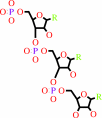 RNA(n)
|
+
|
ribonucleoside 5'-triphosphate
|
=
|
RNA(n+1)
|
+
|
 diphosphate
|
|
|
|
|
|
|
|
|
|
Enzyme class 3:
|
|
E.C.3.4.22.28
- picornain 3C.
|
|
|
|
|
|
|
Reaction:
|
|
Selective cleavage of Gln-|-Gly bond in the poliovirus polyprotein. In other picornavirus reactions Glu may be substituted for Gln, and Ser or Thr for Gly.
|
|
|
|
|
|
Enzyme class 4:
|
|
E.C.3.4.22.29
- picornain 2A.
|
|
|
|
|
|
|
Reaction:
|
|
Selective cleavage of Tyr-|-Gly bond in the picornavirus polyprotein. In other picornavirus reactions Glu may be substituted for Gln, and Ser or Thr for Gly.
|
|
|
|
|
|
Enzyme class 5:
|
|
E.C.3.6.1.15
- nucleoside-triphosphate phosphatase.
|
|
|
|
|
|
|
Reaction:
|
|
a ribonucleoside 5'-triphosphate + H2O = a ribonucleoside 5'-diphosphate + phosphate + H+
|
|
|
|
|
|
ribonucleoside 5'-triphosphate
|
+
|
H2O
|
=
|
ribonucleoside 5'-diphosphate
|
+
|
 phosphate
|
+
|
H(+)
|
|
|
|
|
|
|
|
|
|
|
|
|
Note, where more than one E.C. class is given (as above), each may
correspond to a different protein domain or, in the case of polyprotein
precursors, to a different mature protein.
|
|
|
|
Molecule diagrams generated from .mol files obtained from the
KEGG ftp site
|
|
|
|
|
|
|
|
|
|
|
|
|
|
 |
|
|
|
|
|
|
| |
|
|
| |
|
|
J Virol
82:9458-9464
(2008)
|
|
PubMed id:
|
|
|
|
|
|
| |
|
Crystal structure of coxsackievirus B3 3Dpol highlights the functional importance of residue 5 in picornavirus polymerases.
|
|
G.Campagnola,
M.Weygandt,
K.Scoggin,
O.Peersen.
|
|
|
|
|
| |
ABSTRACT
|
|
|
|
| |
|
|
The crystal structure of the coxsackievirus B3 polymerase has been solved at
2.25-A resolution and is shown to be highly homologous to polymerases from
poliovirus, rhinovirus, and foot-and-mouth disease viruses. Together, these
structures highlight several conserved structural elements in picornaviral
polymerases, including a proteolytic activation-dependent N-terminal structure
that is essential for full activity. Interestingly, a comparison of all of the
picornaviral polymerase structures shows an unusual conformation for residue 5,
which is always located at a distortion in the beta-strand composed of residues
1 to 8. In our earlier structure of the poliovirus polymerase, we attributed
this conformation to a crystal packing artifact, but the observation that this
conformation is conserved among picornaviruses led us to examine the role of
this residue in further detail. Here we use coxsackievirus polymerase to show
that elongation activity correlates with the hydrophobicity of residue 5 and,
surprisingly, more hydrophobic residues result in higher activity. Based on
structural analysis, we propose that this residue becomes buried during the
nucleotide repositioning step that occurs prior to phosphoryl transfer. We
present a model in which the buried N terminus observed in all picornaviral
polymerases is essential for stabilizing the structure during this
conformational change.
|
|
|
|
|
|
|
|
|
|
|
|
|
|
|
|
|
|
 |
 |
 |
|
Literature references that cite this PDB file's key reference
|
|
|
| |
PubMed id
|
|
Reference
|
|
|
|
|
|
C.E.Cameron,
H.Suk Oh,
and
I.M.Moustafa
(2010).
Expanding knowledge of P3 proteins in the poliovirus lifecycle.
|
| |
Future Microbiol,
5,
867-881.
|
|
|
|
|
|
|
J.Kerkvliet,
R.Edukulla,
and
M.Rodriguez
(2010).
Novel roles of the picornaviral 3D polymerase in viral pathogenesis.
|
| |
Adv Virol,
2010,
368068.
|
|
|
|
|
|
|
L.I.Levi,
N.F.Gnädig,
S.Beaucourt,
M.J.McPherson,
B.Baron,
J.J.Arnold,
and
M.Vignuzzi
(2010).
Fidelity variants of RNA dependent RNA polymerases uncover an indirect, mutagenic activity of amiloride compounds.
|
| |
PLoS Pathog,
6,
e1001163.
|
|
|
|
|
|
|
S.E.Hobdey,
B.J.Kempf,
B.P.Steil,
D.J.Barton,
and
O.B.Peersen
(2010).
Poliovirus polymerase residue 5 plays a critical role in elongation complex stability.
|
| |
J Virol,
84,
8072-8084.
|
|
|
|
|
|
|
P.Gong,
G.Campagnola,
and
O.B.Peersen
(2009).
A quantitative stopped-flow fluorescence assay for measuring polymerase elongation rates.
|
| |
Anal Biochem,
391,
45-55.
|
|
|
|
|
|
The most recent references are shown first.
Citation data come partly from CiteXplore and partly
from an automated harvesting procedure. Note that this is likely to be
only a partial list as not all journals are covered by
either method. However, we are continually building up the citation data
so more and more references will be included with time.
|
|


 Links
Links


