 |
PDBsum entry 3c3c

|
|
|
|
|
 |
Contents |
 |
|
|
|
|
|
|
|
|
|
|
|
|
|
|
* Residue conservation analysis
|
|
|
|
|
|
|
|
|
|
|
Enzyme class:
|
|
E.C.2.7.2.3
- phosphoglycerate kinase.
|
|
|
|
|
|
|
Pathway:
|
|
Calvin Cycle (carbon fixation stages)
|
|
|
|
|
|
Reaction:
|
|
(2R)-3-phosphoglycerate + ATP = (2R)-3-phospho-glyceroyl phosphate + ADP
|
|
|
|
|
|
(2R)-3-phosphoglycerate
|
+
|
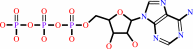 ATP
ATP
|
=
|
(2R)-3-phospho-glyceroyl phosphate
|
+
|
ADP
Bound ligand (Het Group name = )
matches with 85.71% similarity
|
|
|
|
|
|
|
|
|
|
|
|
|
Molecule diagrams generated from .mol files obtained from the
KEGG ftp site
|
|
|
|
|
|
|
|
|
|
|
|
|
|
 |
|
|
|
|
|
|
| |
|
|
| |
|
|
Nucleic Acids Res
36:3620-3629
(2008)
|
|
PubMed id:
|
|
|
|
|
|
| |
|
Molecular basis for the lack of enantioselectivity of human 3-phosphoglycerate kinase.
|
|
C.Gondeau,
L.Chaloin,
P.Lallemand,
B.Roy,
C.Périgaud,
T.Barman,
A.Varga,
M.Vas,
C.Lionne,
S.T.Arold.
|
|
|
|
|
| |
ABSTRACT
|
|
|
|
| |
|
|
Non-natural L-nucleoside analogues are increasingly used as therapeutic agents
to treat cancer and viral infections. To be active, L-nucleosides need to be
phosphorylated to their respective triphosphate metabolites. This stepwise
phosphorylation relies on human enzymes capable of processing L-nucleoside
enantiomers. We used crystallographic analysis to reveal the molecular basis for
the low enantioselectivity and the broad specificity of human 3-phosphoglycerate
kinase (hPGK), an enzyme responsible for the last step of phosphorylation of
many nucleotide derivatives. Based on structures of hPGK in the absence of
nucleotides, and bound to L and d forms of MgADP and MgCDP, we show that a
non-specific hydrophobic clamp to the nucleotide base, as well as a water-filled
cavity behind it, allows high flexibility in the interaction between PGK and the
bases. This, combined with the dispensability of hydrogen bonds to the sugar
moiety, and ionic interactions with the phosphate groups, results in the
positioning of different nucleotides so to expose their diphosphate group in a
position competent for catalysis. Since the third phosphorylation step is often
rate limiting, our results are expected to alleviate in silico tailoring of
L-type prodrugs to assure their efficient metabolic processing.
|
|
|
|
|
|
|
|
|
|
|
|
|
|
|
|
|
|
 |
 |
 |
|
Literature references that cite this PDB file's key reference
|
|
|
| |
PubMed id
|
|
Reference
|
|
|
|
|
|
G.B.Gloor,
G.Tyagi,
D.M.Abrassart,
A.J.Kingston,
A.D.Fernandes,
S.D.Dunn,
and
C.J.Brandl
(2010).
Functionally compensating coevolving positions are neither homoplasic nor conserved in clades.
|
| |
Mol Biol Evol,
27,
1181-1191.
|
|
|
|
|
|
|
Z.Palmai,
L.Chaloin,
C.Lionne,
J.Fidy,
D.Perahia,
and
E.Balog
(2009).
Substrate binding modifies the hinge bending characteristics of human 3-phosphoglycerate kinase: a molecular dynamics study.
|
| |
Proteins,
77,
319-329.
|
|
|
|
|
|
The most recent references are shown first.
Citation data come partly from CiteXplore and partly
from an automated harvesting procedure. Note that this is likely to be
only a partial list as not all journals are covered by
either method. However, we are continually building up the citation data
so more and more references will be included with time.
|
|


 Links
Links


