 |
PDBsum entry 3isc

|
|
|
|
|
|

|

|

|

|
|

|
|

|
|

|
|

|
|

|
|

|
|

|
|
|
 |

|

|
|
|
|
|
|
|
|
|
|
|
|
|
|
|
|
|
|
|
|
|
|
|
|
|
|
|
|
|
|
|
|
|
|
|
|
Transferase/DNA
|
PDB id
|
|
|
|
3isc
|
|
|
|
|
|
|
|
|
|
|
|
|
|
|

|

|

|
|
|
|
|
|
|
|
 |
Contents |
 |
|
|
|
|
|
|
|
|
|
|
|
|
|
|
* Residue conservation analysis
|
|
|
|
|
|
|
|
|
|
|
Enzyme class 1:
|
|
E.C.2.7.7.7
- DNA-directed Dna polymerase.
|
|
|
|
|
|
|
Reaction:
|
|
DNA(n) + a 2'-deoxyribonucleoside 5'-triphosphate = DNA(n+1) + diphosphate
|
|
|
|
|
|
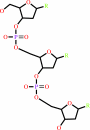 DNA(n)
|
+
|
2'-deoxyribonucleoside 5'-triphosphate
|
=
|
DNA(n+1)
|
+
|
 diphosphate
|
|
|
|
|
|
|
|
|
|
Enzyme class 2:
|
|
E.C.4.2.99.-
- ?????
|
|
|
|
|
|
|
Enzyme class 3:
|
|
E.C.4.2.99.18
- DNA-(apurinic or apyrimidinic site) lyase.
|
|
|
|
|
|
|
Reaction:
|
|
2'-deoxyribonucleotide-(2'-deoxyribose 5'-phosphate)- 2'-deoxyribonucleotide-DNA = a 3'-end 2'-deoxyribonucleotide-(2,3- dehydro-2,3-deoxyribose 5'-phosphate)-DNA + a 5'-end 5'-phospho- 2'-deoxyribonucleoside-DNA + H+
|
|
|
|
|
|
|
|
|
Note, where more than one E.C. class is given (as above), each may
correspond to a different protein domain or, in the case of polyprotein
precursors, to a different mature protein.
|
|
|
|
Molecule diagrams generated from .mol files obtained from the
KEGG ftp site
|
|
|
|
|
|
|
|
|
|
|
|
|
|
 |
|
|
|
|
|
|
| |
|
|
| |
|
|
J Biol Chem
284:31680-31689
(2009)
|
|
PubMed id:
|
|
|
|
|
|
| |
|
DNA polymerase beta substrate specificity: side chain modulation of the "A-rule".
|
|
W.A.Beard,
D.D.Shock,
V.K.Batra,
L.C.Pedersen,
S.H.Wilson.
|
|
|
|
|
| |
ABSTRACT
|
|
|
|
| |
|
|
Apurinic/apyrimidinic (AP) sites are continuously generated in genomic DNA. Left
unrepaired, AP sites represent noninstructional premutagenic lesions that are
impediments to DNA synthesis. When DNA polymerases encounter an AP site, they
generally insert dAMP. This preferential insertion is referred to as the A-rule.
Crystallographic structures of DNA polymerase (pol) beta, a family X polymerase,
with active site mismatched nascent base pairs indicate that the templating
(i.e. coding) base is repositioned outside of the template binding pocket
thereby diminishing interactions with the incorrect incoming nucleotide. This
effectively produces an abasic site because the template pocket is devoid of an
instructional base. However, the template pocket is not empty; an arginine
residue (Arg-283) occupies the space vacated by the templating nucleotide. In
this study, we analyze the kinetics of pol beta insertion opposite an AP site
and show that the preferential incorporation of dAMP is lost with the R283A
mutant. The crystallographic structures of pol beta bound to gapped DNA with an
AP site analog (tertrahydrofuran) in the gap (binary complex) and with an
incoming nonhydrolyzable dATP analog (ternary complex) were solved. These
structures reveal that binding of the dATP analog induces a closed polymerase
conformation, an unstable primer terminus, and an upstream shift of the
templating residue even in the absence of a template base. Thus, dATP insertion
opposite an abasic site and dATP misinsertions have common features.
|
|
|
|
|
|
|
|
|
|
|
|
|
|
|
|
|
|
 |
 |
 |
|
Literature references that cite this PDB file's key reference
|
|
|
| |
PubMed id
|
|
Reference
|
|
|
|
|
|
S.Obeid,
N.Blatter,
R.Kranaster,
A.Schnur,
K.Diederichs,
W.Welte,
and
A.Marx
(2010).
Replication through an abasic DNA lesion: structural basis for adenine selectivity.
|
| |
EMBO J,
29,
1738-1747.
|
|
|
PDB codes:
|
|
|
|
|
|
|
The most recent references are shown first.
Citation data come partly from CiteXplore and partly
from an automated harvesting procedure. Note that this is likely to be
only a partial list as not all journals are covered by
either method. However, we are continually building up the citation data
so more and more references will be included with time.
Where a reference describes a PDB structure, the PDB
codes are
shown on the right.
|
|


 Links
Links


