 |
PDBsum entry 3e0d

|
|
|
|
|
|

|

|

|

|
|

|
|

|
|

|
|

|
|

|
|

|
|

|
|
|
 |

|

|
|
|
|
|
|
|
|
|
|
|
|
|
|
|
|
|
|
|
|
|
|
|
|
|
|
|
|
|
|
|
|
|
|
|
|
Transferase/DNA
|
PDB id
|
|
|
|
3e0d
|
|
|
|
|
|
|
|
|
|
|
|
|
|
|

|

|

|
|
|
|
|
|
|
|
 |
Contents |
 |
|
|
|
|
|
|
|
|
|
|
|
|
|
|
* Residue conservation analysis
|
|
|
|
|
|
|
|
|
|
|
Enzyme class:
|
|
E.C.2.7.7.7
- DNA-directed Dna polymerase.
|
|
|
|
|
|
|
Reaction:
|
|
DNA(n) + a 2'-deoxyribonucleoside 5'-triphosphate = DNA(n+1) + diphosphate
|
|
|
|
|
|
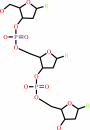 DNA(n)
|
+
|
2'-deoxyribonucleoside 5'-triphosphate
|
=
|
DNA(n+1)
|
+
|
 diphosphate
|
|
|
|
|
|
|
|
|
|
|
|
|
Molecule diagrams generated from .mol files obtained from the
KEGG ftp site
|
|
|
|
|
|
|
|
|
|
|
|
|
|
 |
|
|
|
|
|
|
| |
|
|
| |
|
DOI no:
|
J Mol Biol
382:859-869
(2008)
|
|
PubMed id:
|
|
|
|
|
|
| |
|
Insights into the replisome from the structure of a ternary complex of the DNA polymerase III alpha-subunit.
|
|
R.A.Wing,
S.Bailey,
T.A.Steitz.
|
|
|
|
|
| |
ABSTRACT
|
|
|
|
| |
|
|
The crystal structure of the catalytic alpha-subunit of the DNA polymerase III
(Pol IIIalpha) holoenzyme bound to primer-template DNA and an incoming
deoxy-nucleoside 5'-triphosphate has been determined at 4.6-A resolution. The
polymerase interacts with the sugar-phosphate backbone of the DNA across its
minor groove, which is made possible by significant movements of the thumb,
finger, and beta-binding domains relative to their orientations in the
unliganded polymerase structure. Additionally, the DNA and incoming nucleotide
are bound to the active site of Pol IIIalpha nearly identically as they are in
their complex with DNA polymerase beta, thereby proving that the eubacterial
replicating polymerase, but not the eukaryotic replicating polymerase, is
homologous to DNA polymerase beta. Finally, superimposing a recent structure of
the clamp bound to DNA on this Pol IIIalpha complex with DNA places a loop of
the beta-binding domain into the appropriate clamp cleft and supports a
mechanism of polymerase switching.
|
|
|
|
|
|
| |
Selected figure(s)
|
|
|
|
| |
|
|

|
|

|
|
Figure 2.
Fig. 2. Crystal structure of a replicating complex of T.
aquaticus PolIIIα. (a) A view of the crystal structure of the
replicating complex of T. aquaticus PolIIIα. Domains are
labeled as follows: PHP nuclease, yellow; palm, pink; thumb,
light green; index finger, light blue; middle finger, dark blue;
β-binding, orange; and CTD, red. The template and primer
strands are represented as spheres and shown in wheat and white,
respectively. The primer-terminal 3′ base is depicted with
blue spheres, and the incoming nucleotide is depicted with red
spheres. PolIIIα is depicted in a cartoon representation. The
density for the downstream DNA template strand is represented in
mesh. (b) Close-up of the active site of PolIIIα. PolIIIα is
depicted using a surface representation. The DNA substrate is
depicted as sticks and shown as in the left panel. The incoming
nucleotide and primer-terminal 3′ base are shown in red and
blue, respectively. Key active-site residues are labeled as
follows: D463, D465, and D618 are shown in red; K616 is in
yellow; S426 is in green; and R767 is in blue. The active-site
helix is shown in magenta.
|
|
Figure 3.
Fig. 3. Interactions with the DNA substrate. (a) Surface
representation of interactions between the thumb domain of
PolIIIα and the DNA substrate in a cartoon representation.
Green surfaces indicate the thumb domain, with blue surfaces
representing residues proposed to interact with the DNA
substrate. Yellow surfaces represent the PHP nuclease domain.
The polymerase active site is seen on the left as demarcated by
the blue stick representation of the primer-terminal 3′ base
(ddC) and the red stick representation of the incoming
nucleotide (dATP). (b) Surface representation of interactions
between the β-binding domain of PolIIIα and the DNA substrate
in a cartoon representation. Orange surfaces indicate the
β-binding domain with three key loops implicated in DNA binding
labeled as follows: Taq927–Taq923, blue; HhH motif
Taq892–Taq910, cyan; and Taq846–Taq852, purple. Positively
charged residues that are within proximity to interact with the
sugar–phosphate backbone are labeled, and their positions are
indicated with white arrows. An additional arrow points to the
location of the polymerase active site. (c) The observed DNA
substrate of PolIIIα is depicted using a cartoon representation
with the primer strand shown in white and the template strand
shown in wheat. Idealized B-form DNA aligned with the DNA
substrate prior to bending is displayed in a surface
representation. Black lines indicate the helical axes of the DNA
substrate (outside of the active site) and the idealized B-form
DNA. The primer-terminal 3′ base is represented in blue
sticks. The loops of the thumb domain (Taq492–Taq499 and
Taq569–Taq575) that induce DNA bending are shown in green and
represented as a surface.
|
|
|
|
|
|
| |
The above figures are
reprinted
by permission from Elsevier:
J Mol Biol
(2008,
382,
859-869)
copyright 2008.
|
|
| |
Figures were
selected
by an automated process.
|
|
|
|
|
|
|
|
|
|
|
|
|
|
|
|
 |
 |
 |
|
Literature references that cite this PDB file's key reference
|
|
|
| |
PubMed id
|
|
Reference
|
|
|
|
|
|
J.D.Pata
(2010).
Structural diversity of the Y-family DNA polymerases.
|
| |
Biochim Biophys Acta,
1804,
1124-1135.
|
|
|
|
|
|
|
M.J.McCauley,
and
M.C.Williams
(2009).
Optical tweezers experiments resolve distinct modes of DNA-protein binding.
|
| |
Biopolymers,
91,
265-282.
|
|
|
|
|
|
|
R.E.Georgescu,
I.Kurth,
N.Y.Yao,
J.Stewart,
O.Yurieva,
and
M.O'Donnell
(2009).
Mechanism of polymerase collision release from sliding clamps on the lagging strand.
|
| |
EMBO J,
28,
2981-2991.
|
|
|
|
|
|
|
M.H.Lamers,
and
M.O'Donnell
(2008).
A consensus view of DNA binding by the C family of replicative DNA polymerases.
|
| |
Proc Natl Acad Sci U S A,
105,
20565-20566.
|
|
|
|
|
|
|
R.J.Evans,
D.R.Davies,
J.M.Bullard,
J.Christensen,
L.S.Green,
J.W.Guiles,
J.D.Pata,
W.K.Ribble,
N.Janjic,
and
T.C.Jarvis
(2008).
Structure of PolC reveals unique DNA binding and fidelity determinants.
|
| |
Proc Natl Acad Sci U S A,
105,
20695-20700.
|
|
|
PDB codes:
|
|
|
|
|
|
|
The most recent references are shown first.
Citation data come partly from CiteXplore and partly
from an automated harvesting procedure. Note that this is likely to be
only a partial list as not all journals are covered by
either method. However, we are continually building up the citation data
so more and more references will be included with time.
Where a reference describes a PDB structure, the PDB
codes are
shown on the right.
|
|


 Links
Links


