 |
PDBsum entry 2isp

|
|
|
|
|
|

|

|

|

|
|

|
|

|
|

|
|

|
|

|
|

|
|

|
|
|
 |

|

|
|
|
|
|
|
|
|
|
|
|
|
|
|
|
|
|
|
|
|
|
|
|
|
|
|
|
|
|
|
|
|
|
|
|
|
Transferase/DNA
|
PDB id
|
|
|
|
2isp
|
|
|
|
|
|
|
|
|
|
|
|
|
|
|

|

|

|
|
|
|
|
|
|
|
 |
Contents |
 |
|
|
|
|
|
|
|
|
|
|
|
|
|
|
|
|
* Residue conservation analysis
|
|
|
|
|
|
PDB id:
|
|
|
|
| Name: |
|
Transferase/DNA
|
|
|
Title:
|
|
Ternary complex of DNA polymerase beta with a dideoxy terminated primer and 2'-deoxyguanosine 5'-beta, gamma-methylene triphosphate
|
|
Structure:
|
|
5'-d( Cp Cp Gp Ap Cp Cp Gp Cp Gp Cp Ap Tp Cp Ap Gp C)-3'. Chain: t. Engineered: yes. 5'-d( Gp Cp Tp Gp Ap Tp Gp Cp Gp (Doc))-3'. Chain: p. Engineered: yes. 5'-d(p Gp Tp Cp Gp G)-3'. Chain: d. Engineered: yes.
|
|
Source:
|
|
Synthetic: yes. Homo sapiens. Human. Organism_taxid: 9606. Gene: polb. Expressed in: escherichia coli. Expression_system_taxid: 562
|
|
Resolution:
|
|
|
2.20Å
|
R-factor:
|
0.201
|
R-free:
|
0.261
|
|
|
Authors:
|
|
C.A.Sucato,T.G.Upton,B.A.Kashemirov,V.Martinek,Y.Xiang,W.A.Beard
|
Key ref:

|
|
C.A.Sucato
et al.
(2007).
Modifying the beta,gamma leaving-group bridging oxygen alters nucleotide incorporation efficiency, fidelity, and the catalytic mechanism of DNA polymerase beta.
Biochemistry,
46,
461-471.
PubMed id:
DOI:
|
|
|
Date:
|
|
|
18-Oct-06
|
Release date:
|
30-Jan-07
|
|
|
|
|
|
|
PROCHECK
|

|
|
|
|
|
Headers
|
|
|
|
References
|
|
|
|
|
|

|
|
P06746
(DPOLB_HUMAN) -
DNA polymerase beta from Homo sapiens
|
|
|
|
Seq:
Struc:
|
|
|
|
335 a.a.
326 a.a.
|
|

|

|

|
|
|
|
|
|
|
|
|
|
|
Key: |
 |
PfamA domain |
|
|
 |
Secondary structure |
|
 |
CATH domain |
|
|
|
|
|
|
|
|

|
|
|
|
C-C-G-A-C-C-G-C-G-C-A-T-C-A-G-C
16 bases
|
|
|
|
G-C-T-G-A-T-G-C-G-DOC
10 bases
|
|
|
|
G-T-C-G-G
5 bases
|
|
|
|
|
|
|
|
|
|
|
|
|
|
Enzyme class 1:
|
|
E.C.2.7.7.7
- DNA-directed Dna polymerase.
|
|
|
|
|
|
|
Reaction:
|
|
DNA(n) + a 2'-deoxyribonucleoside 5'-triphosphate = DNA(n+1) + diphosphate
|
|
|
|
|
|
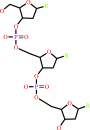 DNA(n)
|
+
|
2'-deoxyribonucleoside 5'-triphosphate
|
=
|
DNA(n+1)
|
+
|
 diphosphate
|
|
|
|
|
|
|
|
|
|
Enzyme class 2:
|
|
E.C.4.2.99.-
- ?????
|
|
|
|
|
|
|
Enzyme class 3:
|
|
E.C.4.2.99.18
- DNA-(apurinic or apyrimidinic site) lyase.
|
|
|
|
|
|
|
Reaction:
|
|
2'-deoxyribonucleotide-(2'-deoxyribose 5'-phosphate)- 2'-deoxyribonucleotide-DNA = a 3'-end 2'-deoxyribonucleotide-(2,3- dehydro-2,3-deoxyribose 5'-phosphate)-DNA + a 5'-end 5'-phospho- 2'-deoxyribonucleoside-DNA + H+
|
|
|
|
|
|
|
|
|
Note, where more than one E.C. class is given (as above), each may
correspond to a different protein domain or, in the case of polyprotein
precursors, to a different mature protein.
|
|
|
|
Molecule diagrams generated from .mol files obtained from the
KEGG ftp site
|
|
|
|
|
|
|
|
|
|
|
|
|
|
 |
|
|
|
|
|
|
| |
|
|
| |
|
DOI no:
|
Biochemistry
46:461-471
(2007)
|
|
PubMed id:
|
|
|
|
|
|
| |
|
Modifying the beta,gamma leaving-group bridging oxygen alters nucleotide incorporation efficiency, fidelity, and the catalytic mechanism of DNA polymerase beta.
|
|
C.A.Sucato,
T.G.Upton,
B.A.Kashemirov,
V.K.Batra,
V.Martínek,
Y.Xiang,
W.A.Beard,
L.C.Pedersen,
S.H.Wilson,
C.E.McKenna,
J.Florián,
A.Warshel,
M.F.Goodman.
|
|
|
|
|
| |
ABSTRACT
|
|
|
|
| |
|
|
DNA polymerase catalysis and fidelity studies typically compare incorporation of
"right" versus "wrong" nucleotide bases where the leaving group is
pyrophosphate. Here we use dGTP analogues replacing the beta,gamma-bridging O
with CH2, CHF, CF2, or CCl2 to explore leaving-group effects on the nucleotidyl
transfer mechanism and fidelity of DNA polymerase (pol) beta. T.G mismatches
occur with fidelities similar to dGTP with the exception of the CH2 analogue,
which is incorporated with 5-fold higher fidelity. All analogues are observed to
bind opposite template C with Kds between 1 and 4 microM, and structural
evidence suggests that the analogues bind in essentially the native
conformation, making them suitable substrates for probing linear free energy
relationships (LFERs) in transient-kinetics experiments. Importantly, Brnsted
correlations of log(kpol) versus leaving-group pKa for both right and wrong base
incorporation reveal similar sensitivities (betalg approximately -0.8) followed
by departures from linearity, suggesting that a chemical step rather than enzyme
conformational change is rate-limiting for either process. The location of the
breaks relative to pKas of CF2, O, and the sterically bulky CCl2-bridging
compounds suggests a modification-induced change in the mechanism by
stabilization of leaving-group elimination. The results are addressed
theoretically in terms of the energetics of successive primer 3'-O addition
(bond forming) and pyrophosphate analogue elimination (bond breaking) reaction
energy barriers.
|
|
|
|
|
|
|
|
|
|
|
|
|
|
|
|
|
|
 |
 |
 |
|
Literature references that cite this PDB file's key reference
|
|
|
| |
PubMed id
|
|
Reference
|
|
|
|
|
|
A.Giraut,
and
P.Herdewijn
(2010).
Influence of the linkage between leaving group and nucleoside on substrate efficiency for incorporation in DNA catalyzed by reverse transcriptase.
|
| |
Chembiochem,
11,
1399-1403.
|
|
|
|
|
|
|
A.Giraut,
X.P.Song,
M.Froeyen,
P.Marlière,
and
P.Herdewijn
(2010).
Iminodiacetic-phosphoramidates as metabolic prototypes for diversifying nucleic acid polymerization in vivo.
|
| |
Nucleic Acids Res,
38,
2541-2550.
|
|
|
|
|
|
|
E.A.Motea,
and
A.J.Berdis
(2010).
Terminal deoxynucleotidyl transferase: the story of a misguided DNA polymerase.
|
| |
Biochim Biophys Acta,
1804,
1151-1166.
|
|
|
|
|
|
|
G.K.Surya Prakash,
M.Zibinsky,
T.G.Upton,
B.A.Kashemirov,
C.E.McKenna,
K.Oertell,
M.F.Goodman,
V.K.Batra,
L.C.Pedersen,
W.A.Beard,
D.D.Shock,
S.H.Wilson,
and
G.A.Olah
(2010).
Synthesis and biological evaluation of fluorinated deoxynucleotide analogs based on bis-(difluoromethylene)triphosphoric acid.
|
| |
Proc Natl Acad Sci U S A,
107,
15693-15698.
|
|
|
PDB code:
|
|
|
|
|
|
|
|
J.Yamtich,
and
J.B.Sweasy
(2010).
DNA polymerase family X: function, structure, and cellular roles.
|
| |
Biochim Biophys Acta,
1804,
1136-1150.
|
|
|
|
|
|
|
R.Rucker,
P.Oelschlaeger,
and
A.Warshel
(2010).
A binding free energy decomposition approach for accurate calculations of the fidelity of DNA polymerases.
|
| |
Proteins,
78,
671-680.
|
|
|
|
|
|
|
R.Venkatramani,
and
R.Radhakrishnan
(2010).
Computational delineation of the catalytic step of a high-fidelity DNA polymerase.
|
| |
Protein Sci,
19,
815-825.
|
|
|
|
|
|
|
S.H.Wilson,
W.A.Beard,
D.D.Shock,
V.K.Batra,
N.A.Cavanaugh,
R.Prasad,
E.W.Hou,
Y.Liu,
K.Asagoshi,
J.K.Horton,
D.F.Stefanick,
P.S.Kedar,
M.J.Carrozza,
A.Masaoka,
and
M.L.Heacock
(2010).
Base excision repair and design of small molecule inhibitors of human DNA polymerase β.
|
| |
Cell Mol Life Sci,
67,
3633-3647.
|
|
|
|
|
|
|
V.K.Batra,
W.A.Beard,
E.W.Hou,
L.C.Pedersen,
R.Prasad,
and
S.H.Wilson
(2010).
Mutagenic conformation of 8-oxo-7,8-dihydro-2'-dGTP in the confines of a DNA polymerase active site.
|
| |
Nat Struct Mol Biol,
17,
889-890.
|
|
|
PDB code:
|
|
|
|
|
|
|
|
E.Gaidamauskas,
H.Parker,
B.A.Kashemirov,
A.A.Holder,
K.Saejueng,
C.E.McKenna,
and
D.C.Crans
(2009).
Complexation of bisphosphonates with ytterbium(III): application of phosphate and ATP detection assay based on Yb(3+)-pyrocatechol violet.
|
| |
J Inorg Biochem,
103,
1652-1657.
|
|
|
|
|
|
|
S.C.Kamerlin,
C.E.McKenna,
M.F.Goodman,
M.F.Goondman,
and
A.Warshel
(2009).
A computational study of the hydrolysis of dGTP analogues with halomethylene-modified leaving groups in solution: implications for the mechanism of DNA polymerases.
|
| |
Biochemistry,
48,
5963-5971.
|
|
|
|
|
|
|
T.G.Upton,
B.A.Kashemirov,
C.E.McKenna,
M.F.Goodman,
G.K.Prakash,
R.Kultyshev,
V.K.Batra,
D.D.Shock,
L.C.Pedersen,
W.A.Beard,
and
S.H.Wilson
(2009).
Alpha,beta-difluoromethylene deoxynucleoside 5'-triphosphates: a convenient synthesis of useful probes for DNA polymerase beta structure and function.
|
| |
Org Lett,
11,
1883-1886.
|
|
|
PDB code:
|
|
|
|
|
|
|
|
F.Liang,
N.Jain,
T.Hutchens,
D.D.Shock,
W.A.Beard,
S.H.Wilson,
M.P.Chiarelli,
and
B.P.Cho
(2008).
Alpha,beta-methylene-2'-deoxynucleoside 5'-triphosphates as noncleavable substrates for DNA polymerases: isolation, characterization, and stability studies of novel 2'-deoxycyclonucleosides, 3,5'-cyclo-dG, and 2,5'-cyclo-dT.
|
| |
J Med Chem,
51,
6460-6470.
|
|
|
|
|
|
|
M.P.Roettger,
M.Bakhtina,
and
M.D.Tsai
(2008).
Mismatched and matched dNTP incorporation by DNA polymerase beta proceed via analogous kinetic pathways.
|
| |
Biochemistry,
47,
9718-9727.
|
|
|
|
|
|
|
M.Renders,
R.Lievrouw,
M.Krecmerová,
A.Holý,
and
P.Herdewijn
(2008).
Enzymatic polymerization of phosphonate nucleosides.
|
| |
Chembiochem,
9,
2883-2888.
|
|
|
|
|
|
|
Y.Xiang,
M.F.Goodman,
W.A.Beard,
S.H.Wilson,
and
A.Warshel
(2008).
Exploring the role of large conformational changes in the fidelity of DNA polymerase beta.
|
| |
Proteins,
70,
231-247.
|
|
|
|
|
|
|
C.E.McKenna,
B.A.Kashemirov,
T.G.Upton,
V.K.Batra,
M.F.Goodman,
L.C.Pedersen,
W.A.Beard,
and
S.H.Wilson
(2007).
(R)-beta,gamma-fluoromethylene-dGTP-DNA ternary complex with DNA polymerase beta.
|
| |
J Am Chem Soc,
129,
15412-15413.
|
|
|
PDB code:
|
|
|
|
|
|
|
|
O.Adelfinskaya,
M.Terrazas,
M.Froeyen,
P.Marlière,
K.Nauwelaerts,
and
P.Herdewijn
(2007).
Polymerase-catalyzed synthesis of DNA from phosphoramidate conjugates of deoxynucleotides and amino acids.
|
| |
Nucleic Acids Res,
35,
5060-5072.
|
|
|
|
|
|
|
V.Martínek,
U.Bren,
M.F.Goodman,
A.Warshel,
and
J.Florián
(2007).
DNA polymerase beta catalytic efficiency mirrors the Asn279-dCTP H-bonding strength.
|
| |
FEBS Lett,
581,
775-780.
|
|
|
|
|
|
The most recent references are shown first.
Citation data come partly from CiteXplore and partly
from an automated harvesting procedure. Note that this is likely to be
only a partial list as not all journals are covered by
either method. However, we are continually building up the citation data
so more and more references will be included with time.
Where a reference describes a PDB structure, the PDB
code is
shown on the right.
|
|


 Links
Links


