 |
PDBsum entry 2f2c

|
|
|
|
|
|

|

|

|

|
|

|
|

|
|

|
|

|
|

|
|

|
|
|
 |

|

|
|
|
|
|
|
|
|
|
|
|
|
|
|
|
|
|
|
|
|
|
|
|
|
|
|
|
|
|
|
|
|
|
|
|
Cell cycle/transferase
|
PDB id
|
|
|
|
2f2c
|
|
|
|
|
|
|
|
|
|
|
|
|
|
|

|

|

|
|
|
|
|
|
|
|
 |
Contents |
 |
|
|
|
|
|
|
|
|
|
|
* Residue conservation analysis
|
|
|
|
|
|
|
|
|
|
Enzyme class 1:
|
|
Chain A:
E.C.?
|
|
|
|
|
|
|
Enzyme class 2:
|
|
Chain B:
E.C.2.7.11.22
- cyclin-dependent kinase.
|
|
|
|
|
|
|
Reaction:
|
|
|
1.
|
L-seryl-[protein] + ATP = O-phospho-L-seryl-[protein] + ADP + H+
|
|
2.
|
L-threonyl-[protein] + ATP = O-phospho-L-threonyl-[protein] + ADP + H+
|
|
|
|
|
|
|
L-seryl-[protein]
|
+
|
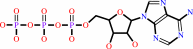 ATP
ATP
|
=
|
O-phospho-L-seryl-[protein]
|
+
|
 ADP
ADP
|
+
|
H(+)
|
|
|
|
|
|
|
L-threonyl-[protein]
|
+
|
ATP
|
=
|
O-phospho-L-threonyl-[protein]
|
+
|
ADP
|
+
|
H(+)
|
|
|
|
|
|
|
|
|
|
|
|
|
Note, where more than one E.C. class is given (as above), each may
correspond to a different protein domain or, in the case of polyprotein
precursors, to a different mature protein.
|
|
|
|
Molecule diagrams generated from .mol files obtained from the
KEGG ftp site
|
|
|
|
|
|
|
|
|
|
|
|
|
|
 |
|
|
|
|
|
|
| |
|
|
| |
|
DOI no:
|
J Med Chem
49:3826-3831
(2006)
|
|
PubMed id:
|
|
|
|
|
|
| |
|
Toward understanding the structural basis of cyclin-dependent kinase 6 specific inhibition.
|
|
H.Lu,
U.Schulze-Gahmen.
|
|
|
|
|
| |
ABSTRACT
|
|
|
|
| |
|
|
Cyclin-dependent kinases (CDKs) are key players in cell cycle control, and
genetic alterations of CDKs and their regulators have been linked to a variety
of cancers. Hence, CDKs are obvious targets for therapeutic intervention in
various proliferative diseases, including cancer. To date, drug design efforts
have mostly focused on CDK2 because methods for crystallization of its inhibitor
complexes have been well established. CDK4 and CDK6, however, may be at least as
important as enzymes for cell cycle regulation and could provide alternative
treatment options. We describe here two complex structures of human CDK6 with a
very specific kinase inhibitor, PD0332991, which is based on a
pyrido[2,3-d]pyrimidin-7-one scaffold, and with the less specific
aminopurvalanol inhibitor. Analysis of the structures suggests that relatively
small conformational differences between CDK2 and CDK6 in the hinge region are
contributing to the inhibitor specificity by inducing changes in the inhibitor
orientation that lead to sterical clashes in CDK2 but not CDK6. These complex
structures provide valuable insights for the future development of CDK-specific
inhibitors.
|
|
|
|
|
|
|
|
|
|
|
|
|
|
|
|
|
|
 |
 |
 |
|
Literature references that cite this PDB file's key reference
|
|
|
| |
PubMed id
|
|
Reference
|
|
|
|
|
|
J.Wesierska-Gadek,
and
V.Krystof
(2009).
Selective cyclin-dependent kinase inhibitors discriminating between cell cycle and transcriptional kinases: future reality or utopia?
|
| |
Ann N Y Acad Sci,
1171,
228-241.
|
|
|
|
|
|
|
L.N.Johnson
(2009).
Protein kinase inhibitors: contributions from structure to clinical compounds.
|
| |
Q Rev Biophys,
42,
1.
|
|
|
|
|
|
The most recent references are shown first.
Citation data come partly from CiteXplore and partly
from an automated harvesting procedure. Note that this is likely to be
only a partial list as not all journals are covered by
either method. However, we are continually building up the citation data
so more and more references will be included with time.
|
|
|


 Links
Links


