
|
|
|
|
|
 |
Contents |
 |
|
|
|
|
|
|
|
|
|
|
|
|
|
|
* Residue conservation analysis
|
|
|
|
|
|
PDB id:
|
|
|
|
| Name: |
|
Transcription/DNA
|
|
|
Title:
|
|
Structure of the DNA binding domains of nfat and foxp2 bound specifically to DNA.
|
|
Structure:
|
|
5'-d(tp Tp Ap Gp Gp Ap Ap Ap Ap Tp Tp Tp Gp Tp Tp Tp Cp Ap Tp Ap Gp )-3'. Chain: a, c. Engineered: yes. 5'-d(ap Ap Cp Tp Ap Tp Gp Ap Ap Ap Cp Ap Ap Ap Tp Tp Tp Tp Cp Cp Tp )-3'. Chain: b, d. Engineered: yes. Nuclear factor of activated t-cells, cytoplasmic 2.
|
|
Source:
|
|
Synthetic: yes. Other_details: solid phase synthesis. Homo sapiens. Human. Organism_taxid: 9606. Gene: nfatc2, nfat1, nfatp. Expressed in: escherichia coli bl21(de3). Expression_system_taxid: 469008. Gene: foxp2.
|
|
Biol. unit:
|
|
Octamer (from
)
|
|
Resolution:
|
|
|
2.70Å
|
R-factor:
|
0.238
|
R-free:
|
0.287
|
|
|
Authors:
|
|
Y.Wu,J.C.Stroud,M.Borde,D.L.Bates,L.Guo,A.Han,A.Rao,L.Chen
|
Key ref:

|
|
Y.Wu
et al.
(2006).
FOXP3 controls regulatory T cell function through cooperation with NFAT.
Cell,
126,
375-387.
PubMed id:
DOI:

|
|
|
Date:
|
|
|
22-Aug-05
|
Release date:
|
08-Aug-06
|
|
|
|
|
|
|
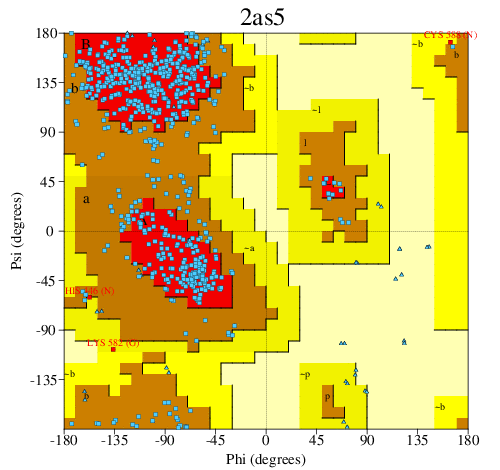
PROCHECK
|
|
|
|
|
|
Headers
|
|
|
|
References
|
|
|
|
|
|
|
|
|
|
|
|
Enzyme class:
|
|
Chains N, M, F, G:
E.C.?
|
|
|
|
|
|
|
|
|
|
|
|
|
|
|
|
|
|
|
 |
|
|
|
|
|
|
| |
|
DOI no:
|
Cell
126:375-387
(2006)
|
|
PubMed id:
|
|
|
|
|
|
| |
|
FOXP3 controls regulatory T cell function through cooperation with NFAT.
|
|
Y.Wu,
M.Borde,
V.Heissmeyer,
M.Feuerer,
A.D.Lapan,
J.C.Stroud,
D.L.Bates,
L.Guo,
A.Han,
S.F.Ziegler,
D.Mathis,
C.Benoist,
L.Chen,
A.Rao.
|
|
|
|
|
| |
ABSTRACT
|
|
|
|
| |
|
|
Antigen stimulation of immune cells activates the transcription factor NFAT, a
key regulator of T cell activation and anergy. NFAT forms cooperative complexes
with the AP-1 family of transcription factors and regulates T cell
activation-associated genes. Here we show that regulatory T cell (Treg) function
is mediated by an analogous cooperative complex of NFAT with the forkhead
transcription factor FOXP3, a lineage specification factor for Tregs. The
crystal structure of an NFAT:FOXP2:DNA complex reveals an extensive
protein-protein interaction interface between NFAT and FOXP2. Structure-guided
mutations of FOXP3, predicted to progressively disrupt its interaction with
NFAT, interfere in a graded manner with the ability of FOXP3 to repress
expression of the cytokine IL2, upregulate expression of the Treg markers CTLA4
and CD25, and confer suppressor function in a murine model of autoimmune
diabetes. Thus by switching transcriptional partners, NFAT converts the acute T
cell activation program into the suppressor program of Tregs.
|
|
|
|
|
|
| |
Selected figure(s)
|
|
|
|
| |
|
|

|
|

|
|
Figure 3.
Figure 3. Protein-Protein Interactions between NFAT and FOXP
|
|
Figure 8.
Figure 8. T Regulatory Function Requires the NFAT:FOXP3
Interface
|
|
|
|
|
|
| |
The above figures are
reprinted
by permission from Cell Press:
Cell
(2006,
126,
375-387)
copyright 2006.
|
|
| |
Figures were
selected
by the author.
|
|
|
|
|
|
|
|
|
|
|
|
|
|
|
|
 |
 |
 |
|
Literature references that cite this PDB file's key reference
|
|
|
| |
PubMed id
|
|
Reference
|
|
|
|
|
|
F.He,
H.Chen,
M.Probst-Kepper,
R.Geffers,
S.Eifes,
A.Del Sol,
K.Schughart,
A.P.Zeng,
and
R.Balling
(2012).
PLAU inferred from a correlation network is critical for suppressor function of regulatory T cells.
|
| |
Mol Syst Biol,
8,
624.
|
|
|
|
|
|
|
A.Ma,
S.Qi,
L.Song,
Y.Hu,
H.Dun,
E.Massicotte,
M.Dupuis,
P.Daloze,
and
H.Chen
(2011).
Adoptive transfer of CD4(+)CD25(+) regulatory cells combined with low-dose sirolimus and anti-thymocyte globulin delays acute rejection of renal allografts in Cynomolgus monkeys.
|
| |
Int Immunopharmacol,
11,
618-629.
|
|
|
|
|
|
|
G.Cheng,
A.Yu,
and
T.R.Malek
(2011).
T-cell tolerance and the multi-functional role of IL-2R signaling in T-regulatory cells.
|
| |
Immunol Rev,
241,
63-76.
|
|
|
|
|
|
|
H.Haiqi,
Z.Yong,
and
L.Yi
(2011).
Transcriptional regulation of Foxp3 in regulatory T cells.
|
| |
Immunobiology,
216,
678-685.
|
|
|
|
|
|
|
H.S.Bandukwala,
Y.Wu,
M.Feuerer,
Y.Chen,
B.Barboza,
S.Ghosh,
J.C.Stroud,
C.Benoist,
D.Mathis,
A.Rao,
and
L.Chen
(2011).
Structure of a domain-swapped FOXP3 dimer on DNA and its function in regulatory T cells.
|
| |
Immunity,
34,
479-491.
|
|
|
PDB code:
|
|
|
|
|
|
|
|
I.Tsaur,
M.Gasser,
B.Aviles,
J.Lutz,
L.Lutz,
M.Grimm,
V.Lange,
K.Lopau,
U.Heemann,
C.T.Germer,
A.Chandraker,
and
A.M.Waaga-Gasser
(2011).
Donor antigen-specific regulatory T-cell function affects outcome in kidney transplant recipients.
|
| |
Kidney Int,
79,
1005-1012.
|
|
|
|
|
|
|
L.S.Walker,
and
D.M.Sansom
(2011).
The emerging role of CTLA4 as a cell-extrinsic regulator of T cell responses.
|
| |
Nat Rev Immunol,
11,
852-863.
|
|
|
|
|
|
|
M.B.Werneck,
A.Vieira-de-Abreu,
R.Chammas,
and
J.P.Viola
(2011).
NFAT1 transcription factor is central in the regulation of tissue microenvironment for tumor metastasis.
|
| |
Cancer Immunol Immunother,
60,
537-546.
|
|
|
|
|
|
|
M.Beyer,
and
J.L.Schultze
(2011).
Plasticity of T(reg) cells: Is reprogramming of T(reg) cells possible in the presence of FOXP3?
|
| |
Int Immunopharmacol,
11,
555-560.
|
|
|
|
|
|
|
M.Redpath,
B.Xu,
L.C.van Kempen,
and
A.Spatz
(2011).
The dual role of the X-linked FoxP3 gene in human cancers.
|
| |
Mol Oncol,
5,
156-163.
|
|
|
|
|
|
|
M.Tone,
and
M.I.Greene
(2011).
Cooperative regulatory events and Foxp3 expression.
|
| |
Nat Immunol,
12,
14-16.
|
|
|
|
|
|
|
M.Vaeth,
T.Gogishvili,
T.Bopp,
M.Klein,
F.Berberich-Siebelt,
S.Gattenloehner,
A.Avots,
T.Sparwasser,
N.Grebe,
E.Schmitt,
T.Hünig,
E.Serfling,
and
J.Bodor
(2011).
Regulatory T cells facilitate the nuclear accumulation of inducible cAMP early repressor (ICER) and suppress nuclear factor of activated T cell c1 (NFATc1).
|
| |
Proc Natl Acad Sci U S A,
108,
2480-2485.
|
|
|
|
|
|
|
N.Ohkura,
M.Hamaguchi,
and
S.Sakaguchi
(2011).
FOXP3+ regulatory T cells: control of FOXP3 expression by pharmacological agents.
|
| |
Trends Pharmacol Sci,
32,
158-166.
|
|
|
|
|
|
|
N.Ohkura,
and
S.Sakaguchi
(2011).
Maturation of effector regulatory T cells.
|
| |
Nat Immunol,
12,
283-284.
|
|
|
|
|
|
|
W.F.Wong,
K.Kohu,
T.Chiba,
T.Sato,
and
M.Satake
(2011).
Interplay of transcription factors in T-cell differentiation and function: the role of Runx.
|
| |
Immunology,
132,
157-164.
|
|
|
|
|
|
|
Y.P.Chu,
C.H.Chang,
J.H.Shiu,
Y.T.Chang,
C.Y.Chen,
and
W.J.Chuang
(2011).
Solution structure and backbone dynamics of the DNA-binding domain of FOXP1: Insight into its domain swapping and DNA binding.
|
| |
Protein Sci,
20,
908-924.
|
|
|
PDB code:
|
|
|
|
|
|
|
|
Y.Satou,
J.Yasunaga,
T.Zhao,
M.Yoshida,
P.Miyazato,
K.Takai,
K.Shimizu,
K.Ohshima,
P.L.Green,
N.Ohkura,
T.Yamaguchi,
M.Ono,
S.Sakaguchi,
and
M.Matsuoka
(2011).
HTLV-1 bZIP Factor Induces T-Cell Lymphoma and Systemic Inflammation In Vivo.
|
| |
PLoS Pathog,
7,
e1001274.
|
|
|
|
|
|
|
Z.Chen,
F.Lin,
Y.Gao,
Z.Li,
J.Zhang,
Y.Xing,
Z.Deng,
Z.Yao,
A.Tsun,
and
B.Li
(2011).
FOXP3 and RORγt: Transcriptional regulation of Treg and Th17.
|
| |
Int Immunopharmacol,
11,
536-542.
|
|
|
|
|
|
|
A.Planchart,
and
C.J.Mattingly
(2010).
2,3,7,8-Tetrachlorodibenzo-p-dioxin upregulates FoxQ1b in zebrafish jaw primordium.
|
| |
Chem Res Toxicol,
23,
480-487.
|
|
|
|
|
|
|
A.Sharabi,
S.Lapter,
and
E.Mozes
(2010).
Bcl-xL is required for the development of functional regulatory CD4 cells in lupus-afflicted mice following treatment with a tolerogenic peptide.
|
| |
J Autoimmun,
34,
87-95.
|
|
|
|
|
|
|
B.Kanwar,
D.Favre,
and
J.M.McCune
(2010).
Th17 and regulatory T cells: implications for AIDS pathogenesis.
|
| |
Curr Opin HIV AIDS,
5,
151-157.
|
|
|
|
|
|
|
B.Liu,
S.Tahk,
K.M.Yee,
G.Fan,
and
K.Shuai
(2010).
The ligase PIAS1 restricts natural regulatory T cell differentiation by epigenetic repression.
|
| |
Science,
330,
521-525.
|
|
|
|
|
|
|
B.Y.Tsai,
J.L.Suen,
and
B.L.Chiang
(2010).
Lentiviral-mediated Foxp3 RNAi suppresses tumor growth of regulatory T cell-like leukemia in a murine tumor model.
|
| |
Gene Ther,
17,
972-979.
|
|
|
|
|
|
|
D.Busse,
M.de la Rosa,
K.Hobiger,
K.Thurley,
M.Flossdorf,
A.Scheffold,
and
T.Höfer
(2010).
Competing feedback loops shape IL-2 signaling between helper and regulatory T lymphocytes in cellular microenvironments.
|
| |
Proc Natl Acad Sci U S A,
107,
3058-3063.
|
|
|
|
|
|
|
D.Hawiger,
Y.Y.Wan,
E.E.Eynon,
and
R.A.Flavell
(2010).
The transcription cofactor Hopx is required for regulatory T cell function in dendritic cell-mediated peripheral T cell unresponsiveness.
|
| |
Nat Immunol,
11,
962-968.
|
|
|
|
|
|
|
D.J.Jung,
D.H.Jin,
S.W.Hong,
J.E.Kim,
J.S.Shin,
D.Kim,
B.J.Cho,
Y.I.Hwang,
J.S.Kang,
and
W.J.Lee
(2010).
Foxp3 expression in p53-dependent DNA damage responses.
|
| |
J Biol Chem,
285,
7995-8002.
|
|
|
|
|
|
|
D.M.Tartar,
A.M.VanMorlan,
X.Wan,
F.B.Guloglu,
R.Jain,
C.L.Haymaker,
J.S.Ellis,
C.M.Hoeman,
J.A.Cascio,
M.Dhakal,
M.Oukka,
and
H.Zaghouani
(2010).
FoxP3+RORgammat+ T helper intermediates display suppressive function against autoimmune diabetes.
|
| |
J Immunol,
184,
3377-3385.
|
|
|
|
|
|
|
D.R.Littler,
M.Alvarez-Fernández,
A.Stein,
R.G.Hibbert,
T.Heidebrecht,
P.Aloy,
R.H.Medema,
and
A.Perrakis
(2010).
Structure of the FoxM1 DNA-recognition domain bound to a promoter sequence.
|
| |
Nucleic Acids Res,
38,
4527-4538.
|
|
|
PDB code:
|
|
|
|
|
|
|
|
E.A.Mittendorf,
and
P.Sharma
(2010).
Mechanisms of T-cell inhibition: implications for cancer immunotherapy.
|
| |
Expert Rev Vaccines,
9,
89.
|
|
|
|
|
|
|
E.Antiga,
C.C.Kretz,
R.Klembt,
D.Massi,
V.Ruland,
C.Stumpf,
G.Baroni,
M.Hartmann,
W.Hartschuh,
W.Volpi,
E.Del Bianco,
A.Enk,
P.Fabbri,
P.H.Krammer,
M.Caproni,
and
A.Kuhn
(2010).
Characterization of regulatory T cells in patients with dermatomyositis.
|
| |
J Autoimmun,
35,
342-350.
|
|
|
|
|
|
|
F.J.Quintana,
A.H.Iglesias,
M.F.Farez,
M.Caccamo,
E.J.Burns,
N.Kassam,
M.Oukka,
and
H.L.Weiner
(2010).
Adaptive autoimmunity and Foxp3-based immunoregulation in zebrafish.
|
| |
PLoS One,
5,
e9478.
|
|
|
|
|
|
|
F.Martin,
S.Ladoire,
G.Mignot,
L.Apetoh,
and
F.Ghiringhelli
(2010).
Human FOXP3 and cancer.
|
| |
Oncogene,
29,
4121-4129.
|
|
|
|
|
|
|
G.Fu,
Y.Chen,
M.Yu,
A.Podd,
J.Schuman,
Y.He,
L.Di,
M.Yassai,
D.Haribhai,
P.E.North,
J.Gorski,
C.B.Williams,
D.Wang,
and
R.Wen
(2010).
Phospholipase C{gamma}1 is essential for T cell development, activation, and tolerance.
|
| |
J Exp Med,
207,
309-318.
|
|
|
|
|
|
|
G.M.Spudich,
and
X.M.Fernández-Suárez
(2010).
Touring Ensembl: a practical guide to genome browsing.
|
| |
BMC Genomics,
11,
295.
|
|
|
|
|
|
|
G.Xu,
L.Wang,
W.Chen,
F.Xue,
X.Bai,
L.Liang,
X.Shen,
M.Zhang,
D.Xia,
and
T.Liang
(2010).
Rapamycin and tacrolimus differentially modulate acute graft-versus-host disease in rats after liver transplantation.
|
| |
Liver Transpl,
16,
357-363.
|
|
|
|
|
|
|
H.Katoh,
P.Zheng,
and
Y.Liu
(2010).
Signalling through FOXP3 as an X-linked tumor suppressor.
|
| |
Int J Biochem Cell Biol,
42,
1784-1787.
|
|
|
|
|
|
|
J.M.Choi,
J.H.Shin,
M.H.Sohn,
M.J.Harding,
J.H.Park,
Z.Tobiasova,
D.Y.Kim,
S.E.Maher,
W.J.Chae,
S.H.Park,
C.G.Lee,
S.K.Lee,
and
A.L.Bothwell
(2010).
Cell-permeable Foxp3 protein alleviates autoimmune disease associated with inflammatory bowel disease and allergic airway inflammation.
|
| |
Proc Natl Acad Sci U S A,
107,
18575-18580.
|
|
|
|
|
|
|
J.Su,
and
Y.C.Liu
(2010).
Foxp3 positive regulatory T cells: a functional regulation by the E3 ubiquitin ligase Itch.
|
| |
Semin Immunopathol,
32,
149-156.
|
|
|
|
|
|
|
J.Zhu,
H.Yamane,
and
W.E.Paul
(2010).
Differentiation of effector CD4 T cell populations (*).
|
| |
Annu Rev Immunol,
28,
445-489.
|
|
|
|
|
|
|
J.Zhu,
and
W.E.Paul
(2010).
Peripheral CD4+ T-cell differentiation regulated by networks of cytokines and transcription factors.
|
| |
Immunol Rev,
238,
247-262.
|
|
|
|
|
|
|
K.Araki,
S.Gangappa,
D.L.Dillehay,
B.T.Rouse,
C.P.Larsen,
and
R.Ahmed
(2010).
Pathogenic virus-specific T cells cause disease during treatment with the calcineurin inhibitor FK506: implications for transplantation.
|
| |
J Exp Med,
207,
2355-2367.
|
|
|
|
|
|
|
K.Bocian,
J.Borysowski,
P.Wierzbicki,
J.Wyzgal,
D.Klosowska,
A.Bialoszewska,
L.Paczek,
A.Górski,
and
G.Korczak-Kowalska
(2010).
Rapamycin, unlike cyclosporine A, enhances suppressive functions of in vitro-induced CD4+CD25+ Tregs.
|
| |
Nephrol Dial Transplant,
25,
710-717.
|
|
|
|
|
|
|
K.Otsubo,
H.Kanegane,
I.Kobayashi,
and
T.Miyawaki
(2010).
[IPEX syndrome and human Treg cells].
|
| |
Nihon Rinsho Meneki Gakkai Kaishi,
33,
196-206.
|
|
|
|
|
|
|
K.Wing,
and
S.Sakaguchi
(2010).
Regulatory T cells exert checks and balances on self tolerance and autoimmunity.
|
| |
Nat Immunol,
11,
7.
|
|
|
|
|
|
|
L.S.Johnstone,
S.J.Graham,
and
M.A.Dziadek
(2010).
STIM proteins: integrators of signalling pathways in development, differentiation and disease.
|
| |
J Cell Mol Med,
14,
1890-1903.
|
|
|
|
|
|
|
M.A.Watanabe,
J.M.Oda,
M.K.Amarante,
and
J.Cesar Voltarelli
(2010).
Regulatory T cells and breast cancer: implications for immunopathogenesis.
|
| |
Cancer Metastasis Rev,
29,
569-579.
|
|
|
|
|
|
|
M.R.Müller,
and
A.Rao
(2010).
NFAT, immunity and cancer: a transcription factor comes of age.
|
| |
Nat Rev Immunol,
10,
645-656.
|
|
|
|
|
|
|
M.S.Sundrud,
and
M.A.Nolan
(2010).
Synergistic and combinatorial control of T cell activation and differentiation by transcription factors.
|
| |
Curr Opin Immunol,
22,
286-292.
|
|
|
|
|
|
|
M.Waterfield,
and
M.S.Anderson
(2010).
Clues to immune tolerance: the monogenic autoimmune syndromes.
|
| |
Ann N Y Acad Sci,
1214,
138-155.
|
|
|
|
|
|
|
N.Hermann-Kleiter,
and
G.Baier
(2010).
NFAT pulls the strings during CD4+ T helper cell effector functions.
|
| |
Blood,
115,
2989-2997.
|
|
|
|
|
|
|
N.Inoue,
M.Watanabe,
M.Morita,
R.Tomizawa,
T.Akamizu,
K.Tatsumi,
Y.Hidaka,
and
Y.Iwatani
(2010).
Association of functional polymorphisms related to the transcriptional level of FOXP3 with prognosis of autoimmune thyroid diseases.
|
| |
Clin Exp Immunol,
162,
402-406.
|
|
|
|
|
|
|
N.Jain,
H.Nguyen,
C.Chambers,
and
J.Kang
(2010).
Dual function of CTLA-4 in regulatory T cells and conventional T cells to prevent multiorgan autoimmunity.
|
| |
Proc Natl Acad Sci U S A,
107,
1524-1528.
|
|
|
|
|
|
|
N.Ohkura,
and
S.Sakaguchi
(2010).
Regulatory T cells: roles of T cell receptor for their development and function.
|
| |
Semin Immunopathol,
32,
95.
|
|
|
|
|
|
|
P.Saas,
B.Gaugler,
and
S.Perruche
(2010).
Intravenous apoptotic cell infusion as a cell-based therapy toward improving hematopoietic cell transplantation outcome.
|
| |
Ann N Y Acad Sci,
1209,
118-126.
|
|
|
|
|
|
|
S.Ghosh,
S.B.Koralov,
I.Stevanovic,
M.S.Sundrud,
Y.Sasaki,
K.Rajewsky,
A.Rao,
and
M.R.Müller
(2010).
Hyperactivation of nuclear factor of activated T cells 1 (NFAT1) in T cells attenuates severity of murine autoimmune encephalomyelitis.
|
| |
Proc Natl Acad Sci U S A,
107,
15169-15174.
|
|
|
|
|
|
|
T.Fehr,
C.L.Lucas,
J.Kurtz,
T.Onoe,
G.Zhao,
T.Hogan,
C.Vallot,
A.Rao,
and
M.Sykes
(2010).
A CD8 T cell-intrinsic role for the calcineurin-NFAT pathway for tolerance induction in vivo.
|
| |
Blood,
115,
1280-1287.
|
|
|
|
|
|
|
W.Chen,
and
J.E.Konkel
(2010).
TGF-beta and 'adaptive' Foxp3(+) regulatory T cells.
|
| |
J Mol Cell Biol,
2,
30-36.
|
|
|
|
|
|
|
W.H.Wang,
C.L.Jiang,
W.Yan,
Y.H.Zhang,
J.T.Yang,
C.Zhang,
B.Yan,
W.Zhang,
W.Han,
J.Z.Wang,
and
Y.Q.Zhang
(2010).
FOXP3 expression and clinical characteristics of hepatocellular carcinoma.
|
| |
World J Gastroenterol,
16,
5502-5509.
|
|
|
|
|
|
|
W.Hansen,
A.M.Westendorf,
T.Toepfer,
S.Mauel,
R.Geffers,
A.D.Gruber,
and
J.Buer
(2010).
Inflammation in vivo is modulated by GPR83 isoform-4 but not GPR83 isoform-1 expression in regulatory T cells.
|
| |
Genes Immun,
11,
357-361.
|
|
|
|
|
|
|
Y.Amasaki
(2010).
[Calcineurin inhibitors and calcineurin-NFAT system].
|
| |
Nihon Rinsho Meneki Gakkai Kaishi,
33,
249-261.
|
|
|
|
|
|
|
Y.Chen,
R.Dey,
and
L.Chen
(2010).
Crystal structure of the p53 core domain bound to a full consensus site as a self-assembled tetramer.
|
| |
Structure,
18,
246-256.
|
|
|
PDB code:
|
|
|
|
|
|
|
|
Y.Harada,
Y.Harada,
C.Elly,
G.Ying,
J.H.Paik,
R.A.DePinho,
and
Y.C.Liu
(2010).
Transcription factors Foxo3a and Foxo1 couple the E3 ligase Cbl-b to the induction of Foxp3 expression in induced regulatory T cells.
|
| |
J Exp Med,
207,
1381-1391.
|
|
|
|
|
|
|
A.D.Pardee,
A.K.Wesa,
and
W.J.Storkus
(2009).
Integrating costimulatory agonists to optimize immune-based cancer therapies.
|
| |
Immunotherapy,
1,
249-264.
|
|
|
|
|
|
|
A.Demirkiran,
V.D.Sewgobind,
J.van der Weijde,
A.Kok,
C.C.Baan,
J.Kwekkeboom,
H.W.Tilanus,
H.J.Metselaar,
and
L.J.van der Laan
(2009).
Conversion from calcineurin inhibitor to mycophenolate mofetil-based immunosuppression changes the frequency and phenotype of CD4+FOXP3+ regulatory T cells.
|
| |
Transplantation,
87,
1062-1068.
|
|
|
|
|
|
|
A.J.Canonigo-Balancio,
C.Fos,
T.Prod'homme,
S.Bécart,
and
A.Altman
(2009).
SLAT/Def6 plays a critical role in the development of Th17 cell-mediated experimental autoimmune encephalomyelitis.
|
| |
J Immunol,
183,
7259-7267.
|
|
|
|
|
|
|
A.Kitoh,
M.Ono,
Y.Naoe,
N.Ohkura,
T.Yamaguchi,
H.Yaguchi,
I.Kitabayashi,
T.Tsukada,
T.Nomura,
Y.Miyachi,
I.Taniuchi,
and
S.Sakaguchi
(2009).
Indispensable role of the Runx1-Cbfbeta transcription complex for in vivo-suppressive function of FoxP3+ regulatory T cells.
|
| |
Immunity,
31,
609-620.
|
|
|
|
|
|
|
A.Rao
(2009).
Signaling to gene expression: calcium, calcineurin and NFAT.
|
| |
Nat Immunol,
10,
3-5.
|
|
|
|
|
|
|
A.Sharabi,
and
E.Mozes
(2009).
Harnessing regulatory T cells for the therapy of lupus and other autoimmune diseases.
|
| |
Immunotherapy,
1,
385-401.
|
|
|
|
|
|
|
C.A.Dendrou,
V.Plagnol,
E.Fung,
J.H.Yang,
K.Downes,
J.D.Cooper,
S.Nutland,
G.Coleman,
M.Himsworth,
M.Hardy,
O.Burren,
B.Healy,
N.M.Walker,
K.Koch,
W.H.Ouwehand,
J.R.Bradley,
N.J.Wareham,
J.A.Todd,
and
L.S.Wicker
(2009).
Cell-specific protein phenotypes for the autoimmune locus IL2RA using a genotype-selectable human bioresource.
|
| |
Nat Genet,
41,
1011-1015.
|
|
|
|
|
|
|
C.E.Egwuagu
(2009).
STAT3 in CD4+ T helper cell differentiation and inflammatory diseases.
|
| |
Cytokine,
47,
149-156.
|
|
|
|
|
|
|
C.Picard,
C.A.McCarl,
A.Papolos,
S.Khalil,
K.Lüthy,
C.Hivroz,
F.LeDeist,
F.Rieux-Laucat,
G.Rechavi,
A.Rao,
A.Fischer,
and
S.Feske
(2009).
STIM1 mutation associated with a syndrome of immunodeficiency and autoimmunity.
|
| |
N Engl J Med,
360,
1971-1980.
|
|
|
|
|
|
|
D.M.Tartar,
A.M.van Morlan,
and
H.Zaghouani
(2009).
T-regulatory/T-helper 17: promiscuous signals and fear of commitment.
|
| |
Immunotherapy,
1,
27-29.
|
|
|
|
|
|
|
D.Rudra,
T.Egawa,
M.M.Chong,
P.Treuting,
D.R.Littman,
and
A.Y.Rudensky
(2009).
Runx-CBFbeta complexes control expression of the transcription factor Foxp3 in regulatory T cells.
|
| |
Nat Immunol,
10,
1170-1177.
|
|
|
|
|
|
|
E.F.de Zoeten,
I.Lee,
L.Wang,
C.Chen,
G.Ge,
A.D.Wells,
W.W.Hancock,
and
E.Ozkaynak
(2009).
Foxp3 processing by proprotein convertases and control of regulatory T cell function.
|
| |
J Biol Chem,
284,
5709-5716.
|
|
|
|
|
|
|
F.Pan,
H.Yu,
E.V.Dang,
J.Barbi,
X.Pan,
J.F.Grosso,
D.Jinasena,
S.M.Sharma,
E.M.McCadden,
D.Getnet,
C.G.Drake,
J.O.Liu,
M.C.Ostrowski,
and
D.M.Pardoll
(2009).
Eos mediates Foxp3-dependent gene silencing in CD4+ regulatory T cells.
|
| |
Science,
325,
1142-1146.
|
|
|
|
|
|
|
G.Driessens,
J.Kline,
and
T.F.Gajewski
(2009).
Costimulatory and coinhibitory receptors in anti-tumor immunity.
|
| |
Immunol Rev,
229,
126-144.
|
|
|
|
|
|
|
H.Ait-Oufella,
S.Taleb,
Z.Mallat,
and
A.Tedgui
(2009).
Cytokine network and T cell immunity in atherosclerosis.
|
| |
Semin Immunopathol,
31,
23-33.
|
|
|
|
|
|
|
I.Baine,
B.T.Abe,
and
F.Macian
(2009).
Regulation of T-cell tolerance by calcium/NFAT signaling.
|
| |
Immunol Rev,
231,
225-240.
|
|
|
|
|
|
|
J.C.Crispín,
and
G.C.Tsokos
(2009).
Transcriptional regulation of IL-2 in health and autoimmunity.
|
| |
Autoimmun Rev,
8,
190-195.
|
|
|
|
|
|
|
J.E.Smith-Garvin,
G.A.Koretzky,
and
M.S.Jordan
(2009).
T cell activation.
|
| |
Annu Rev Immunol,
27,
591-619.
|
|
|
|
|
|
|
J.Hong,
H.Li,
M.Chen,
Y.C.Zang,
S.M.Skinner,
J.M.Killian,
and
J.Z.Zhang
(2009).
Regulatory and pro-inflammatory phenotypes of myelin basic protein-autoreactive T cells in multiple sclerosis.
|
| |
Int Immunol,
21,
1329-1340.
|
|
|
|
|
|
|
J.Nolting,
C.Daniel,
S.Reuter,
C.Stuelten,
P.Li,
H.Sucov,
B.G.Kim,
J.J.Letterio,
K.Kretschmer,
H.J.Kim,
and
H.von Boehmer
(2009).
Retinoic acid can enhance conversion of naive into regulatory T cells independently of secreted cytokines.
|
| |
J Exp Med,
206,
2131-2139.
|
|
|
|
|
|
|
K.Nakamura,
M.Miki,
Y.Mizoguchi,
S.Karakawa,
T.Sato,
and
M.Kobayashi
(2009).
Deficiency of regulatory T cells in children with autoimmune neutropenia.
|
| |
Br J Haematol,
145,
642-647.
|
|
|
|
|
|
|
K.P.Koh,
M.S.Sundrud,
and
A.Rao
(2009).
Domain requirements and sequence specificity of DNA binding for the forkhead transcription factor FOXP3.
|
| |
PLoS One,
4,
e8109.
|
|
|
|
|
|
|
L.Bäckdahl,
A.Bushell,
and
S.Beck
(2009).
Inflammatory signalling as mediator of epigenetic modulation in tissue-specific chronic inflammation.
|
| |
Int J Biochem Cell Biol,
41,
176-184.
|
|
|
|
|
|
|
L.Bruno,
L.Mazzarella,
M.Hoogenkamp,
A.Hertweck,
B.S.Cobb,
S.Sauer,
S.Hadjur,
M.Leleu,
Y.Naoe,
J.C.Telfer,
C.Bonifer,
I.Taniuchi,
A.G.Fisher,
and
M.Merkenschlager
(2009).
Runx proteins regulate Foxp3 expression.
|
| |
J Exp Med,
206,
2329-2337.
|
|
|
|
|
|
|
L.F.Lu,
and
A.Rudensky
(2009).
Molecular orchestration of differentiation and function of regulatory T cells.
|
| |
Genes Dev,
23,
1270-1282.
|
|
|
|
|
|
|
L.Wang,
E.F.de Zoeten,
M.I.Greene,
and
W.W.Hancock
(2009).
Immunomodulatory effects of deacetylase inhibitors: therapeutic targeting of FOXP3+ regulatory T cells.
|
| |
Nat Rev Drug Discov,
8,
969-981.
|
|
|
|
|
|
|
M.López-Hoyos,
D.S.Segundo,
G.Fernández-Fresnedo,
M.J.Marín,
V.González-Martín,
and
M.Arias
(2009).
Regulatory T cells in renal transplantation and modulation by immunosuppression.
|
| |
Transplantation,
88,
S31-S39.
|
|
|
|
|
|
|
M.Mancini,
and
A.Toker
(2009).
NFAT proteins: emerging roles in cancer progression.
|
| |
Nat Rev Cancer,
9,
810-820.
|
|
|
|
|
|
|
M.Oh-hora
(2009).
Calcium signaling in the development and function of T-lineage cells.
|
| |
Immunol Rev,
231,
210-224.
|
|
|
|
|
|
|
M.Oh-hora,
and
A.Rao
(2009).
The calcium/NFAT pathway: role in development and function of regulatory T cells.
|
| |
Microbes Infect,
11,
612-619.
|
|
|
|
|
|
|
M.Paolino,
and
J.M.Penninger
(2009).
E3 ubiquitin ligases in T-cell tolerance.
|
| |
Eur J Immunol,
39,
2337-2344.
|
|
|
|
|
|
|
M.Probst-Kepper,
R.Geffers,
A.Kröger,
N.Viegas,
C.Erck,
H.J.Hecht,
H.Lünsdorf,
R.Roubin,
D.Moharregh-Khiabani,
K.Wagner,
F.Ocklenburg,
A.Jeron,
H.Garritsen,
T.P.Arstila,
E.Kekäläinen,
R.Balling,
H.Hauser,
J.Buer,
and
S.Weiss
(2009).
GARP: a key receptor controlling FOXP3 in human regulatory T cells.
|
| |
J Cell Mol Med,
13,
3343-3357.
|
|
|
|
|
|
|
M.V.Sitkovsky
(2009).
T regulatory cells: hypoxia-adenosinergic suppression and re-direction of the immune response.
|
| |
Trends Immunol,
30,
102-108.
|
|
|
|
|
|
|
N.Jain,
H.Nguyen,
R.H.Friedline,
N.Malhotra,
M.Brehm,
M.Koyanagi,
M.Bix,
J.A.Cooper,
C.A.Chambers,
and
J.Kang
(2009).
Cutting edge: Dab2 is a FOXP3 target gene required for regulatory T cell function.
|
| |
J Immunol,
183,
4192-4196.
|
|
|
|
|
|
|
N.Soto-Nieves,
I.Puga,
B.T.Abe,
S.Bandyopadhyay,
I.Baine,
A.Rao,
and
F.Macian
(2009).
Transcriptional complexes formed by NFAT dimers regulate the induction of T cell tolerance.
|
| |
J Exp Med,
206,
867-876.
|
|
|
|
|
|
|
R.Bommireddy,
O.F.Bueno,
J.Martin,
I.Ormsby,
H.Chen,
C.Gard,
J.D.Molkentin,
G.P.Boivin,
G.F.Babcock,
and
T.Doetschman
(2009).
Calcineurin deficiency decreases inflammatory lesions in transforming growth factor beta1-deficient mice.
|
| |
Clin Exp Immunol,
158,
317-324.
|
|
|
|
|
|
|
R.K.Mailer,
K.Falk,
and
O.Rötzschke
(2009).
Absence of leucine zipper in the natural FOXP3Delta2Delta7 isoform does not affect dimerization but abrogates suppressive capacity.
|
| |
PLoS One,
4,
e6104.
|
|
|
|
|
|
|
S.F.Ziegler,
and
J.H.Buckner
(2009).
FOXP3 and the regulation of Treg/Th17 differentiation.
|
| |
Microbes Infect,
11,
594-598.
|
|
|
|
|
|
|
S.Feske
(2009).
ORAI1 and STIM1 deficiency in human and mice: roles of store-operated Ca2+ entry in the immune system and beyond.
|
| |
Immunol Rev,
231,
189-209.
|
|
|
|
|
|
|
S.Klunker,
M.M.Chong,
P.Y.Mantel,
O.Palomares,
C.Bassin,
M.Ziegler,
B.Rückert,
F.Meiler,
M.Akdis,
D.R.Littman,
and
C.A.Akdis
(2009).
Transcription factors RUNX1 and RUNX3 in the induction and suppressive function of Foxp3+ inducible regulatory T cells.
|
| |
J Exp Med,
206,
2701-2715.
|
|
|
|
|
|
|
S.Sakaguchi,
K.Wing,
and
T.Yamaguchi
(2009).
Dynamics of peripheral tolerance and immune regulation mediated by Treg.
|
| |
Eur J Immunol,
39,
2331-2336.
|
|
|
|
|
|
|
S.Sakaguchi,
K.Wing,
Y.Onishi,
P.Prieto-Martin,
and
T.Yamaguchi
(2009).
Regulatory T cells: how do they suppress immune responses?
|
| |
Int Immunol,
21,
1105-1111.
|
|
|
|
|
|
|
T.A.Chatila
(2009).
Regulatory T cells: key players in tolerance and autoimmunity.
|
| |
Endocrinol Metab Clin North Am,
38,
265.
|
|
|
|
|
|
|
T.Bollinger,
A.Bollinger,
L.Skrum,
S.Dimitrov,
T.Lange,
and
W.Solbach
(2009).
Sleep-dependent activity of T cells and regulatory T cells.
|
| |
Clin Exp Immunol,
155,
231-238.
|
|
|
|
|
|
|
T.K.Hendrikx,
E.A.van Gurp,
W.M.Mol,
W.Schoordijk,
V.D.Sewgobind,
J.N.Ijzermans,
W.Weimar,
and
C.C.Baan
(2009).
End-stage renal failure and regulatory activities of CD4+CD25bright+FoxP3+ T-cells.
|
| |
Nephrol Dial Transplant,
24,
1969-1978.
|
|
|
|
|
|
|
T.R.Torgerson,
A.Genin,
C.Chen,
M.Zhang,
B.Zhou,
S.Añover-Sombke,
M.B.Frank,
I.Dozmorov,
E.Ocheltree,
P.Kulmala,
M.Centola,
H.D.Ochs,
A.D.Wells,
and
R.Q.Cron
(2009).
FOXP3 inhibits activation-induced NFAT2 expression in T cells thereby limiting effector cytokine expression.
|
| |
J Immunol,
183,
907-915.
|
|
|
|
|
|
|
W.W.Hancock,
and
E.Ozkaynak
(2009).
Three distinct domains contribute to nuclear transport of murine Foxp3.
|
| |
PLoS One,
4,
e7890.
|
|
|
|
|
|
|
X.Bi,
Y.Suzuki,
H.Gatanaga,
and
S.Oka
(2009).
High frequency and proliferation of CD4(+)FOXP3(+) Treg in HIV-1-infected patients with low CD4 counts.
|
| |
Eur J Immunol,
39,
301-309.
|
|
|
|
|
|
|
Y.Baba,
and
T.Kurosaki
(2009).
Physiological function and molecular basis of STIM1-mediated calcium entry in immune cells.
|
| |
Immunol Rev,
231,
174-188.
|
|
|
|
|
|
|
Y.Yamano,
N.Araya,
T.Sato,
A.Utsunomiya,
K.Azakami,
D.Hasegawa,
T.Izumi,
H.Fujita,
S.Aratani,
N.Yagishita,
R.Fujii,
K.Nishioka,
S.Jacobson,
and
T.Nakajima
(2009).
Abnormally high levels of virus-infected IFN-gamma+ CCR4+ CD4+ CD25+ T cells in a retrovirus-associated neuroinflammatory disorder.
|
| |
PLoS One,
4,
e6517.
|
|
|
|
|
|
|
Z.Shen,
L.Chen,
F.Hao,
and
J.Wu
(2009).
Transcriptional regulation of Foxp3 gene: multiple signal pathways on the road.
|
| |
Med Res Rev,
29,
742-766.
|
|
|
|
|
|
|
A.A.Vandenbark,
N.E.Culbertson,
R.M.Bartholomew,
J.Huan,
M.Agotsch,
D.LaTocha,
V.Yadav,
M.Mass,
R.Whitham,
J.Lovera,
J.Milano,
G.Theofan,
Y.K.Chou,
H.Offner,
and
D.N.Bourdette
(2008).
Therapeutic vaccination with a trivalent T-cell receptor (TCR) peptide vaccine restores deficient FoxP3 expression and TCR recognition in subjects with multiple sclerosis.
|
| |
Immunology,
123,
66-78.
|
|
|
|
|
|
|
A.Demirkiran,
T.K.Hendrikx,
C.C.Baan,
and
L.J.van der Laan
(2008).
Impact of immunosuppressive drugs on CD4+CD25+FOXP3+ regulatory T cells: does in vitro evidence translate to the clinical setting?
|
| |
Transplantation,
85,
783-789.
|
|
|
|
|
|
|
A.Mor,
G.Keren,
Y.Kloog,
and
J.George
(2008).
N-Ras or K-Ras inhibition increases the number and enhances the function of Foxp3 regulatory T cells.
|
| |
Eur J Immunol,
38,
1493-1502.
|
|
|
|
|
|
|
A.Suto,
D.Kashiwakuma,
S.Kagami,
K.Hirose,
N.Watanabe,
K.Yokote,
Y.Saito,
T.Nakayama,
M.J.Grusby,
I.Iwamoto,
and
H.Nakajima
(2008).
Development and characterization of IL-21-producing CD4+ T cells.
|
| |
J Exp Med,
205,
1369-1379.
|
|
|
|
|
|
|
B.Li,
and
M.I.Greene
(2008).
Special regulatory T-cell review: FOXP3 biochemistry in regulatory T cells--how diverse signals regulate suppression.
|
| |
Immunology,
123,
17-19.
|
|
|
|
|
|
|
C.Jandus,
G.Bioley,
D.E.Speiser,
and
P.Romero
(2008).
Selective accumulation of differentiated FOXP3(+) CD4 (+) T cells in metastatic tumor lesions from melanoma patients compared to peripheral blood.
|
| |
Cancer Immunol Immunother,
57,
1795-1805.
|
|
|
|
|
|
|
D.L.Bates,
K.K.Barthel,
Y.Wu,
R.Kalhor,
J.C.Stroud,
M.J.Giffin,
and
L.Chen
(2008).
Crystal structure of NFAT bound to the HIV-1 LTR tandem kappaB enhancer element.
|
| |
Structure,
16,
684-694.
|
|
|
PDB code:
|
|
|
|
|
|
|
|
G.Martins,
and
K.Calame
(2008).
Regulation and functions of Blimp-1 in T and B lymphocytes.
|
| |
Annu Rev Immunol,
26,
133-169.
|
|
|
|
|
|
|
G.Matarese,
V.De Rosa,
and
A.La Cava
(2008).
Regulatory CD4 T cells: sensing the environment.
|
| |
Trends Immunol,
29,
12-17.
|
|
|
|
|
|
|
G.N.Huang,
D.L.Huso,
S.Bouyain,
J.Tu,
K.A.McCorkell,
M.J.May,
Y.Zhu,
M.Lutz,
S.Collins,
M.Dehoff,
S.Kang,
K.Whartenby,
J.Powell,
D.Leahy,
and
P.F.Worley
(2008).
NFAT binding and regulation of T cell activation by the cytoplasmic scaffolding Homer proteins.
|
| |
Science,
319,
476-481.
|
|
|
PDB code:
|
|
|
|
|
|
|
|
H.von Boehmer,
and
J.Nolting
(2008).
What turns on Foxp3?
|
| |
Nat Immunol,
9,
121-122.
|
|
|
|
|
|
|
I.Apostolou,
P.Verginis,
K.Kretschmer,
J.Polansky,
J.Hühn,
and
H.von Boehmer
(2008).
Peripherally induced treg: mode, stability, and role in specific tolerance.
|
| |
J Clin Immunol,
28,
619-624.
|
|
|
|
|
|
|
J.A.Hill,
J.A.Hall,
C.M.Sun,
Q.Cai,
N.Ghyselinck,
P.Chambon,
Y.Belkaid,
D.Mathis,
and
C.Benoist
(2008).
Retinoic acid enhances Foxp3 induction indirectly by relieving inhibition from CD4+CD44hi Cells.
|
| |
Immunity,
29,
758-770.
|
|
|
|
|
|
|
J.H.Buckner,
and
S.F.Ziegler
(2008).
Functional analysis of FOXP3.
|
| |
Ann N Y Acad Sci,
1143,
151-169.
|
|
|
|
|
|
|
J.H.Niess
(2008).
Role of mucosal dendritic cells in inflammatory bowel disease.
|
| |
World J Gastroenterol,
14,
5138-5148.
|
|
|
|
|
|
|
J.Honkanen,
S.Skarsvik,
M.Knip,
and
O.Vaarala
(2008).
Poor in vitro induction of FOXP3 and ICOS in type 1 cytokine environment activated T-cells from children with type 1 diabetes.
|
| |
Diabetes Metab Res Rev,
24,
635-641.
|
|
|
|
|
|
|
J.L.Coombes,
and
F.Powrie
(2008).
Dendritic cells in intestinal immune regulation.
|
| |
Nat Rev Immunol,
8,
435-446.
|
|
|
|
|
|
|
J.V.Falvo,
C.H.Lin,
A.V.Tsytsykova,
P.K.Hwang,
D.Thanos,
A.E.Goldfeld,
and
T.Maniatis
(2008).
A dimer-specific function of the transcription factor NFATp.
|
| |
Proc Natl Acad Sci U S A,
105,
19637-19642.
|
|
|
|
|
|
|
J.Zhu,
and
W.E.Paul
(2008).
CD4 T cells: fates, functions, and faults.
|
| |
Blood,
112,
1557-1569.
|
|
|
|
|
|
|
K.G.Andersen,
T.Butcher,
and
A.G.Betz
(2008).
Specific immunosuppression with inducible Foxp3-transduced polyclonal T cells.
|
| |
PLoS Biol,
6,
e276.
|
|
|
|
|
|
|
K.Ichiyama,
H.Yoshida,
Y.Wakabayashi,
T.Chinen,
K.Saeki,
M.Nakaya,
G.Takaesu,
S.Hori,
A.Yoshimura,
and
T.Kobayashi
(2008).
Foxp3 inhibits RORgammat-mediated IL-17A mRNA transcription through direct interaction with RORgammat.
|
| |
J Biol Chem,
283,
17003-17008.
|
|
|
|
|
|
|
K.J.Oestreich,
H.Yoon,
R.Ahmed,
and
J.M.Boss
(2008).
NFATc1 regulates PD-1 expression upon T cell activation.
|
| |
J Immunol,
181,
4832-4839.
|
|
|
|
|
|
|
K.M.Elias,
A.Laurence,
T.S.Davidson,
G.Stephens,
Y.Kanno,
E.M.Shevach,
and
J.J.O'Shea
(2008).
Retinoic acid inhibits Th17 polarization and enhances FoxP3 expression through a Stat-3/Stat-5 independent signaling pathway.
|
| |
Blood,
111,
1013-1020.
|
|
|
|
|
|
|
K.Venuprasad,
H.Huang,
Y.Harada,
C.Elly,
M.Subramaniam,
T.Spelsberg,
J.Su,
and
Y.C.Liu
(2008).
The E3 ubiquitin ligase Itch regulates expression of transcription factor Foxp3 and airway inflammation by enhancing the function of transcription factor TIEG1.
|
| |
Nat Immunol,
9,
245-253.
|
|
|
|
|
|
|
K.Wing,
Y.Onishi,
P.Prieto-Martin,
T.Yamaguchi,
M.Miyara,
Z.Fehervari,
T.Nomura,
and
S.Sakaguchi
(2008).
CTLA-4 control over Foxp3+ regulatory T cell function.
|
| |
Science,
322,
271-275.
|
|
|
|
|
|
|
L.Zhou,
J.E.Lopes,
M.M.Chong,
I.I.Ivanov,
R.Min,
G.D.Victora,
Y.Shen,
J.Du,
Y.P.Rubtsov,
A.Y.Rudensky,
S.F.Ziegler,
and
D.R.Littman
(2008).
TGF-beta-induced Foxp3 inhibits T(H)17 cell differentiation by antagonizing RORgammat function.
|
| |
Nature,
453,
236-240.
|
|
|
|
|
|
|
M.E.Pipkin,
and
S.Monticelli
(2008).
Genomics and the immune system.
|
| |
Immunology,
124,
23-32.
|
|
|
|
|
|
|
M.J.Welters,
S.J.Piersma,
and
S.H.van der Burg
(2008).
T-regulatory cells in tumour-specific vaccination strategies.
|
| |
Expert Opin Biol Ther,
8,
1365-1379.
|
|
|
|
|
|
|
M.Kasprzycka,
Q.Zhang,
A.Witkiewicz,
M.Marzec,
M.Potoczek,
X.Liu,
H.Y.Wang,
M.Milone,
S.Basu,
J.Mauger,
J.K.Choi,
J.T.Abrams,
J.S.Hou,
A.H.Rook,
E.Vonderheid,
A.Woetmann,
N.Odum,
and
M.A.Wasik
(2008).
Gamma c-signaling cytokines induce a regulatory T cell phenotype in malignant CD4+ T lymphocytes.
|
| |
J Immunol,
181,
2506-2512.
|
|
|
|
|
|
|
M.Nagar,
H.Vernitsky,
Y.Cohen,
D.Dominissini,
Y.Berkun,
G.Rechavi,
N.Amariglio,
and
I.Goldstein
(2008).
Epigenetic inheritance of DNA methylation limits activation-induced expression of FOXP3 in conventional human CD25-CD4+ T cells.
|
| |
Int Immunol,
20,
1041-1055.
|
|
|
|
|
|
|
M.Oh-Hora,
M.Yamashita,
P.G.Hogan,
S.Sharma,
E.Lamperti,
W.Chung,
M.Prakriya,
S.Feske,
and
A.Rao
(2008).
Dual functions for the endoplasmic reticulum calcium sensors STIM1 and STIM2 in T cell activation and tolerance.
|
| |
Nat Immunol,
9,
432-443.
|
|
|
|
|
|
|
M.Oh-hora,
and
A.Rao
(2008).
Calcium signaling in lymphocytes.
|
| |
Curr Opin Immunol,
20,
250-258.
|
|
|
|
|
|
|
N.M.Tsuji,
and
A.Kosaka
(2008).
Oral tolerance: intestinal homeostasis and antigen-specific regulatory T cells.
|
| |
Trends Immunol,
29,
532-540.
|
|
|
|
|
|
|
N.Selliah,
M.Zhang,
S.White,
P.Zoltick,
B.E.Sawaya,
T.H.Finkel,
and
R.Q.Cron
(2008).
FOXP3 inhibits HIV-1 infection of CD4 T-cells via inhibition of LTR transcriptional activity.
|
| |
Virology,
381,
161-167.
|
|
|
|
|
|
|
P.Pandiyan,
and
M.J.Lenardo
(2008).
The control of CD4+CD25+Foxp3+ regulatory T cell survival.
|
| |
Biol Direct,
3,
6.
|
|
|
|
|
|
|
Q.Jiang,
L.Zhang,
R.Wang,
J.Jeffrey,
M.L.Washburn,
D.Brouwer,
S.Barbour,
G.I.Kovalev,
D.Unutmaz,
and
L.Su
(2008).
FoxP3+CD4+ regulatory T cells play an important role in acute HIV-1 infection in humanized Rag2-/-gammaC-/- mice in vivo.
|
| |
Blood,
112,
2858-2868.
|
|
|
|
|
|
|
R.Zeiser,
D.B.Leveson-Gower,
E.A.Zambricki,
N.Kambham,
A.Beilhack,
J.Loh,
J.Z.Hou,
and
R.S.Negrin
(2008).
Differential impact of mammalian target of rapamycin inhibition on CD4+CD25+Foxp3+ regulatory T cells compared with conventional CD4+ T cells.
|
| |
Blood,
111,
453-462.
|
|
|
|
|
|
|
R.Zeiser,
and
R.S.Negrin
(2008).
Interleukin-2 receptor downstream events in regulatory T cells: implications for the choice of immunosuppressive drug therapy.
|
| |
Cell Cycle,
7,
458-462.
|
|
|
|
|
|
|
S.Basu,
T.Golovina,
T.Mikheeva,
C.H.June,
and
J.L.Riley
(2008).
Cutting edge: Foxp3-mediated induction of pim 2 allows human T regulatory cells to preferentially expand in rapamycin.
|
| |
J Immunol,
180,
5794-5798.
|
|
|
|
|
|
|
S.E.Allan,
A.N.Alstad,
N.Merindol,
N.K.Crellin,
M.Amendola,
R.Bacchetta,
L.Naldini,
M.G.Roncarolo,
H.Soudeyns,
and
M.K.Levings
(2008).
Generation of Potent and Stable Human CD4(+) T Regulatory Cells by Activation-independent Expression of FOXP3.
|
| |
Mol Ther,
16,
194-202.
|
|
|
|
|
|
|
S.E.Allan,
G.X.Song-Zhao,
T.Abraham,
A.N.McMurchy,
and
M.K.Levings
(2008).
Inducible reprogramming of human T cells into Treg cells by a conditionally active form of FOXP3.
|
| |
Eur J Immunol,
38,
3282-3289.
|
|
|
|
|
|
|
S.Gupta,
S.Manicassamy,
C.Vasu,
A.Kumar,
W.Shang,
and
Z.Sun
(2008).
Differential requirement of PKC-theta in the development and function of natural regulatory T cells.
|
| |
Mol Immunol,
46,
213-224.
|
|
|
|
|
|
|
S.Pai,
and
R.Thomas
(2008).
Immune deficiency or hyperactivity-Nf-kappab illuminates autoimmunity.
|
| |
J Autoimmun,
31,
245-251.
|
|
|
|
|
|
|
S.Sakaguchi,
T.Yamaguchi,
T.Nomura,
and
M.Ono
(2008).
Regulatory T cells and immune tolerance.
|
| |
Cell,
133,
775-787.
|
|
|
|
|
|
|
S.Sarkar,
and
D.A.Fox
(2008).
Regulatory T cells in rheumatoid arthritis.
|
| |
Curr Rheumatol Rep,
10,
405-412.
|
|
|
|
|
|
|
S.Taleb,
A.Tedgui,
and
Z.Mallat
(2008).
Regulatory T-cell immunity and its relevance to atherosclerosis.
|
| |
J Intern Med,
263,
489-499.
|
|
|
|
|
|
|
S.Xiao,
H.Jin,
T.Korn,
S.M.Liu,
M.Oukka,
B.Lim,
and
V.K.Kuchroo
(2008).
Retinoic acid increases Foxp3+ regulatory T cells and inhibits development of Th17 cells by enhancing TGF-beta-driven Smad3 signaling and inhibiting IL-6 and IL-23 receptor expression.
|
| |
J Immunol,
181,
2277-2284.
|
|
|
|
|
|
|
T.Aarts-Riemens,
M.E.Emmelot,
L.F.Verdonck,
and
T.Mutis
(2008).
Forced overexpression of either of the two common human Foxp3 isoforms can induce regulatory T cells from CD4(+)CD25(-) cells.
|
| |
Eur J Immunol,
38,
1381-1390.
|
|
|
|
|
|
|
T.C.Shih,
S.Y.Hsieh,
Y.Y.Hsieh,
T.C.Chen,
C.Y.Yeh,
C.J.Lin,
D.Y.Lin,
and
C.T.Chiu
(2008).
Aberrant activation of nuclear factor of activated T cell 2 in lamina propria mononuclear cells in ulcerative colitis.
|
| |
World J Gastroenterol,
14,
1759-1767.
|
|
|
|
|
|
|
T.Dasu,
J.E.Qualls,
H.Tuna,
C.Raman,
D.A.Cohen,
and
S.Bondada
(2008).
CD5 plays an inhibitory role in the suppressive function of murine CD4(+) CD25(+) T(reg) cells.
|
| |
Immunol Lett,
119,
103-113.
|
|
|
|
|
|
|
T.Obsil,
and
V.Obsilova
(2008).
Structure/function relationships underlying regulation of FOXO transcription factors.
|
| |
Oncogene,
27,
2263-2275.
|
|
|
|
|
|
|
T.R.Malek
(2008).
The biology of interleukin-2.
|
| |
Annu Rev Immunol,
26,
453-479.
|
|
|
|
|
|
|
V.Karanikas,
M.Speletas,
M.Zamanakou,
F.Kalala,
G.Loules,
T.Kerenidi,
A.K.Barda,
K.I.Gourgoulianis,
and
A.E.Germenis
(2008).
Foxp3 expression in human cancer cells.
|
| |
J Transl Med,
6,
19.
|
|
|
|
|
|
|
W.Fujimaki,
N.Takahashi,
K.Ohnuma,
M.Nagatsu,
H.Kurosawa,
S.Yoshida,
N.H.Dang,
T.Uchiyama,
and
C.Morimoto
(2008).
Comparative study of regulatory T cell function of human CD25CD4 T cells from thymocytes, cord blood, and adult peripheral blood.
|
| |
Clin Dev Immunol,
2008,
305859.
|
|
|
|
|
|
|
X.Feng,
S.Kajigaya,
E.E.Solomou,
K.Keyvanfar,
X.Xu,
N.Raghavachari,
P.J.Munson,
T.M.Herndon,
J.Chen,
and
N.S.Young
(2008).
Rabbit ATG but not horse ATG promotes expansion of functional CD4+CD25highFOXP3+ regulatory T cells in vitro.
|
| |
Blood,
111,
3675-3683.
|
|
|
|
|
|
|
Y.Ding,
S.Shen,
A.C.Lino,
M.A.Curotto de Lafaille,
and
J.J.Lafaille
(2008).
Beta-catenin stabilization extends regulatory T cell survival and induces anergy in nonregulatory T cells.
|
| |
Nat Med,
14,
162-169.
|
|
|
|
|
|
|
Y.Tone,
K.Furuuchi,
Y.Kojima,
M.L.Tykocinski,
M.I.Greene,
and
M.Tone
(2008).
Smad3 and NFAT cooperate to induce Foxp3 expression through its enhancer.
|
| |
Nat Immunol,
9,
194-202.
|
|
|
|
|
|
|
Y.Zheng,
C.N.Manzotti,
F.Burke,
L.Dussably,
O.Qureshi,
L.S.Walker,
and
D.M.Sansom
(2008).
Acquisition of suppressive function by activated human CD4+ CD25- T cells is associated with the expression of CTLA-4 not FoxP3.
|
| |
J Immunol,
181,
1683-1691.
|
|
|
|
|
|
|
Z.A.Rana,
K.Gundersen,
and
A.Buonanno
(2008).
Activity-dependent repression of muscle genes by NFAT.
|
| |
Proc Natl Acad Sci U S A,
105,
5921-5926.
|
|
|
|
|
|
|
Z.Popmihajlov,
and
K.A.Smith
(2008).
Negative feedback regulation of T cells via interleukin-2 and FOXP3 reciprocity.
|
| |
PLoS ONE,
3,
e1581.
|
|
|
|
|
|
|
Z.Zhou,
X.Song,
B.Li,
and
M.I.Greene
(2008).
FOXP3 and its partners: structural and biochemical insights into the regulation of FOXP3 activity.
|
| |
Immunol Res,
42,
19-28.
|
|
|
|
|
|
|
A.Brüstle,
S.Heink,
M.Huber,
C.Rosenplänter,
C.Stadelmann,
P.Yu,
E.Arpaia,
T.W.Mak,
T.Kamradt,
and
M.Lohoff
(2007).
The development of inflammatory T(H)-17 cells requires interferon-regulatory factor 4.
|
| |
Nat Immunol,
8,
958-966.
|
|
|
|
|
|
|
A.Marson,
K.Kretschmer,
G.M.Frampton,
E.S.Jacobsen,
J.K.Polansky,
K.D.MacIsaac,
S.S.Levine,
E.Fraenkel,
H.von Boehmer,
and
R.A.Young
(2007).
Foxp3 occupancy and regulation of key target genes during T-cell stimulation.
|
| |
Nature,
445,
931-935.
|
|
|
|
|
|
|
B.Li,
A.Samanta,
X.Song,
K.T.Iacono,
K.Bembas,
R.Tao,
S.Basu,
J.L.Riley,
W.W.Hancock,
Y.Shen,
S.J.Saouaf,
and
M.I.Greene
(2007).
FOXP3 interactions with histone acetyltransferase and class II histone deacetylases are required for repression.
|
| |
Proc Natl Acad Sci U S A,
104,
4571-4576.
|
|
|
|
|
|
|
C.A.Chougnet,
and
G.M.Shearer
(2007).
Regulatory T cells (Treg) and HIV/AIDS: summary of the September 7-8, 2006 workshop.
|
| |
AIDS Res Hum Retroviruses,
23,
945-952.
|
|
|
|
|
|
|
C.A.Coleman,
M.C.Muller-Trutwin,
C.Apetrei,
and
I.Pandrea
(2007).
T regulatory cells: aid or hindrance in the clearance of disease?
|
| |
J Cell Mol Med,
11,
1291-1325.
|
|
|
|
|
|
|
C.C.Goodnow
(2007).
Multistep pathogenesis of autoimmune disease.
|
| |
Cell,
130,
25-35.
|
|
|
|
|
|
|
D.Holmes,
G.Knudsen,
S.Mackey-Cushman,
and
L.Su
(2007).
FoxP3 enhances HIV-1 gene expression by modulating NFkappaB occupancy at the long terminal repeat in human T cells.
|
| |
J Biol Chem,
282,
15973-15980.
|
|
|
|
|
|
|
D.J.Campbell,
and
S.F.Ziegler
(2007).
FOXP3 modifies the phenotypic and functional properties of regulatory T cells.
|
| |
Nat Rev Immunol,
7,
305-310.
|
|
|
|
|
|
|
D.Q.Tran,
H.Ramsey,
and
E.M.Shevach
(2007).
Induction of FOXP3 expression in naive human CD4+FOXP3 T cells by T-cell receptor stimulation is transforming growth factor-beta dependent but does not confer a regulatory phenotype.
|
| |
Blood,
110,
2983-2990.
|
|
|
|
|
|
|
E.E.Solomou,
K.Rezvani,
S.Mielke,
D.Malide,
K.Keyvanfar,
V.Visconte,
S.Kajigaya,
A.J.Barrett,
and
N.S.Young
(2007).
Deficient CD4+ CD25+ FOXP3+ T regulatory cells in acquired aplastic anemia.
|
| |
Blood,
110,
1603-1606.
|
|
|
|
|
|
|
E.K.Koltsova,
D.L.Wiest,
and
T.P.Vavilova
(2007).
Transcription factors NFAT2 and Egr1 cooperatively regulate the maturation of T-lymphoma in vitro.
|
| |
Biochemistry (Mosc),
72,
954-961.
|
|
|
|
|
|
|
E.V.Rothenberg
(2007).
Cell lineage regulators in B and T cell development.
|
| |
Nat Immunol,
8,
441-444.
|
|
|
|
|
|
|
F.Rebeaud,
S.Hailfinger,
and
M.Thome
(2007).
Dlgh1 and Carma1 MAGUK proteins contribute to signal specificity downstream of TCR activation.
|
| |
Trends Immunol,
28,
196-200.
|
|
|
|
|
|
|
H.B.Koon,
G.C.Ippolito,
A.H.Banham,
and
P.W.Tucker
(2007).
FOXP1: a potential therapeutic target in cancer.
|
| |
Expert Opin Ther Targets,
11,
955-965.
|
|
|
|
|
|
|
H.D.Ochs,
E.Gambineri,
and
T.R.Torgerson
(2007).
IPEX, FOXP3 and regulatory T-cells: a model for autoimmunity.
|
| |
Immunol Res,
38,
112-121.
|
|
|
|
|
|
|
H.Hu,
I.Djuretic,
M.S.Sundrud,
and
A.Rao
(2007).
Transcriptional partners in regulatory T cells: Foxp3, Runx and NFAT.
|
| |
Trends Immunol,
28,
329-332.
|
|
|
|
|
|
|
H.J.van der Vliet,
and
E.E.Nieuwenhuis
(2007).
IPEX as a result of mutations in FOXP3.
|
| |
Clin Dev Immunol,
2007,
89017.
|
|
|
|
|
|
|
H.P.Kim,
and
W.J.Leonard
(2007).
CREB/ATF-dependent T cell receptor-induced FoxP3 gene expression: a role for DNA methylation.
|
| |
J Exp Med,
204,
1543-1551.
|
|
|
|
|
|
|
H.Wu,
A.Peisley,
I.A.Graef,
and
G.R.Crabtree
(2007).
NFAT signaling and the invention of vertebrates.
|
| |
Trends Cell Biol,
17,
251-260.
|
|
|
|
|
|
|
H.von Boehmer
(2007).
Oral tolerance: is it all retinoic acid?
|
| |
J Exp Med,
204,
1737-1739.
|
|
|
|
|
|
|
I.E.Dijke,
J.H.Velthuis,
K.Caliskan,
S.S.Korevaar,
A.P.Maat,
P.E.Zondervan,
A.H.Balk,
W.Weimar,
and
C.C.Baan
(2007).
Intragraft FOXP3 mRNA expression reflects antidonor immune reactivity in cardiac allograft patients.
|
| |
Transplantation,
83,
1477-1484.
|
|
|
|
|
|
|
J.Baumgartner,
C.Wilson,
B.Palmer,
D.Richter,
A.Banerjee,
and
M.McCarter
(2007).
Melanoma induces immunosuppression by up-regulating FOXP3(+) regulatory T cells.
|
| |
J Surg Res,
141,
72-77.
|
|
|
|
|
|
|
J.Bodor,
Z.Fehervari,
B.Diamond,
and
S.Sakaguchi
(2007).
ICER/CREM-mediated transcriptional attenuation of IL-2 and its role in suppression by regulatory T cells.
|
| |
Eur J Immunol,
37,
884-895.
|
|
|
|
|
|
|
J.Larkin,
C.C.Picca,
and
A.J.Caton
(2007).
Activation of CD4+ CD25+ regulatory T cell suppressor function by analogs of the selecting peptide.
|
| |
Eur J Immunol,
37,
139-146.
|
|
|
|
|
|
|
J.Wang,
A.Ioan-Facsinay,
E.I.van der Voort,
T.W.Huizinga,
and
R.E.Toes
(2007).
Transient expression of FOXP3 in human activated nonregulatory CD4+ T cells.
|
| |
Eur J Immunol,
37,
129-138.
|
|
|
|
|
|
|
L.E.Mays,
and
Y.H.Chen
(2007).
Maintaining immunological tolerance with Foxp3.
|
| |
Cell Res,
17,
904-918.
|
|
|
|
|
|
|
L.Guo,
A.Han,
D.L.Bates,
J.Cao,
and
L.Chen
(2007).
Crystal structure of a conserved N-terminal domain of histone deacetylase 4 reveals functional insights into glutamine-rich domains.
|
| |
Proc Natl Acad Sci U S A,
104,
4297-4302.
|
|
|
PDB codes:
|
|
|
|
|
|
|
|
L.Wang,
D.Li,
Z.Fu,
H.Li,
W.Jiang,
and
D.Li
(2007).
Association of CTLA-4 gene polymorphisms with sporadic breast cancer in Chinese Han population.
|
| |
BMC Cancer,
7,
173.
|
|
|
|
|
|
|
L.Zhang,
and
Y.Zhao
(2007).
The regulation of Foxp3 expression in regulatory CD4(+)CD25(+)T cells: multiple pathways on the road.
|
| |
J Cell Physiol,
211,
590-597.
|
|
|
|
|
|
|
M.Ahmadzadeh,
P.A.Antony,
and
S.A.Rosenberg
(2007).
IL-2 and IL-15 each mediate de novo induction of FOXP3 expression in human tumor antigen-specific CD8 T cells.
|
| |
J Immunother (1997),
30,
294-302.
|
|
|
|
|
|
|
M.Miyara,
and
S.Sakaguchi
(2007).
Natural regulatory T cells: mechanisms of suppression.
|
| |
Trends Mol Med,
13,
108-116.
|
|
|
|
|
|
|
M.Ono,
H.Yaguchi,
N.Ohkura,
I.Kitabayashi,
Y.Nagamura,
T.Nomura,
Y.Miyachi,
T.Tsukada,
and
S.Sakaguchi
(2007).
Foxp3 controls regulatory T-cell function by interacting with AML1/Runx1.
|
| |
Nature,
446,
685-689.
|
|
|
|
|
|
|
M.Podtschaske,
U.Benary,
S.Zwinger,
T.Höfer,
A.Radbruch,
and
R.Baumgrass
(2007).
Digital NFATc2 Activation per Cell Transforms Graded T Cell Receptor Activation into an All-or-None IL-2 Expression.
|
| |
PLoS ONE,
2,
e935.
|
|
|
|
|
|
|
M.S.Sundrud,
and
A.Rao
(2007).
Regulatory T-cell gene expression: ChIP'ing away at Foxp3.
|
| |
Immunol Cell Biol,
85,
177-178.
|
|
|
|
|
|
|
M.Savignac,
B.Mellström,
and
J.R.Naranjo
(2007).
Calcium-dependent transcription of cytokine genes in T lymphocytes.
|
| |
Pflugers Arch,
454,
523-533.
|
|
|
|
|
|
|
N.Cools,
P.Ponsaerts,
V.F.Van Tendeloo,
and
Z.N.Berneman
(2007).
Regulatory T cells and human disease.
|
| |
Clin Dev Immunol,
2007,
89195.
|
|
|
|
|
|
|
O.Dienz,
S.M.Eaton,
T.J.Krahl,
S.Diehl,
C.Charland,
J.Dodge,
S.L.Swain,
R.C.Budd,
L.Haynes,
and
M.Rincon
(2007).
Accumulation of NFAT mediates IL-2 expression in memory, but not naïve, CD4+ T cells.
|
| |
Proc Natl Acad Sci U S A,
104,
7175-7180.
|
|
|
|
|
|
|
P.Reddy,
and
W.Zou
(2007).
Blocking HDACs boosts regulatory T cells.
|
| |
Nat Med,
13,
1282-1284.
|
|
|
|
|
|
|
R.Bommireddy,
and
T.Doetschman
(2007).
TGFbeta1 and Treg cells: alliance for tolerance.
|
| |
Trends Mol Med,
13,
492-501.
|
|
|
|
|
|
|
R.H.Medema,
and
B.M.Burgering
(2007).
The X factor: skewing X inactivation towards cancer.
|
| |
Cell,
129,
1253-1254.
|
|
|
|
|
|
|
R.H.Prabhala,
and
N.C.Munshi
(2007).
Immune therapies.
|
| |
Hematol Oncol Clin North Am,
21,
1217.
|
|
|
|
|
|
|
R.Tao,
E.F.de Zoeten,
E.Ozkaynak,
C.Chen,
L.Wang,
P.M.Porrett,
B.Li,
L.A.Turka,
E.N.Olson,
M.I.Greene,
A.D.Wells,
and
W.W.Hancock
(2007).
Deacetylase inhibition promotes the generation and function of regulatory T cells.
|
| |
Nat Med,
13,
1299-1307.
|
|
|
|
|
|
|
R.Tao,
E.F.de Zoeten,
E.Ozkaynak,
L.Wang,
B.Li,
M.I.Greene,
A.D.Wells,
and
W.W.Hancock
(2007).
Histone deacetylase inhibitors and transplantation.
|
| |
Curr Opin Immunol,
19,
589-595.
|
|
|
|
|
|
|
R.Y.Lan,
I.R.Mackay,
and
M.E.Gershwin
(2007).
Regulatory T cells in the prevention of mucosal inflammatory diseases: patrolling the border.
|
| |
J Autoimmun,
29,
272-280.
|
|
|
|
|
|
|
S.Bandyopadhyay,
N.Soto-Nieves,
and
F.Macián
(2007).
Transcriptional regulation of T cell tolerance.
|
| |
Semin Immunol,
19,
180-187.
|
|
|
|
|
|
|
S.C.Vernes,
E.Spiteri,
J.Nicod,
M.Groszer,
J.M.Taylor,
K.E.Davies,
D.H.Geschwind,
and
S.E.Fisher
(2007).
High-throughput analysis of promoter occupancy reveals direct neural targets of FOXP2, a gene mutated in speech and language disorders.
|
| |
Am J Hum Genet,
81,
1232-1250.
|
|
|
|
|
|
|
S.Choi,
and
R.H.Schwartz
(2007).
Molecular mechanisms for adaptive tolerance and other T cell anergy models.
|
| |
Semin Immunol,
19,
140-152.
|
|
|
|
|
|
|
S.D.Miller,
D.M.Turley,
and
J.R.Podojil
(2007).
Antigen-specific tolerance strategies for the prevention and treatment of autoimmune disease.
|
| |
Nat Rev Immunol,
7,
665-677.
|
|
|
|
|
|
|
S.F.Ziegler
(2007).
FOXP3: not just for regulatory T cells anymore.
|
| |
Eur J Immunol,
37,
21-23.
|
|
|
|
|
|
|
S.S.Myatt,
and
E.W.Lam
(2007).
The emerging roles of forkhead box (Fox) proteins in cancer.
|
| |
Nat Rev Cancer,
7,
847-859.
|
|
|
|
|
|
|
S.Sakaguchi,
and
F.Powrie
(2007).
Emerging challenges in regulatory T cell function and biology.
|
| |
Science,
317,
627-629.
|
|
|
|
|
|
|
S.Sakaguchi,
K.Wing,
and
M.Miyara
(2007).
Regulatory T cells - a brief history and perspective.
|
| |
Eur J Immunol,
37,
S116-S123.
|
|
|
|
|
|
|
T.Korn,
M.Oukka,
V.Kuchroo,
and
E.Bettelli
(2007).
Th17 cells: effector T cells with inflammatory properties.
|
| |
Semin Immunol,
19,
362-371.
|
|
|
|
|
|
|
T.Korn,
and
M.Oukka
(2007).
Dynamics of antigen-specific regulatory T-cells in the context of autoimmunity.
|
| |
Semin Immunol,
19,
272-278.
|
|
|
|
|
|
|
T.R.Torgerson,
A.Linane,
N.Moes,
S.Anover,
V.Mateo,
F.Rieux-Laucat,
O.Hermine,
S.Vijay,
E.Gambineri,
N.Cerf-Bensussan,
A.Fischer,
H.D.Ochs,
O.Goulet,
and
F.M.Ruemmele
(2007).
Severe food allergy as a variant of IPEX syndrome caused by a deletion in a noncoding region of the FOXP3 gene.
|
| |
Gastroenterology,
132,
1705-1717.
|
|
|
|
|
|
|
T.R.Torgerson,
and
H.D.Ochs
(2007).
Regulatory T cells in primary immunodeficiency diseases.
|
| |
Curr Opin Allergy Clin Immunol,
7,
515-521.
|
|
|
|
|
|
|
V.Pillai,
and
N.J.Karandikar
(2007).
Human regulatory T cells: a unique, stable thymic subset or a reversible peripheral state of differentiation?
|
| |
Immunol Lett,
114,
9.
|
|
|
|
|
|
|
V.R.Falkenberg,
and
N.Fregien
(2007).
Control of core 2 beta1,6 N-acetylglucosaminyltransferase-I transcription by Sp1 in lymphocytes and epithelial cells.
|
| |
Glycoconj J,
24,
511-519.
|
|
|
|
|
|
|
W.Gao,
Y.Lu,
B.El Essawy,
M.Oukka,
V.K.Kuchroo,
and
T.B.Strom
(2007).
Contrasting effects of cyclosporine and rapamycin in de novo generation of alloantigen-specific regulatory T cells.
|
| |
Am J Transplant,
7,
1722-1732.
|
|
|
|
|
|
|
W.Lin,
D.Haribhai,
L.M.Relland,
N.Truong,
M.R.Carlson,
C.B.Williams,
and
T.A.Chatila
(2007).
Regulatory T cell development in the absence of functional Foxp3.
|
| |
Nat Immunol,
8,
359-368.
|
|
|
|
|
|
|
Y.Zheng,
and
A.Y.Rudensky
(2007).
Foxp3 in control of the regulatory T cell lineage.
|
| |
Nat Immunol,
8,
457-462.
|
|
|
|
|
|
|
Y.Zheng,
S.Z.Josefowicz,
A.Kas,
T.T.Chu,
M.A.Gavin,
and
A.Y.Rudensky
(2007).
Genome-wide analysis of Foxp3 target genes in developing and mature regulatory T cells.
|
| |
Nature,
445,
936-940.
|
|
|
|
|
|
|
C.Chen,
E.A.Rowell,
R.M.Thomas,
W.W.Hancock,
and
A.D.Wells
(2006).
Transcriptional regulation by Foxp3 is associated with direct promoter occupancy and modulation of histone acetylation.
|
| |
J Biol Chem,
281,
36828-36834.
|
|
|
|
|
|
|
E.Serfling,
S.Klein-Hessling,
A.Palmetshofer,
T.Bopp,
M.Stassen,
and
E.Schmitt
(2006).
NFAT transcription factors in control of peripheral T cell tolerance.
|
| |
Eur J Immunol,
36,
2837-2843.
|
|
|
|
|
|
|
L.Ho,
and
G.Crabtree
(2006).
A Foxy tango with NFAT.
|
| |
Nat Immunol,
7,
906-908.
|
|
|
|
|
|
|
P.A.Velilla,
M.T.Rugeles,
and
C.A.Chougnet
(2006).
Defective antigen-presenting cell function in human neonates.
|
| |
Clin Immunol,
121,
251-259.
|
|
|
|
|
|
|
S.L.Peng
(2006).
Interactions of Fox proteins with inflammatory transcription-factor pathways.
|
| |
Expert Rev Clin Immunol,
2,
869-876.
|
|
|
|
|
|
The most recent references are shown first.
Citation data come partly from CiteXplore and partly
from an automated harvesting procedure. Note that this is likely to be
only a partial list as not all journals are covered by
either method. However, we are continually building up the citation data
so more and more references will be included with time.
Where a reference describes a PDB structure, the PDB
code is
shown on the right.
|
 |


 Links
Links













